

Demolition is engineering in reverse; success depends on a plan-first, strike-second philosophy that prioritizes structural forensics over brute force. Effective demolition planning and scheduling in 2026 requires more than just a basic timeline. It demands a technical understanding of evolving safety standards and complex hazardous material protocols. You’ve likely experienced how a single oversight in abatement coordination or a surprise regulatory hurdle can derail an entire project’s momentum. These incidents don’t just cost time; they jeopardize site safety and professional reputation.
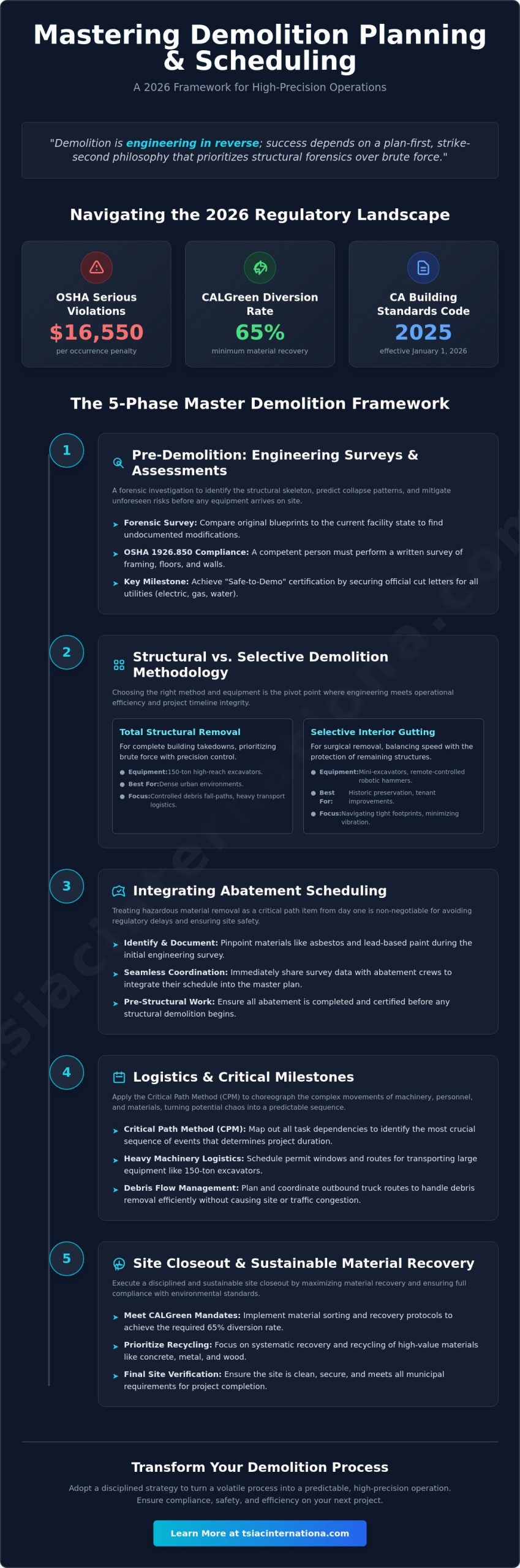
This guide provides an expert-led framework to master these structural complexities, ensuring your site remains under total control. You’ll learn how to navigate the 2025 California Building Standards Code effective as of January 1, 2026, and avoid OSHA’s updated serious violation penalties that now reach $16,550 per occurrence. We’ll outline a methodology for seamless coordination between abatement and removal crews. This approach allows you to maintain full compliance, meet the 65% CALGreen diversion requirements, and maximize material recovery without compromising your schedule. By following this disciplined strategy, you can transform a volatile process into a predictable, high-precision operation.
Key Takeaways
- Identify the structural skeleton of a building through engineering surveys to predict collapse patterns and mitigate unforeseen site risks.
- Select the optimal methodology for your project by evaluating the technical requirements of total structural removal versus selective interior gutting.
- Integrate hazardous material abatement as a critical path item within your demolition planning and scheduling to avoid regulatory delays and safety incidents.
- Apply the Critical Path Method (CPM) to manage complex site logistics, including heavy machinery transport and outbound debris flow.
- Execute a sustainable site closeout by implementing material recovery protocols that prioritize the recycling of concrete, metal, and wood.
The Pre-Demolition Phase: Engineering Surveys and Site Assessments
Precision in structural removal begins long before the first excavator arrives on site. The pre-demolition phase functions as a forensic investigation, designed to uncover the structural skeleton of a building and predict its behavior during deconstruction. Successful demolition planning and scheduling relies on this data to transform a high-risk environment into a controlled engineering project. By identifying load-bearing walls, primary support columns, and later structural modifications, you can establish a sequence that dictates exactly how and where the building will yield. This level of foresight is essential to prevent uncontrolled collapses that threaten site personnel and adjacent properties.
An engineering survey serves as your primary tool for mitigating unforeseen conditions. These hidden variables, such as unrecorded structural reinforcements or degraded masonry, are the leading causes of budget overruns and timeline shifts. Effective demolition methodologies prioritize the identification of these risks during the assessment stage. Beyond the building itself, you must evaluate the impact on the public right-of-way. This includes analyzing vibration and noise thresholds for neighboring structures, which is a critical requirement for maintaining community relations and avoiding work-stop orders from local municipalities.
Conducting a Forensic Engineering Survey
A thorough survey requires a comparison between original blueprints and the current state of the facility. Buildings often undergo decades of renovations that aren’t always documented in the original plans. A competent person, as defined by OSHA 1926.850, must perform a written engineering survey to determine the condition of the framing, floors, and walls to prevent premature collapse. During this inspection, our teams document the presence of hazardous materials like asbestos or lead-based paint. This data is immediately shared with the abatement crews to ensure they’re integrated into the master schedule before structural work begins.
Utility Disconnection and Permitting Milestones
The first major milestone in your project timeline is achieving a safe-to-demo certification. This requires securing official cut letters from electric, gas, and water municipalities to confirm all services are terminated at the street or property line. In the 2026 regulatory landscape, environmental and noise permits have become increasingly stringent. For example, the updated ANSI/ASSP A10.26 standards revised in June 2026 place a higher emphasis on emergency procedures for construction and demolition sites. Establishing a secure site perimeter—which, for projects in the Pacific Northwest, may involve professional vegetation management by CDA TREE AND UTILITY to clear hazards—and installing sediment control measures are not just safety requirements; they’re legal prerequisites that must be satisfied before any physical demolition planning and scheduling milestones can be met.
Structural vs. Selective Demolition: Choosing the Right Methodology
Selecting the appropriate methodology is the pivot point where engineering meets operational efficiency. Total structural removal requires a different logistical mindset than selective stripping. In dense urban environments, high-reach excavators often replace the need for implosion, offering superior control over debris fall-paths and reducing the regulatory burden. This choice directly impacts your demolition planning and scheduling, as mobilizing a 150-ton high-reach machine requires specific permit windows and heavy-load transport logistics that aren’t necessary for smaller-scale work. Precision is mandatory here. If the equipment doesn’t match the building’s structural profile, the timeline will inevitably suffer.
When the project goal involves historic preservation or commercial tenant improvements, the focus shifts to surgical removal. Speed must be balanced with the protection of structural integrity. Our commercial interior gutting services leverage mini-excavators and remote-controlled robotic hammers to navigate tight footprints. These tools allow for high-speed material removal without the vibration risks associated with larger pneumatic equipment. By aligning equipment capacity with site constraints, we ensure the project remains on its critical path. If you’re facing a complex renovation, partnering with a provider of professional demolition services can help you maintain a predictable project timeline.
Waste management also dictates methodology. High-reach mechanical demolition allows for better on-site sorting, which is vital for meeting Sustainable Material Recovery benchmarks. Sorting concrete from steel at the source reduces landfill tipping fees, which have seen significant increases in high-demand regions. A well-planned sequence allows for the recovery of valuable materials while the structure is being dismantled, turning a waste stream into a recovery asset.
Surgical Precision in Interior Gut-Outs
Stripping a building’s interior while it remains occupied or adjacent to active businesses requires a disciplined approach to environmental controls. We prioritize the protection of load-bearing elements by using non-impact cutting tools where possible. Managing dust, noise, and vibration isn’t just about comfort; it’s a regulatory necessity. Scheduling work during off-hours, such as nights or weekends, is often the most effective way to eliminate business disruption and accelerate the removal phase. It’s about maintaining a ghost-like presence while achieving maximum structural progress.
Heavy Structural Removal Techniques
For multi-story urban structures, a top-down approach is frequently the safest methodology. This involves lifting smaller equipment to the roof and working downward, floor by floor. This sequence ensures the building’s structural stability remains intact throughout the process. Every phase requires a clearly defined safety zone and a documented debris fall-path. Whether using mechanical crushing or specialized diamond-wire cutting for reinforced concrete, the goal is to maintain a predictable flow of material from the structure to the transport fleet without risking uncontrolled collapse.
Integrating Abatement and Hazardous Material Scheduling
Abatement is rarely a standalone task; it’s the primary bottleneck that determines the velocity of your entire project. Treating hazardous material removal as a side activity is a common error that leads to cascading delays. In a professional demolition planning and scheduling framework, abatement must be positioned as the “Critical Path” item. This means no structural work can proceed until the site is certified clean. A growing trend in 2026 is the total integration of these phases to avoid the logistical friction that occurs when separate contractors fail to coordinate. By scheduling asbestos and lead surveys as the very first step of the demolition process, you gain the lead time necessary to secure permits and mobilize specialized crews without stalling heavy machinery.
Managing the physical footprint of containment zones is a technical challenge. High-risk areas require “Clean Rooms” and negative-air enclosures that can physically block access to structural elements. If your schedule doesn’t account for these containment barriers, your excavators might sit idle while waiting for a single room to be cleared. Coordination is vital here. You must sequence the work so that abatement teams stay exactly one phase ahead of the structural crews. This requires a deep understanding of OSHA demolition safety guidelines, which mandate strict separation between hazardous work areas and general demolition zones to prevent cross-contamination. Failure to maintain these boundaries doesn’t just risk health; it invites OSHA penalties that, as of June 2026, have reached $16,550 per serious violation.
Disposal logistics also diverge significantly between toxic waste and standard C&D debris. While the national average tipping fee for standard debris is approximately $62.28 per ton in 2026, toxic materials like lead-contaminated steel or asbestos-containing transit pipe require specialized manifests and high-cost hazardous waste landfills. Your schedule must reflect these separate outbound flows to prevent logistical logjams at the site exit.
Asbestos and Lead Abatement Timelines
The timeline for asbestos removal is dictated by the physics of containment. Setting up negative-air systems and sealing penetrations can take days before a single gram of material is removed. You must also factor in the mandatory third-party air clearance testing. This final inspection is a hard stop in the master schedule; structural work cannot begin until a lab verifies the air is safe. For a detailed breakdown of these requirements, consult our hazardous material abatement guide to ensure every compliance step is mirrored in your project timeline.
Managing Mold and Other Biohazards
Water-damaged structures often present mold or other biological hazards that require a different set of protocols. Unlike asbestos, mold can spread rapidly if the building’s envelope is breached during demolition. We schedule specialized remediation crews to stabilize these areas using antimicrobial treatments before general gutting begins. This phase demands high-level PPE and rigorous worker safety monitoring. By identifying these biohazards during the initial engineering survey, we ensure the right protective equipment is on-site from day one, preventing reactive stops that blow the budget.
The Demolition Master Schedule: Logistics and Critical Milestones
Effective demolition planning and scheduling moves beyond simple calendars. It requires the Critical Path Method (CPM) to identify which tasks hold the key to the project’s finish line. Unlike new construction where tasks are additive, demolition is a subtractive process. Each step relies on the structural stability left behind by the last. If a high-reach excavator is scheduled to arrive before the soft-strip is complete, you’re paying for idle machinery. We treat the master schedule as a living document. It must adjust for real-time site conditions while maintaining the hard milestones required by stakeholders and regulatory bodies.
Inbound logistics involve the complex transport of oversized machinery like high-reach excavators or robotic hammers. Outbound logistics focus on the constant flow of debris. Weather contingencies are a non-negotiable part of this framework. High winds can halt high-reach operations, while heavy rain can complicate sediment control measures. Daily reporting and safety stand-downs are integrated into our schedule as fixed points. This ensures every operator is aligned with the day’s structural goals. If trucks stop, the machines stop. Maintaining this flow is the primary responsibility of the project lead.
Sequencing for Efficiency and Safety
We divide the work into distinct phases to maintain site control. Phase 1 involves the soft-strip, where non-structural elements and interior finishes are removed. This allows for cleaner debris sorting on-site, which is essential for meeting the 65% CALGreen diversion requirements verified for 2026 projects. Phase 2 is the structural drop, where heavy machinery begins the systematic dismantling of the building’s frame. In a high-risk demolition context, float time is the amount of time a specific task can be delayed without affecting the overall project completion date or compromising structural safety.
Hauling and Disposal Logistics
The pulse of a demolition site is measured in “pulls,” or the number of dumpster swaps executed per day. We calculate these based on the building’s total volume and the specific density of materials being removed. Managing traffic flow in dense urban environments requires precise coordination with local transit authorities to avoid congestion. Securing tipping permits and scheduling disposal at specialized facilities ensures that outbound material never piles up. If you need a partner who can manage these complex logistics with technical precision, consult our guide on the demolition process to align your project milestones.
Post-Demolition: Site Closeout and Sustainable Material Recovery
The final phase of a project is as critical as the first strike. Site closeout represents the transition from a hazardous work zone to a stabilized platform ready for follow-on construction crews. This transition requires a disciplined approach to site grading and soil stabilization to prevent erosion and ensure proper drainage. In a professional demolition planning and scheduling framework, this isn’t just a cleanup; it’s a strategic hand-off. We provide our clients with a comprehensive Closeout Package that includes all permit closures, final recycling receipts, and third-party air clearance certifications. This documentation is vital for minimizing liability and ensuring the property is legally and physically ready for its next use.
Achieving a Zero Waste goal involves high-level on-site sorting of wood, metal, and concrete. Metals are recovered for their scrap value, which can help offset certain project costs, while wood and concrete are diverted to specialized processing facilities. TSIAC International manages this process with technical precision, ensuring that every ton of material is accounted for in the final environmental report. A successful closeout means the next contractor can begin work immediately without discovering buried debris or unresolved environmental issues.
Material Recycling and Environmental Reporting
Detailed documentation of diversion rates is now a requirement for LEED certification and corporate ESG goals. As of 2026, California’s CALGreen code requires a minimum of 65% of construction and demolition waste to be diverted from landfills. We track these metrics in real-time, providing the data needed to prove compliance with both local and national standards. On-site concrete crushing and reuse significantly reduce the environmental impact of a project by eliminating the need for outbound hauling and the carbon footprint associated with transporting new aggregate. This circular approach to material management turns structural waste into a valuable resource for the next project phase, maintaining the efficiency established during the initial demolition planning and scheduling phases.
Final Inspections and Permit Sign-off
The legal conclusion of a project requires coordinating with local building departments for a final site inspection. This step ensures all work has been performed according to the approved permit and that the site poses no risk to the public. We manage the archiving of all hazardous material manifests, ensuring that every load of asbestos or lead-contaminated debris is tracked from the site to its final disposal point. This level of transparency is what defines a professional partnership. If you’re preparing for a new project, Contact TSIAC International for a comprehensive project assessment that covers every phase of the structural removal process.
Securing the Future of Your Structural Removal Projects
Mastering the complexities of demolition planning and scheduling requires a partner with deep industry experience and a commitment to methodical precision. With over 15 years of structural demolition expertise, TSIAC International provides the technical leadership necessary for high-stakes environments. Our fully licensed hazardous material abatement specialists ensure every phase is compliant, while our comprehensive safety and recycling reporting offers total transparency for your stakeholders. Partner with TSIAC International for Expert Demolition Planning and ensure your next project is executed with unwavering reliability. Your site’s transition to its future use starts with a controlled, expert-led deconstruction.
Frequently Asked Questions
What is the very first step in demolition planning?
The very first step is conducting a forensic engineering survey to determine the building’s structural condition and framing stability. This survey, mandated by OSHA, identifies load-bearing elements and potential hazards before any physical work begins. It sets the foundation for your entire demolition planning and scheduling strategy. Without this baseline data, it’s impossible to predict collapse patterns or ensure site safety during the removal process.
How long does it typically take to get demolition permits in 2026?
Permit timelines in 2026 vary significantly based on project location and local regulatory complexity. In major metropolitan areas, the process typically takes between four and eight weeks, while smaller jurisdictions may move faster. Specific regulations, such as the 10-working-day advance notice required in Arizona for asbestos-related demolitions, must be factored into your schedule. New laws in San Francisco also include strict unit replacement requirements that can extend approval windows.
Can structural demolition and asbestos abatement happen at the same time?
Structural demolition and asbestos abatement cannot occur simultaneously within the same containment area. Abatement is a critical path item that must be completed and certified safe by a third-party laboratory before heavy machinery begins structural removal. Attempting to overlap these phases risks cross-contamination and severe OSHA penalties. We sequence these tasks so that abatement teams stay one phase ahead of structural crews to maintain project momentum safely.
What is an Engineering Survey, and why is it required by OSHA?
An Engineering Survey is a written assessment performed by a competent person to determine the condition of the framing, floors, and walls. OSHA requires this under standard 1926.850 to prevent accidental structural collapse during the demolition process. This forensic analysis identifies where the building is weak or where modifications have altered the original load-bearing capacity. It’s a non-negotiable safety requirement for every professional structural removal project.
How do you calculate the timeline for a commercial interior gut-out?
Calculating the timeline for a commercial interior gut-out involves analyzing the total square footage and the density of interior finishes. We evaluate equipment accessibility, such as whether mini-excavators or robotic hammers can enter the footprint. National averages for interior demolition in 2026 range from $2.00 to $8.00 per square foot, reflecting the technical complexity of the task. The final schedule accounts for material volume and the number of dumpster swaps required per shift.
What factors cause the most common delays in demolition scheduling?
The most common delays in demolition scheduling stem from utility disconnection hurdles and the unexpected discovery of hazardous materials. Securing “cut letters” from municipalities often takes longer than anticipated, stalling the “safe-to-demo” milestone. Weather events, such as high winds or heavy precipitation, also create mandatory safety stand-downs. Building “float” into your demolition planning and scheduling is the only effective way to mitigate these inevitable variables without blowing the budget.
How is debris recycling handled in a professional demolition project?
Debris recycling is managed through rigorous on-site sorting of concrete, metal, and wood. In regions like California, meeting the 2026 CALGreen 65% diversion requirement is a legal necessity. We use specialized attachments to separate materials at the source, which reduces landfill tipping fees and maximizes material recovery. Professional projects provide detailed recycling receipts as part of the closeout package to document these diversion rates for LEED or ESG reporting.
What safety documentation should a property owner expect at project closeout?
At project closeout, a property owner should expect a comprehensive package containing permit closures, hazardous material manifests, and air clearance certifications. This documentation provides a legal paper trail proving that all toxic materials were disposed of at authorized facilities and that the site is safe for follow-on crews. You should also receive final recycling reports showing total tonnage diverted from landfills. These records are essential for minimizing long-term liability and securing final project approvals.
