
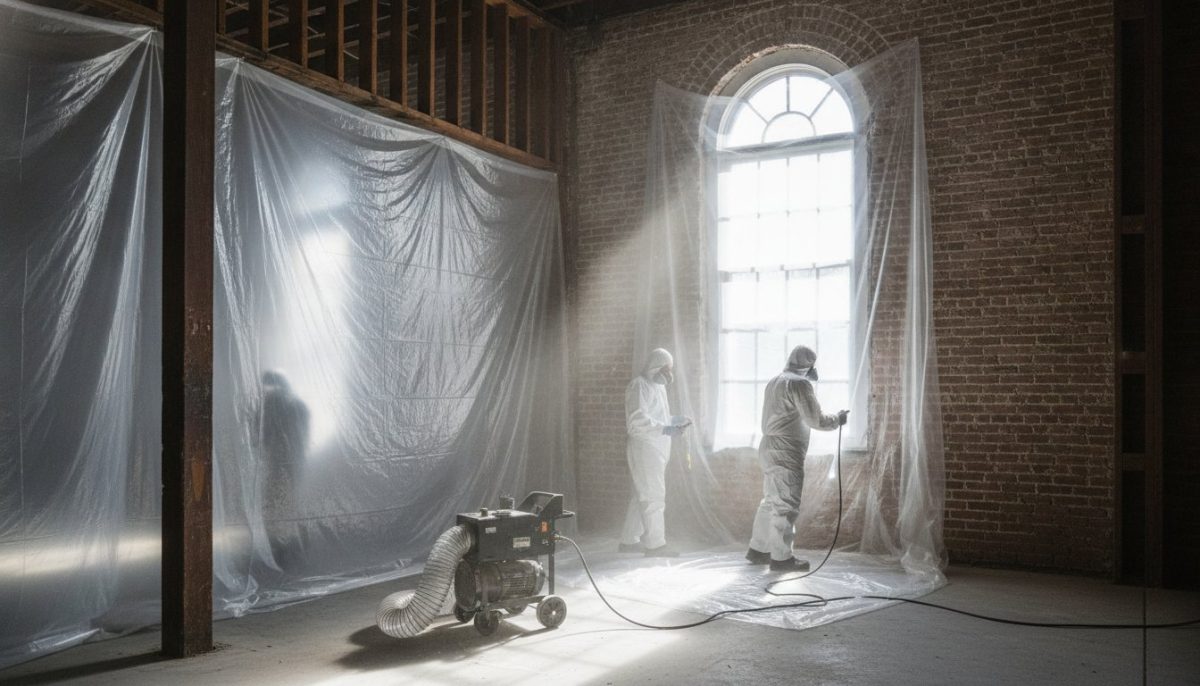
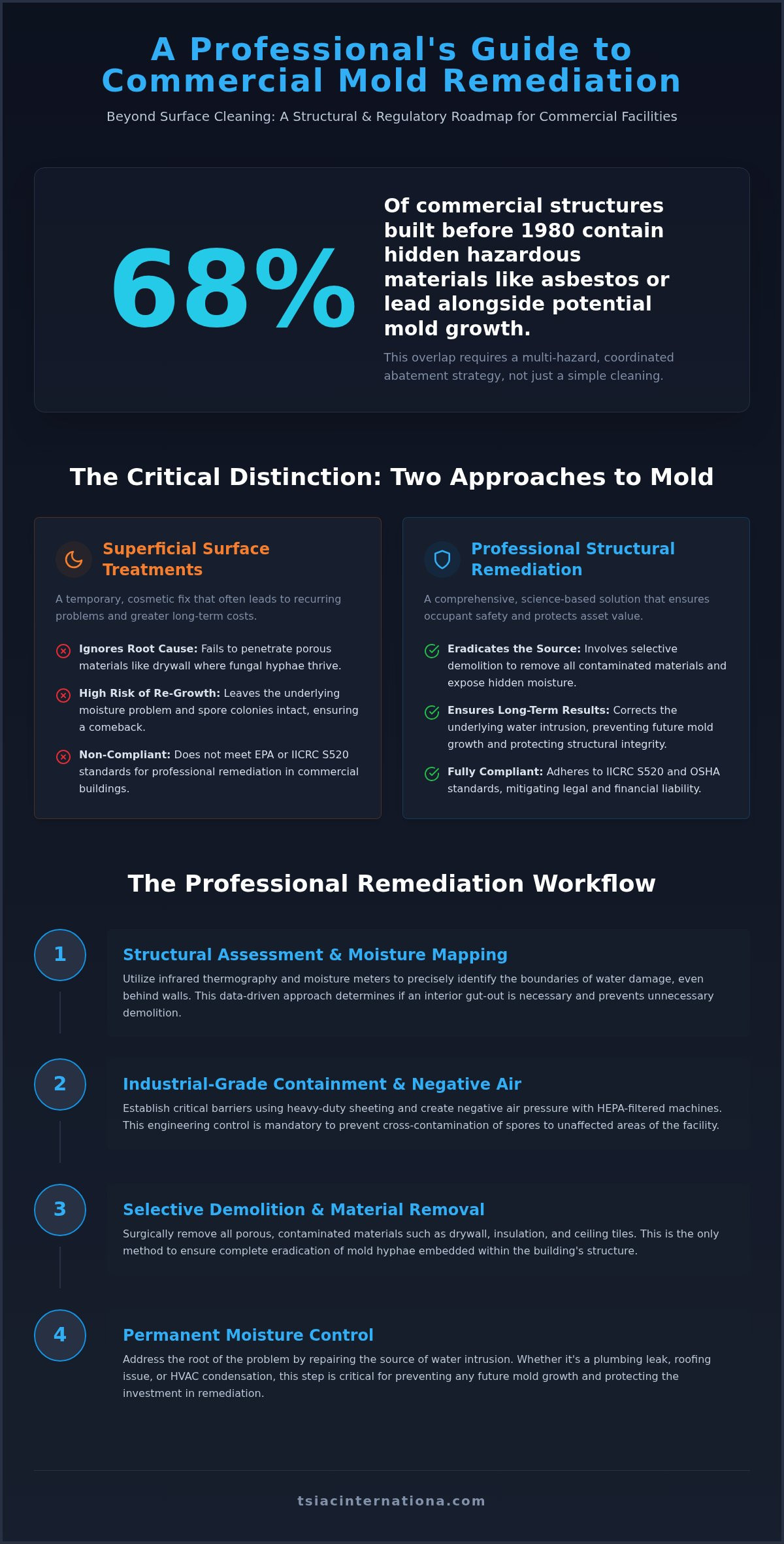
Did you know that 68% of commercial structures built before 1980 contain a hidden layer of regulated hazardous materials like asbestos or lead? When you discover a significant moisture issue in your facility, it’s rarely just about the visible growth on the drywall. You’re likely concerned about the mounting regulatory liability from OSHA and the EPA, not to mention the potential for extended business downtime that threatens your bottom line. It’s a high-stakes environment where a simple surface cleaning won’t suffice, especially when managing commercial mold remediation charleston sc in aging infrastructure. Professional remediation requires a methodical approach that prioritizes structural integrity and environmental safety.
This guide provides a technical roadmap to mastering the complex regulatory standards and structural requirements for large-scale abatement. We’ll examine how to integrate professional services with your existing renovation or demolition schedules while maintaining a safe, compliant, and mold-free environment. By focusing on precise containment and multi-hazard coordination, you can protect both your physical assets and your legal standing. We’ll also cover how to identify hidden costs and hazardous material overlaps before they derail your project timeline.
Key Takeaways
- Distinguish between cosmetic mold removal and industrial-grade remediation to ensure your facility meets rigorous safety and structural standards.
- Recognize the limitations of surface treatments and understand when an interior gut-out is the only method to fully eradicate mold within building shells.
- Execute a compliant strategy for commercial mold remediation charleston sc by coordinating the abatement of overlapping hazards like asbestos and lead in older structures.
- Master the essential technical workflow, from industrial-grade containment and negative air pressure setup to permanent moisture control.
- Leverage the technical precision of a national-scale contractor with over 15 years of experience in complex hazardous material management.
Professional Standards for Commercial Mold Remediation
Commercial mold remediation is an industrial-scale process, not a janitorial task. It involves complex containment strategies and engineering controls designed to manage biological hazards in large-scale environments. For projects involving commercial mold remediation charleston sc, the objective is to return the building to a pre-contamination state while adhering to strict environmental protocols. Unlike simple “mold removal,” which often implies a cosmetic cleaning of visible spots, true remediation involves structural abatement to address the root source and the microscopic spores within the building’s shell. It’s a discipline where technical precision is the only way to ensure safety.
Professional contractors operate under the IICRC S520 Standard for Professional Mold Remediation. This framework ensures that the work follows scientifically sound practices rather than guesswork. Commercial facilities demand significantly higher containment levels than residential properties because of complex HVAC systems and large-scale occupant exposure risks. Industrial-grade negative air machines and physical barriers are mandatory to prevent cross-contamination across thousands of square feet. In a business environment, a single failure in containment can lead to an entire facility becoming a liability.
The Legal and Health Implications of Commercial Mold
OSHA requires employers to provide a workplace free from recognized hazards that cause death or serious physical harm. This includes maintaining acceptable indoor air quality. Property managers face substantial liability risks if they ignore visible growth or reported moisture issues. This Indoor mold overview details how certain fungal species release mycotoxins, which are secondary metabolites capable of causing adverse health effects in occupants. In a commercial setting, failing to address these toxins can lead to legal action, workers’ compensation claims, and mandatory building closures. It’s a risk that no responsible stakeholder should take.
When Cleaning Isn’t Enough: Structural Assessment
Effective remediation requires a structural-first philosophy. If mold has penetrated porous materials like drywall, acoustic ceiling tiles, or insulation, cleaning is no longer a viable option. These materials must be removed through selective demolition to ensure all hyphae are eradicated. We use professional moisture mapping to identify the exact boundaries of the affected area. This technical process uses infrared thermography and moisture meters to find water hidden behind wall assemblies. If the saturation levels are too high, an interior gut-out becomes necessary to protect the building’s long-term value. This rigorous approach to commercial mold remediation charleston sc ensures that the facility isn’t just cleaned, but truly restored to a safe, compliant state.
Structural Remediation vs. Surface Treatments
Many property owners are attracted to “no-demolition” promises that claim to solve mold issues with simple sprays or fogging. While surface treatments or enzyme applications might seem cost-effective, they rarely address the technical reality of high-occupancy buildings. In the context of commercial mold remediation charleston sc, these superficial methods often leave the structural substrate compromised. Surface treatments cannot penetrate the cellulose-rich interiors of wall assemblies where mold thrives in darkness and moisture. Relying on them is a temporary fix that ignores the fungal hyphae growing deep into the building’s infrastructure.
According to the EPA guide to commercial mold remediation, the standard for professional cleanup emphasizes that the source of moisture must be corrected and contaminated materials must be properly handled. Fungal colonies aren’t just on the surface; they’re an integrated part of the materials they inhabit. When you only treat the exterior layer, you leave the root system intact. This creates a cycle of repeated cleaning and re-growth that eventually costs more than a single, decisive structural intervention.
The Role of Selective Demolition in Mold Control
Selective demolition acts as a surgical tool for effective remediation. Instead of a total gut-out, we strip interiors down to the studs only in the specifically affected zones. This process maintains the building’s structural integrity while exposing hidden leaks or condensation points that surface inspections miss. TSIAC’s selective demolition strategy ensures that only the compromised materials are removed, which minimizes waste and accelerates the recovery timeline. It’s the only way to identify hidden moisture sources that would otherwise trigger a secondary outbreak.
Why Building Material Removal is Often Mandatory
Certain building materials act as food for mold and cannot be salvaged once they reach a high level of saturation. We categorize these as non-salvageable porous materials. Attempting to clean them is an exercise in futility that risks the health of the building’s occupants. These materials include:
- Drywall and gypsum board
- Fiberglass and cellulose insulation
- Acoustic ceiling tiles
- Carpeting and porous floor underlayment
Leaving these materials behind creates a high risk of re-colonization. Even if the surface appears clean, the microscopic spores dormant in the structural cavities will reactivate at the first sign of humidity. In extreme cases, deep infiltration into concrete surfaces may require specialized concrete removal to prevent recurring issues. Choosing structural abatement over repeated surface cleaning for commercial mold remediation charleston sc offers a significantly higher long-term ROI. It prevents future outbreaks and ensures the building remains a safe, compliant asset.
Managing Multi-Hazard Environments: Mold, Asbestos, and Lead
Commercial projects rarely involve a single environmental concern. In older properties, moisture intrusion doesn’t just foster fungal growth; it often destabilizes other legacy building materials. When executing commercial mold remediation charleston sc, failing to account for the presence of asbestos or lead-based paint can lead to severe regulatory fines and health risks. Most restoration companies overlook this crossover, but a professional abatement strategy requires identifying all hazardous materials before a single wall is opened. Following EPA’s mold remediation guidelines is essential, but those rules must be harmonized with specific asbestos and lead regulations to ensure total site safety. Handling these hazards simultaneously requires technical precision and a deep understanding of multi-layered containment.
Asbestos and Mold: A Dual Threat
Asbestos and mold frequently coexist in the same structural assemblies. Pipe insulation, floor tile mastic, and HVAC duct wrap are common locations where moisture creates mold while the substrate itself contains asbestos fibers. In South Carolina, all regulated renovation projects require a formal notification to be submitted to the South Carolina Department of Environmental Services (SCDES) at least 10 working days before work begins. A certified asbestos survey is a legal prerequisite for any commercial demolition or remediation. If you discover mold on an asbestos-containing material, the removal process must follow the most stringent containment protocols for both hazards. You can find more detail in our guide to Asbestos Removal in South Carolina.
Lead Paint Considerations in Remediation Projects
Moisture is the primary enemy of lead-based paint. When water leaks occur, the paint layers often delaminate, creating toxic dust and chips that mix with mold spores. This creates a complex cleanup scenario where the remediation team must manage both biological and heavy metal hazards. As of 2026, the EPA’s dust-lead action level for floors is 5 micrograms per square foot. Non-compliance can result in fines as high as $37,500 per violation, per day. Our approach integrates lead-safe work practices into the mold containment strategy, ensuring that all debris is handled according to Hazardous Material Abatement in South Carolina standards. By serving as a single-source contractor, we eliminate the communication gaps that occur when multiple vendors try to manage a single contaminated site. This unified methodology protects your facility and streamlines the path to a successful clearance test.
The Professional Commercial Remediation Workflow
A disciplined workflow is the difference between a temporary fix and a permanent solution. For large-scale commercial mold remediation charleston sc, the process follows a strict five-step sequence designed to eliminate biological hazards without disrupting the entire building. This methodology ensures that every technical requirement is met before the space is cleared for re-occupancy. Each phase is managed with the precision expected of a firm with 15 plus years of specialized abatement experience.
- Step 1: Industrial-grade containment and negative air pressure setup. We establish physical barriers using 6-mil polyethylene sheeting and industrial air scrubbers to create a controlled environment.
- Step 2: Source identification and moisture control. Our team identifies the specific moisture intrusion point, such as a localized HVAC failure or structural leak, to prevent the mold from returning.
- Step 3: Selective removal of contaminated structural elements. We surgically remove non-salvageable materials like saturated drywall or insulation that harbor deep-seated fungal growth.
- Step 4: Decontamination, HEPA vacuuming, and antimicrobial application. All remaining surfaces undergo rigorous cleaning and treatment with EPA-registered antimicrobials to neutralize microscopic spores.
- Step 5: Final clearance testing and documentation. We coordinate independent air quality testing to provide legal and technical proof that the facility is safe for use.
Advanced Containment and Air Filtration
Large facilities require sophisticated air management to prevent cross-contamination. We use HEPA-filtered air scrubbers to maintain constant negative pressure, which ensures that spores don’t migrate to non-affected building zones during the removal process. Continuous pressure monitoring is vital in sensitive commercial environments where occupant safety is a priority. This technical control allows adjacent business operations to continue safely while the remediation zone remains fully isolated.
Waste Management and Material Recycling
Environmental responsibility is a core component of our abatement process. TSIAC’s commitment to sustainability involves sorting and recycling wood, metal, and plastic debris to reduce the landfill footprint while maintaining strict hazardous waste compliance. This approach is particularly effective during larger projects where high volumes of material are removed. For projects requiring a complete reset of the building interior, our Commercial Interior Gutting Services provide a clean, compliant slate for future reconstruction. If you need a partner who understands the technical demands of large-scale projects, you can schedule a professional site assessment to evaluate your facility’s specific requirements.
Selecting a National-Grade Abatement Contractor
Selecting a contractor for commercial mold remediation charleston sc isn’t just about finding a service provider; it’s about choosing a technical partner who understands the high stakes of industrial environments. National-grade contractors bring a level of logistical sophistication that local outfits often lack. They manage complex supply chains, maintain rigorous safety protocols, and provide the comprehensive documentation required by corporate and government legal departments. With 15 plus years of specialized demolition and abatement history, an experienced firm has managed the most extreme contamination scenarios and developed proven methodologies to resolve them. This depth of experience ensures that your project stays on schedule and within regulatory boundaries.
Reliability in this sector is measured by a contractor’s safety record and their commitment to environmental standards. You should evaluate potential partners on their ability to provide transparent compliance records. This includes detailed manifests for hazardous waste disposal and proof of adherence to OSHA and EPA standards. A contractor who prioritizes recycling wood, metal, and plastic debris demonstrates a forward-thinking approach that aligns with modern corporate sustainability goals. When managing commercial mold remediation charleston sc in aging infrastructure, you need a partner who treats documentation as seriously as the physical work itself.
The TSIAC International Advantage
We specialize in high-stakes environments where technical precision is mandatory. Our expertise extends beyond simple mold cleanup to include integrated services like structural demolition and hazardous material removal. This single-source capability allows us to handle multiple hazards simultaneously, which reduces the complexity for facility managers. By focusing on environmental responsibility through site-wide recycling, we ensure that your project meets both regulatory and ethical standards. Our team doesn’t just clear the air; we provide a clean, compliant slate for your building’s next phase.
Preparing for Your Commercial Remediation Project
Successful remediation requires coordination between your facility team and the abatement crew. Before the contractor arrives, ensure that the affected area is isolated from the main HVAC system and that all non-essential personnel are relocated. Scheduling work during off-peak hours or during planned facility shutdowns can minimize business disruption. Clear communication regarding the location of utility shut-offs and access points is essential for a smooth workflow. To begin the process, Contact TSIAC International for a professional assessment of your site’s specific structural and environmental needs.
Securing Your Building’s Structural Future
Effective commercial mold remediation charleston sc requires shifting from cosmetic cleaning to a rigorous structural abatement mindset. You’ve seen how surface treatments often fail to reach deep-seated fungal growth and how ignoring overlapping hazards like asbestos can lead to severe regulatory liability. By prioritizing a disciplined workflow and selecting a partner with 15 plus years of industrial abatement experience, you protect both your building’s integrity and your occupants’ safety. Professional remediation isn’t just about removing a current hazard; it’s about building a compliant, sustainable foundation for the future.
Every project we handle is backed by a commitment to environmental recycling and technical precision in complex multi-hazard environments. You can secure your facility’s long-term value by addressing moisture and contamination issues with methodological accuracy today. Taking a proactive approach ensures your operations remain uninterrupted and your property meets every environmental standard.
Schedule a Professional Structural Assessment with TSIAC International
Frequently Asked Questions
Is commercial mold remediation different from residential services?
Commercial projects demand industrial-scale engineering controls and higher containment standards than typical residential jobs. While residential work often focuses on surface cleaning, commercial mold remediation charleston sc requires managing complex HVAC systems and large occupant exposure risks. We utilize heavy-duty air scrubbers and 6-mil polyethylene barriers to isolate affected zones. The regulatory documentation for commercial sites is also more rigorous, involving detailed compliance logs for OSHA and EPA standards.
How long does a commercial mold remediation project typically take?
The duration of a project depends entirely on the saturation levels and the total square footage affected. A localized office remediation might conclude within three to five business days. However, large-scale structural gut-outs or multi-hazard projects involving asbestos can take several weeks to complete properly. We provide a detailed timeline after the initial moisture mapping phase to ensure your renovation or demolition schedule remains predictable and well-managed.
Can mold return after a professional structural remediation?
Mold won’t return if the underlying moisture source is permanently corrected. Professional remediation includes identifying structural failures like roof leaks, pipe condensation, or HVAC malfunctions. If these root causes are ignored, spores will eventually re-colonize even the cleanest surfaces. Our technical approach focuses on removing contaminated porous materials and ensuring the structural shell is completely dry before any reconstruction begins to prevent future biological growth.
Is it necessary to test for asbestos before starting mold removal?
Testing is a legal requirement for all regulated commercial renovation or demolition projects. In many older buildings, moisture that causes mold also compromises asbestos-containing materials like pipe wrap or floor mastic. You must have a certified asbestos survey completed before disturbing any building components. Failing to test can lead to significant regulatory fines and accidental hazardous exposure. We integrate these surveys into our initial site assessment to maintain full compliance.
What are the OSHA requirements for mold in the workplace?
OSHA doesn’t have a specific permissible exposure limit for mold spores, but they enforce indoor air quality under the General Duty Clause. Employers are legally obligated to provide a workplace free from recognized hazards that could cause physical harm. This includes addressing visible mold growth and moisture issues promptly. Professional commercial mold remediation charleston sc ensures that your facility meets these safety expectations and protects you from potential liability and worker compensation claims.
How does TSIAC handle the debris from a mold remediation site?
We implement a disciplined waste management protocol that prioritizes environmental responsibility. Unlike contractors who send everything to a landfill, we sort and recycle wood, metal, and plastic debris from every project site. Hazardous materials like asbestos or lead-painted components are double-bagged and disposed of at certified facilities according to strict environmental regulations. This process reduces the total project footprint while ensuring that all toxic waste is handled with technical precision.
Can my business stay open during the remediation process?
Most businesses can remain operational if the remediation zone is properly isolated. We use industrial-grade negative air pressure machines to ensure that spores and dust remain within the containment area. This prevents cross-contamination of adjacent, non-affected zones. While some noisy structural removal phases might be scheduled for off-peak hours, the physical barriers allow your staff to continue their work safely in other parts of the building without environmental risk.
What certifications should a commercial mold contractor hold?
A qualified contractor should follow the IICRC S520 professional standards for mold remediation. Because these projects often overlap with other hazards, your partner should also hold certifications for asbestos and lead abatement. In South Carolina, any rebuild work following remediation that exceeds $5,000 requires a valid general contractor license. Choosing a firm with over 15 years of industrial experience ensures that they possess the technical knowledge to navigate these complex regulatory and structural requirements.
