
If a demolition subcontractor misses a single detail in the mandatory OSHA engineering survey, the resulting structural collapse or hazardous exposure can derail your entire project and trigger massive liability. You understand that demolition is far more than a blunt force activity; it’s a high-stakes risk management exercise where safety and technical compliance are the only metrics that truly matter. Learning how to vet a demolition subcontractor effectively is the difference between a seamless site preparation and a project paralyzed by budget overruns or regulatory fines. The fear of project delays due to technical incompetence is a valid concern in a landscape of tightening safety standards and increased oversight.
This professional guide provides a rigorous framework to master the vetting process, ensuring your chosen partner possesses the technical proficiency required for complex structural removal and hazardous material abatement. We’ll examine the critical safety metrics, the latest 2026 lead dust action levels, and the essential credentials required to protect your reputation. You’ll gain a standardized framework to mitigate liability and the confidence that your subcontractor will meet every environmental regulation. We’ll move from the initial safety audit through to the confirmation of technical proficiency, providing the clarity needed to manage even the most demanding technical challenges with precision.
Key Takeaways
- Learn how to vet a demolition subcontractor by verifying specialized licenses and pollution liability insurance to protect your project from unforeseen legal exposure.
- Identify the safety benchmarks, such as the Experience Modification Rate (EMR), that distinguish high-performing crews from those that pose a liability risk.
- Verify technical proficiency in hazardous material abatement to ensure compliance with 2026 lead dust standards and federal asbestos handling protocols.
- Analyze operational stability by evaluating a subcontractor’s owned equipment inventory and their commitment to a permanent, skilled labor force rather than temporary labor.
- Mitigate financial risk through fixed-price contracts and performance bonds that strictly define the “clean and clear” scope of work and debris recycling requirements.
The Critical Importance of Vetting Demolition Subcontractors
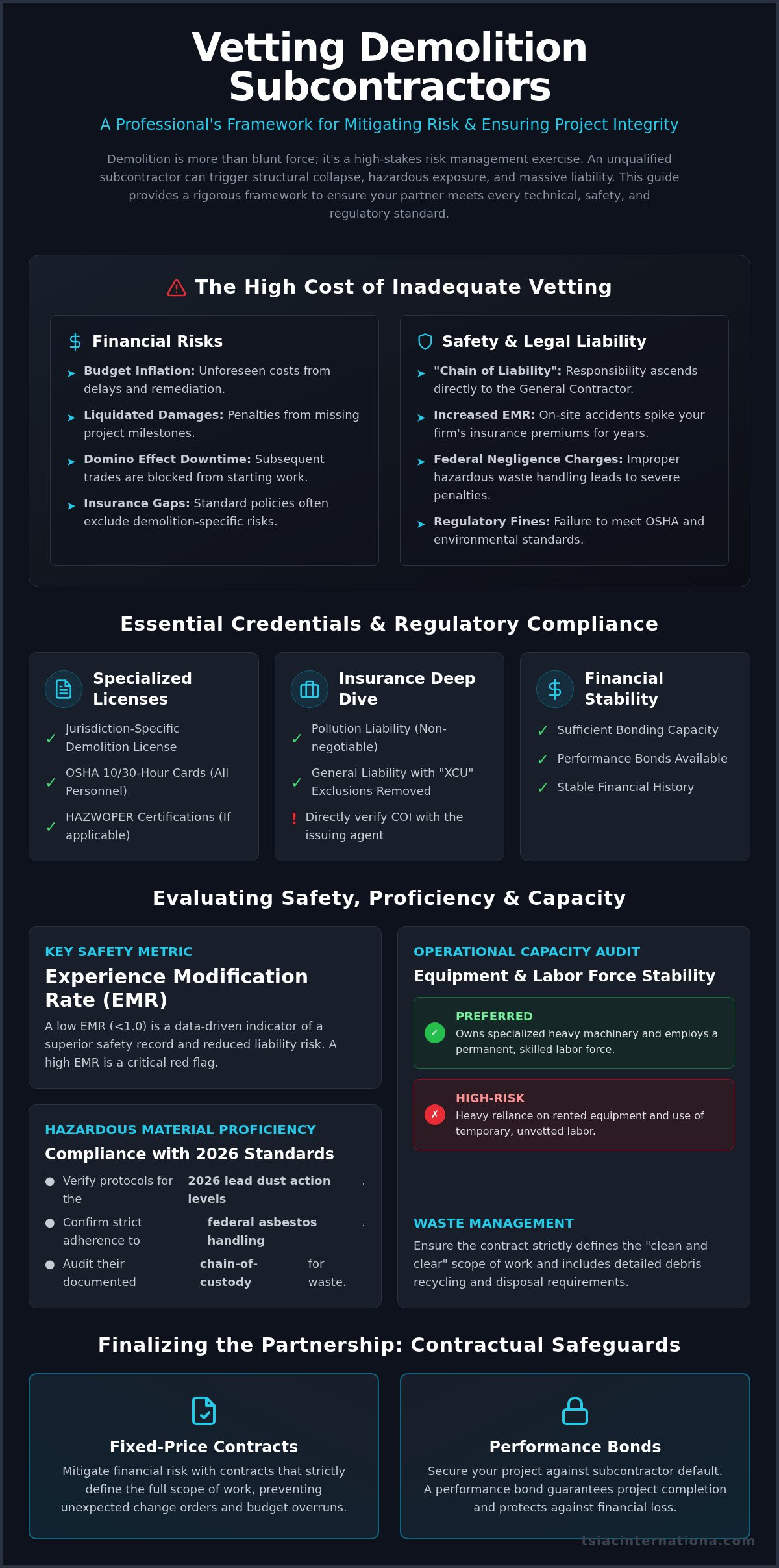
In the high-stakes environment of structural removal, vetting isn’t a mere administrative formality. It’s a comprehensive risk-mitigation strategy designed to protect the integrity of the entire project lifecycle. The Demolition process involves volatile variables like structural integrity shifts, hidden utility lines, and the sudden discovery of hazardous materials. When you analyze how to vet a demolition subcontractor, you’re essentially auditing their ability to shield your firm from the “chain of liability.” This legal and operational principle ensures that if a subcontractor fails to maintain safety or compliance, the consequences ascend directly to the General Contractor. By 2026, professional standards have shifted from passive reviews of past work to proactive, data-driven audits of technical proficiency.
Financial Risks of Poor Selection
Selecting an unqualified partner often leads to catastrophic budget inflation that extends far beyond the initial bid. If a subcontractor lacks the specialized heavy machinery or the technical expertise for selective demolition, project delays aren’t just inconveniences; they translate into liquidated damages that erode your profit margins. Secondary remediation costs can be even more severe. If a sub fails to clear a site to “clean and clear” standards, or leaves behind trace contaminants, subsequent trades cannot begin their work. This creates a domino effect of downtime. Insurance complications also arise when unvetted entities lack the proper pollution liability coverage, potentially leaving the General Contractor to foot the bill for environmental accidents.
Safety and Legal Liability
OSHA compliance represents the baseline of operations, not a differentiator of quality. A professional vetting process looks beyond basic certifications to examine how a subcontractor’s performance affects your own safety record. A major accident on-site can spike your Experience Modification Rate (EMR), which increases your insurance premiums for years to come. The legal ramifications of improper hazardous waste disposal are equally absolute. Improper handling of legacy asbestos or lead-based paint doesn’t just result in regulatory fines; it can lead to negligence charges under federal law. Understanding how to vet a demolition subcontractor involves verifying their specific chain-of-custody protocols. You need to ensure every ton of debris is tracked, recycled, or disposed of according to the latest 2026 environmental standards to prevent future litigation.
Essential Credentials and Regulatory Compliance Checklist
Verification of specialized licenses is the first technical hurdle in the vetting process. A general contractor license is rarely sufficient for structural removal; most jurisdictions require specific demolition classifications that mandate proof of experience and technical testing. In 2026, compliance with OSHA demolition safety standards requires more than just a safety manual on a shelf. It demands documented evidence of employee training, including OSHA 10 or 30-hour cards for all field personnel. If the project involves structures built before the late 1970s, you must also verify HAZWOPER (Hazardous Waste Operations and Emergency Response) certifications to ensure the crew can safely manage unexpected toxic encounters.
Insurance Coverage Deep Dive
Standard General Liability insurance often contains “XCU” exclusions (explosion, collapse, and underground) that are devastating for a demolition project. When you’re determining how to vet a demolition subcontractor, you must confirm that these exclusions have been removed. Pollution Liability is equally non-negotiable for projects involving older structures where legacy asbestos or lead-based paint is present. A standard policy won’t cover the release of hazardous dust into the atmosphere or groundwater. Always verify the Certificate of Insurance (COI) by contacting the issuing agent directly; don’t rely solely on a PDF provided by the bidder, as these are easily falsified in high-risk bidding environments.
Bonding and Financial Stability
A subcontractor’s bonding capacity is a direct reflection of their financial health and operational history. Performance bonds ensure the project is completed even if the subcontractor faces insolvency, while payment bonds protect the property owner from mechanics’ liens filed by the sub’s laborers or suppliers. A high aggregate bonding limit indicates that a surety company has performed a deep audit of the company’s liquidity and past performance, providing an extra layer of professional vetting. If a firm cannot secure a bond for the contract value, it’s a significant red flag regarding their stability. For those overseeing complex sites, partnering with a firm that specializes in structural demolition and maintains high bonding limits is essential for long-term risk management.
Confirming these credentials isn’t just about checking boxes; it’s about establishing a baseline of professional accountability. When you understand how to vet a demolition subcontractor through the lens of insurance and bonding, you’re protecting your project from the financial fallout of a subcontractor’s operational failure. This technical due diligence ensures that the team on-site has the financial backing and the legal authority to execute the scope of work without endangering your firm’s reputation or bottom line.
Evaluating Safety Records and Hazardous Material Proficiency
Safety documentation serves as the most accurate predictor of project success. When you evaluate how to vet a demolition subcontractor, the focus must shift from anecdotal claims of “safety first” to verifiable data. A primary indicator is the Experience Modification Rate (EMR). This metric, used by insurance carriers, compares a company’s workers’ compensation claims to others in the industry. An EMR of 1.0 is the baseline average. Professional contractors strive for a score below 1.0, which indicates a lower than average risk profile. If a sub presents an EMR above 1.2, it’s a clear signal of systemic safety failures that could jeopardize your site’s operational flow.
Understanding the EMR Metric
Beyond the EMR, you should request the last three years of OSHA 300A logs. These summaries provide a transparent view of recordable injuries and illnesses. Look for patterns rather than isolated incidents. A history of repeat violations regarding fall protection or machine guarding suggests a lack of oversight. The National Demolition Association emphasizes that safety culture starts with leadership; if a subcontractor can’t produce a detailed, Site-Specific Safety Plan (SSSP) that addresses structural collapse and emergency evacuation, they aren’t prepared for the complexities of a modern job site. Red flags include a history of repeat violations or serious injury reports that haven’t been followed by documented corrective actions.
Hazardous Material Remediation Standards
In 2026, the intersection of demolition and environmental protection is tighter than ever. Vetting for Asbestos Abatement and lead remediation is critical because disturbing these materials during a standard demo can lead to immediate stop-work orders. The EPA’s 2026 lead dust standards are exceptionally strict, requiring floor clearance levels of ≤5 µg/ft². Your vetting process must verify that the sub uses HEPA filtered vacuum systems and specialized dust suppression equipment to meet these thresholds. Ask for a demonstration of their hazardous material abatement tracking procedures. Every pound of toxic waste must have a corresponding waste manifest that tracks the material from the site to a certified disposal facility. Without this chain of custody, the legal liability for improper disposal remains with the property owner and the General Contractor indefinitely. This technical due diligence is a non-negotiable step in learning how to vet a demolition subcontractor for long term project stability.
Operational Capacity: Equipment, Labor, and Waste Management
Operational readiness is the bridge between a successful bid and actual site execution. When you’re determining how to vet a demolition subcontractor, you must look beyond their portfolio and examine their physical assets. Subcontractors who own their fleet, including high-reach excavators and concrete processors, offer significantly greater schedule reliability than those dependent on third-party rental availability. Rented equipment is a project vulnerability; if a rental house fails to deliver a specialized shear on time, your project timeline suffers. Owned equipment also implies that the operators are intimately familiar with the machinery’s specific capabilities and safety limits.
Heavy Machinery and Technical Assets
Verification of the subcontractor’s fleet should include a review of maintenance logs. Well-maintained machinery doesn’t just prevent downtime; it ensures that hydraulic systems and safety sensors operate at peak performance. Modern demolition often integrates GPS and 3D modeling for precision work, especially in tight urban environments where structural tolerances are slim. Ask for a detailed list of owned assets. A subcontractor with a stable inventory of shears, pulverizers, and grapple attachments is better equipped to handle the rigors of structural removal without the delay of sourcing attachments mid-project.
Sustainability and Debris Recycling
The modern demolition process must prioritize material recovery over simple disposal. Professional subcontractors should manage their own debris recycling to lower environmental impact and reduce tipping fees. This is particularly important for General Contractors pursuing LEED credits or green building certifications. You need a partner who provides detailed documentation for the recycling of wood, metal, and plastic. Technical proficiency in selective demolition and interior gutting requires a surgical approach to material separation at the source. This prevents cross-contamination of recyclables and ensures that the site is cleared efficiently and responsibly.
Labor force stability is equally critical. Temporary “day labor” lacks the specialized HAZWOPER and OSHA training required for high-risk structural work. A permanent team of full-time employees ensures consistent safety protocols and technical execution. When you understand how to vet a demolition subcontractor, you realize that labor stability is a direct indicator of safety culture. If you require a partner with a proven commitment to recycling and operational excellence, explore our demolition and recycling services to see how we manage complex site requirements with precision and environmental responsibility.
Finalizing the Partnership: Contracts and Performance Bonds
The final stage of project procurement is the translation of technical vetting into a legally binding agreement. A handshake or a vague proposal won’t suffice in a sector where hidden structural defects or environmental contaminants can double project costs overnight. When you finalize how to vet a demolition subcontractor, the goal is to shift from a discovery phase to a risk-allocation phase. A fixed-price contract is the industry standard for mitigating “scope creep,” as it forces the subcontractor to stand by their initial engineering survey and site assessment. This agreement must provide a granular definition of “clean and clear.” Does it include the removal of footings and foundations, or just the vertical structure? Precise language here prevents costly disputes during the site hand-off to the next trade.
Critical Contract Clauses
Demolition contracts require specific language that standard construction agreements often overlook. Indemnification clauses must be robust, ensuring the General Contractor is protected from the subcontractor’s operational errors, such as utility strikes or vibration damage to adjacent properties. You also need a clear protocol for “unknown conditions.” In older structures, it’s common to discover hazardous materials behind walls that weren’t identified in the initial survey. The contract should outline a pre-negotiated rate for such discoveries to avoid work stoppages. Finally, ensure the document distinguishes between termination for convenience and termination for cause, providing a clear exit strategy if safety or schedule milestones aren’t met.
Selecting a Strategic Partner
Choosing a partner with 15+ years of industry experience, such as TSIAC International, provides a level of reliability that newer firms simply cannot match. A strategic partner should act as a “one-stop” shop that handles both structural demolition and hazardous material remediation. This integration eliminates the friction between separate demo and abatement crews, which is a frequent source of project delays. When you understand how to vet a demolition subcontractor, you value a partner that manages their own debris recycling and provides the documentation necessary for environmental compliance. It’s about more than just clearing a site; it’s about professional accountability from the first excavator strike to the final waste manifest.
The next step in your procurement process should be the request of a comprehensive vetting package. This should include the subcontractor’s EMR history, proof of pollution liability insurance, and a list of owned specialized equipment. By linking progress payments to verified site milestones, you maintain financial leverage throughout the project lifecycle. This methodical approach ensures that your demolition phase is characterized by technical precision and regulatory adherence rather than unforeseen liabilities. If you are ready to partner with a firm that meets the “Gold Standard” for safety and efficiency, contact TSIAC International to discuss your upcoming project requirements.
Securing Project Integrity Through Rigorous Selection
Mastering how to vet a demolition subcontractor is a fundamental requirement for any general contractor aiming to maintain site safety and financial stability. This process moves beyond a cursory review of bids; it demands a deep audit of a firm’s safety metrics, equipment ownership, and hazardous material proficiency. By focusing on verifiable data like EMR scores and the latest 2026 lead dust clearance standards, you establish a site culture where technical precision is prioritized over speed. A robust vetting framework ensures that every structural removal and abatement task is executed without compromising your legal standing or your project’s timeline.
Selecting a partner with 15+ years of specialized structural removal experience provides the operational continuity necessary for complex urban projects. You need a team that offers comprehensive hazardous material remediation capabilities and a proven track record of environmental recycling and site safety. This level of technical depth mitigates the risk of unforeseen delays and ensures your site remains compliant with evolving federal regulations. Partner with a fully vetted demolition and abatement expert at TSIAC International to secure a partner that treats your project’s risks with the same gravity you do. Your next successful project begins with the right technical partner.
Frequently Asked Questions
What is the most important document to check when vetting a demolition sub?
The engineering survey, mandated by OSHA 29 CFR 1926.850(a), is the most critical document to review. This written survey must be completed by a competent person before any demolition begins to assess structural stability and the possibility of unplanned collapse. When you learn how to vet a demolition subcontractor, you should prioritize this over price. It confirms the sub has evaluated floor loads and wall stability, ensuring they approach the site with technical precision rather than guesswork.
How do I verify a subcontractor’s asbestos abatement certification?
You should verify asbestos abatement certifications by requesting the subcontractor’s state-issued license number and cross-referencing it with the relevant state environmental agency’s database. Additionally, ask for individual training certificates for the supervisors and workers who will be on-site. Valid certifications must align with current federal EPA and AHERA standards. Professional contractors maintain an organized compliance package that includes these credentials alongside their recent hazardous material handling history and disposal manifest protocols.
Should I hire a demolition sub that doesn’t own their own heavy equipment?
Hiring a subcontractor who relies entirely on rented equipment introduces significant schedule risks and technical vulnerabilities. Ownership of high-reach excavators, shears, and concrete processors indicates financial stability and a long-term commitment to the industry. It also ensures that operators are proficient with the specific controls and safety limits of their machinery. While some specialized rentals are common, a core fleet of owned heavy equipment is a hallmark of a reliable partner in structural removal.
What is a “good” EMR rating for a demolition company in 2026?
A “good” Experience Modification Rate (EMR) for a demolition subcontractor in 2026 is 1.0 or lower. An EMR below 1.0 indicates that the company’s safety record is better than the industry average, directly reflecting fewer workers’ compensation claims. If a subcontractor presents an EMR above 1.2, it signals a higher risk profile and potential systemic safety failures. Always request the sub’s EMR letter from their insurance carrier to verify this metric during your initial audit.
How does selective demolition vetting differ from total structural removal?
Vetting for selective demolition requires a greater focus on surgical precision and the subcontractor’s ability to maintain the structural integrity of remaining building sections. You should evaluate their experience with vibration monitoring, dust containment, and shoring techniques. While total structural removal focuses on bulk debris management and heavy machinery force, selective demolition demands a more disciplined labor force capable of working in occupied or sensitive environments without disturbing adjacent utilities or structural load-bearing elements.
Can a demolition subcontractor help with environmental recycling credits?
Yes, a professional subcontractor provides the necessary documentation for LEED or other green building credits by tracking material recovery. They should manage the sorting of wood, metal, and plastic on-site to maximize the volume of diverted waste. When you determine how to vet a demolition subcontractor, ask for sample waste diversion reports. These documents should clearly state the tonnage of recycled versus landfilled material, providing the transparency required for environmental certification and regulatory compliance.
What happens if a subcontractor discovers hazardous materials not in the original scope?
If a subcontractor discovers unforeseen hazardous materials, they must immediately halt work in the affected area to prevent cross-contamination. The discovery should be documented and reported to the General Contractor for assessment by a certified industrial hygienist. A professional contract should include “unknown conditions” clauses that define the protocol for additional abatement services. This proactive approach prevents legal liability and ensures that legacy asbestos or lead is handled according to federal safety standards without stalling the entire project.
Why is pollution liability insurance necessary for demolition?
Pollution liability insurance is necessary because standard general liability policies often exclude coverage for the release of environmental contaminants. In demolition, the risk of disturbing legacy asbestos, lead dust, or underground storage tanks is high. This specialized coverage protects against claims related to bodily injury, property damage, and site cleanup costs resulting from the release of hazardous substances. Without it, the General Contractor and property owner are exposed to massive financial liability if a toxic exposure event occurs.
