
Could a single paperwork oversight under the new 2026 environmental regulations halt your redevelopment project before the first sledgehammer swings? For property owners nationwide, the transition to updated environmental oversight has introduced a rigorous layer of technical scrutiny to commercial asbestos abatement projects. You likely recognize that unmanaged asbestos isn’t just a health hazard. It’s a significant legal and financial liability that requires methodical precision to neutralize without triggering costly project delays.
We’ve developed this guide to provide a disciplined path through the complexities of current asbestos abatement regulations. You’ll learn how to manage the mandatory 10-day notification period, navigate the updated permitting fees for 2026, and ensure your site remains compliant during structural demolition or interior gutting. This overview covers everything from initial inspection requirements to final air clearance protocols, ensuring your project stays on schedule while maintaining the highest safety standards for your stakeholders.
Key Takeaways
- Navigate the transition from DHEC to SCDES oversight by understanding the updated 2026 regulatory framework for hazardous material management.
- Learn to identify high-risk materials in older properties where asbestos was historically used for its durability and thermal resistance.
- Ensure full compliance for commercial asbestos abatement south carolina by adhering to the mandatory 10-working-day notification requirement for all regulated projects.
- Protect your property from long-term contamination and health-related legal liabilities through methodical containment and specialized site protocols.
- Optimize your project schedule by integrating hazardous material remediation and structural demolition through a single, disciplined expert partner.
Understanding Asbestos Abatement Regulations in South Carolina
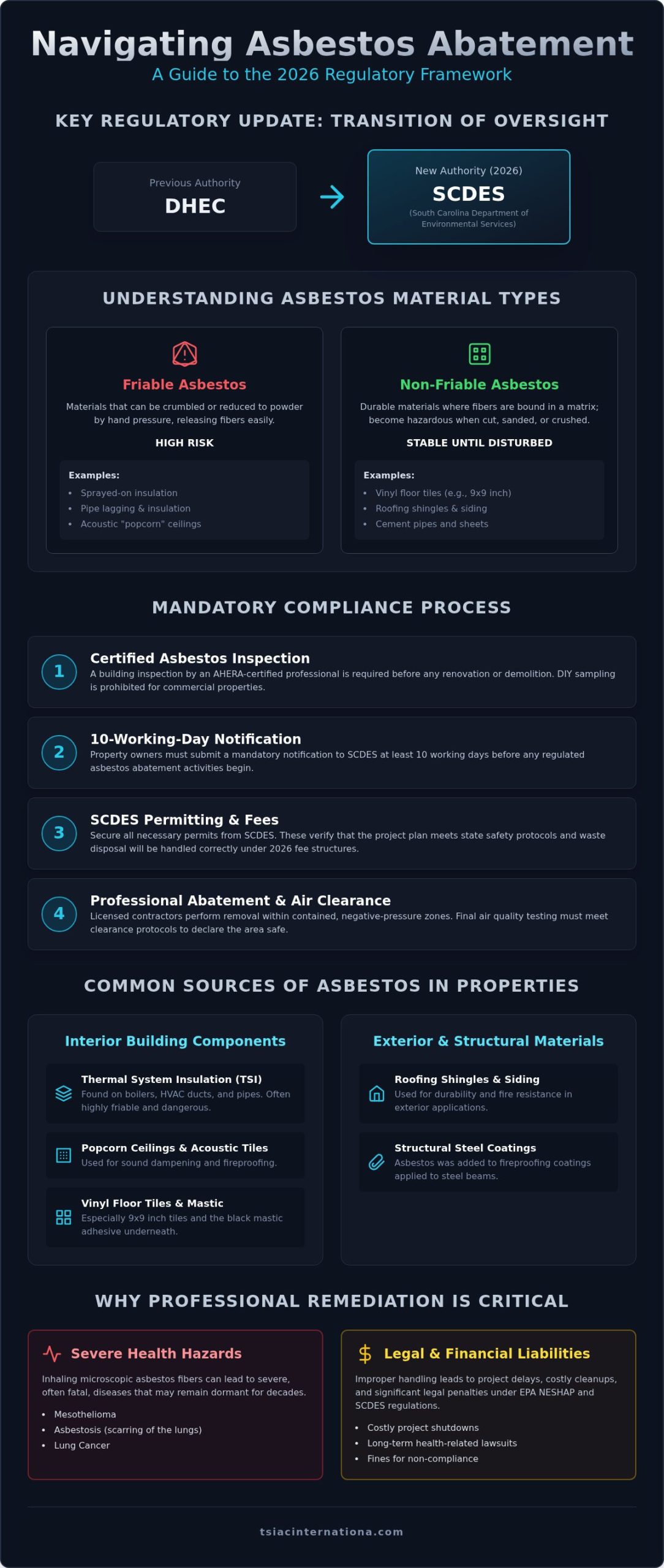
Professional asbestos abatement is a highly technical operation designed to identify, isolate, and remove hazardous mineral fibers from a structure. It’s a process that requires methodical precision to prevent the release of microscopic particles into the environment. In South Carolina, this activity is governed by strict legal frameworks to protect public health and ensure structural safety. As of 2026, the primary regulatory authority has transitioned from DHEC to the South Carolina Department of Environmental Services (SCDES). This agency now oversees all aspects of commercial asbestos abatement south carolina, ensuring that every project adheres to the rigorous safety standards required to mitigate severe health risks.
The necessity for professional intervention stems from the catastrophic nature of asbestos-related diseases. When fibers are inhaled, they can cause mesothelioma, asbestosis, and various forms of lung cancer. These conditions often remain dormant for decades, making immediate and precise containment essential during any renovation or demolition. South Carolina law requires licensed contractors for these tasks because the risk of improper handling extends far beyond the job site. Securing a partner experienced in commercial asbestos abatement south carolina ensures that these evolving 2026 standards are met without risking project delays or long-term legal liabilities.
Friable vs. Non-Friable Asbestos
Materials are classified based on their physical state and potential to release fibers. Friable asbestos refers to materials that can be crumbled or reduced to powder by hand pressure, such as sprayed-on insulation or pipe lagging. Non-friable materials, like vinyl floor tiles or roofing shingles, are generally stable until they’re subjected to mechanical forces. During structural demolition, even non-friable materials become hazardous if they’re cut, sanded, or crushed. Material friability serves as the primary metric for determining the scope of negative pressure containment and the frequency of air quality monitoring required during the project.
The Role of EPA NESHAP and SCDES
While the Environmental Protection Agency (EPA) sets the federal National Emission Standards for Hazardous Air Pollutants (NESHAP), the SCDES enforces these mandates at the state level. Compliance requires a deep understanding of asbestos abatement procedures to ensure every phase of the project remains within legal limits. This includes employing personnel with AHERA certifications, which are mandatory for all building inspectors and site supervisors. Before any structural disturbance occurs, property owners must secure the necessary permits from SCDES. These permits verify that the planned activities meet state safety protocols and that the disposal of toxic waste will be handled at authorized facilities.
Common Sources of Asbestos in Commercial and Residential Properties
South Carolina’s industrial and commercial development throughout the 20th century relied heavily on asbestos for its fire-retardant properties and exceptional durability. It was integrated into thousands of building products, from structural steel coatings to decorative finishes. While 1980 is often cited as the year usage declined, age isn’t the only risk factor. Modern renovations still encounter these materials in unexpected places. Property owners should never assume a building is “asbestos-free” without a certified inspection, especially before starting commercial interior gutting services. DIY sampling is strictly prohibited for commercial entities because accidental disturbance can trigger a massive environmental cleanup and significant legal liability.
Interior Building Components
Interior building components frequently hide hazardous fibers in plain sight. Popcorn ceilings and acoustic tiles were industry standards for sound dampening and fireproofing. Vinyl floor tiles, especially the 9×9 inch format, are notorious for containing asbestos in both the tile matrix and the underlying black mastic adhesive. Thermal system insulation (TSI) on boilers and HVAC ductwork remains one of the most dangerous sources because it’s often highly friable. These materials require the methodical containment protocols central to commercial asbestos abatement south carolina to prevent cross-contamination of clean zones during a renovation.
Exterior and Structural Materials
Exterior structural materials often consist of “transite” or asbestos-cement siding, which remains stable until it’s broken or crushed during demolition. Stucco, joint compounds, and window glazing used in older South Carolina storefronts often contain fibers to prevent cracking under extreme heat. These materials are governed by the EPA Asbestos NESHAP Overview, which mandates specific handling during structural removal. In many historic South Carolina properties, you’ll also find lead-based paint on the same surfaces. Coordinating commercial asbestos abatement south carolina with lead remediation is essential for a safe project site.
Consulting with a licensed specialist for a comprehensive survey ensures these hidden risks are identified before they impact your project timeline or worker safety.
The Technical Process of Professional Asbestos Removal
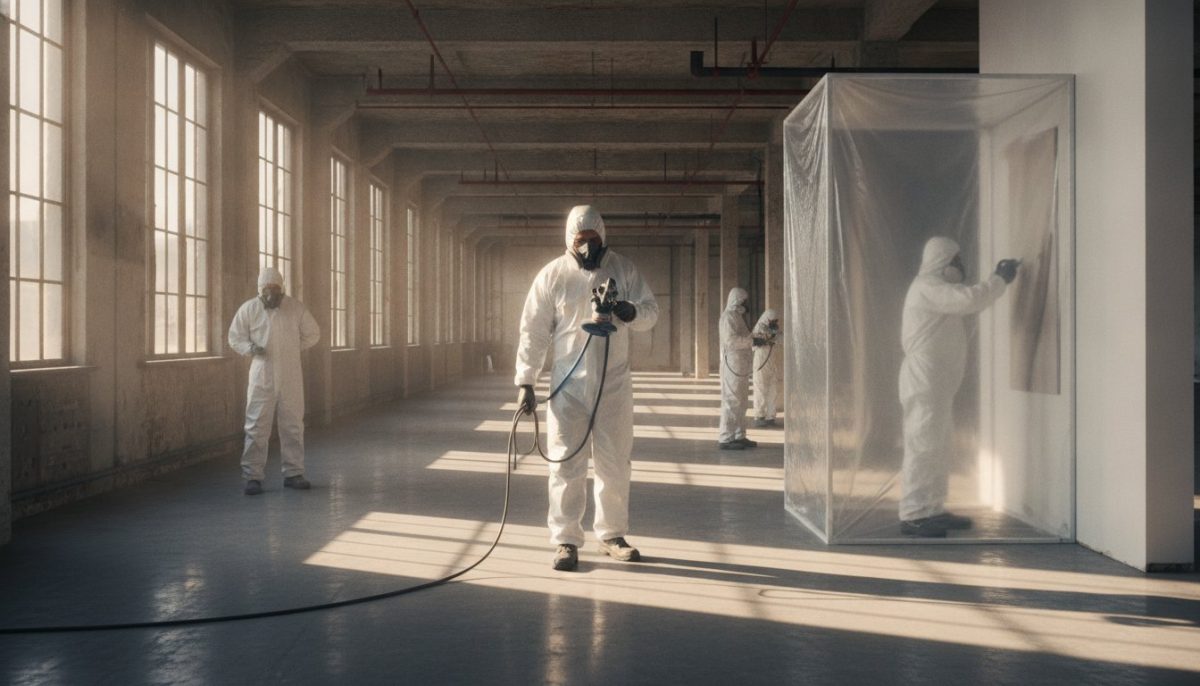
The execution phase of commercial asbestos abatement south carolina is a disciplined technical operation where the primary objective is the total prevention of fiber migration. Success depends on a methodical approach that isolates the work zone from the rest of the facility. Every technician on-site utilizes specialized Personal Protective Equipment (PPE), including N100 or P100 respirators and disposable suits, to ensure their safety while handling toxic materials. This level of precision is why professional remediation is a core component of hazardous material abatement in South Carolina. High-efficiency particulate air (HEPA) filtration systems work continuously to scrub the environment, ensuring that the air quality remains within safe parameters throughout the project duration.
Phase 1: Containment and Site Preparation
Before any material is disturbed, the team constructs a high-integrity containment area. Technicians seal all openings, including vents, windows, and doorways, with multiple layers of 6-mil fire-retardant plastic sheeting. Specialized airlocks provide a controlled transition point for personnel and waste. The installation of negative air pressure machines is critical. These units ensure that air flows exclusively into the containment zone, preventing any escaped fibers from reaching clean areas. Required regulatory signage is posted immediately to restrict site access to licensed personnel only.
Phase 2: Removal and Wet Methods
The removal process prioritizes dust suppression through the use of amended water. By saturating the asbestos-containing material with a specialized wetting agent, technicians significantly reduce the risk of fibers becoming airborne. For selective demolition projects, surgical removal techniques are employed to preserve the surrounding structural integrity. Once removed, the waste is immediately double-bagged and sealed in 6-mil poly bags. Each bag is labeled according to SCDES and EPA standards before being moved through the decontamination unit for eventual transport to a regulated landfill.
Phase 3: Final Cleaning and Clearance
The final phase involves a rigorous multi-stage cleaning protocol. Technicians perform HEPA vacuuming followed by wet-wiping of all surfaces within the containment area to capture microscopic residue. After a visual inspection confirms the area is dust-free, an independent third-party air sampler conducts clearance testing. This verification is essential to prove the environment is safe for re-occupancy. The process concludes with the issuance of a formal Clearance Report, providing the property owner with a permanent record of regulatory compliance and site safety.
Navigating SCDES Permits and Regulatory Compliance
Regulatory compliance in South Carolina isn’t a suggestion; it’s a rigid framework that dictates your project’s timeline. Success in commercial asbestos abatement south carolina depends on early engagement with the South Carolina Department of Environmental Services (SCDES). The most critical hurdle for property owners is the mandatory 10-working-day notification period. This waiting period must pass before any regulated structural disturbance begins. While residential properties with four or fewer units sometimes enjoy exemptions, commercial projects are subject to full oversight. Even if your building is certified “asbestos-free” after a thorough survey, SCDES still requires a formal demolition notification and a $50 flat fee in most jurisdictions. Failing to file this paperwork can result in stop-work orders and heavy fines that dwarf the original project costs.
The Inspection Report
Every project starts with a comprehensive survey conducted by a certified SC asbestos inspector. This professional identifies the type, location, and quantity of all suspect materials. The resulting report isn’t just a diagnostic tool; it’s a legal document that dictates your entire scope of work and the specific permits required. SCDES regulations mandate that a copy of this inspection report remains on-site throughout the project’s duration. If an agency official visits for a spot check, the absence of this document can lead to immediate site closure. We ensure every detail of this report is integrated into our operational plan to maintain total transparency.
Disposal and Environmental Responsibility
Managing hazardous waste doesn’t end at the containment airlock. All removed material must be transported to licensed landfills in South Carolina authorized to accept asbestos waste. This requires a documented “chain of custody” through a waste shipment manifest. This manifest serves as your final legal protection, proving that the toxic materials were disposed of according to state and federal law. Beyond hazardous waste, we prioritize environmental stewardship by sorting and recycling non-hazardous debris like wood, metal, and plastic. This disciplined approach reduces the volume of waste sent to landfills and supports sustainable redevelopment practices.
Don’t let regulatory complexity stall your progress. You can partner with our experienced team to ensure every permit and notification is handled with methodical precision.
Why Professional Remediation is Essential for Structural Integrity
Improper asbestos handling creates a “toxic footprint” that can linger within the structural substrate of a building long after the initial contractors have left the site. When fibers are released due to substandard removal techniques, they don’t just affect air quality; they settle into porous materials, HVAC systems, and structural voids. This leads to long-term property contamination that can trigger massive legal liabilities during future sales or occupancy. By contrast, professional asbestos removal in South Carolina ensures that the building’s structural integrity is preserved through methodical containment and specialized extraction.
Hiring a single-source contractor for both commercial asbestos abatement south carolina and structural demolition provides a distinct engineering advantage. It eliminates the communication gaps that often occur when two separate firms attempt to coordinate on a high-stakes site. At TSIAC International, our 15-year history of handling complex remediation projects allows us to treat abatement as an integrated phase of the demolition process. This unified approach protects the property’s value and guarantees that future occupants are entering a truly decontaminated environment. We don’t just remove hazards; we prepare the site for its next phase of life.
Avoiding Costly Project Delays
Proactive testing and disciplined planning are the most effective tools for preventing “stop-work” orders from state regulators. When hazardous materials are discovered mid-demolition, the resulting delays can derail a project’s budget for months. Integrating abatement into the initial phases of structural removal allows for a seamless transition from remediation to site clearing. Regulatory precision is the fastest path to project completion. By adhering to every SCDES requirement from day one, we ensure your timeline remains predictable and your site remains compliant through every phase of the disturbance.
The TSIAC International Standard
We operate on a foundation of transparency and technical excellence. Our focus on fixed-price contracts and comprehensive documentation ensures that property owners aren’t surprised by hidden costs or missing disposal manifests. We utilize heavy machinery and specialized tools to perform comprehensive site clearing once the hazardous materials are secured. This methodical approach is designed for complex environments where general contractors might struggle to maintain safety protocols. Our word is our guarantee of quality and technical accuracy.
If you’re planning a redevelopment or structural removal, don’t leave your regulatory compliance to chance. You can contact our expert team today to secure a professional consultation and ensure your project meets the 2026 standards for safety and efficiency.
Securing Your Property’s Future Through Regulatory Precision
Managing the transition to SCDES oversight requires more than just paperwork; it demands a disciplined approach to technical containment and a deep understanding of South Carolina’s updated 2026 mandates. By integrating hazardous material remediation with structural demolition, you eliminate the communication gaps that often stall complex projects. This methodological synergy ensures that every phase of your redevelopment remains compliant and efficient. Successful commercial asbestos abatement south carolina isn’t just about immediate safety. It’s about protecting your long-term investment and ensuring a seamless path to the next phase of construction.
TSIAC International brings over 15 years of expert demolition and abatement experience to every job site. We strictly adhere to AHERA and SCDES compliant protocols while maintaining a firm commitment to comprehensive site recycling and debris management for materials like wood, metal, and plastic. This focus on sustainability and technical accuracy provides property owners with the peace of mind that their liabilities are fully neutralized. Contact TSIAC International for Professional Abatement Services to discuss your site’s specific requirements with a trusted partner. Your project’s success starts with a foundation of safety and expert oversight.
Frequently Asked Questions
Do I need an asbestos inspection before renovating my home in South Carolina?
Yes, professional inspections are necessary for most renovation projects. While private residential properties with four or fewer dwelling units are often exempt from specific SCDES regulations, this exemption does not apply if the demolition is for commercial purposes. Identifying hazardous materials before work begins prevents accidental exposure and ensures compliance with state safety standards. A certified survey is the only reliable method to confirm if suspect materials like joint compound or textured ceilings contain dangerous fibers.
How much does asbestos removal cost for a commercial building?
The cost for abatement depends on the project’s scale, the friability of the materials, and the complexity of the required containment. Factors such as the type of components, like acoustic ceilings or thermal insulation, influence the final fee. We recommend securing a fixed-price contract that includes site preparation, regulatory notifications, and disposal manifests. This methodical approach ensures budget predictability while addressing the specific technical challenges of your facility’s hazardous material remediation needs.
Can I remove asbestos siding or floor tiles myself in SC?
While South Carolina law generally allows homeowners to perform work on their own primary residence, it’s strongly discouraged due to the extreme health risks of fiber release. For commercial properties, all removal must be performed by licensed professionals. Improper handling of non-friable materials like vinyl floor tiles can quickly turn them into hazardous airborne particles. This leads to long-term contamination and significant legal liabilities that can impact the future value and safety of your property.
What happens if asbestos is found during a demolition project?
If suspect material is discovered during active demolition, all work must stop immediately to prevent fiber migration. The site should be secured and a certified inspector must verify the material. Once confirmed, a licensed contractor must perform commercial asbestos abatement south carolina before structural removal resumes. This proactive pause is essential for maintaining site safety and avoiding severe penalties from the South Carolina Department of Environmental Services for the accidental disturbance of toxic substances.
How long does the asbestos abatement process usually take?
The duration depends on the project’s scale and the time required for proper site preparation. A typical timeline includes the mandatory 10-day notification period followed by phases for containment setup, material removal using wet methods, and final cleaning. After removal, independent third-party air clearance testing is conducted to verify the area is safe for re-occupancy. Larger commercial projects with extensive interior gutting requirements naturally require a more methodical schedule to ensure total environmental safety.
What is the 10-day rule for asbestos in South Carolina?
The 10-day rule refers to the mandatory notification period required by the South Carolina Department of Environmental Services (SCDES). Property owners must submit a formal notification at least 10 working days before starting any regulated renovation or demolition project. This period allows state regulators to review the project scope and ensure that the planned commercial asbestos abatement south carolina meets all safety and environmental compliance standards under Regulation 61-86.1 before any structural disturbance occurs on the site.
How do I know if a contractor is licensed for asbestos removal in SC?
You can verify a contractor’s credentials directly through the SCDES licensing database. A qualified professional must hold valid state licenses for their specific roles, such as contractor, supervisor, or worker. It’s also vital to ensure the firm follows AHERA compliant protocols and has a documented history of successful remediation. Requesting copies of current licenses and insurance certificates before signing a contract is a standard best practice that confirms the contractor’s technical qualifications and reliability.
What are the penalties for improper asbestos disposal in South Carolina?
Improper disposal can lead to severe civil and criminal penalties, including heavy fines and stop-work orders. South Carolina enforces a strict “No Burn” policy for all asbestos waste. All hazardous materials must be transported to authorized landfills with a documented waste shipment manifest. Failure to maintain a proper chain of custody or violating containment protocols puts public health at risk and creates significant legal exposure that can remain tied to a property’s title for years.
