
Did you know that failing to submit a formal 10-day notification to environmental regulatory agencies can trigger penalties of up to $25,000 per day? For project managers and commercial contractors, mastering commercial asbestos disposal regulations is often the difference between a successful structural removal and a costly legal shutdown. You likely recognize the frustration of coordinating abatement while fearing that an unexpected hazardous material discovery will derail your entire project timeline.
This guide, brought to you by TSIAC International, provides the technical clarity you need to navigate the 2026 compliance landscape and ensure your site remains safe and legally sound. We’ll examine the specific requirements of applicable regulatory frameworks, including mandatory licensing fees for demolition projects and the methodological precision required for double-bagging waste in 6-mil polyethylene sheeting. You’ll learn how to streamline the transition from hazardous material removal to structural demolition, securing documented proof of compliance while maintaining a disciplined project schedule through every phase of the work.
Key Takeaways
- Understand how the 2026 commercial asbestos disposal regulations south carolina impact your project timeline and the mandatory 10-day SCDES notification requirements.
- Learn to identify hidden hazardous materials like lead-based paint and legacy asbestos in industrial structures before they cause unexpected project delays.
- Discover the systematic abatement lifecycle, from certified site assessments to the implementation of engineered containment barriers and environmental protections.
- Mitigate corporate liability by evaluating contractor safety records and ensuring all state-specific certifications are verified for current compliance standards.
- Explore how integrated selective demolition and fixed-price models provide budget certainty while streamlining the transition from abatement to structural removal.
Understanding the Regulatory Landscape for Commercial Hazardous Waste in South Carolina
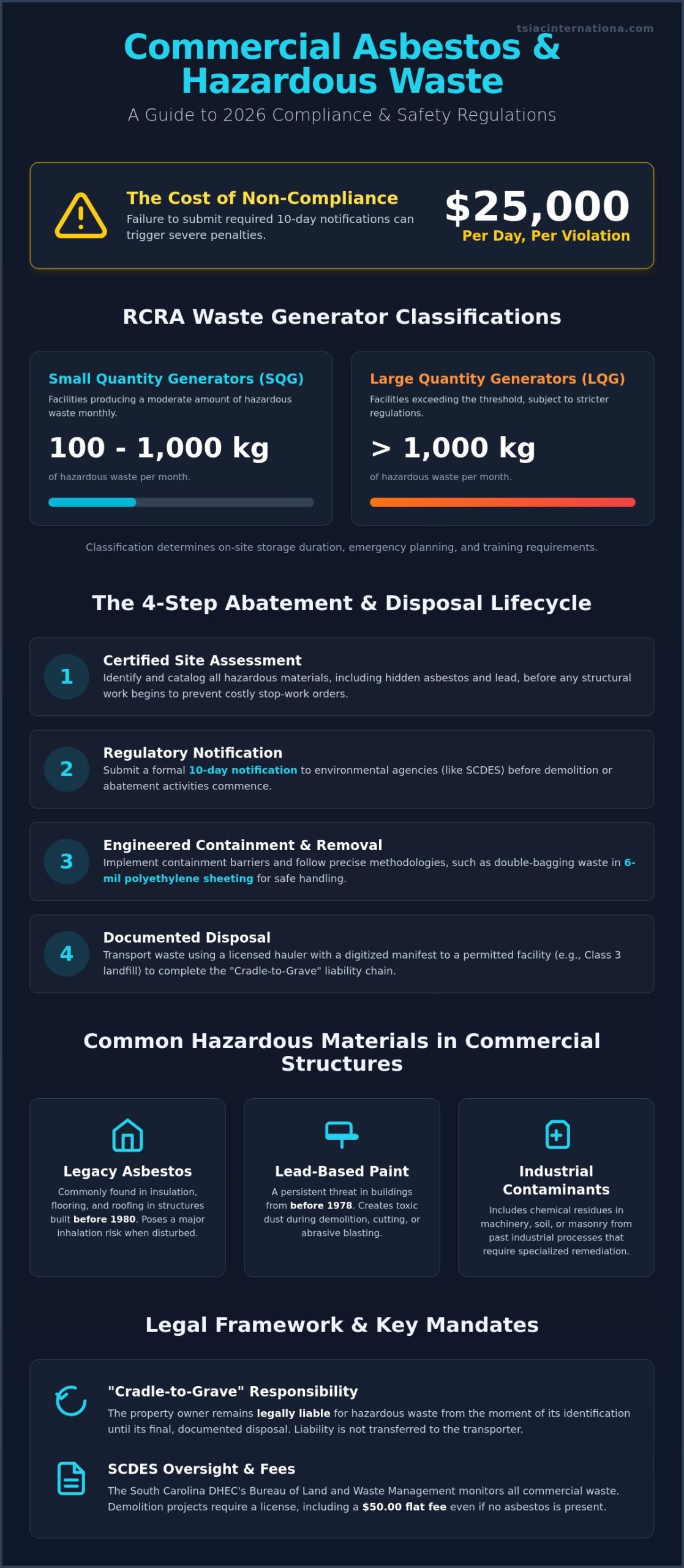
In South Carolina, commercial hazardous waste is defined by its chemical characteristics, including ignitability, corrosivity, reactivity, and toxicity. As of July 1, 2024, the South Carolina Department of Environmental Services (SCDES) assumed full regulatory authority over these materials, succeeding the previous health and environmental department. For property owners and contractors, adherence to commercial asbestos disposal regulations south carolina is a mandatory requirement that governs every phase of a project, from initial site assessment to final disposal at a Class 3 landfill. These regulations ensure that hazardous materials don’t pose a threat to the public or the surrounding ecosystem during structural modifications.
Under the 2026 Resource Conservation and Recovery Act (RCRA) standards, businesses are classified based on the volume of waste they generate. Small Quantity Generators (SQG) produce between 100 and 1,000 kilograms of hazardous waste per month, while Large Quantity Generators (LQG) exceed the 1,000-kilogram threshold. Each classification carries distinct requirements for on-site storage duration, emergency planning, and personnel training. Precision in these classifications is vital, as mislabeling a facility’s generator status can lead to immediate regulatory scrutiny and potential project delays.
The Role of SCDES in Waste Oversight
The Bureau of Land and Waste Management within the SCDES serves as the primary monitoring body for all commercial waste streams across the state. Every commercial facility must obtain and maintain a unique generator identification number, which allows the state to track the movement of hazardous materials through a digitized manifest system. Recent 2026 updates to state-level reporting have increased the frequency of mandatory electronic filings for LQGs. These updates also include adjusted fee structures for demolition project licenses, which now require a $50.00 flat fee even if no asbestos is present, ensuring that the state can maintain a comprehensive database of all structural removals.
Legal Consequences of Improper Disposal
The legal framework surrounding hazardous waste is built on the “Cradle-to-Grave” responsibility principle. This doctrine dictates that a property owner remains legally liable for the waste from the moment it’s identified until its final, permanent disposal. Even after the material leaves the site with a transporter, the owner is not absolved of liability. Because asbestos remains a primary concern in industrial renovations, stakeholders should consult a comprehensive overview of asbestos to understand the physical properties that necessitate such rigorous containment. Failure to provide proper 10-day notifications or utilizing unpermitted disposal sites can result in civil fines of up to $25,000 per day of violation. Professional documentation and waste manifests aren’t merely administrative tasks; they serve as a critical legal shield for property owners against environmental litigation.
Identifying Hazardous Materials in Commercial and Industrial Facilities
The transition from a regulatory framework to physical site preparation requires an exacting eye for material identification. In South Carolina, commercial structures, particularly those built before 1980, often contain a complex matrix of hazardous substances that must be cataloged before any structural intervention. While commercial asbestos disposal regulations south carolina focus heavily on fiber containment, a truly compliant project must also account for lead, chemical residues, and emerging industrial contaminants. Identifying these materials early prevents the “stop-work” orders that occur when a demolition crew unexpectedly strikes a hazardous vein of insulation or contaminated masonry.
Lead-based paint remains a persistent threat in pre-1978 industrial buildings and warehouses. Unlike residential lead concerns, industrial lead exposure often involves high-friction surfaces or structural steel coatings that, when disturbed by selective demolition, create toxic dust. Modern safety standards require that these coatings be tested and abated before any mechanical cutting or abrasive blasting begins. This methodological approach ensures that heavy metal particles don’t migrate into the building’s HVAC systems or the surrounding environment.
Asbestos and Lead: The Legacy Hazards
Asbestos is rarely visible to the naked eye, hiding instead within the functional layers of a building. It’s frequently found in floor mastics, thermal pipe insulation, and acoustic ceiling tiles. Because these materials become friable when handled, the state enforces strict licensing for those who identify and remove them. Property owners should review The South Carolina Asbestos Abatement License Act to understand the legal qualifications required for site inspectors. For a deeper dive into the technical requirements for these projects, our guide on asbestos removal in South Carolina details the specific containment protocols necessary for 2026 compliance. Integrating these surveys into your initial project scope is the most effective way to maintain budget certainty.
Chemical and Industrial Waste Streams
Industrial facilities often present unique challenges beyond legacy building materials. Laboratory waste, chemical solvents, and industrial-grade batteries require specialized handling and disposal at permitted South Carolina facilities. Flammable liquids and heavy-duty cleaning agents cannot be discarded through standard waste channels; they require a documented chain of custody to avoid environmental litigation. Additionally, professional mold remediation is often necessary in older commercial properties to restore structural integrity and long-term asset value. If your project involves complex hazardous streams, our team can assist with selective demolition services that surgically remove contaminants without compromising the remaining structure.
In specialized industrial sectors like oil and gas, managing complex chemical byproducts requires similar technical rigor and precision. For instance, TEG Reclamation Services provides comprehensive glycol reclamation and dehydration maintenance to ensure that gas processing operations remain efficient and environmentally compliant.
Beyond oil and gas, industries such as mining and water treatment also rely on advanced chemical management; for these needs, JAS Global Industries provides specialty chemical solutions that help maintain operational efficiency and regulatory alignment.
The Professional Abatement and Disposal Lifecycle: A Systematic Approach
Successful hazardous material management isn’t a byproduct of luck; it’s the result of a disciplined, multi-stage lifecycle. While many contractors view demolition as a singular event, professional abatement is a separate, surgical precursor that ensures the safety of the subsequent structural removal. Following commercial asbestos disposal regulations south carolina requires a transition from identification to physical isolation. This systematic approach prevents the accidental release of fibers and protects both the workforce and the property owner’s long-term liability. By treating abatement as a distinct phase, project managers can maintain a streamlined timeline where environmental remediation doesn’t stall the broader demolition schedule.
Site Assessment and Containment
The lifecycle begins with a certified site assessment. Testing must occur before any structural removal or interior gutting begins to prevent the disturbance of unknown contaminants. Once hazardous materials are mapped, the team establishes engineered containment zones. These zones utilize negative pressure environments and industrial-grade HEPA filtration systems to ensure that air is scrubbed and exhausted safely, preventing any particulate migration into clean areas of the facility. Containment serves as a critical safety barrier that isolates hazardous materials from the rest of the facility to prevent environmental cross-contamination during remediation. This level of technical precision is what distinguishes professional abatement from general demolition, as the latter focuses on structural volume rather than microscopic fiber control.
Transportation and Manifesting
Once the material is physically removed and double-bagged in 6-mil polyethylene sheeting, the focus shifts to the documented chain of custody. South Carolina and federal laws require a rigorous manifesting process for all hazardous waste. This documentation tracks the waste from the project site to a permitted Class 3 landfill, providing a permanent record that the material was handled according to state law. Understanding how hazardous material abatement in South Carolina integrates with professional hauling is essential for maintaining compliance. The use of commercial rental vehicles is strictly prohibited for asbestos transport; instead, specialized, lined vehicles must be used to prevent any accidental release during transit to the disposal facility.
The final stage of the lifecycle is post-removal verification. This involves independent air clearance testing and a final inspection to ensure the containment zone is completely free of hazardous residues. Only after these results are documented and the waste manifests are signed by the receiving facility is the project considered compliant. These final documents serve as your primary defense during any future SCDES audit, ensuring full alignment with commercial asbestos disposal regulations south carolina before the site is cleared for the next phase of construction or demolition.
Mitigating Liability: Criteria for Selecting a Hazardous Waste Contractor
Selecting a partner for hazardous waste management is a critical exercise in risk mitigation. Because the legal liability for hazardous materials remains with the property owner indefinitely, the technical proficiency of your contractor is your primary defense against future litigation. You must verify that any firm you consider is fully conversant with commercial asbestos disposal regulations south carolina and maintains the specific state-issued licenses required for 2026. A bid that seems unusually low often indicates a lack of proper insurance or a plan to bypass the rigorous containment protocols mandated by the SCDES.
A contractor’s Experience Modification Rate (EMR) provides a transparent, data-driven indicator of their safety performance. For commercial projects, you should prioritize firms with an EMR below 1.0, as this suggests a safety record superior to the industry average. A lower EMR doesn’t just reflect a safer job site; it also indicates lower insurance premiums and a disciplined approach to operational hazards. When a contractor maintains a high safety standard, the likelihood of project delays due to site accidents or regulatory “stop-work” orders is significantly reduced.
Licensing and Regulatory Compliance
Property owners should demand proof of current SCDES certifications for both the company and the individual supervisors assigned to the site. A reliable partner manages the entire administrative burden, including the mandatory 10-day notifications for renovation and demolition. This proactive management prevents the administrative oversights that lead to heavy fines. You should also avoid haulers who cannot provide verified waste manifests. These documents are the only legal proof that your waste reached a permitted Class 3 landfill; without them, your business remains exposed to environmental liability if the material is illegally dumped.
Integrated Capabilities
Risk increases every time a project changes hands between different subcontractors. Hiring a single firm to handle both commercial interior gutting services and hazardous material abatement creates a seamless, more secure workflow. This integration allows environmental experts and structural teams to communicate in real-time, ensuring that abatement happens surgically and doesn’t stall the demolition schedule. Specialized heavy machinery, when operated by a team trained in hazardous material handling, allows for more efficient site clearing while maintaining strict dust suppression protocols. This holistic approach ensures that the transition from a contaminated interior to a clean, structural shell is handled with methodological precision.
Comprehensive pollution liability insurance is another non-negotiable requirement. Standard general liability policies often contain exclusions for hazardous material incidents, leaving the property owner vulnerable if a fiber release occurs. Ensure your contractor carries professional bonding and specific environmental coverage to shield your assets from unforeseen remediation costs. If you require a partner with over 15 years of experience in high-stakes environments, contact us to discuss our asbestos abatement services and secure a fixed-price model for your next project.
Integrated Remediation Solutions: The TSIAC International Advantage
TSIAC International brings over 15 years of industry experience to the intersection of structural removal and environmental safety. We understand that for commercial contractors and government agencies, the primary objective is to maintain a predictable project flow while adhering to commercial asbestos disposal regulations south carolina. Unlike brokers who merely coordinate services, we operate as a direct partner with our own equipment and specialized crews. This boots-on-the-ground presence allows us to offer a fixed-price model for complex projects, providing the budget certainty that’s often missing in the abatement sector.
Our technical expertise extends to the most challenging industrial environments, where we handle everything from acoustic ceiling removal to heavy-duty concrete disposal. We don’t just clear sites; we manage them with a focus on long-term value and legal protection. By consolidating asbestos abatement, lead removal, and structural demolition under one disciplined management structure, we eliminate the communication gaps that typically lead to compliance failures or safety incidents. This integrated approach ensures that every hazardous material stream is identified, contained, and discarded with methodological precision.
A Legacy of Safety and Precision
We approach every high-stakes commercial gut-out with a technical precision that mirrors the complexity of the materials we handle. Our crews are trained to exceed 2026 safety standards and maintain strict OSHA compliance on every job site, regardless of the project’s scale. This commitment to safety ensures that your project remains on schedule and free from regulatory interruptions. For a detailed look at how we sequence these operations, you can review our technical guide on the demolition process in South Carolina. This workflow ensures that every phase, from the first 10-day notification to the final site clearing, is executed with professional authority.
Sustainable Demolition Practices
Environmental stewardship is a core component of our operational philosophy. We actively reduce the environmental footprint of our projects by sorting and recycling wood, metal, and plastic on-site. This practice doesn’t just minimize landfill impact; it also helps control waste costs for our partners by reducing the volume of material sent to Class 3 facilities. In historic or operational commercial buildings, we utilize selective demolition to surgically remove hazardous materials while preserving the structural integrity of the surrounding architecture. This surgical approach is essential for maintaining the asset’s value while meeting the rigorous demands of commercial asbestos disposal regulations south carolina.
Our team is ready to provide the technical oversight and physical execution required for your next renovation or demolition project. We don’t promise results we can’t deliver; we deliver results through proven methodology and a disciplined work ethic. Contact TSIAC International today for a professional consultation on your next project.
Ensuring Long-Term Compliance and Structural Safety
Maintaining strict compliance with commercial asbestos disposal regulations south carolina is the most effective way to protect your commercial assets and project timelines. The 2026 regulatory environment demands absolute transparency in waste manifesting and site containment, making the choice of a qualified contractor more critical than ever. By prioritizing methodological site assessments and integrated remediation strategies, you ensure that hazardous materials are removed surgically before they can disrupt your broader structural goals. This disciplined approach minimizes the risk of environmental litigation and ensures that your site remains safe for future development.
TSIAC International leverages over 15 years of industry expertise to provide a seamless bridge between environmental abatement and structural demolition. We are fully licensed and insured for hazardous material remediation, specializing in the specialized techniques required for acoustic ceiling removal, lead abatement, and complex interior gut-outs. Our fixed-price model and commitment to on-site recycling provide the predictability and environmental stewardship your stakeholders expect. Don’t let regulatory complexity stall your progress.
Secure Your Project with TSIAC International’s Expert Abatement Services and move forward with the confidence that every technical detail is under control. We are ready to partner with you to achieve a safe, compliant, and efficient project outcome.
Frequently Asked Questions
What qualifies as commercial hazardous waste in South Carolina?
Commercial hazardous waste includes any material that exhibits ignitability, corrosivity, reactivity, or toxicity according to SCDES standards. In a structural context, this primarily refers to friable asbestos, lead based paint, and specific industrial residues like chemical solvents or heavy duty batteries. Identifying these materials through a certified survey is the first step in maintaining compliance with state law.
Do I need a special permit for asbestos removal during a commercial renovation?
Yes, you must obtain a specific project license from the SCDES before beginning work. Current commercial asbestos disposal regulations south carolina mandate a 10-day waiting period following the submission of a formal notification. This applies to all regulated renovation and demolition projects, regardless of whether the material is friable or non friable.
How much does commercial hazardous waste disposal cost in 2026?
While the cost of professional abatement services depends on the specific project scope, the SCDES charges standardized regulatory fees. As of 2026, a flat $50.00 fee is required for all demolition project licenses. For renovation projects, the state calculates fees based on the volume of material removed, generally at a rate of 10 cents per linear or square foot.
Can I dispose of lead-based paint debris in a standard South Carolina landfill?
No, lead based paint debris cannot be discarded in standard municipal landfills. It must be transported to a Class 3 landfill that’s specifically permitted by the state to accept hazardous materials. Improperly disposing of lead contaminated waste in a standard facility can lead to environmental litigation and significant civil penalties for the property owner.
What is a hazardous waste manifest and why do I need one?
A hazardous waste manifest is a mandatory shipping document that tracks hazardous materials from the project site to the final disposal facility. This document provides a verifiable chain of custody, ensuring that the waste was handled by licensed transporters and received by a permitted landfill. It serves as your primary legal defense during a regulatory audit.
How long can a business store hazardous waste on-site before disposal?
The allowable on-site storage duration depends on your facility’s generator status. Large Quantity Generators (LQG) typically have a 90-day limit, while Small Quantity Generators (SQG) may store waste for up to 180 days. Exceeding these timeframes without an extension can result in your facility being reclassified, leading to more stringent regulatory requirements and potential fines.
What is the difference between abatement and remediation in commercial settings?
Abatement refers specifically to the physical removal, sealing, or permanent encapsulation of a hazardous material like asbestos. Remediation is a broader term that encompasses the entire process of identifying, containing, and cleaning an environmental hazard to restore a site to a safe condition. Both processes require specialized equipment and certified personnel to execute properly.
Who is responsible for hazardous waste found during a property gut-out?
Under the “Cradle-to-Grave” doctrine, the property owner is legally responsible for any hazardous waste found on their site. This liability remains with the owner even after the waste is transported to a disposal facility. Hiring a licensed contractor who provides full documentation is the only way to mitigate the risks associated with discovering hazardous materials during an interior gut-out.
