
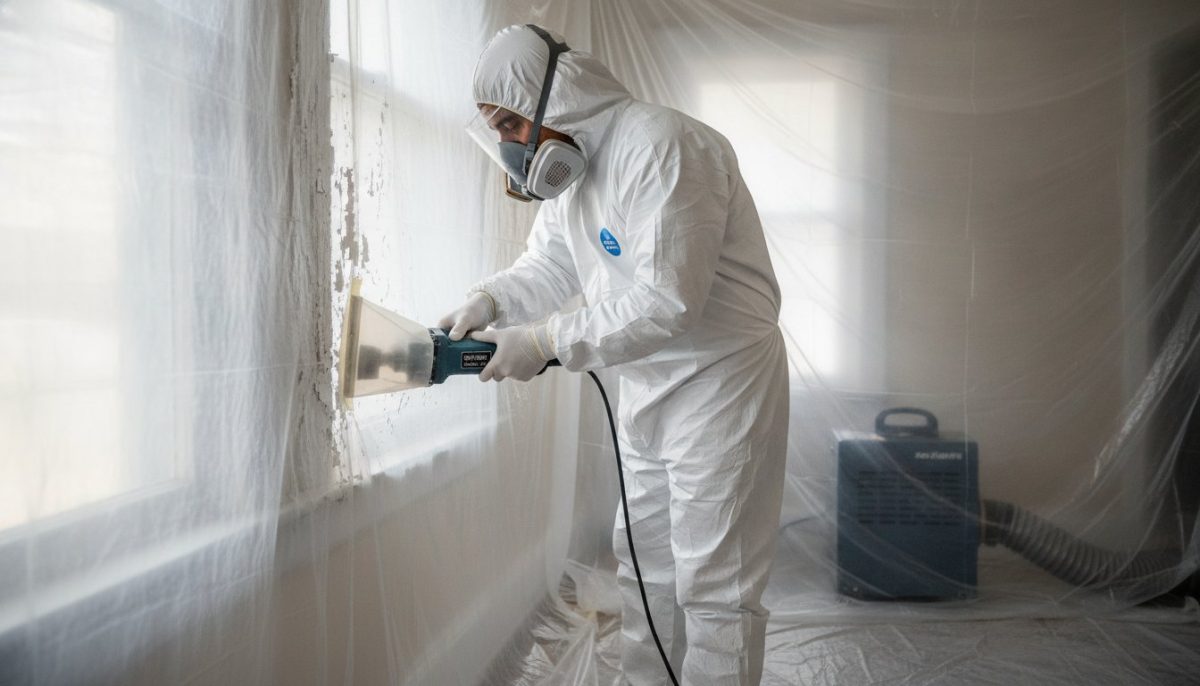
Did you know that an improper home renovation in 2026 could result in EPA civil penalties of up to $46,989 per violation, every single day? While the desire to manage property costs is understandable, the technical risks of DIY lead paint removal often create liabilities that far outweigh any initial savings. You want a safe environment for your family or tenants, yet lead dust remains one of the most persistent and dangerous contaminants in the built environment, especially with the EPA now classifying any detectable level of lead dust as a hazard.
This guide examines the critical health, legal, and environmental dangers of attempting lead paint removal yourself. We’ll demonstrate why professional intervention is the only path to achieving the stringent 2026 clearance standards, such as the 5 micrograms per square foot floor limit. You’ll learn how current regulations have shifted the burden of proof onto property owners and why methodical, expert abatement is a non-negotiable asset for your property’s safety and long-term value.
Key Takeaways
- Understand how microscopic lead dust infiltrates HVAC systems and why pre-1978 structures require rigorous containment to prevent persistent health hazards.
- Identify the critical technical risks of DIY lead paint removal, including the dangerous “dust cloud” effect and the inadequacy of standard consumer-grade PPE.
- Discover the specialized engineering controls, such as negative air pressure and HEPA-shrouded tools, that differentiate professional abatement from high-risk DIY attempts.
- Learn about the legal liabilities under the EPA RRP Rule and the mandatory protocols for the disposal of lead-contaminated hazardous waste.
- Explore the strategic benefits of combining certified lead abatement with professional interior gutting to ensure a safe, compliant start for any renovation project.
Understanding the Invisible Threat: Why Lead Paint is More Dangerous Than You Think
Lead-based paint isn’t merely an aesthetic concern or a relic of older architecture. It’s a hazardous material that remains chemically active and dangerous decades after its application. In the United States, properties constructed prior to 1978 frequently contain these heavy metal pigments, often buried beneath layers of modern, non-toxic coatings. The core issue lies in the material’s degradation. As the paint ages, it becomes brittle and breaks down into microscopic dust. These particles are so fine that they bypass standard filtration systems, allowing them to settle deep within HVAC ductwork and porous surfaces like carpets or insulation. This widespread distribution is one of the primary risks of DIY lead paint removal, as uncontained scraping or sanding releases millions of these toxic particles into the living environment.
The dangers of lead paint are rooted in its fundamental chemistry. Lead is a potent neurotoxin that interferes with the development and function of the human nervous system. While adults suffer from hypertension and cognitive decline, children are the most vulnerable. Their developing brains absorb lead more readily, leading to permanent IQ loss and behavioral disorders. Many property owners believe that simply applying a fresh coat of latex paint solves the problem. This is a misconception. Unless a certified encapsulant is used on a stable surface, “painting over it” merely masks the hazard. Friction surfaces, such as window sashes and door frames, will continue to grind the lead-based layers into dust every time they are operated.
The Long-Term Impact of Lead Exposure
Lead exposure is particularly insidious because of bioaccumulation. Once lead enters the bloodstream, the body treats it like calcium, storing it in the bones and teeth for decades. Inhalation provides a direct route to the lungs and blood, while ingestion usually occurs through hand-to-mouth contact with contaminated dust. Lead-based paint hazards are a persistent environmental toxin requiring specialized handling. Without professional intervention, these toxins can be re-released into the bloodstream during periods of physiological stress or illness, creating a lifelong health burden.
Identifying Lead in Your Property
You can’t identify lead paint through a visual inspection. It often looks identical to modern coatings, though “alligatoring” or distinct cracking patterns can sometimes indicate its presence. It’s most commonly found on high-wear areas like windows, doors, and exterior trim. To accurately assess the risks of DIY lead paint removal in your specific property, technical testing is mandatory. Professionals utilize X-ray fluorescence (XRF) analyzers to detect lead through multiple layers of paint without damaging the surface. This data-driven approach, combined with lab-certified dust sampling, provides the only reliable baseline for a safe remediation plan.
The Technical Risks of DIY Lead Paint Removal
The “Dust Cloud” effect is perhaps the most underestimated of the risks of DIY lead paint removal. When you sand or scrape lead-based paint without industrial containment, you aren’t just removing a coating; you’re aerosolizing a heavy metal. These particles are so fine that they remain suspended in the air for hours, eventually settling in carpets, upholstered furniture, and HVAC ductwork. Once lead dust enters your ventilation system, it’s redistributed throughout the property every time the furnace or air conditioner cycles, creating a persistent contamination loop that’s incredibly difficult to break without professional intervention.
Standard N95 masks, while suitable for basic carpentry or drywall work, are fundamentally insufficient for lead work. They lack the filtration density required to block lead fumes or microscopic dust particles. Professionals utilize P100-rated respirators and full-body Tyvek suits to prevent both inhalation and the secondary transfer of lead on clothing. Without a lead-safe certified renovator to manage the site, the risk of carrying lead home to your family via your work boots or clothes is a mathematical certainty. This cross-contamination often extends to the soil around the property, where lead flakes can poison the ground for decades.
Heat-gun stripping presents an even more acute danger. If a DIYer uses a heat gun at temperatures exceeding 1,100 degrees Fahrenheit, the lead actually vaporizes. This creates toxic fumes that are absorbed into the bloodstream almost instantly upon inhalation. It’s a technical failure that can lead to emergency-level blood lead levels in a matter of minutes. The chemical reality of lead requires precise temperature control and vapor management that consumer-grade tools simply cannot provide.
The Failure of Consumer-Grade Equipment
Standard shop vacuums are often the primary cause of environmental cross-contamination in DIY projects. These machines lack the specialized seals and certified HEPA filtration found in industrial abatement systems. Instead of capturing lead dust, they exhaust the smaller, more dangerous particles back into the air, acting as a motorized distribution system for toxins. Professional abatement requires negative air machines that pull air through multi-stage filtration, ensuring that no lead migration occurs during the project.
Common DIY Mistakes and Their Consequences
Dry sanding is the leading cause of acute lead poisoning during home renovations. Without constant wetting to suppress dust, the mechanical action of sanding generates a concentrated plume of lead. Many DIYers also fail to establish a formal decontamination zone. They walk from the work area into clean zones, spreading lead through “track-off” on their shoes. Even chemical strippers provide a false sense of security; if the resulting sludge isn’t handled as hazardous waste, the risks of DIY lead paint removal remain as high as ever. If your project involves a total overhaul, consider how commercial interior gutting services can provide a clean, safe slate by removing all hazardous materials at the source.
Professional Abatement vs. DIY: A Comparison of Safety and Efficiency
While a property owner might view lead removal as a standard weekend renovation, professional abatement is a highly technical field governed by physics and engineering. The risks of DIY lead paint removal stem from a lack of environmental control. A professional team doesn’t just scrape paint; they build a temporary laboratory environment. This starts with 6-mil polyethylene sheeting, which is significantly thicker and more durable than the plastic tarps found at hardware stores. Every seam is taped to create an airtight seal, ensuring that no microscopic dust escapes the work zone into the rest of the building.
The technical heart of professional abatement is the negative air pressure machine. These units use high-capacity fans to pull air through multi-stage HEPA filters, creating a vacuum effect within the containment area. This ensures that air only flows into the work zone, never out, preventing the migration of toxins. Without this equipment, even the most careful DIYer will inevitably spread lead dust throughout their property. If exposure occurs, the symptoms of lead poisoning in adults, such as hypertension and joint pain, can be difficult to diagnose until significant damage has occurred.
Efficiency is another critical differentiator. A certified team can often complete a full interior abatement in a matter of days. A DIYer, working without wet-shrouded power tools or industrial-grade HEPA vacuums, may spend weeks on the same task. During that extended timeframe, the risks of DIY lead paint removal increase exponentially as the house remains a construction site with active contaminants. Professionals use specialized equipment that captures dust at the point of origin, drastically reducing the labor required for final cleanup.
Industrial Strength Containment Strategies
Negative air pressure is a physical barrier that works when plastic sheeting fails. By exhausting filtered air out of a window, the machine creates a lower pressure inside the room, which prevents dust from leaking through small gaps or under doors. Air scrubbers run constantly during the process to purify the environment, capturing particles that standard masks miss. Professional abatement is a controlled engineering project, not just a cleaning task.
Post-Abatement Verification
The project isn’t finished when the paint is gone. It’s finished when the property passes a third-party clearance test. This involves dust wipe sampling on floors and windowsills to ensure lead levels are below the strict 2026 EPA thresholds. You’ll receive legal documentation providing a “Lead-Safe” certification, which is an invaluable asset for future property sales or tenant occupancy. This verification provides the peace of mind that a DIY project simply cannot offer, as it replaces guesswork with lab-certified data.
Legal Liabilities and Proper Disposal of Lead Waste
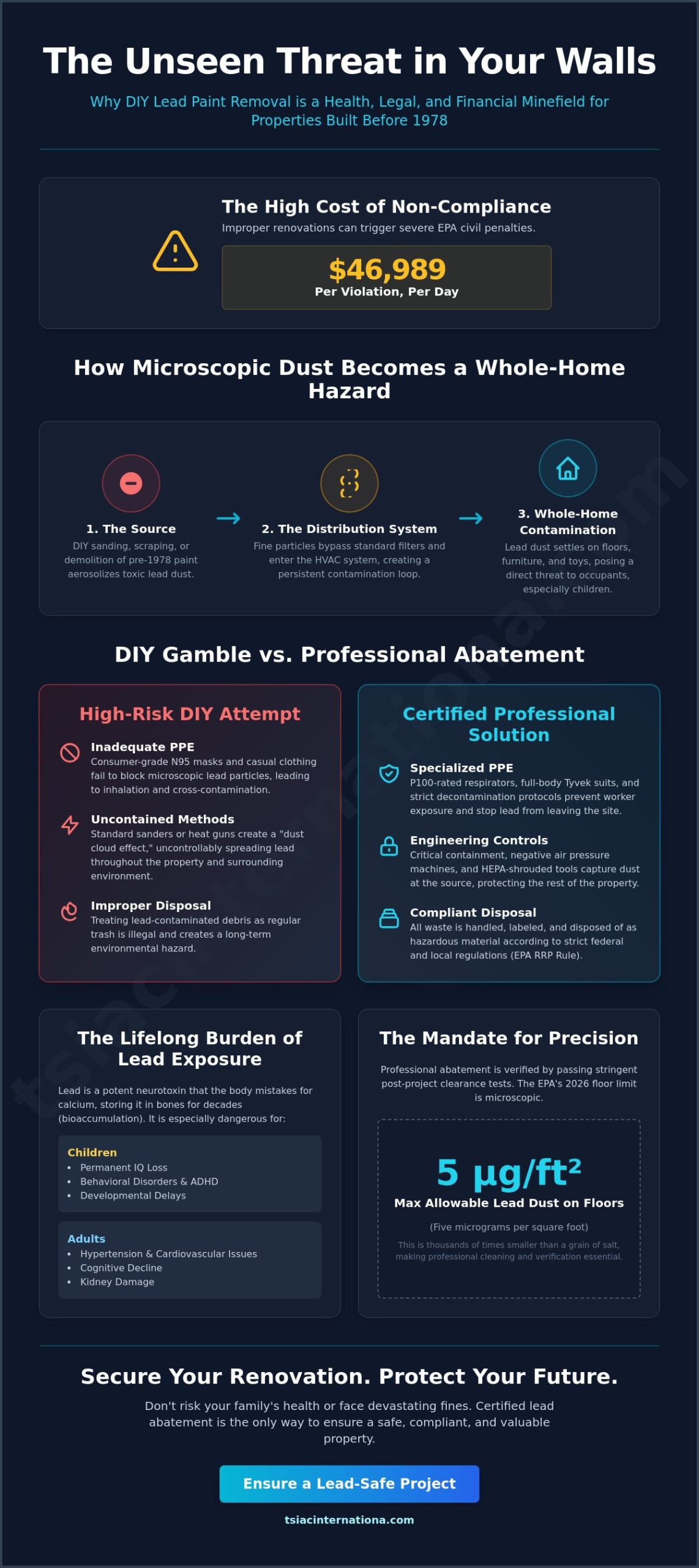
The physical risks of DIY lead paint removal are matched by severe legal liabilities that many property owners overlook. In 2026, federal oversight of lead hazards has intensified, with the EPA’s Renovation, Repair, and Painting (RRP) Rule serving as the primary regulatory framework. For professionals, violating these work practice standards can result in civil penalties of up to $46,989 per violation, per day. While homeowners performing their own work may face different direct regulatory hurdles, they remain fully responsible for the illegal disposal of hazardous materials and the long-term health of their occupants. If you fail to document that lead was removed according to certified standards, you create a permanent cloud over the property’s title and your personal liability.
Disposal is where many DIY projects transition from a health hazard to a criminal offense. Lead-based paint debris, including contaminated plastic sheeting, HEPA filters, and paint chips, is legally classified as hazardous waste. You cannot simply place these materials in a standard residential dumpster or curb-side trash bin. Lead is a persistent element; when it ends up in a standard landfill, it can leach into the local water table and soil, creating an environmental crisis. Professional contractors manage the entire chain of custody, providing a documented paper trail that proves the waste was transported and processed at a licensed hazardous waste facility.
Hazardous Waste Management Protocols
Proper waste management involves strict labeling, manifesting, and the use of puncture-resistant, 6-mil poly bags. Every ounce of debris must be accounted for to prevent environmental leaching. Utilizing professional hazardous material abatement acts as a legal safeguard, ensuring that your renovation doesn’t result in an unexpected EPA audit or local environmental fine. We handle the technical logistics so that your property remains compliant with all state and federal statutes.
Insurance and Liability Risks
Attempting to remove lead yourself can have disastrous effects on your insurance coverage. Most homeowner and commercial property policies contain “pollution exclusions” that specifically name lead as a substance they won’t cover if handled by uncertified individuals. If a neighbor or future tenant develops symptoms of lead poisoning, you could face personal injury lawsuits without the protection of your insurance carrier. Professional certification is your only effective defense against these claims, as it proves that the hazard was mitigated using industry-standard engineering controls. Protect your financial future by partnering with a certified abatement expert before the first seal is broken.
Securing Your Property: Professional Lead Abatement Solutions
TSIAC International approaches lead abatement as a mission-critical safety operation rather than a standard construction task. We’ve spent 15 years refining a methodical protocol that eliminates the technical and legal liabilities inherent in hazardous material handling. Handling toxic pigments requires more than just basic certification; it requires the field-tested experience to manage complex site conditions where lead may be hidden behind multiple layers of modern renovation. By choosing an expert partner, you effectively mitigate the risks of DIY lead paint removal while ensuring the project meets all 2026 regulatory thresholds from the first day of containment to the final clearance report.
Many large-scale renovation projects require a complete reset of the interior environment to be successful. We specialize in integrating lead abatement with commercial interior gutting services. This holistic strategy allows our teams to remove lead-contaminated components, such as legacy window sashes, door frames, and trim, as part of a broader, controlled demolition process. It’s a significantly more efficient way to secure the building’s envelope while maintaining a strictly monitored hazardous waste stream. This single-source approach reduces the logistical friction of managing multiple contractors and ensures that no hazardous dust is left behind to contaminate new building materials.
Our commitment to environmental responsibility is reflected in our rigorous disposal and recycling protocols. We don’t just remove the hazard; we ensure it’s neutralized. All lead-contaminated debris is manifested and transported to licensed facilities, preventing the heavy metal leaching that occurs when lead is improperly discarded. This level of precision is why property owners and government agencies trust us to handle their most sensitive environments. We provide the technical documentation that serves as your permanent record of compliance and safety.
Comprehensive Abatement and Demolition
Complex structures often harbor multiple hazardous materials simultaneously. Our teams are equipped to handle projects involving both lead and asbestos removal, providing a comprehensive solution for aging properties. The advantage of a single-source contractor is clear: we maintain a unified containment zone and a consistent safety protocol across the entire site. This ensures a safe working environment for subsequent general contractors and guarantees that the property remains in full alignment with state and federal environmental statutes.
Take the First Step Toward a Safe Property
Securing your property begins with an accurate technical assessment. We offer professional lead inspections that utilize XRF technology to map hazards without unnecessary destruction. To provide our clients with financial predictability, we utilize fixed-price contracts for abatement projects, ensuring there are no hidden costs as the project progresses. Don’t let the risks of DIY lead paint removal jeopardize your health or your investment. Contact TSIAC International today to develop a comprehensive hazardous material strategy tailored to your property’s specific technical requirements.
Ensure a Certified and Safe Property Future
The 2026 regulatory landscape leaves no room for error when managing legacy environmental hazards. We’ve explored how the technical risks of DIY lead paint removal extend far beyond simple dust control, encompassing severe neurotoxic health impacts and massive legal liabilities under the EPA RRP Rule. Attempting to manage these variables without industrial-grade engineering controls often results in permanent contamination and significant financial penalties. Professional abatement is the only way to meet modern safety standards and protect the long-term value of your assets.
True property safety requires a methodical partner who understands the physics of containment and the rigors of hazardous waste disposal. With over 15 years of abatement experience and a comprehensive national service capacity, we provide the technical precision needed to transform a toxic liability into a certified safety asset. Our EPA-compliant hazardous waste management ensures that every stage of the process is documented and legally sound. Don’t risk the safety of your occupants or the integrity of your investment. Consult the Experts at TSIAC International for Safe Lead Abatement and secure a clean, compliant foundation for your next project. We’re ready to help you achieve a lead-safe environment with total confidence.
Frequently Asked Questions
Is lead paint removal a good DIY project for homeowners?
Lead paint removal is not a suitable DIY project due to the extreme technical and medical risks involved. Handling toxic pigments requires specialized engineering controls like negative air machines and industrial-grade HEPA filtration that typical consumer equipment lacks. Attempting this work yourself often leads to widespread contamination and long-term health liabilities for your family or tenants.
How can I tell if my house has lead-based paint without a professional?
You cannot definitively identify lead-based paint through visual inspection alone, though “alligatoring” or checkered cracking is a common indicator in pre-1978 homes. While DIY lead test swabs are available for initial screening, they often produce false negatives on deeper layers of paint. A professional XRF inspection is the only way to map lead content accurately across all paint layers without surface damage.
What happens if I accidentally disturb lead paint during a renovation?
If you accidentally disturb lead paint, you should immediately stop work, turn off your HVAC system, and seal the area with 6-mil plastic sheeting. Use wet cleaning methods and a certified HEPA vacuum to capture visible debris, but avoid standard shop vacuums which will redistribute the dust. Professional air sampling is recommended to ensure that microscopic particles haven’t migrated to other rooms in the property.
Can I just paint over lead paint to make it safe?
Standard latex or oil-based paint is not a permanent safety solution because it doesn’t bond to the lead or prevent it from chipping. You must use a certified lead encapsulant, which is a specialized coating designed to seal the hazard chemically. However, encapsulation is ineffective on friction surfaces like window sashes or door frames where mechanical action will eventually release toxic dust into the air.
What are the EPA requirements for lead paint removal in 2026?
In 2026, the EPA Renovation, Repair and Painting (RRP) Rule requires that any work disturbing more than 6 square feet of interior lead paint must be performed by certified renovators. New standards established on January 12, 2026, mandate that any detectable level of lead dust is considered a hazard. Post-abatement clearance levels are now strictly set at 5 micrograms per square foot for floors and 40 micrograms for window sills.
How much does professional lead abatement usually cost?
The cost of professional lead abatement depends on several technical factors, including the square footage of the affected area, the chosen removal method, and the complexity of the containment required. Projects are typically quoted based on the number of friction surfaces or the total volume of hazardous debris being removed. Requesting a professional inspection is the best way to secure a fixed-price contract for your specific property.
Are there specific masks that protect against lead dust for DIYers?
Standard N95 masks don’t provide adequate protection against the risks of DIY lead paint removal because they cannot filter lead fumes or the finest dust particles. A NIOSH-approved P100 respirator is the minimum requirement for lead work. Even with a P100 mask, DIYers remain at risk because they lack the full-body Tyvek protection and decontamination zones used by professionals to prevent cross-contamination.
How do professionals dispose of lead-contaminated materials?
Professionals manage lead-contaminated materials by sealing them in puncture-resistant 6-mil poly bags and transporting them to licensed hazardous waste facilities. Every shipment is accompanied by a waste manifest that provides a legal paper trail for the property owner. This process ensures that toxic debris doesn’t end up in local landfills where it could leach into the soil or groundwater.
