
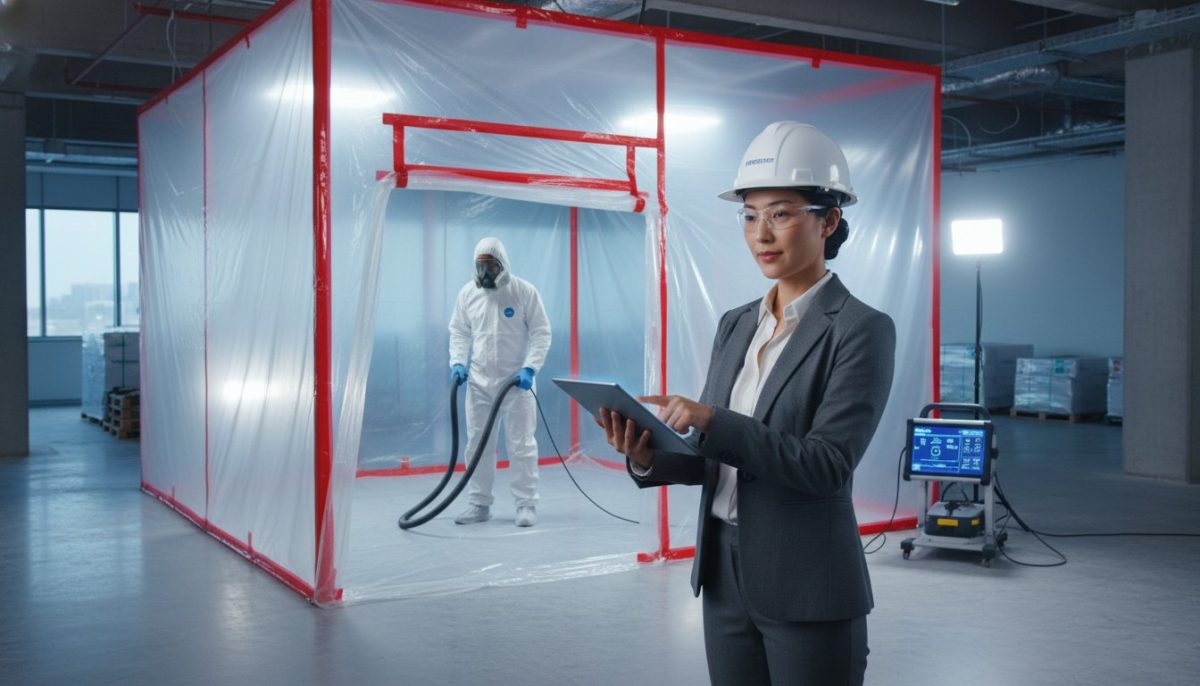
Did you know that nearly 40,000 Americans still die from asbestos-related illnesses every year, even with the 2024 EPA ban on chrysotile asbestos facing ongoing legal challenges? This staggering figure highlights why abatement isn’t a standard construction task; it’s a high-stakes compliance operation where the wrong choice leads to severe health risks or heavy regulatory penalties. Understanding how to choose an asbestos removal company requires you to look beyond the lowest quote and instead audit a contractor’s technical safety infrastructure and legal documentation.
It’s natural to feel overwhelmed by technical jargon and the pressure to ensure your site is safe and compliant. We understand that you need more than just a service provider; you need a partner who treats your liability and safety with methodical precision. This guide promises to clarify the critical safety, legal, and technical criteria for selecting a top-tier abatement professional who gets the job done right the first time.
We’ll walk you through the essential certifications, air monitoring protocols, and the specific documentation required to prove your property is truly asbestos-free. By the end of this article, you’ll have a clear framework for evaluating contractors based on their actual performance standards and regulatory history.
Key Takeaways
- Identify why specialized pollution liability insurance is non-negotiable for protecting your property against hazardous material exposure during remediation.
- Discover the specific technical criteria for how to choose an asbestos removal company, focusing on engineering controls like negative air pressure and HEPA filtration.
- Learn to distinguish between a standard trade quote and a comprehensive abatement work plan that details containment strategies and decontamination protocols.
- Understand the critical legal differences between temporary encapsulation and permanent asbestos removal to ensure full compliance with 2026 EPA and OSHA regulations.
- Gain insights into why coordinating asbestos abatement with structural demolition requires a contractor with deep experience in complex, multi-phase hazardous environments.
Understanding the Risks and Regulatory Landscape of Asbestos Abatement
Asbestos abatement isn’t a standard renovation task. It is a highly regulated discipline centered on the containment and elimination of microscopic mineral fibers. While simple repair or encapsulation might temporarily address a hazard, professional removal remains the only definitive solution for long-term liability protection. When you evaluate how to choose an asbestos removal company, you must prioritize contractors who understand that “abatement” implies a rigorous set of asbestos abatement procedures designed to prevent environmental contamination. This process is governed by strict federal mandates that have evolved significantly as of 2026.
The legal stakes are exceptionally high for property owners. The EPA finalized a rule in March 2024 to ban chrysotile asbestos, but by mid-2026, this regulation faced intense legal scrutiny in the U.S. Court of Appeals for the Fifth Circuit. These shifts mean that compliance isn’t static. It requires a contractor who stays current with NESHAP (National Emission Standards for Hazardous Air Pollutants) updates. Attempting a DIY approach is a critical mistake. Friable asbestos can release millions of invisible fibers into the air with the slightest disturbance, leading to incurable respiratory diseases. Professional intervention ensures these fibers are captured before they can migrate through a building’s HVAC system.
The Hazards of Friable vs. Non-Friable Asbestos
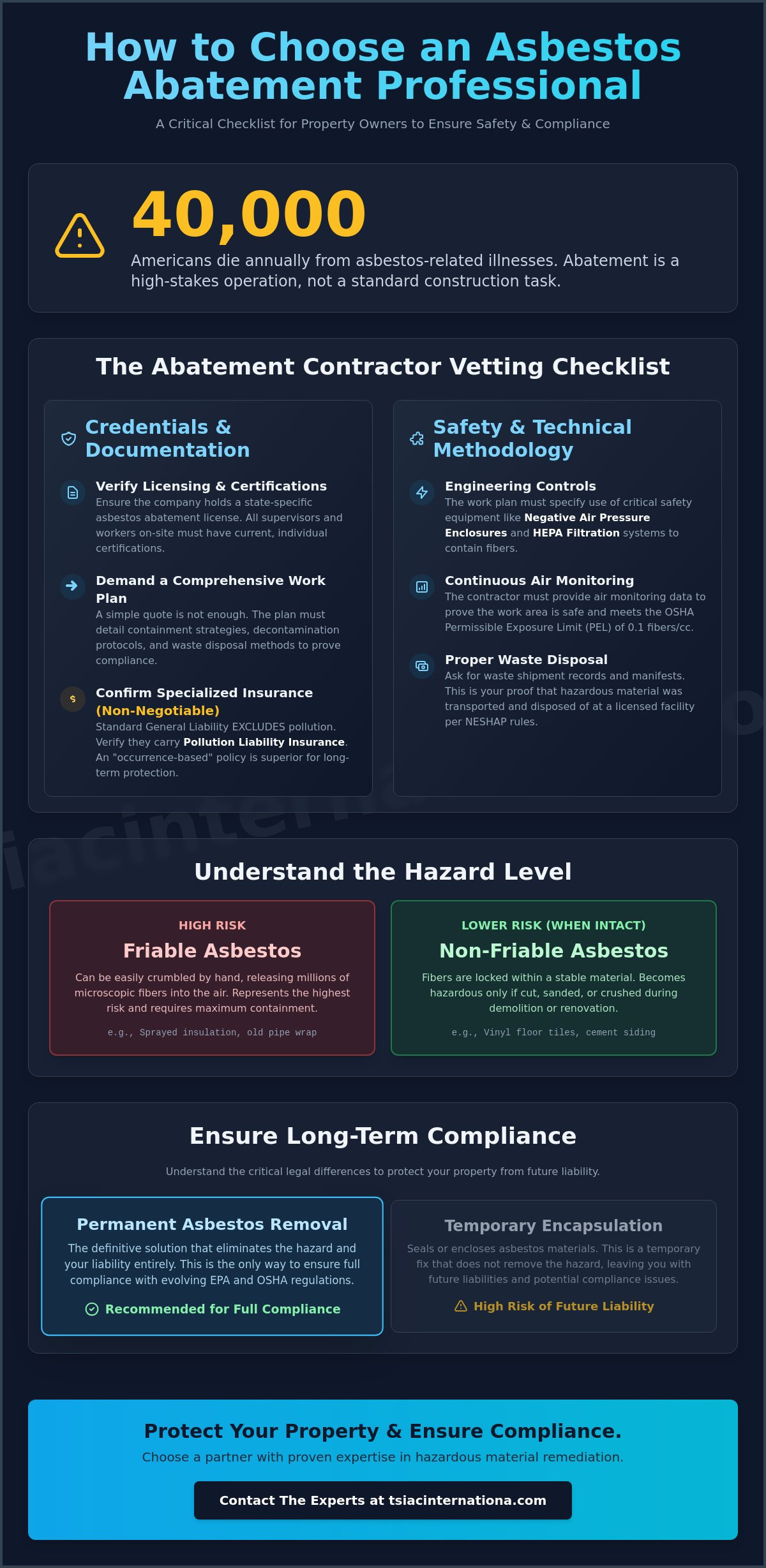
Technicians categorize asbestos based on its physical state. Friable materials, such as sprayed-on insulation or pipe wrap, can be easily crumbled or reduced to powder by hand pressure. This state represents the highest risk because the fibers are already primed for airborne release. Non-friable materials, such as vinyl floor tiles or cement siding, are generally stable unless they’re cut, sanded, or crushed during demolition. Friability is the primary factor in determining containment levels. High-risk, friable projects require full-scale negative pressure enclosures, while non-friable removal might use localized wet methods depending on the project scope.
Federal and State Compliance Requirements
The Clean Air Act mandates that any facility renovation or demolition involving specific quantities of asbestos must follow NESHAP protocols. This includes a mandatory ten-day notification period to the EPA or state agencies before work begins. These regulations ensure that hazardous materials aren’t released during the process. OSHA standards further protect occupants and workers by setting a Permissible Exposure Limit (PEL) of 0.1 fibers per cubic centimeter of air. A reputable contractor doesn’t just promise safety; they provide the air monitoring data and waste shipment records required to prove it. Understanding these layers of oversight is the first step in learning how to choose an asbestos removal company that won’t leave you vulnerable to fines or lawsuits.
Essential Credentials: What to Verify Before Requesting a Quote
When determining how to choose an asbestos removal company, the first line of defense is a rigorous audit of their credentials. You aren’t just hiring a contractor; you’re hiring a licensed specialist capable of managing hazardous waste. State-specific licensing is mandatory and varies by jurisdiction. For example, some states require an asbestos survey by a licensed professional before any renovation of a commercial building, regardless of its age. Every supervisor and worker on your site must hold valid, up-to-date certifications that match the specific material being handled. This documentation is your only proof that the team possesses the technical training required to prevent cross-contamination.
Insurance: Protecting Your Property from Liability
Standard General Liability insurance usually contains a pollution exclusion clause. This means if asbestos fibers are accidentally released into your building, your contractor’s standard policy won’t cover the damages. You must verify that the company carries professional Pollution Liability Insurance. Ideally, seek an occurrence-based policy rather than claims-made. An occurrence policy covers incidents that happen during the policy period, even if the claim is filed years later. Always request a Certificate of Insurance (COI) directly from the insurance agent to ensure the policy is active and has sufficient limits for high-risk hazardous material projects.
Certifications and Professional Affiliations
A legitimate firm maintains a transparent paper trail for every employee. All on-site personnel should have EPA-approved training, often referred to as AHERA certification. Working with a contractor affiliated with organizations like the Environmental Industries Association (EIA) signals a commitment to industry best practices. You can usually verify a license number through state regulatory portals to ensure there are no pending disciplinary actions. Understanding these asbestos rules and regulations helps you identify which certifications are legally required in your specific jurisdiction.
For large-scale commercial or government remediation, bonding is often a requirement. Performance and payment bonds protect you if the contractor fails to complete the work or pay their subcontractors. Additionally, OSHA requires medical surveillance records for abatement workers. These records prove the staff is physically fit to wear respirators and perform high-intensity labor in containment zones. When you’re deciding how to choose an asbestos removal company, ask to see their safety manual and recent OSHA logs. A company that prioritizes its own workers’ health is far more likely to prioritize yours. If you are managing a complex site renovation, partnering with an expert in asbestos abatement and structural demolition ensures that these compliance layers are integrated into the entire project lifecycle.
Evaluating the Removal Methodology and Safety Protocols
Professional abatement is an engineering challenge that requires a sequence of technical controls to prevent the migration of toxic fibers. When you assess how to choose an asbestos removal company, you must look beyond their equipment list and instead evaluate their operational methodology. A high-standard contractor begins by establishing a primary containment zone using 6-mil reinforced polyethylene sheeting and multi-stage decontamination enclosures. These enclosures, which include dedicated shower units for technicians, ensure that fibers don’t leave the work area on clothing or equipment. This physical barrier is the first line of defense in maintaining a controlled environment.
The removal process itself relies on wet methods to suppress dust at the source. Technicians use surfactants or amended water to saturate materials like popcorn ceilings or pipe insulation before they are disturbed. This technique keeps fibers heavy and prevents them from becoming airborne. Once the bulk material is removed and sealed in leak-tight containers, the team performs a meticulous post-removal cleanup. This involves HEPA vacuuming all surfaces followed by a detailed wet-wiping process. This methodical approach ensures that even microscopic dust is captured and removed from the site.
Negative Air Pressure and Air Monitoring
Engineering controls are the most critical component of a safe abatement project. Contractors use high-volume negative air machines equipped with HEPA filters to create a pressure differential. This ensures that air only flows into the containment zone, never out of it, effectively trapping any escaped fibers within the filtration system. To verify the efficacy of these controls, an independent third-party industrial hygienist should conduct air monitoring throughout the project. They use Phase Contrast Microscopy (PCM) or Transmission Electron Microscopy (TEM) to analyze air samples. Air clearance testing is the only way to prove a site is safe for re-entry.
The Legal Chain of Custody: Disposal Manifests
One of the most overlooked aspects of how to choose an asbestos removal company is their waste management protocol. Asbestos is a hazardous material that requires a documented “cradle-to-grave” chain of custody. Every bag of waste must be tracked from your property to an EPA-approved hazardous waste landfill. This process is documented through a Waste Shipment Record (WSR), also known as a disposal manifest. This document must include the generator’s name, the transporter’s information, and the signature of the landfill operator confirming receipt.
The property owner is legally responsible for the asbestos waste even after it leaves the site. If a contractor illegally dumps the material, the owner can face significant fines and legal repercussions. You must demand a copy of the final, signed manifest for your records. This document is a critical piece of your compliance package, providing peace of mind that your liability has been fully discharged through proper disposal channels.
The Vetting Process: Interviewing and Comparing Contractors
A professional bid for hazardous material remediation cannot be accurately produced over the phone. The first step in learning how to choose an asbestos removal company involves conducting a preliminary site walk-through with potential bidders. During this inspection, a qualified contractor will identify the location of all asbestos-containing materials, assess the condition of the substrate, and determine the logistical requirements for containment and decontamination units. If a contractor offers a firm quote without visiting your property, it’s a sign that they may be underestimating the technical complexity of the job, which often leads to change orders or safety shortcuts later.
Once you receive your bids, your analysis must focus on the detailed written work plan rather than the bottom-line price. A high-standard proposal should outline the specific engineering controls the company intends to use, including the number of negative air machines and the layout of the decontamination shower system. Comparing these technical details allows you to see which contractor is prioritizing safety and which is simply trying to undercut the competition. You should also audit their past performance by requesting their Experience Modification Rate (EMR) and checking for any recent OSHA citations. A company with a history of safety violations represents a significant liability risk for your property.
Red Flags: When to Walk Away from a Contractor
Identifying poor practices early can save you from a failed air clearance test or legal penalties. Be wary of the following indicators:
- Bids that are significantly lower than the industry average, which often suggests the use of untrained labor or improper disposal methods.
- Contractors who suggest “off-the-books” removal or fail to name the specific EPA-approved landfill they intend to use.
- Reliance on standard shop-vacs instead of certified HEPA-filtered equipment designed for microscopic fiber capture.
Questions to Ask During the Consultation
Direct technical questions will help you gauge a contractor’s expertise. Ask how they plan to handle a breach in containment, such as a power failure to the negative air machines. Inquire about their third-party air monitoring partner; the laboratory performing the clearance testing should always be independent of the removal company to avoid a conflict of interest. Finally, request a project timeline that accounts for mandatory drying periods and the time required for laboratory analysis of air samples. For projects requiring the highest level of technical precision, choosing a partner with a proven record in selective demolition and asbestos abatement ensures that every phase of the project meets 2026 regulatory standards.
Before signing any contract, review the fine print regarding air clearance failures. A reputable firm should clearly state who is responsible for the costs of re-cleaning and re-testing if the site fails the initial clearance. If the contract is vague on this point, you may find yourself facing unexpected fees for the contractor’s own failure to meet safety standards. Following this systematic vetting process is the most effective way to ensure your abatement project is handled with the necessary methodological accuracy.
Why TSIAC International is the Standard for Hazardous Remediation
Selecting a contractor with over 15 years of field experience in complex structural removal provides a level of certainty that newer firms cannot match. When you research how to choose an asbestos removal company, you’ll find that technical expertise must be paired with operational reliability. TSIAC International has built a reputation on this exact synergy, managing high-compliance projects for commercial and residential clients nationwide. Our approach doesn’t treat hazardous material handling as a secondary task; it’s the core of our technical infrastructure.
Integrating asbestos removal in South Carolina with structural demolition allows us to manage the entire site lifecycle with methodological precision. This coordination is critical for maintaining the integrity of the project timeline and ensuring that no hazardous fibers are disturbed during the subsequent demolition phases. We don’t just clear the site; we protect the property owner’s long-term liability through rigorous documentation and environmental responsibility.
The Advantage of a Full-Service Abatement and Demolition Firm
Our ability to streamline the demolition process in South Carolina by handling all hazardous materials in-house removes the friction often caused by managing multiple subcontractors. By maintaining total control over both abatement and structural removal, we ensure a higher standard of site cleanliness from start to finish. This integrated model reduces project delays and eliminates the communication gaps that frequently lead to safety breaches on complex job sites. You receive a single, accountable point of contact for the entire remediation and demolition scope.
Expertis in Large-Scale Remediation
TSIAC International excels in hazardous material abatement in South Carolina for government and commercial entities. Our team has a proven track record in commercial interior gutting services where legacy asbestos is a persistent challenge. We understand the unique pressures of large-scale remediation, from strict air clearance deadlines to the need for comprehensive waste shipment records that survive legal audits.
Our commitment to the environment extends beyond the removal of toxins. We prioritize the recycling of non-hazardous debris, ensuring that materials like concrete and metal are diverted from landfills whenever possible. This holistic approach to site management defines our role as a responsible partner in the construction industry. If you need a partner who understands how to choose an asbestos removal company based on technical merit and safety records, contact TSIAC International today for a professional consultation and transparent project quote.
Securing Your Property Through Methodical Abatement
Navigating the complexities of hazardous material remediation requires recognizing abatement as a high-stakes compliance operation. By prioritizing technical work plans over bottom-line pricing and verifying specialized pollution liability coverage, you effectively mitigate the long-term risks associated with legacy asbestos. You now have the framework for how to choose an asbestos removal company that aligns with the rigorous safety and legal standards of 2026. This diligence ensures your site remains safe, compliant, and free from the threat of cross-contamination.
TSIAC International brings over 15 years of industry experience to every project, ensuring full EPA and OSHA compliance. Our team provides comprehensive pollution liability coverage to protect your property and interests from start to finish. We provide a methodological solution tailored to the most challenging environmental conditions. When your project demands technical precision and unwavering reliability, we’re ready to serve as your professional partner. Contact TSIAC International for a Professional Abatement Quote and take the first step toward a safe, asbestos-free property today.
Frequently Asked Questions
Do I really need a professional company for small amounts of asbestos?
Yes, professional intervention is necessary regardless of the quantity. Even small amounts of asbestos can release millions of microscopic fibers if disturbed without proper engineering controls. DIY attempts often lead to cross-contamination of the entire property and may violate state and federal disposal laws. Professionals use specialized 6-mil polyethylene containment and HEPA-filtered vacuum systems to ensure that toxic dust is captured at the source and doesn’t migrate to other rooms.
How much does professional asbestos removal typically cost?
Abatement costs are calculated based on the material type, the total square footage, and the complexity of the required containment. Friable materials like pipe insulation or popcorn ceilings require more intensive labor and specialized negative air machines than non-friable floor tiles. While industry data provides broad ranges, a precise quote requires a site-specific walk-through to evaluate the logistical challenges and disposal fees associated with your specific project.
What is the difference between an asbestos survey and asbestos abatement?
A survey is the diagnostic phase where a licensed professional identifies and samples suspected materials to confirm asbestos content. Abatement is the actual remediation process, which involves the physical containment, removal, and legal disposal of those hazardous materials. Knowing this distinction is vital when researching how to choose an asbestos removal company, as you must ensure your contractor is licensed for the specific phase of work they are performing.
Can I stay in my home or building during the asbestos removal process?
Occupants must typically vacate the work zone and any adjacent areas during the removal process. High-risk projects require the contractor to seal off the HVAC system and establish negative pressure zones, which makes the area inaccessible. While some localized, non-friable removals might allow for limited building use, most safety protocols recommend full evacuation to prevent accidental exposure during the transport of hazardous waste through common areas.
What happens if a contractor finds more asbestos during a demolition project?
Work must stop immediately if suspect material is discovered during demolition. The area is secured to prevent fiber release while a licensed investigator takes samples for laboratory analysis. If the tests are positive, the abatement plan must be updated, and the appropriate state or federal agencies must be notified. This process ensures that unforeseen hazards are managed with the same methodological precision as the rest of the project.
How long does a typical asbestos abatement project take to complete?
The duration varies from two days to several weeks depending on the project’s scale. Site preparation and the establishment of decontamination enclosures usually take the first full day. After the removal is finished, a mandatory waiting period is required for the air to settle before third-party clearance testing can begin. Large-scale commercial interior gutting projects involving multiple floors will naturally require a more extended, multi-phase timeline.
What documentation should I receive after the asbestos removal is finished?
You should receive a final close-out package containing all regulatory paperwork. This includes the Waste Shipment Record signed by the disposal facility, daily work logs, and worker training certifications. Most importantly, it must include the independent air clearance report. These documents serve as your legal proof of compliance and are required for property insurance, future renovations, or the eventual sale of the building.
How do I know if the air is safe to breathe after the containment is removed?
Air safety is verified through independent laboratory analysis of air samples collected by a third-party industrial hygienist. They use Phase Contrast Microscopy or Transmission Electron Microscopy to count any remaining fibers. The containment barriers are only dismantled once the samples confirm that fiber levels are below the OSHA permissible exposure limit. This scientific verification is the only reliable way to ensure the site is safe for re-entry.
