Asbestos Popcorn Ceiling Removal in South Carolina: The 2026 Safety Guide

Could the textured finish on your ceiling be a silent health hazard waiting for a single disturbance to release toxic fibers into your living space?…

Could the textured finish on your ceiling be a silent health hazard waiting for a single disturbance to release toxic fibers into your living space? For many property owners, that dated “popcorn” look is more than an aesthetic eyesore; it’s a potential source of friable material that makes asbestos popcorn ceiling removal south carolina a critical safety priority. You likely recognize that disturbing these surfaces without professional oversight can lead to extensive contamination and long-term health liabilities.

We understand the anxiety surrounding the mess and the complex legal landscape of hazardous waste disposal. This guide provides the technical clarity you need to manage the abatement process according to the latest 2026 safety protocols. You’ll learn how to identify suspect materials, navigate the SCDES Regulation 61-86.1 requirements, and implement industrial-grade containment strategies. We’ll walk through the entire methodology from initial testing to the final air clearance, ensuring your renovation is compliant, safe, and results in a modern finish that protects your property’s value.

Key Takeaways

  • Professional laboratory testing is the only definitive method to identify hazardous materials, as visual inspections cannot confirm the presence of asbestos in textured finishes.
  • DIY removal attempts often result in severe cross-contamination because standard household vacuums and basic “wet methods” fail to capture microscopic airborne fibers.
  • The process of asbestos popcorn ceiling removal south carolina requires industrial-grade protocols, including the establishment of negative air pressure and multi-layer poly-containment zones.
  • Compliance with 2026 state regulations mandates that all regulated asbestos-containing material is documented and transported to specifically permitted landfills.
  • Engaging a certified specialist like TSIAC International ensures a systematic remediation process that follows strict environmental standards and results in a safe, modern ceiling finish.

Understanding Asbestos Popcorn Ceilings in South Carolina Properties

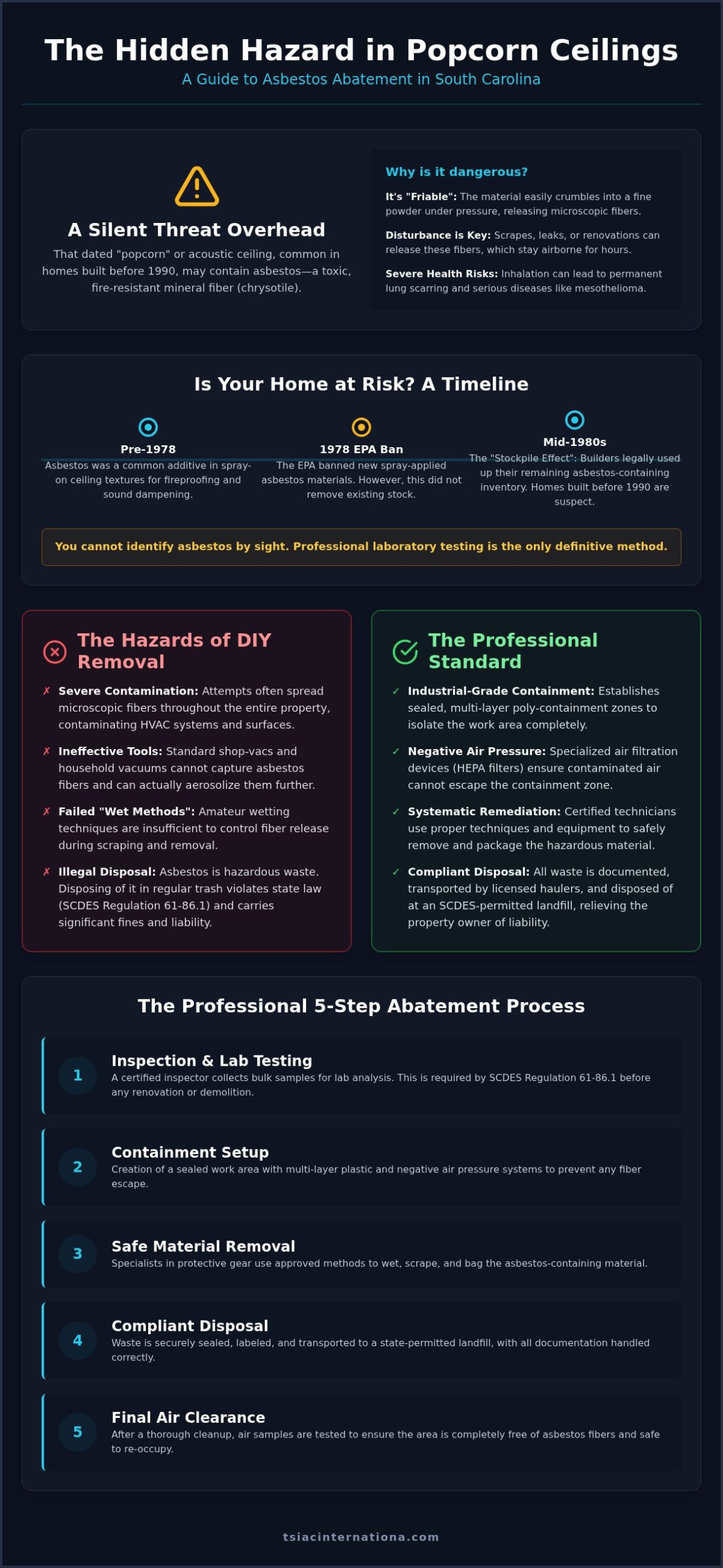
Popcorn ceilings, technically known as acoustic ceilings, served as a standard architectural finish for decades. Builders favored this spray-on texture because it efficiently masked imperfections in drywall and provided superior sound dampening. However, the primary additive in these mixtures was often chrysotile, a mineral fiber. To understand the risks, one must ask, What is Asbestos? It’s a naturally occurring silicate that is highly resistant to heat and chemicals, making it an ideal fireproofing agent for mid-century construction.

In residential settings, popcorn finishes are almost always categorized as “friable.” This means the material can be easily crumbled or reduced to powder by hand pressure. When these ceilings are disturbed, whether by a roof leak, a scrape from furniture, or an amateur renovation attempt, they release microscopic fibers into the environment. These fibers remain suspended in the air for hours. Inhalation leads to permanent lung scarring or more severe conditions like mesothelioma. This extreme health risk is why asbestos popcorn ceiling removal south carolina requires a methodical, containment-first approach rather than a simple cosmetic scraping.

The 1978 Ban and the “Stockpile” Reality

In 1978, the EPA enacted a ban on spray-applied asbestos-containing materials for architectural purposes. While this regulation stopped the production of new mixtures, it didn’t immediately clear the market. Many South Carolina homes built as late as the mid-1980s still contain these hazardous materials. Builders were legally permitted to use their existing inventory of texture products until supplies were exhausted, a phenomenon known as the “stockpile” effect. Consequently, the age of your property is a vital indicator, but it isn’t a guarantee of safety.

Identifying Risk: When to Suspect Asbestos

You cannot determine if a ceiling contains hazardous fibers simply by looking at it. The texture of a safe, non-asbestos ceiling and a dangerous one is virtually identical. Probability is largely tied to the age of the structure and the specific materials used during the original build. If your property was built before 1990, you should assume the material is hazardous until laboratory testing proves otherwise. This precaution is a foundational step in asbestos removal in South Carolina. Accurate identification through bulk sampling is the only way to avoid accidental exposure and ensure your project meets current environmental standards.

South Carolina Regulations and Asbestos Testing Requirements

South Carolina maintains stringent oversight regarding hazardous materials to protect public health and the local environment. As of 2026, the South Carolina Department of Environmental Services (SCDES) serves as the primary regulatory body, assuming the responsibilities previously held by DHEC. Under SCDES Regulation 61-86.1, a formal asbestos inspection is legally required before any renovation or demolition activities begin on a regulated property. You cannot determine the presence of hazardous fibers through a simple visual check. Because asbestos was often added to acoustic textures in varying concentrations, two ceilings in the same building might have different chemical compositions. Skipping the testing phase before starting asbestos popcorn ceiling removal south carolina projects isn’t just a safety risk; it’s a violation of state law that can result in significant fines.

Disposal is another area where the state exercises strict control. Asbestos waste cannot be discarded with standard household trash or at a typical construction and debris landfill. It must be transported by licensed personnel to an SCDES-permitted facility. If hazardous materials are improperly disposed of, the property owner remains legally liable for the environmental impact and the subsequent remediation costs. This liability underscores why professional oversight is essential for maintaining compliance with South Carolina environmental standards.

The Professional Testing Protocol

A certified building inspector follows a systematic process to identify hidden risks. They collect bulk samples from multiple areas of the ceiling to account for potential inconsistencies in the original material mixture. These samples are sent to a laboratory for Polarized Light Microscopy (PLM) analysis. This technique allows technicians to identify specific mineral fibers and determine their concentration. If the lab report indicates a concentration greater than 1% asbestos, the material is classified as Regulated Asbestos-Containing Material (RACM). This classification triggers a series of mandatory safety protocols, including specialized containment and air monitoring. Understanding the Hazards of DIY Asbestos Removal is vital here, as improper sampling by an untrained individual can release the very fibers the test is meant to identify.

Regulatory Compliance for Property Owners

Property owners must realize that the legal responsibility for hazardous waste doesn’t disappear once a contractor is hired. You are responsible for ensuring that all work performed on your site meets state and federal guidelines. For large-scale or commercial removals, a formal notification must be submitted to the SCDES at least 10 working days before work commences. For a deeper look at your responsibilities, review our guide on hazardous material abatement in South Carolina. Ensuring your project is fully documented protects you from future litigation and environmental claims. If you’re unsure about the current status of your property’s ceilings, consulting with a remediation specialist can help you establish a legally sound plan of action.

Evaluating the Hazards of DIY Popcorn Ceiling Removal

Treating a textured ceiling as a simple cosmetic upgrade is a dangerous miscalculation. Many property owners attempt asbestos popcorn ceiling removal south carolina as a weekend project, relying on the “wet method” to keep fibers grounded. This technique involves saturating the ceiling with water before scraping, but it rarely provides a 100% safety guarantee. Water often fails to penetrate the entire thickness of the material, leaving the core dry. When the scraper hits these dry pockets, it releases a cloud of microscopic dust that is invisible to the naked eye but lethal if inhaled.

The contamination risks extend far beyond the immediate work area. Using a standard household vacuum, even one labeled with a HEPA filter, often exacerbates the problem. Consumer-grade vacuums lack the airtight seals found in industrial equipment; they effectively act as “asbestos cannons,” sucking up large debris while exhausting microscopic fibers back into the room. These fibers then enter the HVAC system, distributing toxins throughout the entire property. Once the air ducts are contaminated, the cost of professional decontamination can far exceed the price of an initial expert abatement.

Financial and legal liabilities also present a significant hurdle for DIYers. South Carolina real estate laws require the disclosure of known environmental hazards during a sale. If you remove asbestos without a certified air clearance report, you create a “cloud” on the property’s history. Future buyers or home inspectors may demand a full forensic cleaning if they suspect an uncertified removal took place. This can lead to a drastic reduction in property value or even a total collapse of the sale due to the perceived risk of residual contamination.

The Inadequacy of Consumer-Grade PPE

Personal protective equipment (PPE) found at local hardware stores is generally insufficient for high-stakes hazardous material handling. N95 masks are designed for large particulates like sawdust, not the needle-like crystalline structures of asbestos. Without a fit-tested respirator, fibers easily bypass the seal around the nose and mouth. Additionally, amateur removers often track fibers into “clean” zones of the home via their clothing and hair. While a standard dust mask only filters large particulate matter, a P100 respirator is specifically engineered to block 99.97% of airborne particles, including microscopic asbestos fibers.

Professional vs. Amateur Cleanup Standards

Achieving a truly safe environment requires more than just a broom and a mop. Porous surfaces like carpets, upholstery, and even drywall can trap fibers permanently if they aren’t protected by industrial poly-containment. A room that looks “clean to the eye” can still harbor thousands of fibers per square inch. Professional teams use specialized surfactants and wet-wiping techniques that meet the strict criteria of South Carolina Regulation 61-86.1. Certified hazardous waste hauling ensures that the resulting sludge is tracked from the site to a permitted landfill, a level of accountability that DIY disposal cannot provide.
Asbestos Popcorn Ceiling Removal in South Carolina: The 2026 Safety Guide

The Professional Abatement Methodology for Textured Ceilings

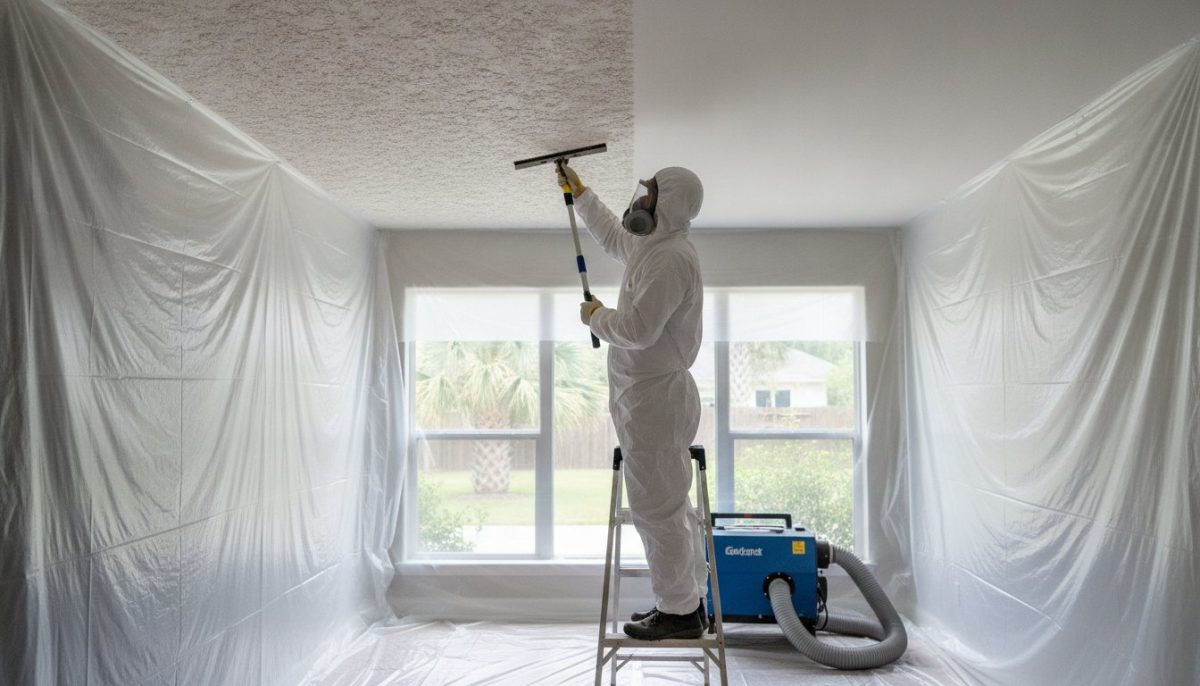
Professional abatement is an engineering project that requires methodical precision from the initial setup. Before any material is disturbed, technicians seal all HVAC supply and return vents with two layers of 6-mil polyethylene. This critical step prevents microscopic fibers from entering the building’s ventilation system. We then establish a multi-layer poly-containment zone, covering the floors and walls entirely. This creates a “room within a room” that isolates the work area from the living spaces. By treating the site as a controlled environment, we eliminate the risk of cross-contamination that often plagues amateur attempts at asbestos popcorn ceiling removal south carolina.

Negative air pressure is the cornerstone of our safety protocol. We deploy industrial HEPA air scrubbers that constantly pull air out of the containment zone, creating a vacuum effect. If a seal were to fail, air would rush into the work area rather than out of it. This ensures that any airborne particles remain trapped within the filtration system. The removal itself utilizes a specialized wet-scraping technique. Technicians apply an amended water solution containing surfactants, which penetrate the texture more effectively than standard water. Once the substrate is bare, we apply an encapsulant. This “lock-down” sealant traps any microscopic residual fibers, ensuring the surface is safe for future finishing.

Containment and Air Management

Airlocks, or decontamination chambers, serve as the only entry and exit points for the work zone. These multi-chambered systems allow workers to clean their protective equipment before leaving the regulated area. The HEPA filters in our air scrubbers are certified to capture 99.97% of particles as small as 0.3 microns. This level of technical precision is essential for maintaining air quality in both residential and commercial environments. It’s a standard that consumer-grade equipment simply cannot meet.

Final Clearance and Air Testing

A project is only considered complete once a third-party laboratory provides an air clearance report. Certified project monitors conduct a rigorous visual inspection to ensure no dust or debris remains. Following this, they collect air samples to verify that fiber counts are well below the SCDES-mandated thresholds. This documentation serves as a permanent record for your property’s history. It provides the necessary proof for future real estate disclosures that the hazard was remediated according to professional standards. If you’re ready to secure your property’s health and value, request a quote for professional asbestos abatement services today.

Choosing TSIAC International for Certified Asbestos Remediation

Selecting a partner for hazardous material remediation is a decision that directly impacts both your property’s structural integrity and its long-term safety. TSIAC International brings over 15 years of industry experience to every project, providing a level of technical oversight that general painting or renovation firms cannot replicate. While some contractors treat asbestos popcorn ceiling removal south carolina as a side service or a simple cosmetic scraping task, we approach it as a high-stakes environmental remediation project. Our team’s deep familiarity with the transition from DHEC to SCDES regulations ensures that your project remains in total compliance with the latest 2026 state mandates. We’ve built our reputation on the principle that technical precision and safety are non-negotiable when dealing with friable materials.

One of the primary advantages of partnering with our team is the transparency provided through our fixed-price contracts. In the abatement industry, “unforeseen circumstances” are often used as an excuse for sudden price hikes. We eliminate this uncertainty by conducting thorough initial assessments. Our comprehensive service model covers the entire lifecycle of the project. We handle everything from the initial poly-containment setup and HEPA air filtration to the final transportation of waste to a permitted facility. This all-in-one approach minimizes the logistical burden on property owners and ensures a single point of accountability for the safety of the work environment.

A Legacy of Safety and Reliability

Our specialized team is uniquely equipped to manage the complexities of both residential dwellings and large-scale commercial facilities. We don’t just remove hazardous textures; we integrate our abatement work with broader selective demolition and interior gutting services. This is particularly vital when asbestos popcorn ceiling removal south carolina projects are part of a larger renovation. We understand how to strip a space down to its structural bones without compromising the building’s integrity. For property owners planning extensive changes, understanding the demolition process in South Carolina is a critical first step. Our dual expertise in demolition and abatement allows us to move seamlessly from hazardous material removal to structural preparation, saving you time and reducing the risk of project delays.

Sustainability in Abatement

Environmental stewardship is a core pillar of our operational philosophy. Most abatement projects generate a significant amount of waste, but we’ve developed protocols to mitigate the impact on South Carolina landfills. We meticulously sort materials on-site, identifying wood, metal, and plastic that can be diverted to recycling facilities. By choosing a contractor that prioritizes material recycling, you’re supporting a more sustainable construction industry. This commitment to environmental responsibility doesn’t come at the expense of safety; it’s a reflection of our disciplined, professional approach to every site we manage. If you’re looking for a partner who values safety, transparency, and the environment, it’s time to take the next step. Contact TSIAC International for a professional abatement consultation and ensure your ceiling project is handled with industrial-grade precision.

Securing a Hazardous-Free Future for Your Property

Managing legacy hazardous materials requires more than a standard cosmetic renovation. It demands a rigorous commitment to technical precision and a comprehensive understanding of South Carolina’s environmental mandates. By prioritizing certified laboratory testing and professional containment, you eliminate the risk of invisible fiber release and protect your family’s long-term respiratory health. Professional asbestos popcorn ceiling removal south carolina ensures that your property remains a safe, compliant environment while meeting all strict legal disposal requirements for 2026.

TSIAC International brings over 15 years of specialized abatement experience to every project. We handle the entire lifecycle of remediation, offering DHEC-compliant hazardous waste disposal and full-service structural and selective demolition. Our methodological approach guarantees that your ceilings are stripped safely and prepared for a modern, high-quality finish. Don’t leave your property’s safety to chance or amateur methods. Secure your property with a professional asbestos abatement quote from TSIAC International. Taking the correct steps today prevents future legal liabilities and creates a healthy living space for the years to come.

Common Questions Regarding Asbestos Abatement

How do I know if my popcorn ceiling contains asbestos?

Laboratory analysis is the only definitive method to identify asbestos in textured finishes. You cannot determine the presence of hazardous fibers through a visual check, as the mineral additives are microscopic and mixed into the paint or plaster. A certified inspector must collect bulk samples from multiple areas of the ceiling and submit them for Polarized Light Microscopy (PLM) testing to confirm the asbestos concentration exceeds the 1% regulatory threshold.

Is it illegal to remove asbestos popcorn ceilings myself in South Carolina?

While South Carolina law generally allows owner-occupants of single-family homes to perform their own work, professional asbestos popcorn ceiling removal south carolina is the only way to ensure total compliance with SCDES safety standards. If you hire any outside labor, they must be state-licensed. DIY removal is strongly discouraged because it lacks industrial-grade containment, often leading to severe cross-contamination and the release of friable fibers into your home’s HVAC system.

Can I just paint over my popcorn ceiling to seal in the asbestos?

Painting over a textured ceiling is a form of encapsulation that can temporarily stabilize the fibers, but it isn’t a permanent solution. The extra weight of the paint can actually cause the texture to peel or pull away from the drywall, creating a new hazard. Additionally, any future electrical work or renovations will still require professional abatement. Painting makes the eventual removal process significantly more difficult and labor-intensive for remediation teams.

How long does the professional asbestos abatement process take?

The timeline for a professional project typically ranges from two to four days depending on the square footage and complexity. The first day is dedicated to establishing the multi-layer poly-containment zone and negative air pressure systems. Actual removal and encapsulation occur on the second day, followed by detailed cleaning. The final stage involves a mandatory waiting period for the air to settle before a third-party lab conducts clearance testing to verify safety.

What is the average cost of asbestos popcorn ceiling removal?

The total investment for remediation depends on several technical variables rather than a flat rate. Factors include the height of the ceilings, the total square footage, and the specific disposal fees at SCDES-permitted landfills. Projects involving high-reach areas or complex architectural features require more extensive containment and labor. A professional estimate after a site walk-through is necessary to provide an accurate fixed-price contract that covers everything from initial testing to final waste hauling.

Does removing popcorn ceilings increase my South Carolina property value?

Removing hazardous materials significantly enhances property value and marketability. Most modern buyers are wary of older homes with acoustic ceilings due to the associated health risks and future renovation costs. By completing a certified abatement, you provide prospective buyers with a clean air clearance report. This documentation removes a significant legal hurdle during the disclosure process and allows you to market the home with a modern, safe, and updated interior finish.

What happens to the asbestos waste after it is removed from my home?

Regulated waste is handled with extreme care to prevent any environmental release. Technicians place the wet debris into 6-mil polyethylene bags which are then double-sealed and labeled with hazardous material warnings. This waste is stored in a secure, leak-tight container until it’s transported to a landfill specifically permitted by the SCDES to accept asbestos. Every shipment is tracked with a waste shipment record to ensure the hazardous material is permanently and safely sequestered.

Do I need to move out of my house during the asbestos removal process?

It’s highly recommended to vacate the property during the active phase of asbestos popcorn ceiling removal south carolina. While the work area is strictly contained under negative pressure, the presence of airlocks and industrial machinery makes daily life in the home impractical. Vacating ensures that you and your family are not exposed to any noise or logistical disruptions. Most residents find it safest to return only after the final air clearance report is issued.
Acoustic Ceiling Removal Cost: The 2026 Comprehensive Pricing & Safety Guide

According to historical EPA assessments, approximately 10% of textured ceiling materials applied before 1990 contain asbestos fibers, a reality that…

According to historical EPA assessments, approximately 10% of textured ceiling materials applied before 1990 contain asbestos fibers, a reality that transforms a standard cosmetic update into a complex environmental safety operation. You likely recognize that removing these dated surfaces is the first step toward increasing property value, but the fear of hidden hazardous material fees often stalls necessary renovations. Determining a precise acoustic ceiling removal cost requires more than a simple calculation of square footage; it demands a disciplined evaluation of material composition and site conditions.

We promise to demystify the financial and technical aspects of this process by providing a clear framework for evaluating professional demolition quotes. You’ll gain a comprehensive understanding of current labor rates, the specific scenarios where asbestos testing is legally mandatory, and the logistical protocols that prevent property disruption. This guide details the 2026 pricing benchmarks and safety standards required to ensure your project stays under control from the initial inspection to the final surface preparation.

Key Takeaways

  • Learn how to accurately estimate the acoustic ceiling removal cost by analyzing 2026 price benchmarks and the multi-stage technical requirements of the demolition process.
  • Identify the significant financial and safety implications of asbestos abatement compared to standard removal, specifically for industrial and residential structures built before 1980.
  • Evaluate how project scale affects your budget, contrasting the economies of scale in commercial environments with the detailed labor requirements of residential spaces.
  • Recognize hidden cost drivers such as structural rot, mold remediation, and the complexities of working around integrated HVAC and electrical systems.
  • Understand the long-term value of professional abatement strategies in mitigating legal liabilities and preserving the structural integrity of your property.

Understanding the Variables of Acoustic Ceiling Removal Cost

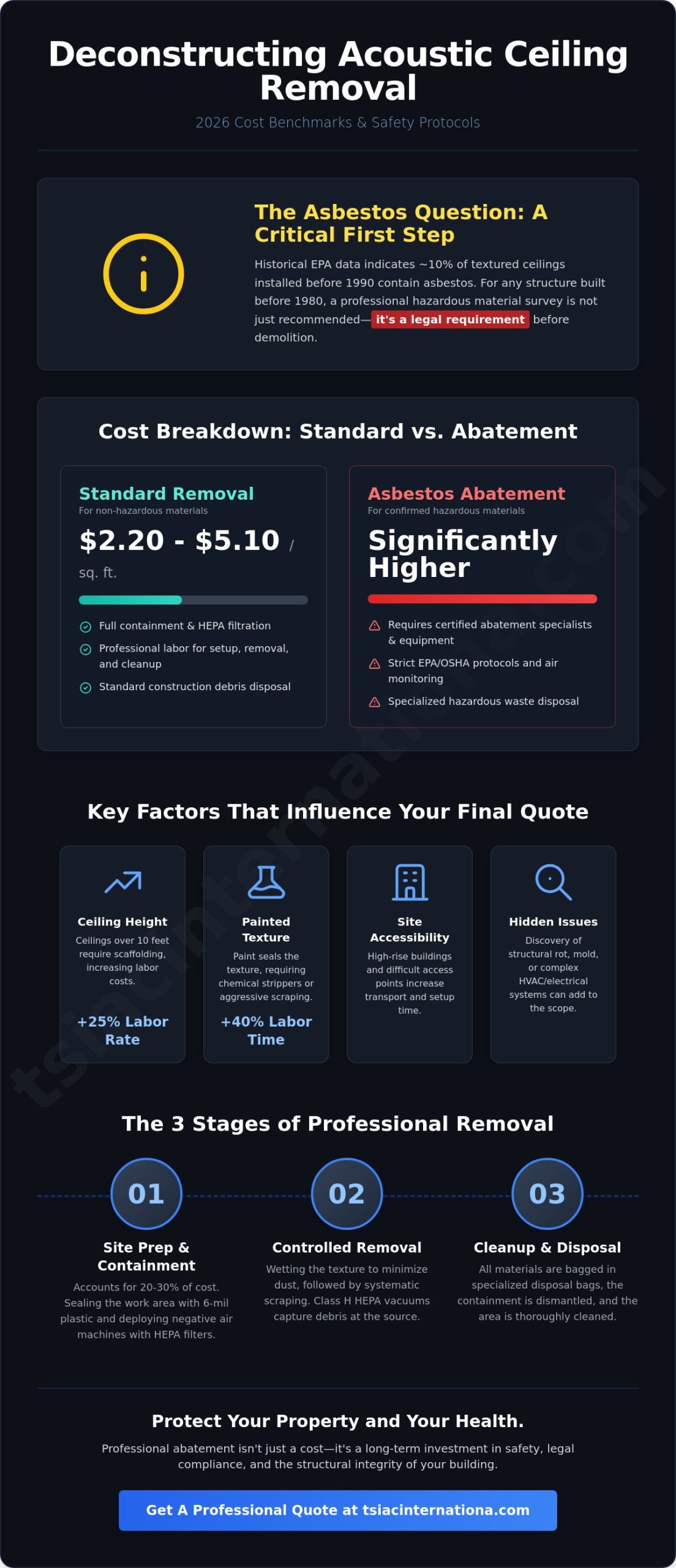
Acoustic ceiling removal is a multi-stage demolition process that requires technical precision and strict adherence to safety protocols. It isn’t a simple cosmetic update. The acoustic ceiling, often referred to as a popcorn ceiling, consists of a spray-on or paint-on treatment that was standard in construction for decades. In 2026, the national acoustic ceiling removal cost typically ranges from $2.20 to $5.10 per square foot for standard residential projects. These figures reflect the rising costs of specialized labor and the stringent disposal regulations for construction debris.

Professional abatement differs significantly from a basic “scrape and paint” approach. While a handyman might offer a lower price to simply wet and scrape the texture, this method often ignores the underlying risks of hazardous fibers. Professional teams implement full containment, utilizing negative air machines and HEPA filtration to maintain air quality. Site preparation accounts for roughly 20% to 30% of the initial cost estimate. This phase ensures that the surrounding environment remains uncontaminated and that the substrate is ready for a high-quality finish.

The Baseline: Labor and Material Requirements

Labor is the most significant component of the budget. A standard 150-square-foot room generally requires 6 to 9 labor hours for a two-person crew to complete the setup, removal, and initial cleanup. Specialized equipment costs include the rental or depreciation of Class H HEPA vacuums and industrial-grade scrapers. Protection materials are essential for property safety. Crews utilize 6-mil polyethylene sheeting to seal walls and floors, secured with high-tack painter’s tape to prevent moisture seepage into the subfloor or drywall.

  • Labor hours: 0.05 to 0.07 hours per square foot.
  • Equipment: HEPA filtration systems and pressurized sprayers.
  • Consumables: Plastic sheeting, tape, and specialized disposal bags.

Why Estimates Vary Across Different Property Types

Structural variables dictate the final acoustic ceiling removal cost. Single-story residential homes are straightforward, but multi-level commercial facilities present unique logistical hurdles. Ceilings exceeding 10 feet in height require scaffolding or aerial work platforms, which can increase labor rates by 25%. Accessibility to the site also plays a role; high-rise buildings involve longer transport times for waste removal, adding to the total project duration.

The existing finish of the ceiling is a critical factor. Unpainted acoustic textures absorb water easily, making them simpler to saturate and strip. If the ceiling has been painted, the texture becomes non-porous. This requires the use of chemical strippers or more aggressive mechanical scraping, which can increase labor time by 40%. Engineers and project managers must assess these surface conditions during the initial walkthrough to provide an accurate, fact-based quote that accounts for these technical challenges.

The Asbestos Impact: How Hazardous Material Abatement Shifts Your Budget

Buildings finalized before 1980 require mandatory hazardous material surveys before any disturbance occurs. This is a legal prerequisite, not an optional safety measure. If a laboratory confirms asbestos presence, the project scope shifts from a standard renovation to a high-risk abatement operation. This transition is the primary driver behind a fluctuating acoustic ceiling removal cost. The complexity of safely handling friable materials requires specialized labor and equipment that standard drywall contractors simply don’t possess. Engineering precision dictates that we treat every pre-1980 structure as a potential hazard until certified otherwise. Following EPA asbestos regulations protects both the structural integrity of the property and the health of its occupants.

Asbestos Testing and Inspection Fees

Professional inspectors typically charge between $400 and $900 for a comprehensive building survey, depending on the square footage and number of samples required. While DIY kits exist for under $60, they lack the chain-of-custody documentation required for commercial compliance or insurance validation. Lab results generally take 48 to 72 hours to process. This timeline must be factored into the project’s critical path to avoid idle labor costs. If the 2026 project schedule is tight, expedited 24-hour testing often carries a 50% premium. Accurate bulk sampling is the only way to confirm if the ceiling texture contains Chrysotile or Amosite fibers before work begins.

Specialized Abatement Containment Costs

Safe removal demands a sealed environment to prevent cross-contamination. Technicians must establish a negative air pressure zone using industrial HEPA filtration units that cycle the air at least four times per hour. The cost of materials increases when accounting for 6-mil poly sheeting used for double-layer floor and wall protection. Every crew member requires specialized PPE, including P100 respirators and disposable Tyvek suits. Hazardous waste disposal fees are separate from labor. These fees cover the transport to licensed landfills capable of accepting hazardous materials in accordance with NESHAP standards. For those managing complex industrial solutions, these safety protocols are non-negotiable components of the budget. Double-bagging waste in 6-mil bags and using a three-stage decontamination unit ensures that zero fibers escape the work zone during the acoustic ceiling removal cost calculation.

Acoustic Ceiling Removal Cost: The 2026 Comprehensive Pricing & Safety Guide

Square Footage and Structural Scale: Estimating Commercial vs. Residential Projects

Project scale serves as the primary driver for the acoustic ceiling removal cost. While total square footage determines the bulk of the material volume, the logistical complexity varies significantly between residential and commercial environments. Large-scale industrial projects often benefit from economies of scale. When a crew mobilizes for a 10,000-square-foot warehouse, the fixed costs for setup, containment, and equipment are spread across a larger area. This often reduces the per-square-foot rate compared to smaller jobs. Conversely, residential projects involve smaller footprints that require high-precision detail work and frequent repositioning of protective barriers.

Selective demolition plays a critical role in the final project invoice. This process involves the surgical removal of specific ceiling components while preserving the surrounding structural integrity. In commercial settings, this often means working around HVAC ducts, fire suppression systems, and complex electrical grids. Precision here prevents collateral damage that could otherwise inflate the project budget by 15% to 25% due to unplanned repairs. It’s a calculated approach where every cut is planned to protect the building’s core assets.

Residential Pricing Models and Room Minimums

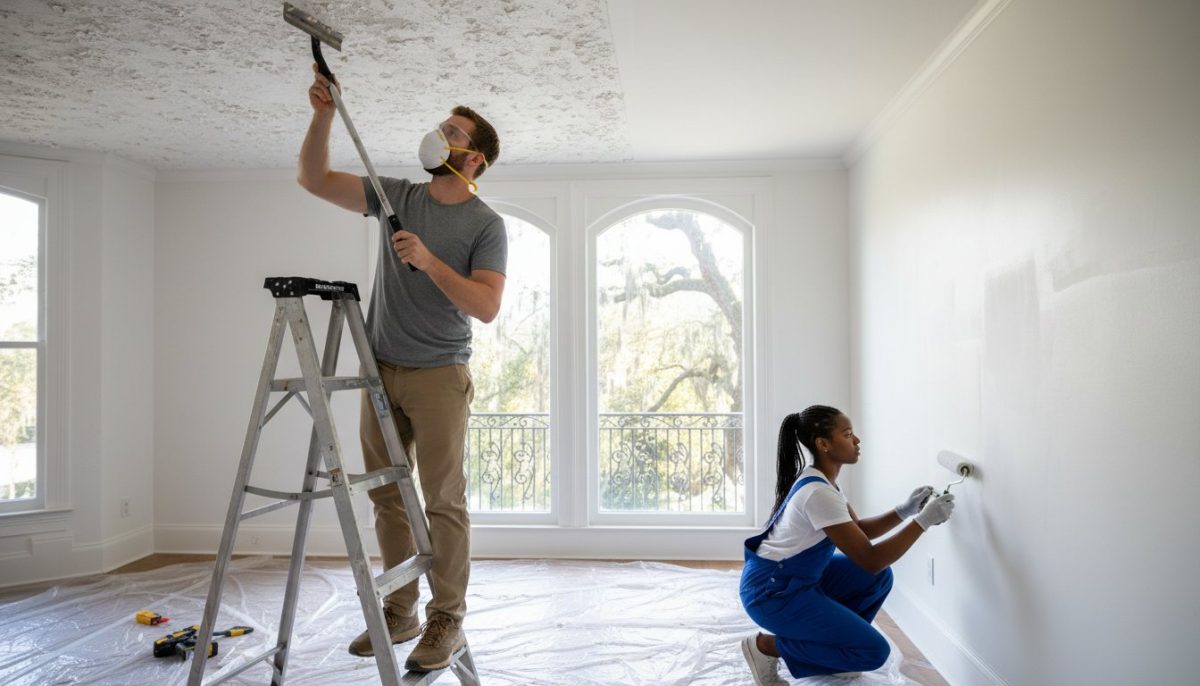
Most specialized contractors implement a minimum call-out fee for residential jobs. Even if you’re only stripping a small 120-square-foot bedroom, the labor involved in site preparation and disposal remains constant. Vaulted or cathedral ceilings introduce a labor multiplier. Working at heights above 10 feet requires specialized scaffolding and increases safety risks. Beyond the removal itself, homeowners must account for post-removal drywall finishing. Scraping the texture often reveals imperfections in the substrate. These flaws require “level 5” finishing and professional painting to achieve a modern aesthetic. It’s not just about what you take away, but the quality of the surface left behind.

Safety remains the non-negotiable priority during these interventions. Before any scraping begins, testing for hazardous materials is mandatory. Understanding the health risks of asbestos is vital for anyone living in homes built before the late 1980s. Professional mitigation ensures these microscopic fibers don’t contaminate the living space, protecting both the residents and the technicians on-site.

Commercial and Industrial Ceiling Removal

In the commercial sector, ceiling removal is rarely a standalone task. It’s frequently integrated into commercial interior gutting services as part of a total renovation. This integration allows for more efficient debris management. Wood and metal components are separated on-site to facilitate recycling and reduce landfill fees. Many businesses require work to be performed during off-hours to avoid operational downtime. While night-shift labor often carries a 20% to 30% premium, it’s a strategic investment that prevents revenue loss during business hours. A disciplined approach to logistics ensures the project stays on schedule and within the engineered budget.

Beyond the Scrape: Hidden Factors That Influence Your Final Quote

Calculating an accurate acoustic ceiling removal cost requires looking past the surface texture. Structural variables often dictate the final invoice more than the square footage itself. If a 2025 site inspection reveals historical water damage or structural rot, the scope of work shifts from simple abatement to complex restoration. Mold remediation alone can increase the labor budget by 25% or more, as specialized containment protocols and HEPA filtration systems become mandatory under modern safety regulations.

Mechanical integration presents another layer of technical complexity. Technicians must navigate HVAC vents, recessed lighting, and fire suppression systems during the scraping process. Improper handling of these fixtures risks expensive utility damage or system failures. High-liability contractors include comprehensive insurance and bonding in their quotes to protect your assets. This coverage ensures that any accidental disruption to the building’s electrical or structural grid is fully mitigated without additional financial burden on the property owner.

Disposal logistics are frequently overlooked by property owners. Landfill tipping fees for construction debris have seen a 12% increase in several regions since 2024 due to stricter environmental mandates. Proper recycling of acoustic materials requires specific hauling permits and designated waste streams. Our team manages these logistics to ensure every cubic yard of waste is processed according to current environmental standards.

Repairing the Substrate After Removal

Once the texture is gone, the underlying drywall or plaster often shows its age. You’ll likely find gouges, tape failures, or uneven joints that were previously hidden. Achieving a modern, smooth finish requires professional skim coating, which involves applying multiple thin layers of joint compound to reach a Level 5 finish. For a deeper look at how structural integrity is maintained during these transitions, review our guide on the demolition process.

Logistics and Site Accessibility

Urban projects face unique hurdles that influence the overall acoustic ceiling removal cost. Parking permits and dumpster placement fees in dense city centers often add several hundred dollars to the project total. In high-rise environments, limited elevator access or strict stairwell usage policies extend the project timeline, directly impacting labor hours. Mobilization costs also fluctuate based on site distance; remote locations require additional fuel and transit time surcharges for specialized equipment transport and crew logistics.

Contact the experts at TSIA C International to secure a precise technical assessment for your specialized ceiling project.

Professional Abatement Strategies: Ensuring Safety and Long-Term Value

Attempting DIY removal of textured ceilings often results in catastrophic health consequences and severe legal entanglements. In 2026, the EPA and local South Carolina authorities have tightened oversight on residential and commercial renovations. Property owners face strict liability if hazardous fibers are released into the air without industrial-grade containment. Beyond the immediate health risks, professional remediation directly impacts the financial performance of an asset. Real estate data from 2025 indicates that properties with certified asbestos-free interiors sell up to 7% faster than those with unmanaged materials. When calculating the total acoustic ceiling removal cost, you’re investing in a documented safety trail that protects your property’s marketability.

Professional contractors prioritize environmental stewardship by diverting waste from landfills through rigorous sorting processes. We separate wood, metal, and plastic components for specialized recycling facilities, which reduces the carbon footprint of a renovation by approximately 35%. This systematic approach ensures that the acoustic ceiling removal cost reflects a commitment to both safety and ecological standards. You should prioritize firms with a minimum of 15 years in technical abatement. This level of experience ensures that every protocol is executed with engineering precision, especially in complex environments where high-altitude work or intricate structural details are present.

  • Elimination of cross-contamination risks through negative air pressure systems.
  • Protection against future litigation and property transfer delays.
  • Enhanced indoor air quality through HEPA-filtered vacuuming and wet-stripping techniques.
  • Documented disposal at licensed hazardous waste facilities.

Evaluating Contractor Credentials

Verification is the cornerstone of a successful project. You must confirm that your team holds current asbestos removal certifications and maintains comprehensive liability insurance. A qualified contractor manages lead-based paint and mold remediation simultaneously to prevent project bottlenecks. High-tier firms implement advanced recycling practices on demolition sites, ensuring that 80% or more of non-hazardous debris is repurposed rather than discarded. Don’t settle for verbal promises; demand to see a valid license and a track record of at least 150 successful abatement projects.

Next Steps: Securing an Accurate Project Quote

A “ballpark estimate” often fails to account for structural complexities or hidden contamination. For a fixed-price contract, you’ll need to provide site access for a formal bid. This inspection evaluates ceiling height, material density, and necessary containment barriers. A formal site bid eliminates the risk of 25% cost overruns that often plague poorly planned projects. To finalize your budget and protect your investment, contact TSIAC International for expert hazardous material abatement. Our team provides the technical precision required for high-stakes environmental projects.

Secure Your Environment with Engineering Precision

Navigating the complexities of acoustic ceiling removal cost requires more than a simple square footage calculation. It demands a rigorous assessment of environmental risks, especially since the EPA reports that asbestos remained common in construction materials throughout the late 1970s. Whether you’re managing a 50,000 square foot industrial facility or a smaller residential renovation, the safety of your site depends on precise containment protocols and verified disposal methods. We’ve seen how hidden variables like ceiling height and structural accessibility can shift a budget if they aren’t identified during the initial survey.

TSIA C International brings over 15 years of industry experience to every demolition project. We specialize in hazardous material containment and maintain a strict commitment to job site recycling and safety standards. Our team provides the technical control needed to handle “impossible locations” where standard contractors often fail. You’ll receive a transparent roadmap for your project that prioritizes both long term value and regulatory compliance. Get a Professional Quote for Your Demolition Project and ensure your renovation starts on a stable, safe foundation. We’re ready to help you transform your space with professional confidence.

Frequently Asked Questions

Is it cheaper to remove a popcorn ceiling or cover it with drywall?

Removing the texture is more cost-effective than covering it with new drywall layers. Industry data from 2024 indicates that professional scraping costs between $1 and $3 per square foot. Adding a second layer of drywall increases structural load and reduces vertical clearance by approximately 0.5 inches. This method also requires extensive taping and mudding, which often doubles the labor hours compared to a standard removal process.

How much does asbestos testing cost before starting a ceiling project?

Professional asbestos testing typically ranges from $250 to $750 according to EPA-certified laboratory standards. This fee covers the initial site inspection, physical sample collection, and polarized light microscopy analysis. Accurate testing is a mandatory safety protocol before determining the final acoustic ceiling removal cost for any structure built before 1980. We don’t recommend proceeding without a certified lab report to ensure technician and resident safety.

Can I stay in my home during the acoustic ceiling removal process?

Residents must vacate the property during the active scraping and decontamination phases to prevent respiratory exposure. The EPA mandates strict containment protocols because microscopic dust particulates can remain airborne for up to 48 hours after the work finishes. Professional crews use HEPA-filtered air scrubbers to achieve a clean air rating before it’s safe for families to return. We prioritize these technical safety measures to protect the integrity of your living space.

How long does it take to remove 1,000 square feet of acoustic ceiling?

A professional team of three technicians typically completes a 1,000 square foot project in 2 to 3 business days. This schedule accounts for site preparation, material saturation, mechanical scraping, and final substrate cleaning. If the project involves vaulted ceilings or heights exceeding 10 feet, the timeline may increase by 20% due to the necessary scaffolding and specialized safety equipment. Efficiency is maintained through disciplined project management and technical precision.

Does removing an acoustic ceiling increase my property value?

Removing an outdated acoustic texture can increase a property’s market value by 2.5% to 5% based on 2024 real estate trends. Modern buyers prefer smooth, contemporary finishes and often discount offers if they suspect legacy materials like asbestos are present. By investing in professional remediation, you provide documented proof of a safe environment. This transparency simplifies the appraisal process and accelerates the sale of the asset.

What happens if asbestos is found during the removal process?

If laboratory results confirm asbestos, the project transitions into a specialized abatement protocol regulated by OSHA standards. Technicians must establish a negative pressure environment and use wet-stripping techniques to keep fibers from becoming friable. This shift in technical requirements is a critical factor in the total acoustic ceiling removal cost. We manage these complexities with engineering precision to ensure the site meets all environmental safety regulations before work resumes.

Are there specific disposal fees for acoustic ceiling debris?

Disposal fees for ceiling debris are determined by local municipal regulations and the material’s hazardous status. Specialized landfills often charge between $50 and $150 per ton for materials containing regulated fibers. All debris must be double-bagged in 6-mil polyethylene bags and transported by licensed haulers. These costs ensure that the waste is managed in a way that doesn’t create long-term environmental liabilities for the property owner.

Does the 2026 cost of removal include the cost of repainting?

The standard removal price typically covers the labor for scraping and basic sanding but doesn’t include the final painting. Homeowners should expect the priming and painting phase to add approximately 30% to the total project budget. This finishing work is essential for protecting the exposed drywall and achieving a high-quality aesthetic result. It’s important to review the contract’s line items to confirm exactly which technical services are included in the scope.