Did you know that approximately 42% of commercial structures built before 1978 still harbor legacy hazardous materials within their textured finishes? It’s a sobering reality for any facility manager or property owner. You likely recognize that a standard renovation isn’t enough when safety and legal compliance are on the line. The fear of asbestos exposure is valid, and the logistical nightmare of managing extreme debris during a complex commercial kitchen demolition charleston sc project can stall even the most well-planned modernization.
This guide delivers the technical protocols you need to navigate these high-stakes environments safely and efficiently. You’ll learn how to secure a compliant renovation while ensuring full hazardous material clearance and documentation. We’ll detail the 2026 regulatory landscape, from mandatory notifications to relevant national regulatory agencies to the precise engineering controls required for containment. We’ll also explore how disciplined waste management and material recycling turn a hazardous site into a clean, smooth substrate ready for its next phase of life. TSIAC International’s methodical approach ensures that your project meets every safety standard without unnecessary site disruption.
Key Takeaways
- Understand why buildings constructed after the 1978 ban may still harbor hazardous asbestos or lead within legacy acoustic textures.
- Learn how specialized abatement protocols integrate with commercial kitchen demolition charleston sc to ensure full regulatory compliance and documented clearance.
- Master the professional removal sequence, from comprehensive site containment and vent sealing to controlled wetting techniques that eliminate airborne particulates.
- Evaluate the logistical and financial risks of DIY scraping compared to professional methods that utilize industrial-grade HEPA filtration and specialized PPE.
- Explore the transition from surface-level ceiling removal to full interior gutting and the benefits of sustainable recycling for wood, metal, and plastic materials.
What is Acoustic Ceiling Removal and Why is it Necessary?
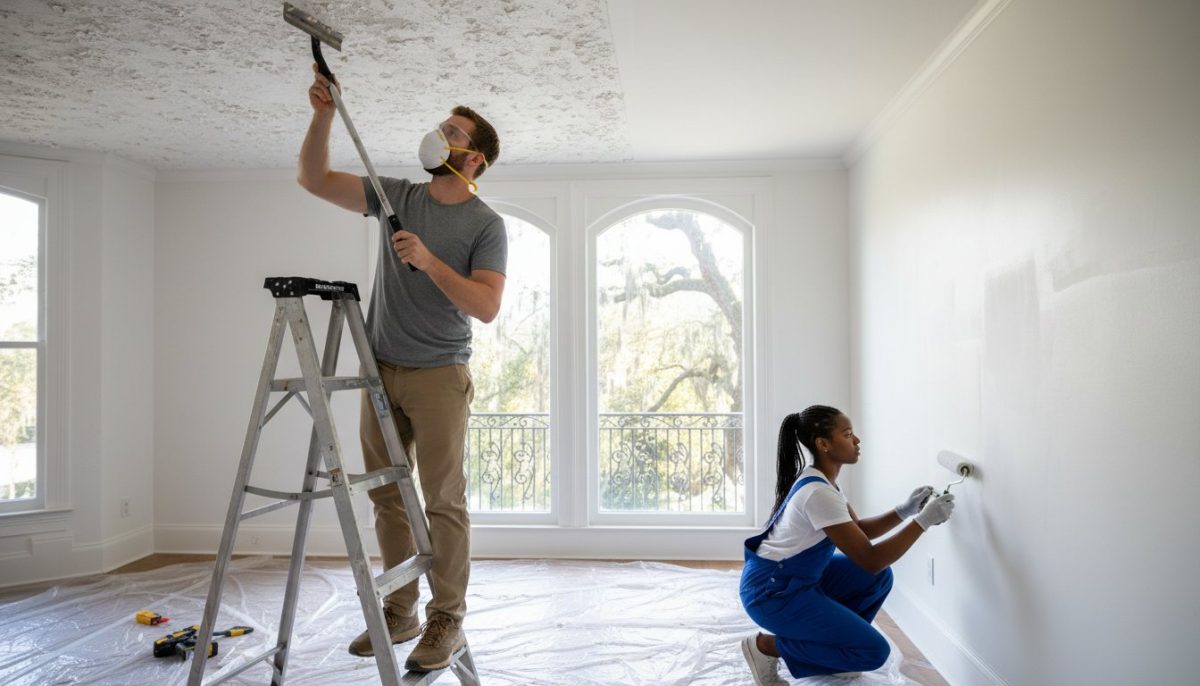
Acoustic ceilings, frequently identified by their spray-on or paint-on friable textures, represent a specific era of construction engineering focused on sound attenuation. These materials were designed to dampen ambient noise by increasing the surface area of the ceiling through complex, irregular patterns. The history of acoustic ceilings shows their rise to prominence in the mid-20th century, primarily because they offered a cost-effective method for masking structural imperfections and drywall finishing flaws. While these textures provided a quick solution for builders, they’ve become a significant technical liability in modern commercial environments.
The decision to remove these textures is rarely based on aesthetics alone. In professional settings, these surfaces act as massive filters that trap environmental allergens, dust, and microscopic particulates. When managing a commercial kitchen demolition charleston sc, the removal of legacy textures is a critical step in ensuring food safety and air quality. These porous materials absorb airborne grease and moisture, creating a breeding ground for bacteria that no standard cleaning protocol can reach. Stripping these layers back to the structural substrate is the only way to guarantee a truly sanitary environment.
The Aesthetic and Functional Shift
Modern interior design has moved decisively toward smooth, clean lines that support high-efficiency lighting and open spatial concepts. Textured ceilings create millions of micro-shadows, which significantly reduce the “bounce” of light and make rooms feel smaller and dimmer. Furthermore, acoustic textures are nearly impossible to match or repair during selective demolition. If a wall is moved or a utility line is serviced, the resulting patch is always visible. Removing the texture creates a uniform surface that allows for flexible modernization and improved lighting efficiency across the entire floor plan.
Maintenance and Longevity Issues
The inherent fragility of acoustic textures leads to inevitable material degradation over time. High-traffic commercial spaces often suffer from “ceiling flake,” where the bond between the texture and the drywall fails, causing debris to rain down on equipment and personnel. This isn’t just a maintenance nuisance; it can damage sensitive HVAC systems and contaminate products. Cleaning these surfaces is technically impossible, as any friction or moisture application often triggers further shedding. Professional removal replaces this unstable material with a durable, paintable surface that can be sanitized and maintained for decades without the risk of particulate release.
Identifying Hazards: Asbestos and Lead in Acoustic Textures
Identifying the presence of hazardous substances is the most critical phase of any technical renovation. Asbestos was historically integrated into acoustic sprays because of its superior fireproofing and sound-dampening properties. These mineral fibers provided structural reinforcement to the spray-on texture, but they created a legacy of risk for modern property owners. Any asbestos-containing material becomes a severe health threat when it reaches a friable state, meaning it can be easily crumbled or reduced to powder by hand pressure.
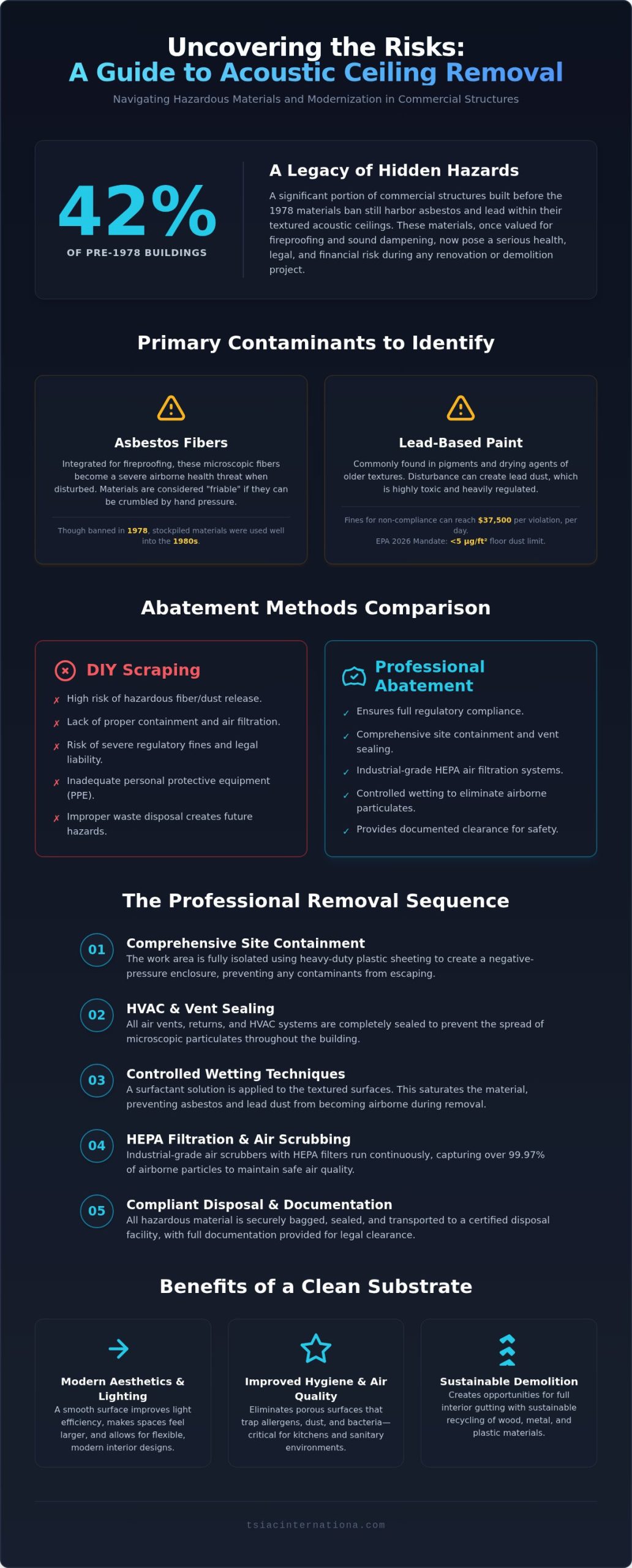
While federal regulations restricted the manufacture of these materials in 1978, the ban didn’t apply to existing inventories. Builders continued to use stockpiled acoustic textures well into the 1980s. Statistics indicate that approximately 42% of pre-1978 structures in the local peninsula contain legacy hazardous materials. This makes it unsafe to assume a building is “clean” based solely on its construction date. During a commercial kitchen demolition charleston sc, the mechanical vibration from removing equipment or walls can easily dislodge these microscopic fibers, allowing them to remain suspended in the air for days.
Lead-based paint additives also present a significant challenge. Vintage acoustic textures often contain lead pigments or drying agents that were standard in commercial applications. The 2026 EPA mandates a strict 5 µg/ft² floor dust limit for lead, and failing to meet this standard during a renovation can result in catastrophic legal and financial consequences. Fines for mishandling lead-based materials can reach up to $37,500 per violation, per day.
The Importance of Professional Testing
Visual inspection is technically impossible for identifying hazardous particulates. Professional laboratory bulk sampling is the only reliable method to confirm the presence of asbestos or lead. This testing process must be integrated into the broader hazardous material abatement phase of your project. By identifying specific fiber counts and lead concentrations before work begins, we can establish the necessary engineering controls to prevent cross-contamination.
Regulatory Compliance and Safety Standards
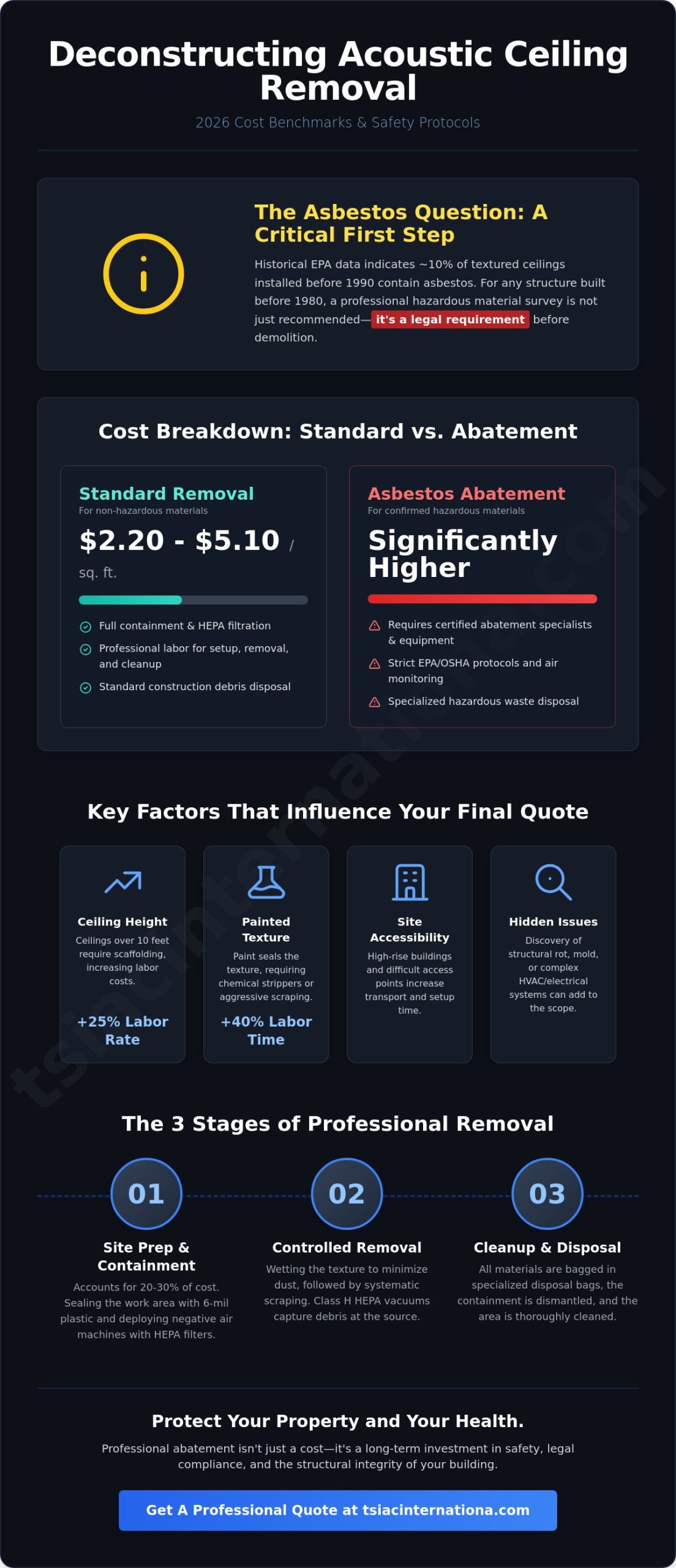
Adhering to 2026 OSHA and SCDES protocols is not optional for commercial entities. Legal requirements demand full disclosure of hazardous materials and a documented remediation plan before any structural permits are issued. TSIAC ensures total compliance by providing detailed safety reporting and air clearance documentation at every stage. If you’re planning a major renovation, you can consult with our abatement specialists to ensure your site meets all current safety benchmarks.
Professional Abatement vs. DIY Ceiling Removal
The physical toll of manual ceiling scraping is often underestimated by property owners. While DIY methods appear cost-effective initially, the environmental mess and logistical burden quickly outweigh any perceived savings. In a technical environment, such as a commercial kitchen demolition charleston sc, the risk of improper handling is amplified by the presence of complex utility lines and heavy equipment. Professional abatement ensures that every square inch of the site is managed with surgical precision, preventing the catastrophic spread of dust that characterizes amateur attempts. Scraping textured surfaces without proper containment isn’t just difficult; it’s a liability that can compromise the entire facility’s safety.
Hidden costs represent the most significant deterrent for the DIY approach. Effective removal requires industrial-grade HEPA vacuums, specialized personal protective equipment (PPE), and strict adherence to hazardous waste disposal fees. Property owners also face immense legal risks when handling regulated materials without certification. Utilizing specialized asbestos removal services provides a legal shield, ensuring that all hazardous waste is tracked from the point of origin to the final disposal site with full documentation. This paper trail is essential for future property transactions and insurance compliance.
Containment and Cross-Contamination Risks
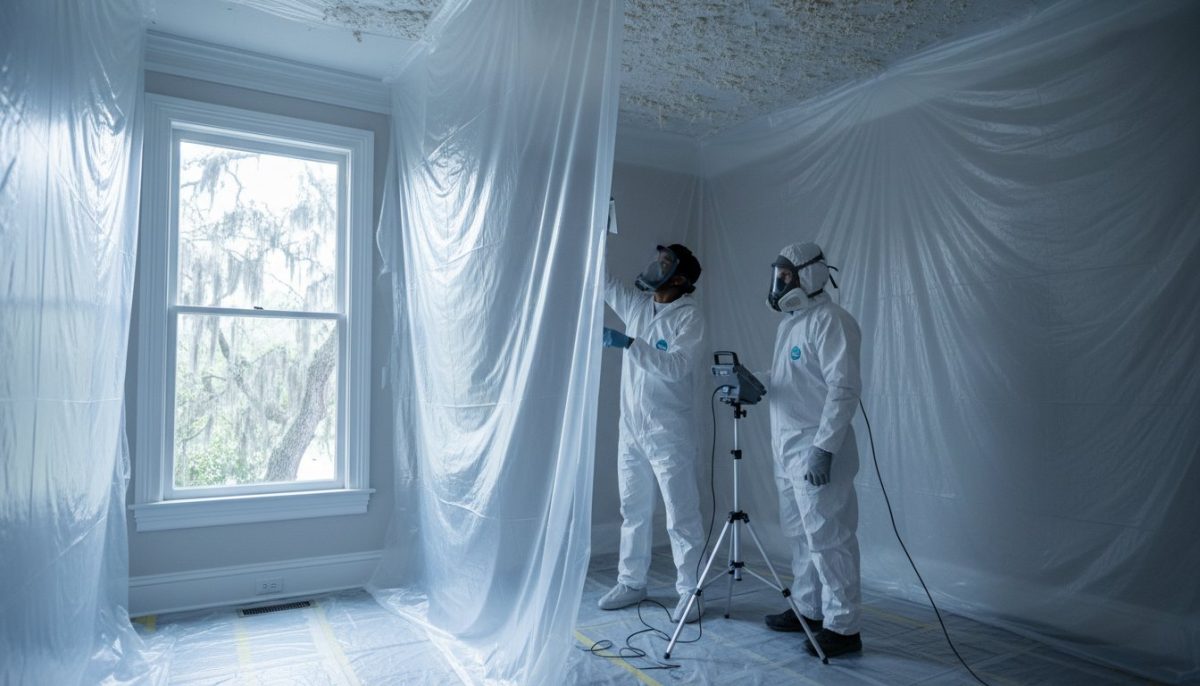
Professional teams implement advanced containment protocols using heavy-duty poly-sheeting and negative air pressure systems. This setup prevents microscopic fibers from migrating into HVAC ductwork or adjacent rooms. A common DIY failure is the use of standard household vacuums; these machines lack the filtration capacity to trap asbestos or lead dust. Instead, they exhaust the particles back into the air, contaminating the entire facility. Technical containment is the only way to avoid long-term health liabilities and expensive post-project decontamination. Our methodical approach ensures that the work area remains isolated, protecting both the workers and the building’s permanent occupants.
Speed and Efficiency for Large Projects
With over 15 years of industry experience, TSIAC streamlines the selective demolition process to minimize downtime. Scaling a removal project for an industrial facility or office building requires a disciplined workflow that DIY methods cannot replicate. We prioritize Reusing and recycling construction and demolition (C&D) materials, which reduces landfill tipping fees and supports environmental sustainability goals. Our crews focus on the recovery of wood, metal, and plastic on every site we manage. Fixed-price contracts provide commercial clients with budgetary certainty, covering everything from initial containment to total debris management. This methodical approach ensures the project stays on schedule while maintaining the highest safety benchmarks.
The Step-by-Step Professional Removal Process
Professional acoustic ceiling removal follows a rigid methodological sequence designed to eliminate environmental risk. Unlike cosmetic scraping, this technical process prioritizes the containment of particulates at the source. It starts with a comprehensive site assessment to identify utility locations and structural vulnerabilities. This disciplined approach ensures that the project remains under total control, preventing the chaotic debris field often associated with amateur removal attempts. Every phase of the operation is documented to provide a clear record of safety compliance and procedural accuracy.
Site Preparation and Protection
Technicians begin by sealing all HVAC vents, registers, and returns with industrial-grade polyethylene sheeting. This critical step prevents hazardous fibers from entering the building’s climate control system. Floors and adjacent walls are double-layered with 6-mil plastic to create a seamless basin for debris collection. During a commercial kitchen demolition charleston sc, this protection extends to fixed equipment, drainage systems, and sensitive utility connections. We establish dedicated decontamination zones where technicians undergo a multi-stage cleaning process. This protocol ensures that no microscopic dust is tracked into clean zones of the facility, maintaining the integrity of the surrounding environment.
Removal and Surface Refinement
The actual removal utilizes controlled wetting techniques. We apply an amended water solution to the texture, which saturates the material and keeps fibers from becoming airborne. Dry scraping is strictly avoided in abatement scenarios because it maximizes dust dispersion. Technicians use specialized scraping tools to strip the material down to the original drywall or plaster substrate. High-efficiency HEPA vacuums capture any residual moisture and fine particulates immediately upon release. This level of substrate preparation is foundational for high-performance finishes often required after a commercial kitchen demolition charleston sc.
Once the texture is removed, the substrate undergoes a detailed cleaning and refinement phase. We ensure the surface is free of adhesive residues and ready for modernization, such as new drywall finishing or painting. The process concludes with post-removal air quality testing conducted by an independent third party. This provides a professional clearance certification, confirming the area is safe for re-occupancy. All collected debris is sealed in regulated containers and transported for legal disposal or recycling of wood, metal, and plastic components. This commitment to sustainable waste management reduces environmental impact while ensuring full regulatory compliance.
If your facility requires this level of technical precision and documented safety, contact our demolition specialists to schedule a site walkthrough.
Beyond the Surface: Interior Gutting and Material Recycling
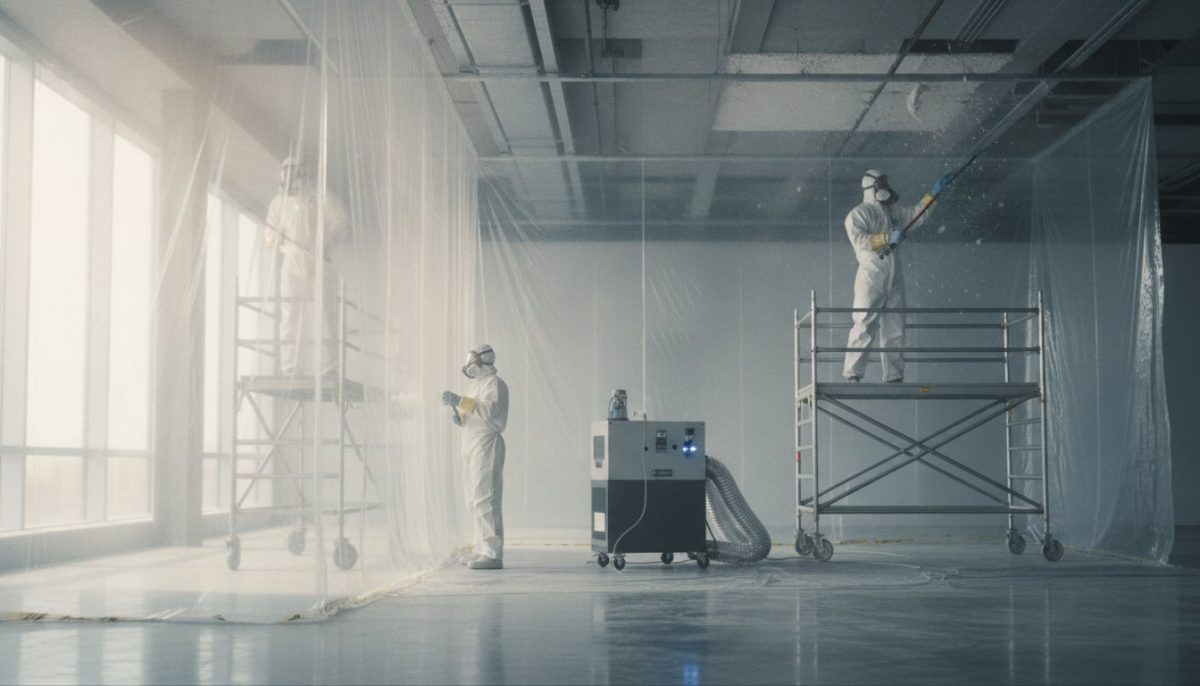
Acoustic ceiling removal is rarely an isolated task in professional renovations. It often serves as the initial phase of a more comprehensive commercial interior gutting project. Transitioning from surface remediation to a full interior strip-out allows property owners to reset their facility to its structural shell. This deep-clearing process is essential for modernizing outdated layouts and ensuring that every legacy hazard is permanently removed. By stripping a building down to its structural studs, we provide a blank canvas that meets 2026 engineering and safety standards.
Selective demolition requires a disciplined touch to preserve the building’s structural integrity. During a complex commercial kitchen demolition charleston sc, our crews focus on the methodical removal of non-structural elements while protecting the primary skeleton of the facility. This approach prevents unnecessary damage to load-bearing components and utility mains. Our 15+ years of industry experience allows us to navigate these sensitive environments with the technical precision needed to clear the site without compromising the building’s future stability.
Strategic Interior Gut-Outs
Coordinating the removal of textured ceilings with the stripping of walls and floors creates a more efficient workflow. When we manage the demolition of metal framing and drywall simultaneously, we reduce the total project timeline and minimize site disruption. This integrated strategy is particularly beneficial for tenant improvements where new layouts require a complete overhaul of the existing footprint. We prepare the space for modernization by clearing away all debris and ensuring the structural substrate is clean and ready for immediate reconstruction. This level of preparation is what separates a professional gut-out from a standard demolition job.
Environmental Responsibility and Debris Management
Our commitment to sustainability is reflected in our rigorous on-site sorting protocols. We don’t view demolition debris as simple waste; instead, we treat it as a source of recoverable materials. TSIAC prioritizes the recycling of wood, metal, and plastic on every project we manage. By separating these materials at the point of removal, we significantly reduce the volume of waste sent to landfills. This disciplined approach to debris management supports the environmental goals of modern developers and helps lower overall project costs by reducing tipping fees.
Recovering metal framing and clean wood components has a measurable impact on the sustainability profile of a commercial renovation. Our crews are trained to identify and sort recyclable materials during the gutting phase, ensuring that every project contributes to a circular construction economy. This methodical disposal practice reflects our dedication to technical excellence and environmental stewardship. When you choose a partner who values material recovery, you ensure that your renovation is as responsible as it is thorough.
Securing Your Facility’s Future with Technical Precision
Managing legacy hazardous materials requires a disciplined methodology that amateur approaches can’t replicate. You’ve learned that identifying asbestos and lead through laboratory testing is the only way to ensure 2026 regulatory compliance. By implementing professional containment and controlled wetting techniques, you eliminate the risk of airborne fiber migration. These protocols don’t just protect your personnel; they preserve the long-term value of your property and ensure a seamless transition to modernization.
Whether you’re initiating a commercial kitchen demolition charleston sc or a full floor gut-out, achieving a clean substrate is the foundation of any successful renovation. TSIAC International brings over 15 years of specialized remediation experience to every site. Our certified asbestos and lead abatement experts manage the entire lifecycle of your project, from initial sampling to comprehensive on-site material recycling protocols for wood, metal, and plastic.
Don’t let legacy hazards stall your renovation progress or create legal liabilities. Contact TSIAC International for a Professional Abatement Quote to secure a compliant, debris-free environment for your next phase of construction. We’re ready to help you build on a safe and sustainable foundation.
Frequently Asked Questions
Does all acoustic ceiling material contain asbestos?
No, not all acoustic textures contain asbestos, but visual identification is technically impossible. Materials manufactured before 1978 frequently utilized asbestos for its fire-retardant properties, and stockpiled inventory was used well into the 1980s. Statistics show that approximately 42% of older structures in the local peninsula harbor these hazardous materials. We treat all textured surfaces as presumptive asbestos-containing material until laboratory bulk sampling provides a definitive negative result.
How long does the professional acoustic ceiling removal process take?
The duration of the removal process depends on the total square footage and the complexity of the containment required. A standard commercial project typically spans three to five business days. This timeline includes one day for site preparation and poly-sheeting, followed by the technical removal and a final phase for HEPA cleaning and air clearance testing. Complex environments like a commercial kitchen demolition charleston sc may require additional time for utility protection.
Is it safe to stay in the building during the removal process?
It’s not safe to remain in the immediate work zone during the abatement process. While our technicians utilize negative air pressure systems and 6-mil poly-sheeting to isolate the area, the risk of accidental exposure is too high for unprotected occupants. We establish strict containment boundaries and decontamination chambers. Once the final air clearance documentation is issued by a third-party laboratory, the space is certified as safe for re-entry and modernization.
What is the cost difference between professional abatement and DIY?
Professional abatement provides a fixed-price solution that includes specialized labor, industrial HEPA filtration, and legal disposal fees. DIY attempts often incur significant hidden costs, such as the purchase of specialized PPE and the high price of regulated hazardous waste disposal. More importantly, professional services mitigate the massive legal and health liabilities associated with improper asbestos disturbance. Handling these materials without certification can lead to expensive decontamination requirements that far exceed professional service fees.
Can you remove acoustic texture if it has been painted over?
Yes, painted acoustic texture can be removed, though it requires a more labor-intensive mechanical approach. Multiple layers of paint create a non-porous barrier that prevents standard wetting agents from saturating the underlying texture. This increases the risk of the material becoming friable and airborne during scraping. Our technicians use specialized scraping tools and continuous HEPA vacuuming to manage this complexity, ensuring the substrate is stripped clean while maintaining total dust control throughout the project.
What happens if lead paint is found in the ceiling texture?
If lead is detected, we implement specific lead-safe work practices mandated by the 2026 EPA guidelines. This includes enhanced containment and a strict 5 µg/ft² floor dust limit for final clearance. Lead abatement adds technical complexity to a project, often requiring specialized chemical strippers or mechanical shrouds. We ensure all lead-contaminated debris is handled according to SCDES regulations, providing you with the necessary documentation to prove full compliance with federal safety standards.
Do you provide air clearance documentation after the project?
Yes, providing air clearance documentation is a standard part of our technical protocol. After the final HEPA cleaning, an independent third-party laboratory conducts air sampling to verify that particulate levels meet safety standards. This clearance certification is a critical legal document that proves the environment is safe for workers and future occupants. It’s especially vital during a commercial kitchen demolition charleston sc to ensure the facility meets all health and sanitation requirements before reopening.
How is the debris from the ceiling removal disposed of?
All hazardous debris is double-bagged in regulated 6-mil containers and transported to a certified disposal facility. We maintain a strict chain of custody for all asbestos and lead-containing waste. For non-hazardous elements of a project, we follow our commitment to sustainability by sorting and recycling wood, metal, and plastic components. This disciplined waste management strategy reduces landfill impact while ensuring that your project adheres to all local and federal environmental protection laws.