

The physical act of leveling a structure is frequently the shortest stage of a redevelopment project, yet it remains the primary focus when stakeholders ask how long does demolition take. In professional practice, the mechanical destruction is merely the final step in a rigorous technical sequence. We recognize the pressure you face when balancing construction deadlines against potential regulatory delays or the discovery of hazardous materials. These variables can transform a predictable schedule into a series of costly interruptions if they aren’t managed with methodical precision from the outset.
This guide offers a realistic, phase-by-phase breakdown of the demolition timeline, incorporating current 2026 requirements such as the mandatory digital filing for asbestos permits. You’ll gain a clear understanding of why administrative preparation and hazardous material abatement often require more time than the physical site clearance itself. We’ll outline the critical path from initial survey to final debris removal, providing the technical insights needed to expedite your project without compromising safety standards. By mastering the logic of the demolition sequence, you can ensure your site is ready for its next phase on a predictable and controlled schedule.
Key Takeaways
- Differentiate between residential and commercial timelines, which typically range from one week to three months depending on structural complexity and scale.
- Understand the 2-6 week administrative window required for local permit approvals and structural surveys before any mechanical work begins.
- Recognize hazardous material abatement as a critical path item that must be completed and certified before structural demolition can legally proceed.
- Identify exactly how long does demolition take by distinguishing between the rapid physical knockdown and the essential weeks of utility disconnects and site preparation.
- Learn how professional debris management and on-site material recycling ensure a compliant and efficient site handoff for the next phase of construction.
Defining the Demolition Timeline: Expectations vs. Reality
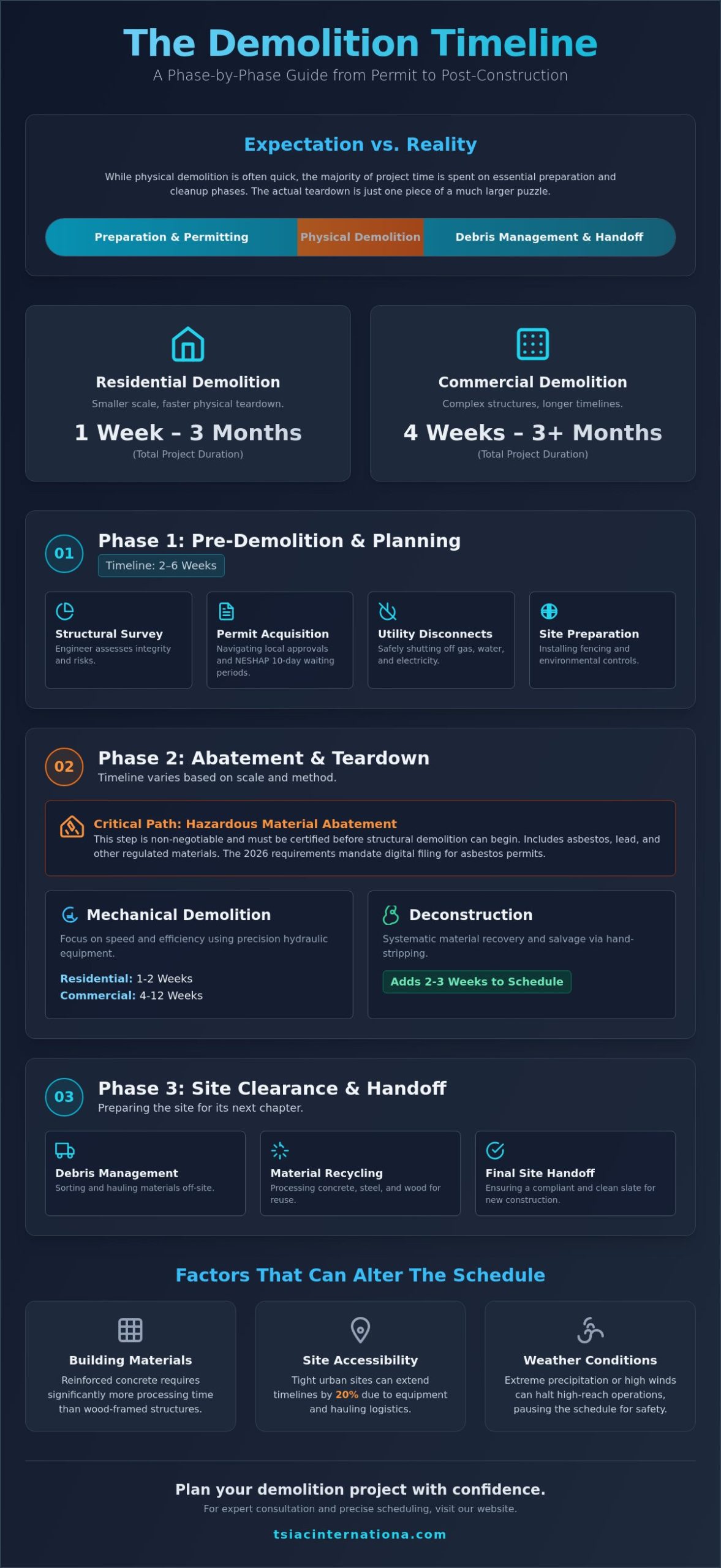
When stakeholders ask how long does demolition take, they often envision a single afternoon of dramatic structural collapse. In reality, modern structural removal is a disciplined engineering process where the physical knockdown represents only a fraction of the total schedule. The popular “wrecking ball” imagery is largely a relic of the past; today’s projects rely on precision hydraulic attachments that dismantle buildings piece by piece to control dust, vibration, and noise. For a standard residential property, the physical phase typically spans 1 to 2 weeks. In contrast, complex commercial projects often require 4 to 12 weeks of active site work depending on the height and footprint of the structure. A demolition timeline is the period from permit filing to final debris recycling. This comprehensive view ensures that expectations remain grounded in technical reality rather than cinematic tropes.
The Difference Between Demolition and Deconstruction
While mechanical demolition prioritizes speed through high-reach excavators, deconstruction focuses on the systematic recovery of materials. Choosing deconstruction for material salvage typically adds 2 to 3 weeks to a project schedule. This method involves labor-intensive hand-stripping of interiors and the careful removal of structural components to preserve their integrity for reuse. While heavy machinery can clear a site in days, the surgical precision of hand-stripping is necessary when environmental certifications or tax benefits for salvaged materials are project priorities. You shouldn’t choose speed over salvage unless immediate construction deadlines outweigh the financial and environmental returns of material recovery. The choice between these methods fundamentally alters the labor requirements and the volume of waste destined for landfills.
Factors That Accelerate or Delay the Schedule
Technical variables dictate the daily progress rate of any structural project. Building material types play a decisive role; for instance, reinforced concrete structures require significantly more time for hydraulic processing and rebar separation compared to wood-framed buildings. Site accessibility also limits the scale of equipment we can deploy. In tight urban environments, the logistics of moving heavy machinery and managing debris hauling trucks can extend the timeline by 20% compared to open-access rural sites. Finally, weather contingencies remain a factor. While we operate in various conditions, extreme precipitation or high winds can halt high-reach operations to ensure the safety of the crew and surrounding structures. This Demolition overview highlights how diverse techniques, from simple mechanical removal to complex deconstruction, are selected based on these specific site constraints. Proper planning accounts for these variables to maintain a predictable delivery schedule.
The Pre-Demolition Phase: Planning, Permits, and Utilities
The true answer to how long does demolition take is often found in the weeks of administrative and technical preparation that precede the first strike. Precision starts with a comprehensive site survey. A structural engineer must verify the integrity of the building and identify potential risks to adjacent properties before any equipment is mobilized. This assessment dictates the equipment choice and the specific sequence of the tear-down. Following the survey, the project enters the permit acquisition phase. Navigating the Demolition Permit Process typically requires a 2 to 6 week window. This duration varies based on local municipal backlogs and the specific requirements for site-specific safety plans. Only after these approvals are secured can a contractor legally establish site safety perimeters, including high-visibility fencing and environmental controls to manage dust and sediment runoff.
Navigating Regulatory and Permit Hurdles
Regulatory compliance is a non-negotiable component of the timeline. In many jurisdictions, environmental notifications under the National Emission Standards for Hazardous Air Pollutants (NESHAP) require a mandatory 10-day waiting period. This period allows agencies to review the planned methods for handling potential contaminants. If the structure is subject to historical preservation reviews, the planning phase can extend by several months. You must have all stamped drawings and approved notifications on-site before heavy machinery can be offloaded. Failure to produce this documentation can result in immediate work stoppages and significant daily fines. Engaging a partner for professional structural demolition services ensures these regulatory milestones are met with methodical accuracy.
Utility Disconnection and Site Preparation
Utility coordination is frequently the most unpredictable variable in the pre-demolition schedule. Managing the ‘cut-and-cap’ procedures for water, gas, and electricity requires direct communication with third-party utility providers. These companies operate on their own internal schedules, which can lead to delays if not managed weeks in advance. A ‘safe-to-demo’ certificate is a mandatory requirement for insurance and safety compliance. It confirms that all live services have been terminated at the property line. Once the site is verified as cold, the ground must be prepared for the weight of high-reach excavators. This involves soil stabilization and the construction of reinforced access ramps to prevent equipment from sinking or tipping during high-impact operations. These preparatory steps ensure that once the mechanical phase begins, it proceeds without technical interruption.
Hazardous Material Abatement: The Critical Path to Safety
The sequence of hazardous material removal is the most significant factor in determining how long does demolition take for structures built before the mid-1980s. You can’t overlook the critical path, which is defined as the sequence of tasks that determines the project’s earliest completion date. In a demolition context, this path always begins with a comprehensive hazardous material survey. Licensed inspectors collect samples from floor tiles, pipe insulation, and textured coatings, which are then sent for laboratory analysis. This initial phase typically requires 3 to 5 business days for results. Once the results are confirmed, a specialized abatement plan is developed. Depending on the volume of friable materials found, the actual abatement process adds 1 to 3 weeks to the total project duration.
Safety protocols for interior abatement require the establishment of rigorous containment areas. We utilize heavy-duty polyethylene sheeting and high-efficiency particulate air (HEPA) filtration systems to maintain negative air pressure. This technical setup prevents the migration of toxic fibers or dust into the surrounding environment during the removal of asbestos-containing materials (ACM) or lead-based paint. The physical removal is a meticulous, manual process that prioritizes containment over sheer speed. Once the materials are safely bagged and removed, the site must remain undisturbed for a final inspection. This period includes third-party air clearance testing, which usually involves a 24 to 48 hour wait for final laboratory verification. This certification is a legal prerequisite that must be satisfied before any structural demolition can begin.
Asbestos and Lead Remediation Timelines
The timeline for remediation is dictated by the physical state and location of the contaminants. Removing non-friable floor tiles is generally a faster process than stripping friable pipe insulation or specialized roofing materials. Each material category requires specific handling and disposal methods to remain compliant with state and federal regulations. You can learn about the complexities in our Asbestos Removal in South Carolina guide. Following the physical removal, a third-party environmental consultant performs air sampling to ensure the site meets safety standards. This clearance window is a fixed point in the schedule that cannot be bypassed or rushed without risking the safety of the demolition crew.
Integrating Abatement into the Master Schedule
Coordinating different vendors often leads to mobilization lag, where the demolition crew waits for the abatement team to clear the site. Hiring a single contractor for both hazardous material abatement south carolina and structural demolition eliminates these scheduling gaps. This integrated approach allows for a seamless transition between phases. The demolition team is ready to move the moment air clearance is granted. Beyond efficiency, this single-source responsibility simplifies the management of compliance documentation. All waste manifests and clearance certificates are consolidated, ensuring your project is ready for post-project audits and future property transactions.
Structural vs. Selective Demolition: Comparing Duration
Total structural demolition represents the most efficient phase of a project when measured by daily production rates. Once the site is cleared of hazardous materials and utilities are capped, high-reach excavators and hydraulic shears can process thousands of square feet of building shell per day. However, when stakeholders ask how long does demolition take, they are often surprised to learn that selective demolition or interior gutting can actually require a more extended timeline. While selective work involves a smaller physical footprint, it demands a higher degree of manual labor and structural shoring to preserve the integrity of the remaining building. The physical footprint is not always the best indicator of project duration; rather, the complexity of the separation process dictates the schedule.
The Speed of Mechanical Structural Removal
The duration of a total structural removal is largely dictated by the height of the building and its total square footage. For a typical mid-rise commercial structure, a professional crew using high-reach excavators can expect to clear approximately 5,000 to 10,000 square feet of structural shell per week, depending on material density. Reinforced concrete requires more time for hydraulic processing and rebar separation than steel or wood frames. You can review the demolition process south carolina for a detailed look at how we sequence machinery workflows to maximize site efficiency. This high-impact phase is designed for speed, focusing on the rapid reduction of the structure into manageable debris for recycling.
Interior Gutting and Tenant Improvements
Selective demolition is a surgical operation that often occurs within occupied buildings or as part of a major renovation. This process involves stripping a space down to its structural studs while leaving the exterior shell and essential MEP (Mechanical, Electrical, and Plumbing) systems intact. The complexity of these systems significantly impacts the schedule; disconnecting and rerouting live lines requires meticulous coordination to avoid unplanned outages. Utilizing commercial interior gutting services allows for tenant improvements to proceed without compromising the building’s core functions. Logistics also play a role in the timeline. When working in active office or retail environments, we often transition to night shifts and utilize specialized elevator protection to manage debris removal without disrupting daily business operations.
The choice between total and selective removal depends on your long-term redevelopment goals and structural constraints. If you need a precise evaluation of how long does demolition take for your specific site, you can request a custom demolition timeline assessment from our technical team. While total demolition offers the fastest path to a clean slate, selective work provides the precision necessary for high-value renovations. Understanding these duration differences is essential for accurate project scheduling and successful stakeholder management.
Post-Demolition: Debris Management and Site Handoff
The project’s conclusion involves more than just an empty lot. When stakeholders evaluate how long does demolition take, they must account for the intensive logistics of debris management that follow the structural knockdown. Once the building components are on the ground, the site transitions into a high-volume sorting and hauling operation. We separate wood, ferrous and non-ferrous metals, and plastics to ensure maximum recovery and compliance with local regulations. This systematic sorting is essential for both environmental responsibility and project cost control. For projects with significant masonry components, on-site concrete crushing is often the most efficient solution. We utilize mobile crushing plants to process debris into aggregate that meets specific engineering standards for future fill. This conversion process can take several days, but it provides immediate value by keeping materials on-site for the next construction phase.
Environmental Responsibility and Recycling Timelines
Methodical on-site sorting is a hallmark of professional structural removal. While this approach can extend the active work phase by 10 to 15 percent, it significantly lowers landfill disposal costs and mitigates the project’s environmental footprint. Our specialized hauling fleets are coordinated to maintain a consistent project rhythm, preventing debris piles from obstructing site movement or creating safety hazards. We provide detailed reports on diversion rates, which are critical for projects seeking LEED certification or meeting corporate sustainability mandates. This documentation tracks every load of material from the point of origin to its final recycling or disposal facility, ensuring full transparency for project audits.
Final Site Clearance and Handoff
The final stage of the timeline focuses on what lies beneath the surface. Removing sub-grade structures like foundations, deep footings, and abandoned underground storage tanks is a technically demanding task that must be completed before the site is considered clear. Once the underground obstacles are removed, we focus on final site grading and stabilization. This involves backfilling voids with engineered fill and compacting the soil to prepare a stable ‘pad’ for the incoming general contractor. We also implement erosion control measures to protect the site until the next phase of construction begins. This preparation ensures that the transition between demolition and new construction is seamless and technically sound.
The project officially closes with a 3-5 day window dedicated to final site inspections and the compilation of close-out documentation. This package includes all safety logs, waste manifests, and structural clearance certificates required for your records. A successful handoff ensures that the next team can begin their work without discovering hidden structural remnants or regulatory gaps. Ready to plan your project? Contact TSIAC International for a detailed timeline and quote. By understanding the full scope of the post-demolition phase, you can better predict how long does demolition take from the first permit filing to the final site grade.
Securing Your Project Schedule with Technical Precision
Predicting how long does demolition take requires a deep understanding of the regulatory and technical hurdles that dictate the critical path. As we explored, the timeline isn’t defined by the speed of the excavator alone. It’s the combination of meticulous permit acquisition, certified hazardous material abatement, and precise site stabilization that ensures a successful site handoff. Whether your project involves a high-impact structural removal or a surgical interior gut-out, the key to maintaining your schedule lies in proactive management and environmental compliance.
With 15+ years of structural removal expertise, TSIAC International provides the technical rigor necessary to navigate complex urban environments and strict regulatory landscapes. Our team consists of certified hazardous material abatement specialists who integrate remediation directly into the master schedule to eliminate mobilization lag. We prioritize comprehensive recycling and debris management, ensuring your site is not only clear but also environmentally compliant for the next phase of development.
Request a Professional Demolition Timeline and Quote from TSIAC International to gain a predictable and controlled schedule for your next project. We’re ready to help you move forward with confidence.
Frequently Asked Questions
How long does it take to demolish a 2,000-square-foot house?
A standard 2,000-square-foot residential demolition typically requires 3 to 5 business days for the physical structural removal and site clearance. However, the comprehensive timeline usually spans 3 to 5 weeks when accounting for mandatory hazardous material surveys, utility disconnects, and permit acquisition. The presence of a basement or complex foundation structures can extend this period by several days as specialized machinery is required for sub-grade removal and engineered backfilling.
Can demolition be done in a single day?
While the actual knockdown of a small, single-story wood structure can occur within several hours, a professional demolition cannot be completed in a single day. This is due to the rigorous sequence of site stabilization, utility verification, and methodical debris sorting required for regulatory compliance. Rushing the process compromises safety protocols and environmental standards, potentially leading to legal violations or structural damage to adjacent properties and infrastructure.
How does asbestos removal affect the overall demolition schedule?
Asbestos abatement is a critical path item that must be finalized before any structural mechanical work begins. This process typically adds 1 to 3 weeks to the project duration, depending on the volume of friable materials and the complexity of containment setups. You must also account for a mandatory 24 to 48 hour waiting period for third-party air clearance results, which serves as the legal prerequisite for mobilizing heavy demolition equipment.
What is the longest part of the demolition process?
The pre-demolition phase is consistently the most time-consuming segment of the project lifecycle. While stakeholders often ask how long does demolition take in reference to machinery on-site, the 2 to 6 week window required for permit approvals and utility coordination often exceeds the time spent on physical destruction. This administrative and preparatory stage is essential for ensuring that the subsequent mechanical phase proceeds without unplanned interruptions or legal complications.
Does weather affect how long demolition takes?
Environmental conditions play a significant role in maintaining the project rhythm. High-reach operations and crane work are frequently halted during high wind speeds to prevent debris migration and ensure operator safety. Heavy precipitation can also impact soil stability, making it difficult for heavy machinery to navigate the site or perform precise grading. We integrate weather contingencies into our schedules to manage these variables without compromising technical standards or site safety.
Do I need to be on-site during the demolition process?
You aren’t required to be on-site during the active demolition phase; in fact, safety protocols often limit site access to essential personnel only. Our project managers provide detailed daily logs and photographic documentation to keep stakeholders informed of progress. If a property owner chooses to be present, they must adhere to strict Personal Protective Equipment requirements and remain outside the designated high-risk exclusion zones to ensure their safety.
How much time should I budget for permit approvals?
You should budget between 2 and 6 weeks for local permit approvals, though this duration fluctuates based on municipal backlogs and structural complexity. Projects involving historical preservation reviews or specialized environmental notifications, such as NESHAP filings, may require additional time. Securing these approvals early is the most effective way to prevent delays once the abatement and demolition crews are ready to mobilize for the physical work.
What happens if hazardous materials are found after demolition starts?
If suspected hazardous materials are discovered after the project begins, all work stops immediately to prevent the release of toxic fibers or dust. The area is isolated, and a certified inspector is brought in to perform sampling and laboratory analysis. If the presence of asbestos or lead is confirmed, an abatement plan must be filed and executed before work resumes, which can add several weeks to the how long does demolition take estimate.
