
A clean surface is not a guarantee of a healthy environment. While the visible mold may be gone, the true test of a successful project lies in the microscopic data that remains hidden from the naked eye. If you’re managing a commercial or residential property, the stakes for re-occupancy air testing after mold remediation are incredibly high. You’ve likely invested significant resources into cleanup, yet the fear of recurring growth or liability concerns for tenants can still persist. It’s natural to feel anxious about hidden moisture in wall cavities or feel confused by the dense terminology found in laboratory reports.
This 2026 professional guide will help you master the technical requirements and safety protocols for post-remediation air testing to ensure your property is truly safe for occupants. We’ll break down the latest ANSI/IICRC S520 standards and the impact of the 2026 National Defense Authorization Act on remediation guidelines. You’ll learn how to secure objective proof of success, providing the legal documentation necessary for insurance and future sales while finally achieving total peace of mind for everyone in the building.
Key Takeaways
- Understand the methodology behind Post-Remediation Verification (PRV) to distinguish between simple visual inspections and the scientific necessity of laboratory air sampling.
- Learn how re-occupancy air testing after mold remediation utilizes indoor-to-outdoor spore count comparisons to provide an objective baseline for environmental safety.
- Identify why inadequate containment and hidden moisture reservoirs lead to clearance failures and how selective demolition or interior gutting ensures a definitive pass.
- Navigate the 2026 legal landscape by securing a formal Clearance Report, which serves as critical documentation for insurance adjusters and future property transactions.
- Follow a disciplined two-step protocol involving professional HEPA cleaning and air scrubbing to transition safely from hazardous material abatement to full re-occupancy.
Understanding Post-Remediation Verification (PRV) and Air Testing
Post-Remediation Verification, commonly referred to as PRV, serves as the definitive structural audit for any hazardous material abatement project. It isn’t merely a courtesy check; it’s a rigorous, multi-stage protocol designed to confirm that a property has returned to a normal fungal ecology. Relying solely on a visual inspection is a common but dangerous mistake. While a surface might look clean to the naked eye, microscopic spores can remain suspended in the air or trapped in porous materials. To understand the necessity of this data, one must first recognize What is Mold? and how its microscopic spores behave within a structural environment after being disturbed during demolition.
A professional re-occupancy air testing after mold remediation protocol bridges the gap between “clean” and “safe.” For property owners, “trusting the remediator” to self-certify their own work presents a significant liability risk. If the firm that performed the interior gutting also conducts the final clearance, a clear conflict of interest exists. This is why involving an independent environmental professional is the gold standard for commercial and high-value residential projects. They provide an unbiased, third-party laboratory analysis that stands up to scrutiny from insurance adjusters and legal entities.
The Core Objectives of Re-Occupancy Testing
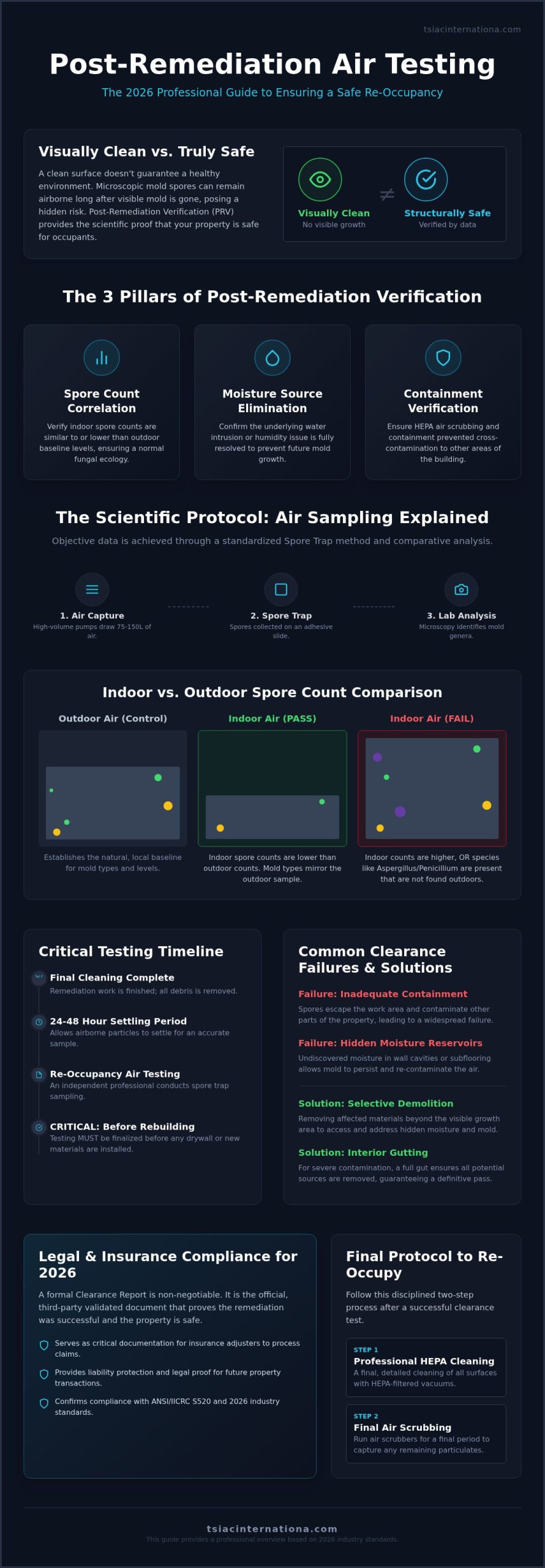
The primary goal of a PRV is to provide empirical evidence that the remediation strategy was successful. This involves three critical checkpoints:
- Spore Count Correlation: Verifying that indoor airborne spore counts are statistically lower than, or similar to, the outdoor baseline levels.
- Moisture Source Elimination: Confirming that the underlying water intrusion or humidity issue has been fully resolved, as mold cannot thrive without a moisture catalyst.
- Containment Verification: Ensuring that the high-grade containment and HEPA air scrubbing used during the project successfully prevented cross-contamination to unaffected areas of the building.
When Should Testing Occur?
Timing is as important as the testing methodology itself. A professional re-occupancy air testing after mold remediation should ideally take place 24 to 48 hours after the final cleaning is completed. This settling period allows any remaining airborne particles to descend, ensuring the samples reflect the true environmental state of the room. Testing too early often leads to false negatives, as active air scrubbers may temporarily mask a failure. Most importantly, this testing must be finalized before any rebuilding or drywall installation begins. Sealing a wall cavity before a clearance pass risks trapping residual growth behind new materials, leading to costly secondary remediations later.
The Scientific Protocol: How Re-Occupancy Air Sampling Works
The technical foundation of re-occupancy air testing after mold remediation rests on the Spore Trap method. This procedure utilizes high-volume air pumps to draw a specific volume of air, typically 75 to 150 liters, through a specialized collection cassette. Inside the cassette, an adhesive-coated glass slide captures airborne particulates, including mold spores, pollen, and hyphal fragments. A laboratory then analyzes these slides under high-magnification microscopy to identify specific mold genera. Identifying the genus is critical because certain types, such as Aspergillus or Penicillium, behave differently in indoor environments compared to common outdoor varieties. While following the EPA Mold Cleanup Guidelines ensures physical debris is removed, the air sample provides the final, invisible proof of success.
Industry standards for 2026 rely heavily on comparative analysis rather than arbitrary “pass/fail” numbers. Because there are no federal EPA thresholds for mold concentrations, professionals use outdoor air as a baseline control. A successful test requires that the indoor spore counts are lower than the outdoor concentrations and that the types of mold found indoors mirror those found naturally outside. If the indoor air contains species not present in the outdoor control, it indicates an active, unresolved source. For complex commercial projects, utilizing professional mold remediation services ensures that the structural cleaning is thorough enough to meet these rigorous comparative metrics.
Essential Testing Equipment and Tools
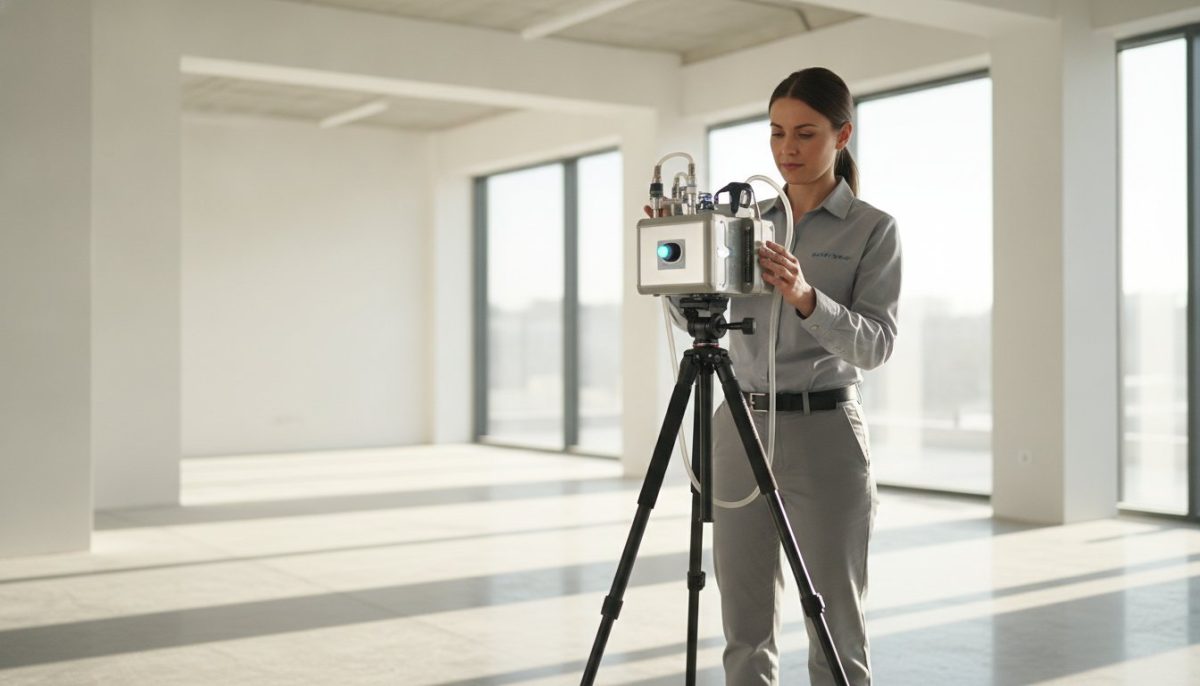
Precision requires calibrated hardware. Technicians use high-volume air pumps that are flow-calibrated before every use to ensure the volume of air sampled is exact. Laser particle counters offer an immediate, real-time assessment of total particulate loads, though they cannot distinguish between mold and dust. To find hidden reservoirs that air samples might miss, professionals employ moisture meters and thermal imaging cameras. These tools detect temperature anomalies behind drywall, which often indicate the moisture pockets that allow mold to persist in wall cavities after the surface appears clean.
Interpreting the Lab Report
Laboratory reports provide two primary data points: the “Raw Count” and “Spores per Cubic Meter.” The Raw Count is the actual number of spores identified on the slide, while the Spores per Cubic Meter is a calculated estimate of the total concentration in the room. You must pay close attention to the “Analytical Sensitivity” section, which defines the lowest concentration the lab can detect. Red flags in a report include any detection of Stachybotrys (black mold) or Chaetomium. These genera are heavy, “sticky” spores that are rarely found in the air unless there is an active, significant growth source nearby. Finding even a single spore of these types often triggers an automatic failure of the clearance test.
Common Reasons for Air Clearance Failure and Structural Solutions
Failing a clearance test is rarely a matter of bad luck; it’s almost always a result of procedural shortcuts or overlooked structural reservoirs. When containment barriers aren’t pressurized correctly, spores released during demolition infiltrate unaffected areas of the building. This migration is a primary reason why re-occupancy air testing after mold remediation yields elevated indoor counts even after the visible growth is gone. Many property owners don’t realize that microscopic particles can settle in fine dust on horizontal surfaces, creating a “dust reservoir” that air pumps easily detect during a final audit. Adhering to strict CDC Guidance on Mold Remediation requires meticulous HEPA vacuuming of every square inch within the containment zone to prevent these false failures.
Hidden mold reservoirs within wall cavities or subflooring represent another significant hurdle. If moisture has wicked into porous materials, surface-level scrubbing won’t suffice. Spores trapped behind baseboards or inside insulation will continue to off-gas into the air, triggering a failure during the 24 to 48 hour settling period. Achieving a “pass” often requires a more aggressive approach than simple remediation, shifting the focus toward total structural decontamination and the removal of all compromised organic substrates.
The Role of Interior Gutting in Passing Clearance
For severe infestations, surface cleaning is statistically likely to fail. Professional commercial interior gutting services provide the most reliable path to a successful clearance by stripping the environment down to the structural studs. This process ensures that no mold remains trapped behind drywall or under flooring. Utilizing selective demolition allows for the surgical removal of contaminated materials while preserving the building’s essential structural integrity. This methodological precision eliminates the risk of hidden reservoirs, ensuring that the final re-occupancy air testing after mold remediation reflects a truly sterile environment rather than a temporarily masked one.
HVAC System Remediation and Testing
The HVAC system is frequently the culprit behind cross-contamination failures. Mold spores are easily drawn into return vents and deposited onto AC coils or within fiberglass duct liners. If the system isn’t professionally cleaned and sealed, it will redistribute spores the moment it’s reactivated after remediation. A successful clearance protocol must include a thorough inspection of the air handling unit and the application of antimicrobial coatings to prevent future colonization. Verifying that the ductwork is free of debris is a non-negotiable step before any environmental professional conducts final air sampling near supply registers.
Legal, Insurance, and Compliance Standards for 2026
A successful re-occupancy air testing after mold remediation is the document that separates a completed job from a legally defensible one. Many property owners confuse a Certificate of Completion with a Clearance Report. The former is just a statement from the contractor that the work’s done. The latter’s a data-driven report from an independent laboratory. In 2026, insurance adjusters frequently refuse to close claims without Post-Remediation Verification (PRV) data. This is especially true in commercial settings where liability protection for landlords is a priority. Following the 2026 National Defense Authorization Act, which mandates guidelines consistent with ANSI/IICRC S520, the industry now demands standardized, transparent reporting for all professional projects. OSHA standards for workplace safety also require facility managers to provide a safe environment. Avoiding litigation starts with data.
Documentation for Real Estate Transactions
Clearance reports are vital for maintaining property value during real estate transactions. During a sale, these reports serve as an official health record for the building, proving that past issues were handled with professional-grade precision. Disclosure requirements for previous mold remediation are becoming stricter every year. New rules in 2026, such as those implemented in Virginia and Connecticut, highlight the necessity of having documented proof that a dwelling is habitable. Without this data, a history of water damage can lead to significant price devaluations or complex legal disputes after the keys have changed hands. Creating a permanent health record for the building isn’t just a safety measure; it’s a financial safeguard.
Regulatory Compliance in Abatement
Mold remediation rarely happens in isolation. If your project involves stripping materials in an older building, you must integrate mold clearance with broader hazardous material abatement protocols. This includes ensuring that asbestos removal standards were met if insulation or floor tiles were disturbed during the interior gutting. The intersection of mold, lead-based paint, and asbestos regulations requires a unified compliance strategy. This approach protects both the workers during the project and the occupants after re-entry. For professional assistance with these complex safety standards, consult the specialists at TSIAC International for a comprehensive evaluation of your property’s environmental health.
The transition from a hazardous environment to a safe, habitable space follows a disciplined five-step sequence. It begins with a final visual inspection by the remediation supervisor to ensure no physical debris, dust, or organic residue remains within the containment zone. Following this, professional HEPA cleaning and air scrubbing are deployed to capture microscopic particulates that may have been disturbed during the gutting process. Once the 24-to-48-hour settling period has elapsed, the property undergoes independent air sampling and laboratory analysis. This is the stage where re-occupancy air testing after mold remediation provides the empirical proof required for a safe return. After a successful review and sign-off on the clearance report, technicians finally remove the containment barriers and proceed with final building restoration. This final stage is when the property is officially returned to the owner, free of hazardous contaminants and structural risks.
Ensuring Long-Term Success
Passing a clearance test is the immediate goal, but long-term success requires active environmental management. Implementing humidity controls to keep indoor moisture levels below 50% is the most effective way to prevent re-growth. In high-risk commercial buildings, scheduled air quality monitoring provides an early warning system for structural leaks or HVAC failures. Ongoing maintenance after structural repairs ensures that the moisture catalysts identified during the initial assessment don’t return. You shouldn’t view remediation as a one-time event, but rather the starting point for a more robust facility management strategy that prioritizes occupant health and building longevity.
Choosing the Right Abatement Partner
Selecting a contractor with deep technical expertise is the most critical decision a property owner makes. TSIAC International brings over 15 years of industry experience in structural removal and hazardous material management. Their team understands that re-occupancy air testing after mold remediation is only as reliable as the contractor’s methodology. By ensuring that every project uses certified laboratories for PRV testing, they provide the objective proof needed for legal and insurance compliance. When the stakes involve occupant health and property value, a partner with a proven track record in complex hazardous environments is indispensable. They don’t just clear the air; they provide a foundation for safe, long-term occupancy through methodological precision and a commitment to absolute safety.
Securing Structural Safety and Regulatory Compliance
Achieving a successful clearance isn’t just about passing a test; it’s about validating the integrity of your entire abatement strategy. By prioritizing the microscopic data provided by re-occupancy air testing after mold remediation, property owners can move forward with absolute confidence. We’ve explored how methodical interior gutting and professional-grade containment are the most reliable ways to eliminate hidden reservoirs and ensure your facility meets the strict 2026 standards. These protocols provide the legal and insurance documentation necessary to protect your long-term interests.
When the safety of your occupants and the value of your asset are on the line, you need a partner with a disciplined approach to hazardous environments. With over 15 years of industry experience, TSIAC International specializes in expert hazardous material abatement and comprehensive structural gutting capabilities that guarantee a definitive path to clearance. Don’t leave your liability to chance or surface-level cleanups. Contact TSIAC International for Professional Abatement and Remediation Services to ensure your property’s environmental health is managed with technical precision. Your path to a safe, compliant, and mold-free environment starts with professional-grade intervention.
Frequently Asked Questions
How long does mold air testing take to get results?
Laboratory results typically take between 24 and 72 hours after the samples arrive at the facility. While standard turnaround is 2 to 3 business days, many accredited labs offer expedited “rush” analysis for a faster sign-off. It’s important to remember that this timeline doesn’t include the mandatory 24 to 48 hour settling period required before the air pumps are even turned on at the project site.
Can I stay in the house while mold remediation is happening?
It’s generally recommended that occupants vacate the immediate work area during the project. Professional remediation involves high-grade containment and loud air scrubbing equipment that creates significant noise and negative air pressure. The risk of cross-contamination during the demolition of contaminated materials is high. Relocating temporarily ensures your safety and allows the remediation team to maintain the integrity of the containment zone without interference.
What is a “passing” score for a mold air test?
A “pass” isn’t defined by a single numerical value but by a statistical comparison to outdoor air. For a successful re-occupancy air testing after mold remediation, the indoor spore counts must be lower than or similar to the outdoor baseline sample. Additionally, the types of mold identified indoors must mirror the natural outdoor environment, with no detection of “target” species like Stachybotrys or Chaetomium.
Is re-occupancy air testing required by law?
Federal law doesn’t mandate testing, but several state regulations and industry standards effectively require it for liability protection. The 2026 National Defense Authorization Act and new state laws in Virginia and Connecticut emphasize adherence to IICRC S520 standards. Most commercial insurance carriers and real estate disclosure requirements make this documentation a necessity to prove the building is safe for habitation and to close out claims.
What happens if my building fails the air clearance test?
If a test fails, the remediation team must re-clean the area and re-evaluate the moisture source. A failure often indicates that spores migrated past containment or that hidden reservoirs remain in wall cavities. The contractor will typically perform additional HEPA vacuuming and air scrubbing. In severe cases, a failed test suggests that surface cleaning was insufficient and a more aggressive interior gutting is required to reach a pass.
Should I test for mold after a selective demolition project?
Yes, testing is essential whenever structural materials are disturbed in an environment with a history of water damage. Selective demolition can release microscopic spores that were previously trapped behind walls or under flooring. Conducting re-occupancy air testing after mold remediation ensures that the surgical removal of building components didn’t inadvertently contaminate the remaining structure, providing the objective proof needed before you begin any reconstruction or drywall installation.
Does insurance cover the cost of post-remediation testing?
Most property damage policies cover clearance testing as a standard part of the remediation claim. Insurance adjusters rely on Post-Remediation Verification (PRV) data to prove the loss has been professionally mitigated and to close the file. Since this documentation protects the insurer from future liability, it’s usually a covered expense. You should verify your specific policy limits and ensure an independent third party performs the actual sampling.
What is the difference between air testing and surface tape-lift sampling?
Air testing measures suspended spores to determine what occupants are breathing, while tape-lifts identify specific growth on a physical surface. Air sampling is the gold standard for re-occupancy because it provides a comprehensive look at the entire environment. Tape-lift sampling is better suited for identifying a specific mold genus or verifying that a particular structural beam has been successfully decontaminated after the physical removal of growth.
