
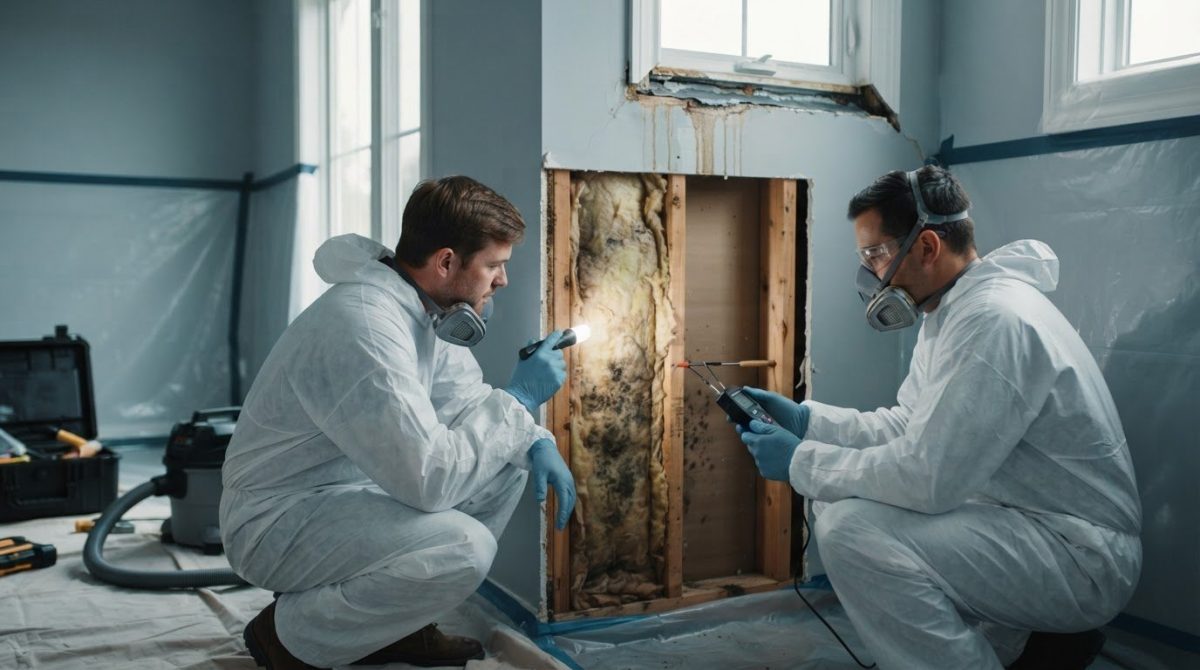
What good is removing mold if the construction defect that lets moisture in remains unresolved? A leak or building-envelope failure can leave materials damp, so mold remediation for construction defects needs to address both the affected area and the moisture pathway behind it.
Cleanup should do more than make visible growth disappear. A lasting plan separates remediation from the work needed to correct the defect, then coordinates the two so removal of affected materials and property repairs happen in a clear sequence.
This article explains how construction defects may contribute to mold, what a responsible remediation scope should cover, and which coordination questions matter before work begins. You’ll also learn how demolition and related removal capabilities can support projects where building materials need to be removed.
TSIAC International provides mold remediation, selective demolition, interior gutting, and related abatement services nationwide. With more than 15 years of industry experience, the company helps coordinate removal work with the wider project scope.
Key Takeaways
- Visible mold and a suspected building defect are related clues, not proof of the same cause. Document conditions and past water events before work is scoped.
- A responsible mold remediation for construction defects plan considers moisture assessment, affected materials, work boundaries, and how completion will be reviewed.
- Compare cleanup-only and coordinated repair scopes by identifying who addresses the moisture pathway, manages construction interfaces, and handles follow-up.
- Before demolition or renovation begins, align remediation and repair scopes so affected materials, work boundaries, and responsibilities are clear.
How Construction Defects Create Conditions for Mold Growth
A construction defect can create a route for water to enter or prevent moisture from draining or drying as intended. If building materials remain damp, conditions may support mold growth. However, mold alone does not establish that a defect caused it. The connection needs to be assessed in light of the building’s condition, moisture patterns, and history.
In concise terms: a construction defect may create or prolong a moisture condition, and persistent dampness may support mold growth. Identifying the actual connection requires site-specific findings.
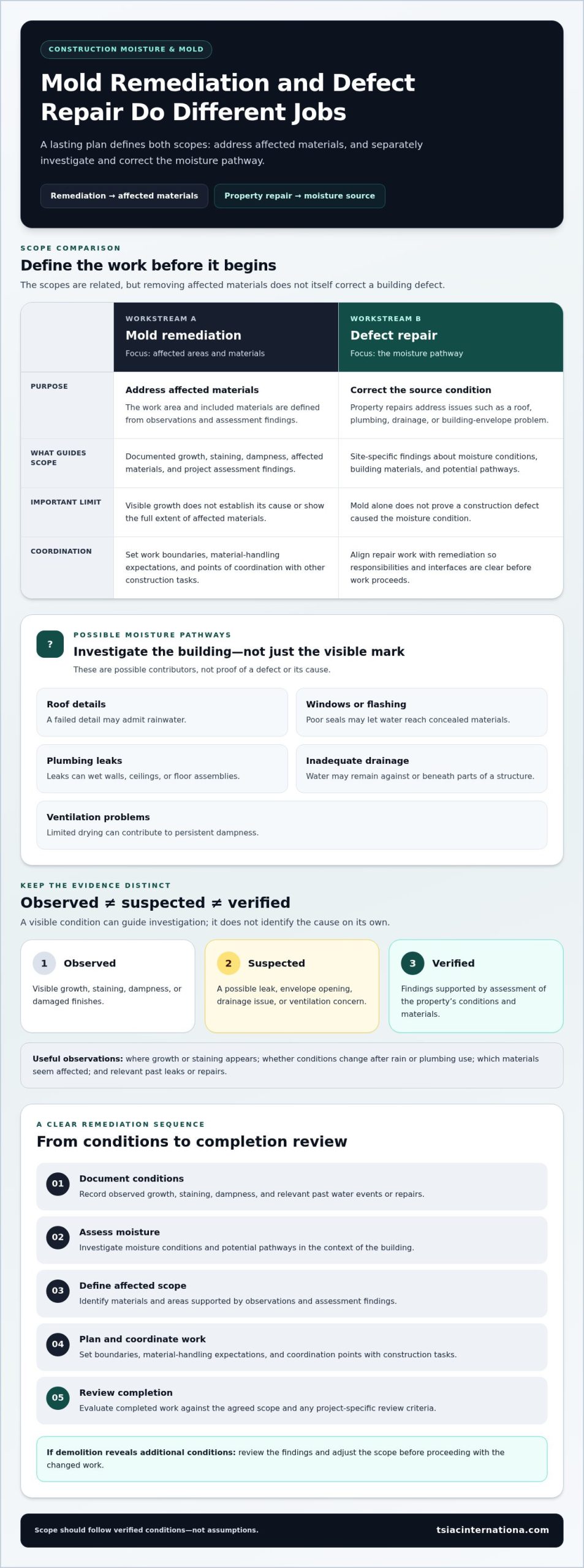
This distinction matters because remediation and repair address different parts of the problem. Mold remediation for construction defects considers affected materials and the suspected moisture pathway. Correcting a roof, plumbing, drainage, or envelope issue belongs to the property-repair scope. An overview of Indoor Mold also describes the relationship between indoor mold and moisture, but it cannot determine what is happening inside a particular building.
Which construction defects can contribute to mold?
A failed roof detail may admit rainwater. Poorly sealed windows or flashing may allow water to reach concealed materials. Plumbing leaks can wet walls, ceilings, or floor assemblies, while inadequate drainage may leave water against or beneath parts of a structure. Ventilation problems can also contribute to persistent dampness by limiting drying. These are possible pathways, not proof of a defect. Identifying the source requires a site-specific assessment of the building and available evidence.
Does visible mold identify the construction defect?
No. Visible growth shows an observed condition, not its cause. Moisture may come from a leak, condensation, or another source, and affected materials can be hidden behind finishes or within an assembly. A mark on a ceiling, for example, may indicate an area to investigate, but it does not establish whether water came from the roof, plumbing, or elsewhere. Keep observations, suspected causes, and verified findings distinct.
That separation makes an investigation more useful. Record where growth or water staining appears, whether the area changes after rain or plumbing use, and which materials seem affected. Note past leaks and repairs, too. These observations can help focus an assessment without treating a pattern as conclusive evidence.
- Observed: visible growth, staining, dampness, or damaged finishes.
- Suspected: a possible leak, envelope opening, drainage issue, or ventilation concern.
- Verified: findings supported by assessment of the property’s conditions and materials.
Concealed conditions can complicate the picture. Moisture may travel beyond the visible area or remain within a wall, ceiling, or floor assembly. The remediation scope should be based on the affected materials and project findings, rather than assuming the visible boundary shows the full extent. Identifying the moisture source separately helps define what property repairs may need to address.
What Mold Remediation for Construction Defects Should Address
A useful remediation scope turns observations into a defined work plan. It should account for what is known about moisture, which materials are affected, how the work relates to adjacent construction, and how completion will be reviewed. The right scope depends on the building, its materials, and project findings. It should not assume every hidden area is affected or that visible growth marks the full extent.
A remediation scope should follow verified conditions, not assumptions, and distinguish work on affected materials from repairs needed to correct the moisture source.
A general sequence helps keep decisions organized:
- Document conditions: Record observed growth, staining, dampness, and relevant past water events or repairs.
- Assess moisture: Investigate moisture conditions and potential pathways in the context of the building.
- Define affected scope: Identify materials and areas supported by observations and assessment findings.
- Plan the work: Set boundaries, material-handling expectations, and coordination points with other construction tasks.
- Review completion: Evaluate the completed work against the agreed scope and any project-specific review criteria.
The EPA Mold Remediation Guide provides guidance for schools and commercial buildings, including assessment and remediation considerations. It can inform planning, but the building’s conditions and project scope determine how work is designed. Mold remediation for construction defects should also be distinguished from corrective construction: addressing affected materials does not itself repair a roof, plumbing, drainage, or envelope problem.
How are affected areas and materials scoped?
Documented observations provide a starting point. Where appropriate, an assessment can help interpret moisture conditions and identify materials that need attention. Record visible impacts separately from potential concealed impacts. A stained finish may justify further investigation, but it does not prove that every nearby cavity is affected. If demolition exposes additional conditions, review and adjust the scope before proceeding with the changed work.
What belongs in the remediation work plan?
A project-specific plan should define the work area, identify materials included for handling or removal, and describe how remediation connects with adjacent construction tasks. Sequencing matters if finish removal is needed to reach affected material or if repairs will follow in the same area. Project controls should reflect the building, materials, and work scope rather than rely on a universal procedure.
Clear boundaries help prevent gaps between remediation and corrective repairs. The remediation scope can describe the areas and materials being addressed; the construction repair scope can identify the work intended to stop water intrusion or persistent dampness. When different tasks are involved, assigning responsibilities and documenting changes as conditions become visible supports orderly coordination. It also clarifies what the completion review covers and what remains part of the property-repair work.
TSIAC International provides mold remediation and related removal capabilities, including selective demolition and interior gutting. For projects where affected materials and removal work need to be coordinated, learn about mold remediation and related removal work.
Remediation Alone or Coordinated Defect Repair: How to Compare Approaches
The right approach depends on project findings. If the moisture source has already been corrected or is being managed through a separate repair, remediation may be scoped as a distinct task. If repair work could expose or disturb affected materials, planning remediation alongside construction can help prevent overlapping or out-of-sequence work. Neither approach fits every building.
Use the comparison below to clarify what each scope covers. Make responsibilities explicit, especially where remediation ends and corrective construction begins.
| Planning factor | Standalone remediation | Coordinated remediation and repair |
|---|---|---|
| Scope | Focuses on identified affected areas and materials. | Connects remediation boundaries with areas involved in corrective construction. |
| Moisture-source correction | The source has been corrected or is addressed separately, with responsibility made clear. | Repair work is planned alongside remediation to address the suspected moisture pathway. |
| Construction coordination | May require defined access and sequencing where other work occurs nearby. | Schedules removal, remediation, and repair tasks to reduce clashes or repeated disturbance. |
| Follow-up responsibilities | Clarifies who reviews remediation completion and who tracks separate repairs. | Defines how completion of remediation and corrective work will each be reviewed. |
Surface cleaning alone may not resolve underlying conditions if moisture continues to reach the area. Conversely, a suspected defect does not automatically mean all nearby materials require removal. For mold remediation for construction defects, recommendations should reflect verified conditions, the materials involved, and the repair plan, rather than defaulting to the broadest or narrowest scope.
When may a standalone remediation scope be appropriate?
A separate scope may suit a clearly bounded affected area when the moisture source has already been corrected or is being managed under a distinct repair plan. Separating the work can make responsibilities easier to track, provided the documents identify affected materials, access needs, and who handles follow-up. A focused scope is not a guarantee against recurrence if moisture conditions change or concealed impacts emerge.
When should remediation align with construction repairs?
Coordination is especially relevant when repair work will open walls, ceilings, or other assemblies, or could disturb materials near the affected area. Agreeing on sequence and work boundaries helps limit conflicting tasks, avoid closing an area before related work is complete, and address newly exposed conditions through a documented scope review. Planning for interior removal can also benefit from understanding commercial interior gutting services and how demolition work fits into the wider project.
Before work begins, record who handles each task: moisture-source repairs, removal or remediation of affected materials, restoration work, and review of completion. TSIAC International provides mold remediation, selective demolition, and interior gutting for projects where remediation and related removal work need to be coordinated. Keep the final scope specific to the building and project findings.
How to Plan Mold Remediation Around Construction Work
Good coordination starts before materials are removed. Bring together what is known about affected locations, past water events, previous repairs, building access, and planned construction tasks. This gives the project team a practical basis for setting boundaries and sequencing work, while leaving room to revise the scope if demolition reveals conditions that were not visible beforehand.
A useful planning checklist separates confirmed observations and completed repairs from suspected causes, unverified conditions, and open questions.
What information helps establish a clear project scope?
Assemble available records rather than relying on memory alone. Photograph observed conditions, note where and when they appear, and record changes over time without treating appearance as a diagnosis. Maintenance and repair records can help establish what work has been completed and what may still need attention.
- Photographs of affected locations, with dates where available
- Maintenance records and prior leak or water-event history
- Documentation of completed repairs and areas addressed
Scope documents can distinguish confirmed conditions from assumptions, identify exclusions, and explain how newly discovered conditions will be recorded and reviewed. This matters when work opens an assembly: findings may expand, narrow, or otherwise change the planned work. Documenting those changes helps keep responsibilities clear.
Set boundaries for both remediation and corrective construction. Define which areas are included, what work is assigned to each scope, and how the tasks connect. For instance, a repair crew may need access to a wall or ceiling that also contains materials included in remediation. If responsibilities are not mapped, work can overlap, leave a gap, or require a completed area to be disturbed again.
Plan around the building’s use, too. Identify access routes, occupied areas, and nearby work so the schedule accounts for people using the space and trades working in adjacent areas. Details depend on the property and planned tasks, but coordination should make clear who needs access, which areas are affected, and when work may need to pause for another task.
How do demolition and hazardous-material work affect coordination?
Removal work can intersect with finishes, concealed assemblies, and other trades’ work areas. Before disturbance begins, note whether asbestos or lead concerns have been identified or need separate project consideration and verification. Do not assume these materials are present or absent based on appearance alone. TSIAC International provides related abatement and demolition services, including selective demolition and interior gutting.
When removal is part of a broader project, planning for demolition and hazardous-material work can clarify how those tasks fit alongside remediation and repairs. Aligning access, work boundaries, and sequencing before crews begin can reduce conflicting work, particularly when a space is occupied or several trades share the same area.
For mold remediation for construction defects, TSIAC International brings more than 15 years of industry experience to mold remediation and related removal work. Learn more about planning mold remediation and related removal work with TSIAC International.
How TSIAC Supports Mold Remediation and Related Removal Work
Construction-defect mold projects can involve several types of work. TSIAC International provides mold remediation alongside selective demolition, interior gutting, asbestos abatement, and lead abatement. With more than 15 years of industry experience, the company brings related removal capabilities to projects where affected building materials may need to be addressed as part of a defined scope. This experience spans the company’s work and is not presented as a mold-specific track record.
Remediation and building repair have distinct roles. Mold remediation addresses mold-related work, while correcting the source of water intrusion belongs in the property-repair scope. Clear project boundaries connect these activities without treating them as interchangeable. TSIAC International’s related demolition capabilities can support a project when the scope calls for removal of building components, with that work coordinated alongside the broader schedule.
Which related services may fit a defect-remediation project?
Mold remediation is the core service relevant to this article. Selective demolition may fit when specific components need removal, while interior gutting may suit a project that calls for more extensive interior removal. Asbestos or lead abatement is a separate consideration when relevant materials are identified; it should not be assumed necessary because mold is present. The appropriate combination depends on the building and project requirements.
For mold remediation for construction defects, the practical question is how to align remediation and related removal with the project’s documented conditions. Define which areas and materials are in scope, how removal connects to adjacent work, and which tasks remain part of separate corrective construction. TSIAC International scopes work to the building and project requirements rather than assuming every project needs the same extent of removal or combination of services.
Before a project discussion, organize available details that can help clarify the work:
- Locations where mold, water staining, or dampness has been observed
- Available photographs, maintenance records, and prior water-event history
- Repairs already completed and any unresolved construction work
- Planned demolition, renovation, or other work that could affect the same areas
These details help establish a starting point for discussing the project. They can also separate observed conditions from questions that still need assessment and clarify where remediation, removal, and property repairs may intersect. TSIAC International’s related demolition work can be included in the project scope when removal is needed.
Bring available records and a clear description of work underway or planned to your project discussion. TSIAC International provides mold remediation and related demolition and abatement services, with scope tailored to the building and project requirements. Discuss mold remediation and related removal requirements with TSIAC International.
Set a Clear Path for the Work Ahead
Turn the available information into a practical project brief. Identify what is known, what remains uncertain, and which decisions need coordination before work begins. This gives everyone involved a clearer basis for defining responsibilities and moving from investigation to action without treating assumptions as findings.
For mold remediation for construction defects, sound planning keeps both the moisture concern and affected materials in view as the project scope develops. As conditions become clearer, refine the work plan to reflect the building and its repair requirements.
TSIAC International brings more than 15 years of industry experience and provides service nationwide, with mold remediation alongside selective demolition, interior gutting, and abatement services. Discuss your mold remediation project with TSIAC and take the next step toward a clearly coordinated scope.
Frequently Asked Questions
Can mold grow behind walls after a construction defect is repaired?
Yes. Mold may be present behind a wall even after the defect is repaired if materials stayed damp and were not addressed. Repairing a pipe or sealing a window stops or limits a moisture pathway, but it does not establish what happened to materials already inside the assembly. For example, a repaired leak may leave insulation or drywall that needs further assessment. Evaluate the concealed area based on its condition rather than presuming it is affected or clear.
Does finding mold prove that a construction defect caused it?
No. Finding mold establishes that growth is present, but it does not establish why moisture accumulated or who may be responsible. Condensation, a plumbing event, or another moisture source may also warrant consideration. Keep photographs, repair records, and observations about when dampness appears. These can help distinguish what was seen from what has been verified. Determining the cause requires evidence about the building and its history, not visual appearance alone.
Is mold remediation the same as repairing a construction defect?
No. Mold remediation addresses mold-related conditions and affected materials within its defined scope. Repairing a construction defect involves correcting the building condition that may allow water intrusion or persistent dampness. For example, addressing growth near a window and correcting a failed window detail are related tasks, but they are not interchangeable. Project documents should state which work is included, who is responsible for it, and how remediation and repairs connect.
Can remediation begin before the moisture source is fixed?
Some remediation work may be planned or begin while source correction is managed separately, but the ongoing moisture condition matters. If water is still entering, materials may remain damp or conditions may change during the work. Coordinate access, sequencing, and decisions about affected materials, including how newly observed conditions will be handled. The project plan should also clarify when repairs need to be complete before finishes or other materials are put back.
How long does mold remediation for a construction defect take?
There is no reliable single duration for every project. The schedule depends on the confirmed work area, materials involved, access, whether removal exposes additional conditions, and how remediation fits with corrective repairs. A small, accessible area and a project involving concealed assemblies or several construction tasks have different planning needs. Request a project-specific sequence that identifies dependencies and decision points rather than relying on a generic timeframe before the scope is defined.
Will homeowners insurance cover mold caused by a construction defect?
Coverage depends on the policy, the circumstances that led to the moisture, and the documentation available. A sudden event such as a burst pipe may be treated differently from gradual dampness, but no general answer determines a particular claim. Keep records of the water event, observed damage, repairs, and remediation scope. Review the policy and speak with the insurer about coverage and documentation; a remediation contractor does not decide policy coverage.
Should damaged building materials be removed during mold remediation?
Sometimes, but removal depends on the material’s condition, assessment findings, and the agreed project scope. A visibly damaged material may need a different response from one that is intact and can be addressed another way. The decision should account for the work needed to reach affected areas and any adjacent construction. If removal could involve asbestos or lead concerns, consider those materials separately as part of the project rather than making assumptions based on appearance.
