
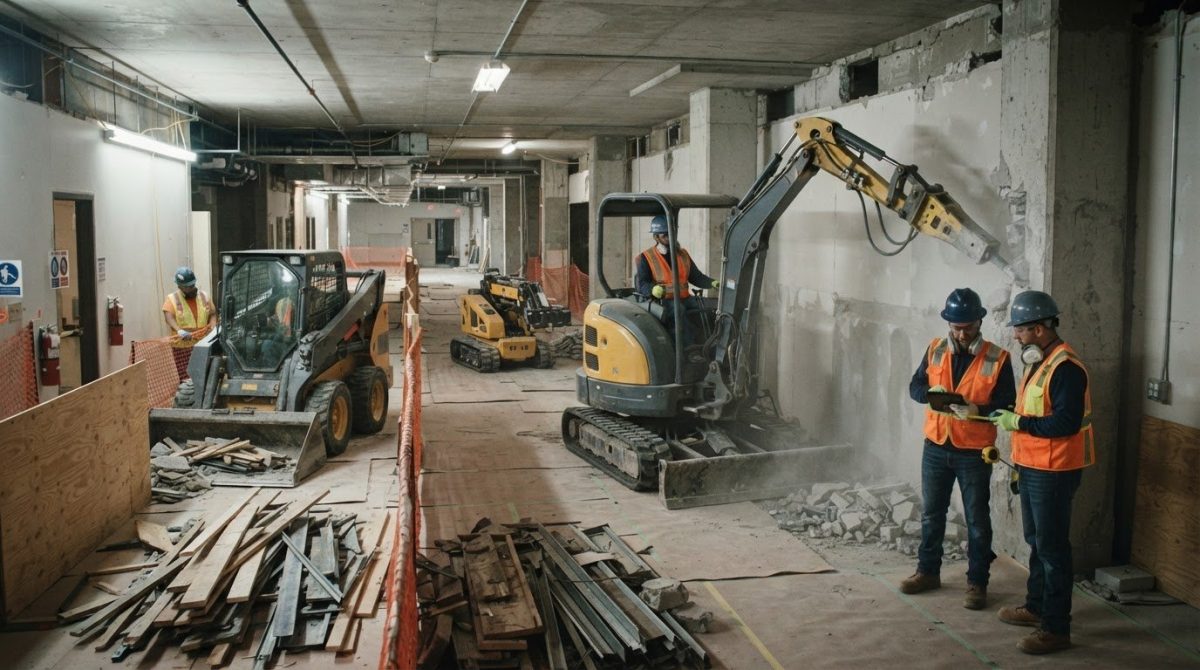
The smallest machine isn’t automatically the right choice for a tight demolition site. Effective demolition equipment selection for tight spaces starts with the full work envelope: entry width, overhead clearance, turning room, the structure being removed, and what must remain intact. If familiar machinery can’t get through the access point, it’s reasonable to question whether smaller equipment can still complete the work efficiently.
That concern is best addressed by assessing the site and demolition scope together. Equipment must fit the route and operating area while supporting controlled removal around retained structural elements and adjacent occupied spaces. Planning also needs to account for how debris will be moved and separated, not just how material will be broken up.
This guide compares equipment categories for different access and maneuvering constraints, explains the site information to gather before making a selection, and outlines how structure, safety, and debris handling shape the work sequence. TSIAC International brings more than 15 years of demolition and abatement experience to project planning, with selective demolition, interior gutting, and recycling practices for wood, metal, and plastic integrated into its work.
Key Takeaways
- Map the work envelope, including access, headroom, reach, and maneuvering clearance, before comparing machine size.
- Compare compact excavators, skid-steer loaders, remote-controlled machines, and hand tools by access needs, working position, control, and task.
- Smaller equipment can improve access, but it doesn’t automatically make demolition safer; account for reach, stability, visibility, and material handling.
- Use a site-first checklist to organize scope, access measurements, retained elements, and site conditions before choosing equipment.
- Effective demolition equipment selection for tight spaces connects the work method with structural protection, hazardous-material planning, and debris management.
Demolition Equipment Selection for Tight Spaces Starts With the Site
A demolition site is “tight” when the available work envelope limits how equipment can enter, travel, position itself, reach the material, or operate with clearance. That can describe a large building with a narrow access route just as readily as a small room with low overhead obstructions. For demolition equipment selection for tight spaces, the relevant question isn’t simply whether a machine fits inside. It’s whether it can reach the work and perform the required task within the space available.
A machine’s size describes its dimensions; its operating envelope describes the space it needs to enter, maneuver, reach, and work. That distinction helps prevent a common planning error: measuring a doorway but overlooking turning room, tool movement, or the space needed to remove debris. A general overview of demolition methods and equipment provides useful context, but site-specific planning must connect the chosen method to actual access and working conditions.
Assessing those conditions early allows the demolition scope, access route, work sequence, and equipment approach to be considered together. It also helps identify constraints that may affect preparation, protection of adjacent areas, or handling of removed materials before work begins.
Which site constraints affect equipment access?
Assess the complete route, not just the entrance. Record openings, travel paths, floor transitions, overhead obstructions, and turning areas, then distinguish the path equipment must travel from the area where it must operate. The route may be passable even when the work position lacks clearance for the required reach or movement.
- Note neighboring structures, occupied areas, utilities, and elements intended to remain.
- Identify changes in level or overhead conditions along both the travel path and work zone.
- Consider where removed material can be staged and moved without obstructing access.
These observations describe the actual work envelope. Measurements and equipment dimensions should be assessed against the specific project rather than assumed from a general machine category.
How do demolition scope and surroundings change the requirements?
Broad structural removal and selective demolition impose different demands. Work involving a larger portion of a structure may allow a different sequence than removal beside components that must remain. In selective work, the method and equipment approach must account for retained elements, nearby finishes, and the space available to control removal.
Interior gutting, concrete removal, and material sorting can also change the sequence. For example, removing interior materials in planned stages may affect when access routes open or where debris can be separated. When the project includes interior removal, commercial interior gutting planning can help frame how scope and sequencing relate.
At TSIAC International, equipment planning is part of delivering demolition and abatement work, not a decision made in isolation. Connecting site conditions to scope and debris management helps establish a controlled approach, whether the project involves structural demolition, selective removal, or interior gutting.
Compare Demolition Equipment Categories by Access and Control
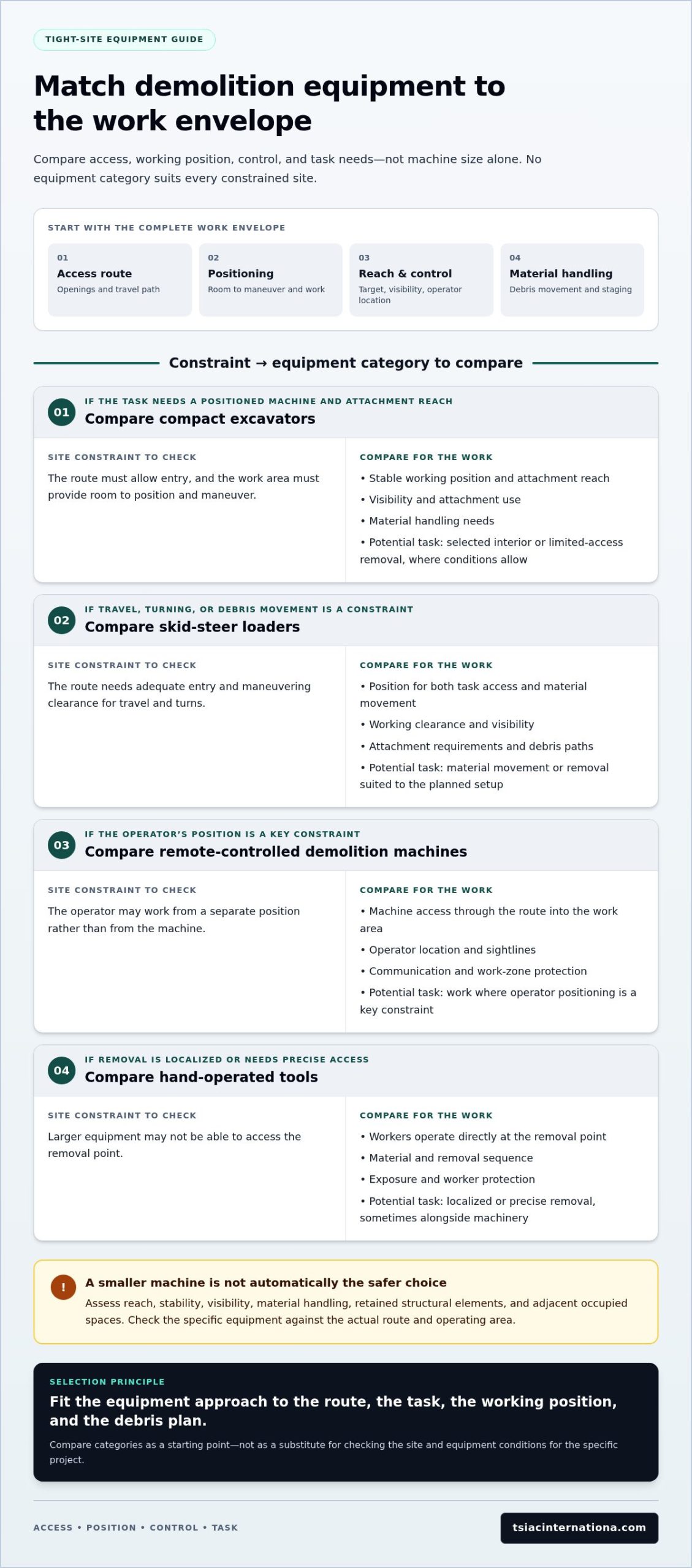
No single equipment category suits every constrained site. Compact excavators, skid-steer loaders, remote-controlled demolition machines, and hand-operated tools differ in how they enter, position, reach the work, and handle removed material. Compare them against the actual task and operating envelope, not a general assumption that a smaller machine will fit. The following table is a starting point, not a substitute for checking the equipment and site conditions for a specific project.
| Category | Access needs | Working position | Control considerations | Potential task types |
|---|---|---|---|---|
| Compact excavators | Require a suitable route and room to position and maneuver. | Work from a stable position where the attachment can reach the target. | Consider reach, attachment use, visibility, and material handling. | Selected interior or limited-access removal, where site conditions allow. |
| Skid-steer loaders | Need adequate entry and maneuvering clearance for travel and turns. | Operate from a position that allows task access and material movement. | Assess working clearance, visibility, attachment needs, and debris paths. | Material movement or removal tasks suited to the planned setup. |
| Remote-controlled demolition machines | Access depends on the machine and the route into the work area. | Can be operated from a separate position rather than from the machine. | Plan operator location, sightlines, communication, and work-zone protection. | Tasks where operator positioning is a key constraint. |
| Hand-operated tools | May reach locations that larger equipment cannot access. | Workers operate directly at the removal point. | Consider material, removal sequence, exposure, and worker protection. | Localized or precise removal, sometimes alongside machinery. |
When might compact machinery suit a constrained work area?
Compact machinery may be considered for interior removal or limited-access demolition when the route, working position, and task align. Maneuverability is only one part of the assessment: required reach, attachment movement, machine stability, and the path for moving debris also matter. A machine that can enter may still be unsuitable if it cannot work effectively from the available position. Verify dimensions and operating conditions for the specific site and equipment.
Where can remote-controlled or hand-operated methods fit?
Remote-controlled machinery may be assessed when the operator’s position is a significant site constraint, while hand-operated tools can support controlled, localized removal. Neither approach automatically replaces other equipment. Material characteristics, sequence, visibility, and worker protection shape the method. OSHA’s demolition safety guidelines provide a reference for safety planning; the work plan must address the conditions on the actual site.
Equipment categories can also be combined or sequenced. For example, a project may use one method for access or material movement and another for targeted removal, with the sequence coordinated around retained components and debris handling. TSIAC International brings more than 15 years of demolition and abatement experience to project-specific planning, connecting equipment approach to scope and site preparation.
Does Smaller Demolition Equipment Automatically Make a Tight Site Safer?
No. A smaller machine may be easier to bring through a restricted opening, but access alone doesn’t establish that it can perform the task safely or effectively. It may have less reach, require repositioning, or handle debris differently, which can affect the work sequence and exposure around the work area. A larger machine that can’t enter is not a solution either. The relevant comparison is between the task requirements and the complete operating conditions.
Safety depends on the equipment, the task, site controls, and the work sequence working together. Equipment selection is one part of a demolition safety plan, not a substitute for assessing hazards, protecting workers, or planning how removal will proceed. A tight work area also isn’t automatically a regulatory confined space. OSHA’s confined space regulations address specific hazards and work conditions, so the site must be assessed rather than classified by its size alone.
What trade-offs should the comparison make visible?
Compare what a machine can reach and handle from its planned position with what the task requires. A smaller unit may need to work closer to the material or be repositioned more often; a longer task or additional handling steps may follow. Neither outcome is automatic. Review the actual equipment capabilities alongside the work area, material, access route, and planned sequence.
- Reach: Can the tool reach the target without placing equipment or workers in an unsuitable position?
- Stability and handling: Can the machine perform the task and manage removed material under the site’s conditions?
- Visibility: Can the operator see the work, nearby openings, walls, and retained structures from the operating position?
- Repositioning: Does the sequence require repeated moves that affect access or coordination?
These factors don’t establish a universal ranking. A category that suits one task may be inappropriate for another, and no machine should be described as inherently safer or more productive without considering the project conditions.
How do structural and hazardous-material conditions affect the choice?
Selective demolition requires control around structural and building components designated to remain. The equipment approach and removal sequence must account for those elements, not just the material being taken out. A method that can reach the target may still be unsuitable if its operation conflicts with the planned protection of adjacent components.
Suspected hazardous materials add another planning dependency. Their assessment and any necessary abatement must be considered before demolition sequencing is set, since removal activities can affect where and how work proceeds. TSIAC International connects demolition and abatement planning to project scope, particularly when remediation shapes the work sequence.
For constrained projects, sound demolition equipment selection for tight spaces weighs access against task demands, retained structures, worker positioning, and material handling. That comparison supports a coordinated plan rather than relying on machine size as a shortcut for safety.
Use This Site-First Checklist to Select Demolition Equipment
A reliable selection process starts with the work to be done, then tests each equipment option against the site and planned sequence. This keeps the decision grounded in actual project conditions rather than a preferred machine category. For demolition equipment selection for tight spaces, record measurements and compare them with the specific equipment’s dimensions and operating requirements before finalizing the approach.
What information should the site assessment capture?
Work through the checklist in order. Each step informs the next, and unresolved structural or hazardous-material conditions should be addressed before the demolition approach is finalized.
- Define the scope. Identify what will be removed, whether work is structural or selective, and whether interior gutting, concrete removal, or material sorting is part of the project.
- Document access. Record entry routes, openings, overhead clearance, floor transitions, surface conditions, and turning areas. Map the route equipment must travel separately from the areas where it will operate.
- Mark retained elements. Identify structural components and finishes that must remain, along with adjacent spaces that need to be considered in the work plan.
- Review site conditions. Note utilities, occupied areas, obstructions, and any known conditions that may affect equipment positioning or worker access.
- Plan material movement. Trace how debris will leave the work area, where materials can be staged, and how wood, metal, and plastic will be separated for recycling.
- Record assessment and abatement needs. Include any structural review or hazardous-material assessment and abatement steps that could affect the demolition sequence.
This record should make the path from access to removal and debris handling visible. A broader demolition process and debris planning guide can provide useful context for how equipment use fits into the overall work sequence.
How should the team compare the shortlisted options?
Compare each option against the same project criteria. Check proposed entry and operating needs against measured site conditions, then consider whether the equipment can perform the task without obstructing the work sequence or material-removal path. Machine dimensions alone aren’t enough; verify attachment needs, reach, working position, and debris-handling requirements for the specific equipment.
- Access and positioning: Does the route and work area accommodate the equipment’s movement?
- Task and control: Does the method suit the material, removal precision, and planned sequence?
- Protection and flow: Can work proceed with retained elements considered and debris moved or sorted as planned?
- Open questions: Are structural or hazardous-material conditions still unresolved?
Keep assumptions visible. If measurements, equipment capabilities, or site conditions don’t align, revise the shortlist or work sequence before proceeding. TSIAC International brings more than 15 years of demolition and abatement experience to project-specific planning. Plan your constrained demolition project with TSIAC International.
How TSIAC Plans Demolition Work in Constrained Spaces
Constrained-site demolition is planned as a coordinated scope of work, not as an equipment decision in isolation. TSIAC International brings more than 15 years of demolition and abatement experience to projects where access, operating space, retained building elements, and material movement all influence how work can proceed. The equipment approach is considered alongside the removal requirements and site conditions, so the method and sequence support the project rather than simply fitting through an opening.
This approach applies across structural demolition, selective demolition, interior gutting, and hazardous-material abatement. Each service has different planning considerations. Broad structural removal has a different scope from selective work beside elements intended to remain, while abatement can affect what work takes place first. The goal is to understand these relationships before setting the work sequence.
How does project scope guide the work sequence?
For selective demolition, the removal boundaries and retained components help define how the work is organized. Site preparation, equipment operation, and debris handling are planned in relation to those boundaries. A clear sequence also accounts for how removed material will leave the work area, where it can be staged, and how sorting fits without obstructing the next task.
Recycling is part of TSIAC’s project-site operations. Wood, metal, and plastic are recycled on every project site, so material separation and movement are considered as part of demolition planning. This connects removal methods with the practical work that follows each task, rather than treating debris handling as an afterthought.
Where hazardous materials are involved, abatement planning is integrated with the demolition scope and sequence. This helps establish how remediation relates to the planned removal work. Equipment decisions remain project-specific: the required task, access conditions, retained structures, and material flow all inform the approach.
What is the next step for a constrained-site demolition project?
A useful starting point is a clear description of the site and intended outcome. Include access limitations, the areas or materials to be removed, structural or finish elements that must remain, and any known hazardous-material concerns. Details such as the route to the work area and where debris can be staged help frame the planning discussion. TSIAC delivers demolition and abatement work, with equipment planning connected to project scope and site preparation rather than equipment sales.
With more than 15 years of industry experience, TSIAC brings a measured, project-specific approach to constrained demolition conditions. If you’re planning selective removal, interior gutting, structural demolition, or related abatement work, discuss your demolition project with TSIAC to begin a practical conversation about scope, access, and sequencing.
Turn Your Site Assessment Into a Clear Demolition Plan
The next useful step is to turn observations into a shared project brief. Note the removal boundaries, access restrictions, areas that must remain undisturbed, and any unresolved site conditions. This gives the project team a practical basis for aligning the work sequence, equipment approach, and debris movement before activity begins.
Strong demolition equipment selection for tight spaces is ultimately a planning decision: the right approach is the one matched to the work, the conditions, and the intended outcome. A clear brief can help bring those factors together and support an orderly path from preparation through removal and material handling.
TSIAC International delivers demolition and abatement projects with a focus on project-specific planning. Share the constraints and scope you’ve identified to start a practical conversation about your site. Discuss your demolition project with TSIAC, and take the next step with a plan built around the conditions on the ground.
Frequently Asked Questions
What is the best demolition equipment for tight spaces?
There’s no single best machine for every constrained demolition site. The choice depends on the route into the work area, available headroom, room to position equipment, material, removal scope, and components that must remain. Compact machinery, remote-controlled equipment, or hand-operated tools may suit different tasks. For demolition equipment selection for tight spaces, compare each option’s operating requirements with measured site conditions. A tool suited to one surface may not suit nearby work or debris handling.
Can an excavator fit through a standard doorway?
It depends on the specific excavator and the doorway’s clear opening, as well as the route beyond it. Measure the narrowest point and account for thresholds, turns, and obstructions rather than relying on a doorway label or typical dimensions. Even if a machine can pass through the entrance, it may not have room to turn, position its attachment, or reach the work. Compare verified machine dimensions with the full travel path.
Is remote-controlled demolition equipment safer in confined spaces?
Remote control can let an operator work from a different position, but it doesn’t make every confined-space task safe by itself. Visibility, communication, material behavior, structural conditions, and site controls still affect the work plan. For example, an operator may be outside the immediate work area but still need a clear view and a controlled way to coordinate the task. Assess the specific hazards and work conditions before choosing remote operation.
What should be measured before selecting demolition equipment?
Measure access openings at their clear width and height, then document narrow route points, turns, floor transitions, overhead obstructions, and the intended work position. For example, note whether a doorway opens fully or whether a corridor narrows beyond it. Also map utilities, adjacent structures, and components to remain. Use this information with the removal scope and debris route, so equipment fit is assessed as part of the full operation, not as a doorway-only check.
Can tight-space demolition be completed without heavy machinery?
Yes, some demolition tasks can use hand-operated tools, while others call for mechanical equipment or a combination of methods. The amount and type of material matter: removing a limited area of interior finish presents different demands from removing substantial concrete or structural components. Hand tools aren’t automatically suitable just because access is restricted. A project-specific assessment should match the removal method to material, scope, required control, and how debris will be handled.
How does hazardous material affect demolition equipment selection?
Suspected hazardous material can change the order of work and how affected areas are handled, so equipment selection shouldn’t be considered separately from assessment and abatement planning. For example, planned removal near suspected asbestos-containing material may need to wait until the appropriate assessment and any necessary abatement steps are addressed. The material and site conditions determine the sequence. TSIAC International provides hazardous-material abatement alongside demolition planning to coordinate the work around identified conditions.
