

A successful handover starts before the last day of work. The general contractor usually collects closeout documents from subcontractors, and each subcontractor supplies records for its scope. Tracking lead abatement project closeout documents throughout the job helps prevent missing records from delaying punch list completion, inspections, or handover.
Treating closeout as a final paperwork push can leave important records scattered across trades and project stages. Instead, assign responsibility, set submission requirements early, and keep the document tracker current as work progresses.
This checklist explains who collects each record, which documents to track, and how to organize punch list items, inspection evidence, and final handover materials. It also shows how to build closeout readiness into project execution and address gaps before they become last-minute obstacles.
Key Takeaways
- The general contractor usually gathers subcontractor closeout records, so assign submission requirements and owners early.
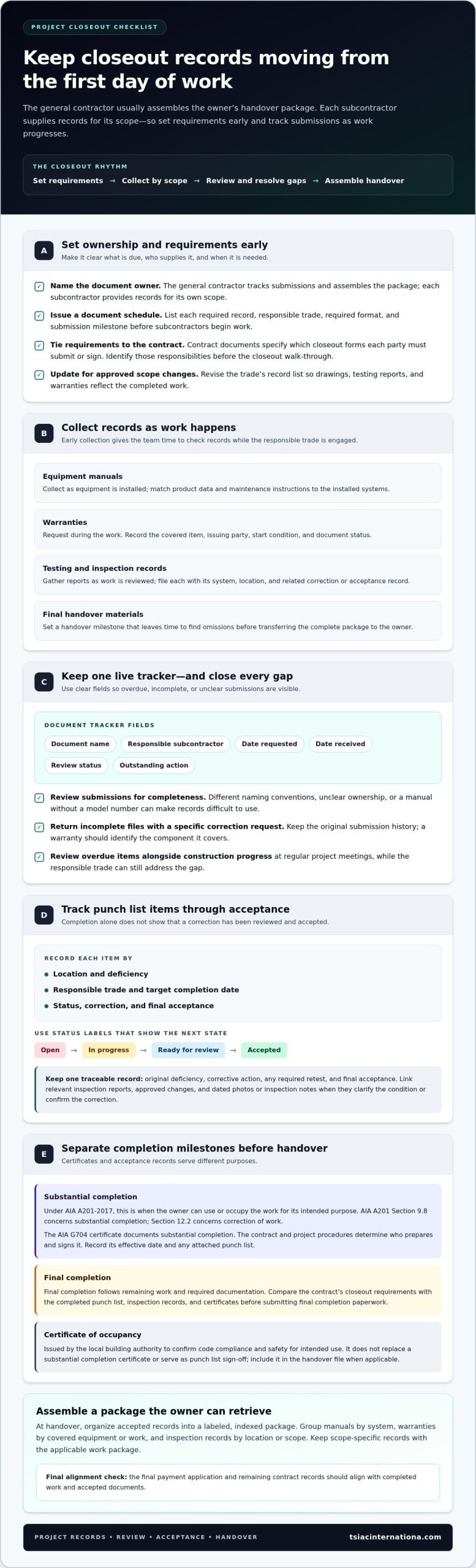
- Track each punch list item by location, deficiency, responsible trade, target completion date, and status.
- Use a requirements register tied to the contract, and keep records labeled, indexed, and easy to retrieve.
- The U.S. Department of Energy identifies FAR 4.804-5 as a procedure reference for confirming which documents are needed to close out contract files.
- Keep the closeout tracker active during project execution so missing manuals, test records, or inspection evidence surface before handover.
Punch list completion
General contractors typically coordinate punch list completion with the owner, architect, and subcontractors. Contract documents specify which closeout forms each party must submit or sign. For lead abatement project closeout documents, track each correction through acceptance, not simply to completion.
A punch list identifies work that remains before a project is considered finished. Record each item’s location, deficiency, responsible trade, target completion date, and status. For example, “north stairwell, damaged wall finish, drywall subcontractor, repair required, open” gives the team a traceable task. Add dated photos or inspection notes when they clarify the condition or confirm the correction.
- Assign every item to a responsible trade. A named subcontractor makes ownership clear and helps the general contractor follow up.
- Set a target date and status. Labels such as open, in progress, ready for review, and accepted distinguish completed work from work awaiting inspection.
- Document the correction and its acceptance. Retain the original deficiency, corrective action, any required retest, and final acceptance as one record.
- Keep the punch list tied to project records. Link relevant inspection reports, approved changes, and photographs to the item for a clear closeout trail.
Substantial completion is not the same as final completion. Under AIA A201-2017, substantial completion is when the owner can use or occupy the work for its intended purpose. AIA A201 Section 9.8 concerns substantial completion, while Section 12.2 concerns correction of work. The certificate of substantial completion records that milestone; final completion follows remaining work and required documentation.
The AIA G704 certificate is used to document substantial completion. The contract and project procedures determine who prepares and signs it, so identify those roles before the closeout walk-through. The certificate can establish warranty-period start, shift insurance and site-control responsibilities, and trigger partial retainage release. Record its effective date and any attached punch list.
A certificate of occupancy serves a different purpose. The local building authority issues it to confirm that the structure complies with applicable codes and is safe for its intended use. It does not replace a substantial completion certificate, and contractors or owners should not treat it as punch list sign-off. Include the issued certificate in the handover file when applicable.
At closeout, the contractor and owner may sign project-specific acceptance, completion, and payment documents required by the contract. There is no universal signature set for every project. Before submitting final completion paperwork, compare the contract’s closeout requirements with the completed punch list, inspection records, and certificates.
Closeout collection timelines and common delays
The general contractor usually collects closeout documents from subcontractors. Each subcontractor supplies records for its scope, while the general contractor tracks submissions and assembles the owner’s handover package. Closeout begins when physical construction is largely complete and continues until ownership formally transfers. It is an ongoing process, not a final-day paperwork task.
Set collection requirements before subcontractors begin work. The project team can issue a document schedule listing each record, responsible trade, required format, and submission milestone. For example, the mechanical subcontractor can submit equipment manuals and warranties as equipment is installed, instead of searching for them after final inspection. Clear requirements make missing records visible while the responsible trade is still engaged.
- Collect manuals as equipment is installed. Early submission gives the team time to match product data and maintenance instructions to installed systems.
- Request warranties during the work. Record the covered item, issuing party, start condition, and document status in the project tracker.
- Gather testing and inspection records as work is reviewed. File each report with its system, location, and related correction or acceptance record.
- Set a handover milestone for final documents. This gives the team time to identify omissions before transferring the complete package to the owner.
Delays often occur when a subcontractor submits an incomplete file, uses a different naming convention, or leaves ownership of a document unclear. A manual without a model number may not identify the installed equipment. A warranty that does not specify its covered component may be difficult to use later. Return incomplete submissions with a specific correction request and retain the original submission history.
Use a live tracker to record the document name, responsible subcontractor, date requested, date received, review status, and outstanding action. Review overdue items alongside construction progress at regular project meetings. If a trade’s work changes through an approved change order, update its record list so revised drawings, testing reports, or warranties reflect the completed scope.
At handover, the general contractor organizes accepted records into a labeled, indexed package for the owner. Manuals should be grouped by system, warranties by covered equipment or work, and inspection records by location or scope. The final payment application and remaining contract records should align with completed work and accepted documents. For projects that include concrete removal, keep scope-specific records with the applicable work package; concrete removal work can involve distinct project documentation.
Start collecting early, review submissions as they arrive, and resolve gaps before ownership transfers. This keeps closeout tied to the project’s intended use and gives the owner a usable record set, rather than a box of unverified files.
Closeout requirements registers and document control
What documents are required to close out a lead abatement project? The contract determines the package, which may include approved scope changes, inspection and testing records, waste documentation, punch list acceptance, warranties, and final payment records. A requirements register maps each item to its responsible party, due point, review status, and facility work area.
Build the register from the executed contract, specifications, approved change orders, and applicable project procedures. Group requirements under physical completion, contractual acceptance, and financial closeout. The physical group tracks completed work and test evidence; contractual records document approvals and obligations; financial records support final payment and contract balance reconciliation. The register should also record document revision, submission date, reviewer, and corrective action.
What are the EPA requirements for lead abatement project records and retention? Identify which EPA program requirements apply to the work, then record the required documents and retention period in the register. Because there is no universal retention period for every project, the contract and applicable program requirements determine the project-specific schedule.
What state or local rules govern lead abatement closeout documents? Applicable state and local requirements depend on the project location. In many jurisdictions, lead-based paint activity regulations are governed by state-specific administrative codes and statutory authorities. Licensed supervisors and employing lead contractors must ensure compliance with those chapters and all applicable federal, state, and local rules.
What should be included in lead waste disposal manifests and receipts? File each waste record with the related project area, material description, shipment or disposal date, and receiving-facility information, when those details appear on the record. Match each receipt to the corresponding work and keep the original in the closeout file with its review status.
What happens if a lead abatement project fails clearance testing? Preserve the original failed result, document the correction or disposition, record any required retest, and retain final acceptance. Link each test result to its location and corrective action in the register, creating a record of how the issue moved from failure to disposition.
Assign lead contractor and supervisor responsibilities in writing. The general contractor manages the complete register; each trade submits records for its scope; and the designated reviewer checks for completeness. Certified lead supervisors and employing lead contractors maintain specific compliance responsibilities across all project locations. This division helps prevent unassigned records from becoming late closeout issues.
Change orders must connect the original scope to the approved modification and its closeout evidence. Update the register when an owner-approved change affects work, testing, or payment. The U.S. Department of Energy identifies FAR 4.804-5 as a procedure reference for confirming documents required to close out contract files. Use that reference for federal contract-file procedures, while the project contract governs its own closeout package.
Commissioning reports, inspections, and permits
Inspection records show what authorities, architects, or engineers reviewed, what they found, and whether the work received approval. For each report, record the inspection date, location, scope, result, and any condition requiring action. A permit record should identify the related work and approval status. These details help the owner trace a certificate or approval to the work it covers.
Are post-abatement clearance test results required for project closeout? The contract determines the closeout package, and applicable program rules govern required records. Include the clearance result, sampling locations, date, and final disposition whenever testing is performed or required for the project.
Who can perform lead abatement clearance inspections and testing? The applicable state or local lead program determines who is authorized to perform each inspection or test. In Virginia, lead supervisor, inspector, and risk assessor applicants must pass a board-approved examination on Virginia lead laws and regulations.
Keep commissioning and test records linked to the system or work area they document. A completed Inspection and Test Plan can serve as an index, connecting each requirement to its final inspection or test record. For example, a record for a tested room should identify the location, method or test reference, result, reviewer, and related corrective action. This connection helps prevent an incomplete report from being mistaken for proof of acceptance.
- File the original result. Retain a failed result alongside its correction or disposition, any required retest, and final acceptance.
- Match reports to approved scope. Link each inspection to the relevant permit, specification, or approved change.
- Record outstanding conditions. Assign each deficiency to a responsible party and track it through documented closure.
- Separate approvals from certificates. Keep the inspection report and the authority-issued certificate together, but identify each record distinctly.
Schedule code inspections before the owner’s walk-through so code-related corrections can be addressed first. Then use the owner’s review to confirm completed work and identify remaining contractual items. When issued, a certificate of occupancy confirms that the local building authority considers the completed structure compliant with applicable codes and safe for its intended use. It does not replace inspection reports or project testing evidence.
Before handover, compare every permit and inspection requirement with the closeout register. Mark records accepted only when the result, reviewer, and any corrective action are traceable. If a report is revised, retain the earlier version and identify the current approved record. This gives the owner a reliable record set and clarifies the project’s evidence of completed inspections, testing, and approvals.
Closeout readiness during project execution
Closeout is easier to manage when the document tracker starts alongside construction, not after substantial completion. Assign each required record an owner, due point, review status, and project location. A signed inspection report, for example, should identify the inspected area and work it covers. This helps teams spot missing evidence while the responsible trade can still provide it.
Review the tracker at regular project meetings. Compare field progress with planned submissions, then record decisions and follow-up actions. If an approved change order alters a work area, update the record list and drawing references promptly. This keeps the closeout file aligned with the completed scope rather than the original plan.
- Capture field changes as they occur. Add dated photos or site scans to support record drawings and show actual completed conditions.
- File reports by location and requirement. Connect each inspection or test report to its work area and acceptance criteria.
- Track revisions and approvals. Label each document with its revision, review status, and approval record.
- Collect manuals and warranties during installation. Match each file to the equipment or material installed, then log missing details for correction.
- Keep the punch list active. Link each open item to its assigned trade, corrective action, and evidence of completion.
Document control should preserve the full sequence of events. Keep the original test result, correction or disposition, required retest, and final acceptance together. If a record is replaced, retain the earlier version and clearly mark the current approved copy. This creates a usable audit trail and helps prevent an incomplete draft from being mistaken for final evidence.
Before handover, compare the register with the contract, approved changes, inspection records, and completed work. Confirm that each required file is present, readable, correctly named, and assigned to the proper facility area. Prepare a transfer index listing document titles and locations so the owner can retrieve a specific report without sorting through unrelated files.
For projects involving several scopes, include closeout tasks in the work plan and meeting agenda from the start. If concrete removal is part of the project, plan concrete removal work alongside its related records and handover requirements. A current tracker turns closeout from a final document chase into a controlled project activity.
TSIAC International: Structural Demolition
TSIAC International provides structural demolition, selective demolition, interior gutting, and lead abatement for projects involving controlled removal or abatement work. These services can suit facility renovations that combine hazardous-material work with demolition scopes, where clear coordination between completed work and closeout records matters.
For projects that also involve asbestos, TSIAC International provides asbestos abatement. Defining the work scope and documenting completed activities helps keep inspection records, accepted work, and handover materials aligned. The appropriate scope depends on the planned work and site conditions.
Contact TSIAC International or visit tsiacinternational.com to discuss your project.
Carry Closeout Discipline Into the Next Phase
Project handover is not the end of document control. The owner’s team needs a usable record set to support future maintenance, repairs, and facility decisions. Before transfer, identify who will retain the files, how revisions will be recorded, and where approved documents can be retrieved. Clear ownership helps keep lead abatement project closeout documents useful beyond final acceptance.
For projects combining abatement with removal work, coordinate the work scopes and handover records from the outset. TSIAC International offers lead abatement, structural demolition, asbestos abatement, and selective demolition. The next step is a project discussion focused on the site scope and the work requiring coordination.
Contact TSIAC International to discuss your project and plan the next phase with a clear scope.
Frequently Asked Questions
Who is responsible for collecting closeout documents from subcontractors?
The general contractor typically coordinates collection and delivery, while each subcontractor provides records for its own scope. For example, a trade performing equipment work supplies the related product information and test records. The general contractor’s document control lead can compare submissions against the contract register, return incomplete files to the responsible trade, and assemble accepted records for the owner. This keeps responsibility for each document distinct from responsibility for the full package.
How Should Teams Manage Closeout Documentation Across Multiple Trades?
Use a shared register with consistent file names and a designated reviewer for each document type. Give every record a trade, work area, revision, submission status, and related contract requirement. For example, label a test report with the system and room it covers, not only the subcontractor’s company name. At coordination meetings, resolve duplicate versions and dependencies across trades, such as a finish inspection waiting on another trade’s work.
What happens if the closeout documentation is incomplete?
Incomplete records can leave the owner without evidence that specified work was tested, approved, or transferred as required. The general contractor may need to obtain corrected submissions, document missing items, and complete outstanding contractual actions before final acceptance or payment processing. For example, a warranty that does not identify covered equipment needs clarification from the submitting trade. Retain the original file and correction history so reviewers can follow how the gap was resolved.
How early should teams start preparing for closeout?
Start during contract review and preconstruction, before field work begins. Identify each required record, the responsible trade, and when the team can collect it. Then build collection into submittal reviews, inspections, and progress meetings. For example, request equipment manuals with product data, then match the final manuals to the installed equipment. Early planning gives the team time to address gaps while the relevant trade is still involved.
What Is Included in a Project Closeout Package?
A project closeout package contains the records required by the contract and completed scope. It may include approved drawings, permits, inspection reports, testing records, warranties, operation and maintenance manuals, accepted punch list items, and final payment documentation. The exact package varies by project. For a useful handover, organize records by system or work area and include an index showing each file’s title, revision, and approval status.
What Should the Final Documentation Package Include?
The final package should contain accepted records that help the owner understand the completed work and manage the facility. Include record drawings showing actual conditions, relevant certificates, final inspection and test reports, manuals, warranties, and contract-required closeout correspondence. Add a document index and identify superseded revisions. For example, pair a final test report with the system location and associated approval so the owner can retrieve evidence without searching unrelated files.
What must a lead abatement completion report include?
A useful completion report identifies the project and work areas, describes the completed scope, and references related inspection, testing, waste, and corrective-action records. Include report dates, responsible parties, test locations and results when testing was performed, and the documented disposition of any failed result. Link each attachment to the work it supports. The contract and applicable program requirements determine which records must accompany the report and how they must be retained.
How do lead abatement closeout requirements differ for HUD-funded projects?
HUD-funded closeout must account for both the project contract and the applicable funding program documents. Review the award or assistance agreement, approved scope, reporting conditions, and project specifications, then map each required submission to its responsible party. Keep evidence that funded work matches the approved scope, including changes and acceptance records. HUD funding alone does not establish a universal closeout package; the applicable program documents and contract determine the required project records.
