
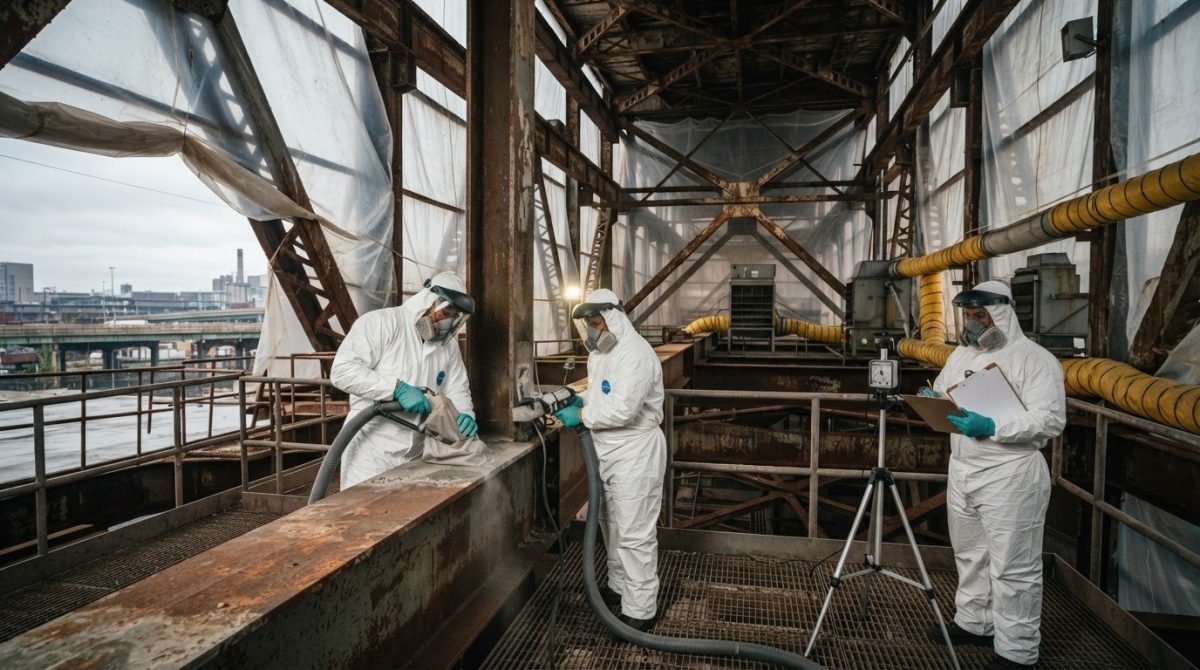
Demolition can turn an old coating into an airborne hazard if lead-coated steel is cut, sanded, or blasted without controls. Lead abatement for industrial steel structures involves identifying lead hazards, containing dust and debris, protecting workers, and managing removed material before demolition or surface work proceeds. OSHA’s construction lead standard is 29 CFR 1926.62, according to the Occupational Safety and Health Administration.
It’s reasonable to expect the work to be planned around the structure, the removal method, and the people who must remain protected. This guide explains what industrial lead abatement involves, who should perform the work, and how OSHA exposure requirements shape worker protections. It also covers how contract documents can assign responsibilities, why older industrial and commercial buildings need abatement assessment before demolition, and how containment, waste handling, and clearance fit into the project. EPA’s Renovation, Repair and Painting Rule applies to relevant child-occupied facilities built before 1978, according to the Environmental Protection Agency, but industrial projects also require attention to the OSHA rules and applicable state and local requirements that govern the work.
Key Takeaways
- Lead-coated steel can release hazardous dust or fumes during cutting, sanding, and blasting, so plan controls before disturbing the coating.
- Removal methods such as chemical stripping and power-tool preparation have different containment and waste-handling needs.
- Use OSHA exposure requirements to shape worker protections, air monitoring, and task planning.
- Clear contract specifications help define who handles the abatement plan, containment, debris, and regulatory notifications.
- Assess older industrial and commercial structures for lead and asbestos before demolition, then coordinate abatement with the planned work.
Can normal renovation crews handle lead removal?
Routine renovation can disturb lead coatings and spread contamination. Industrial work needs a plan tailored to the coating, removal method, and exposure controls.
Older tanks, structural steel, and piping may have lead-containing industrial coatings. Torch cutting and welding can release lead into fumes workers may inhale. Saws, scraping, sanding, and abrasive blasting can create hazardous dust. A crew equipped for ordinary renovation may lack the containment, monitoring, and waste procedures this work requires.
Lead removal calls for personnel with training suited to the work. For relevant child-occupied facilities built before 1978, the EPA’s Renovation, Repair and Painting Rule applies, according to the Environmental Protection Agency. Applicability depends on the facility and project; industrial coating removal also requires attention to worker-protection rules and applicable state requirements. Stabilization or removal should be selected for the coating, substrate, and planned work, not treated as routine paint preparation.
Exposure can reach workers beyond the active work zone. Lead dust can cling to clothing, shoes, hair, and skin, then travel home after a shift. Planning should address contaminated materials and the route workers take out of the controlled area. Separating clean and contaminated areas helps limit the spread of dust.
Special-Waste Handling
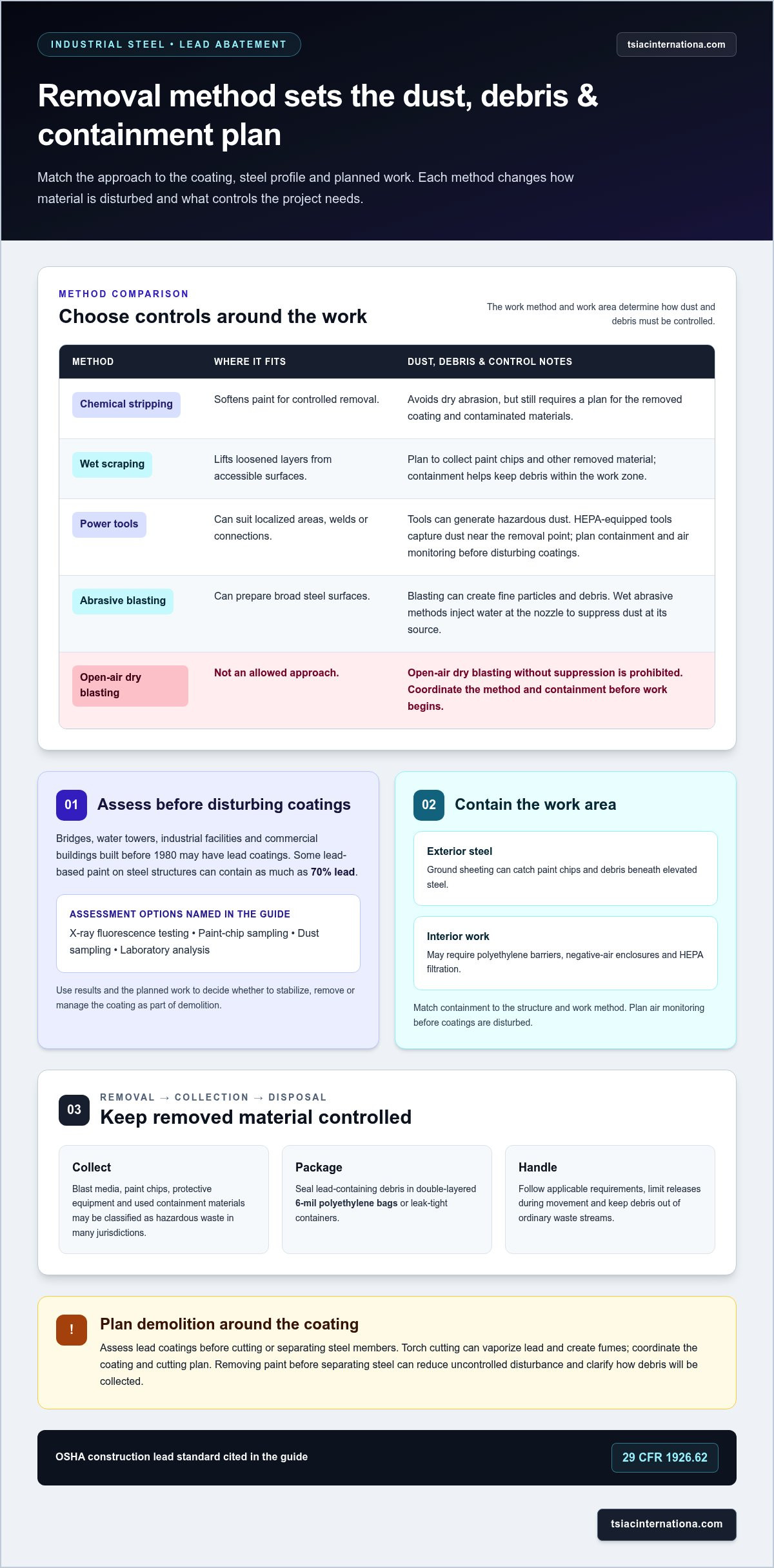
Special-waste handling means containing removed coating and contaminated materials, then transporting and disposing of them under applicable requirements. Blast media, paint chips, protective equipment, and used containment materials may be classified as hazardous waste in many jurisdictions. Crews should seal lead-containing debris in double-layered 6-mil polyethylene bags or leak-tight containers. Waste should be handled and disposed of in a way that limits releases and keeps debris out of ordinary waste streams. Proper packaging limits releases during movement and keeps removal debris out of ordinary waste streams.
Work-Area Containment
Containment uses barriers and collection controls to keep lead dust within the removal zone. Exterior projects may use ground sheeting to catch paint chips and debris beneath elevated steel. Interior work may require polyethylene barriers, negative-air enclosures, and HEPA filtration. These controls matter because sanding, blasting, or cutting can send fine particles beyond the immediate work area. Plan air monitoring and containment before disturbing coatings, and match the setup to the structure and work method.
For example, removing paint from an outdoor tank requires control of falling chips as well as airborne dust. A demolition sequence that includes torch cutting must also account for lead coatings at cut locations. Stabilization, removal, containment, and disposal are linked decisions: changing the removal method changes the debris, exposure pathways, and controls the facility needs.
What Is Industrial Lead Abatement?
Industrial lead abatement identifies lead coatings and controls their removal, stabilization, or disturbance during dismantling. Testing and the planned work help determine the appropriate method for each steel component.
Lead Paint on Steel Structures
Lead-based paint is a durable coating that resists corrosion and can flex as steel expands and contracts. These properties helped it protect infrastructure exposed to weather and temperature changes.
Bridges, water towers, industrial facilities, and commercial buildings built before 1980 may have lead coatings. Lead-based paint on steel structures can sometimes contain as much as 70% lead. The scale of potential exposure makes testing important before repair, repainting, or demolition begins.
X-ray fluorescence testing, paint-chip sampling, dust sampling, and laboratory analysis can help identify lead hazards. Results inform whether a coating should be stabilized, removed, or managed as part of a demolition plan. At older facilities, connect the coating’s condition to the next planned task rather than treating every painted surface the same way.
Industrial Steel Paint Removal Methods
Industrial paint-removal methods should suit the coating, steel profile, and work sequence. Chemical stripping softens paint for controlled removal, while wet scraping can lift loosened layers from accessible surfaces. Needle guns and other power tools can address coatings on steel components, but the plan must account for the dust or debris they generate.
Abrasive blasting can prepare broad steel surfaces, while power tools may suit localized areas, welds, or connections. Wet abrasive methods inject water at the nozzle to suppress dust at its source. Open-air dry blasting without suppression is prohibited, so coordinate the method and containment before work begins.
Steel dismantling changes the work sequence: assess lead coatings before cutting or separating members. Torch cutting can vaporize lead and create fumes, so consider the coating and cutting plan together. In demolition projects, removing paint before separating steel can reduce uncontrolled disturbance and clarify how debris will be collected.
HEPA Tools and Chemical Stripping
HEPA-equipped tools capture dust near the removal point, while chemical stripping loosens paint without dry abrasion. These approaches suit different surfaces, access conditions, and project sequences. Neither eliminates the need to control debris or handle contaminated materials appropriately.
For example, a power tool connected to HEPA vacuuming can collect dust during localized paint removal. With chemical strippers, workers apply the product, allow it to act, then remove the softened coating. Choose a process that suits the steel geometry and the finish needed for the next operation.
Method selection also affects environmental controls and the waste stream. Collect and dispose of chemical residues, paint chips, and used materials under applicable requirements. Include an approved disposal route and a defined work sequence in the project plan, especially when removal leads directly to structural dismantling.
For projects that proceed from coating removal to dismantling, industrial lead abatement work should be coordinated with the steel work sequence.
OSHA lead-in-construction requirements and exposure thresholds
Industrial coating removal and construction work can expose workers to airborne lead. OSHA’s construction lead standard, 29 CFR 1926.62, sets exposure thresholds and worker-protection requirements for covered work.
Worker Protection and Exposure Monitoring
Exposure monitoring measures airborne lead so employers can assess tasks against OSHA’s construction thresholds. The standard sets the action level at 30 micrograms per cubic meter of air, averaged over an 8-hour shift. OSHA’s construction lead standard sets the permissible exposure limit at 50 micrograms of lead per cubic meter of air, averaged over an 8-hour shift, according to the Occupational Safety and Health Administration.
Those thresholds make the work method central to planning. Torch cutting, surface preparation, and rivet busting can create different exposure conditions, so monitoring should reflect the tasks workers perform. OSHA requires employers to provide training, air monitoring, and other protections when worker exposure reaches or exceeds the 50 mcg/m³ permissible exposure limit.
Protection also includes selecting appropriate personal protective equipment and respiratory controls for the exposure conditions. OSHA’s respiratory protection standard is 1910.134. Employers should connect the assessment, selected protection, and worker training to the actual job tasks, rather than relying on a generic renovation plan. For example, cutting lead-coated steel and using power tools to remove coatings involve different work activities and potential exposure pathways.
Monitoring results can inform decisions as work progresses. If a task or removal method changes, the exposure assessment may need updating. A surface-preparation plan, for instance, should account for the tools used, containment, and workers’ positions relative to the surface. Documenting these decisions gives supervisors a clear basis for coordinating worker protection across shifts and work areas.
OSHA and EPA Compliance
OSHA’s construction lead requirements address occupational exposure during construction activities, including renovation and demolition tasks. The OSHA standard is 29 CFR 1926.62. Its action level and permissible exposure limit provide benchmarks for exposure assessment and protections, helping employers structure compliance around the work being performed.
EPA requirements address a different regulatory scope. The EPA Renovation, Repair and Painting Rule applies to relevant child-occupied facilities built before 1978, according to the Environmental Protection Agency. That rule’s applicability depends on the facility and project. It does not replace the need to address OSHA worker exposure during construction work.
For a facility project, coordinate the work plan with both the site and the tasks. Identify coating-removal and cutting work, determine where exposure monitoring applies, and align worker training and PPE with the assessment. Then evaluate whether the facility falls within the EPA RRP scope. Keeping these responsibilities distinct supports compliance without treating one regulation as a substitute for another.
Clear records connect requirements to field execution. A project file can identify applicable standards, scheduled tasks, monitoring arrangements, training, and selected protections. If the sequence changes, supervisors can use the record to reassess the affected task before work continues. This makes compliance part of project coordination, not a step taken after removal begins.
Contract specifications and project responsibilities
A lead-abatement contract should define affected surfaces, the removal method, containment, and debris handling. A clear scope connects the facility assessment to field work and the project estimate.
Assessment and Abatement Workflow
An assessment and abatement workflow connects survey findings to removal tasks, containment, and closeout records. Before industrial demolition, assess for lead-based paint and asbestos-containing materials. A hazardous-materials survey by licensed inspectors helps identify affected areas. The contract can then set out the work sequence, including which surfaces need treatment before blasting, cutting, or dismantling begins.
For example, a survey may identify coated structural steel, while the demolition plan identifies nearby connections for cutting. Tie these findings together in the scope: map affected components, select the planned treatment, and specify how debris will be collected. This gives the contractor and facility team a shared reference when coordinating operations near the project area.
Project-Specific Lead Compliance Plans
A project-specific lead compliance plan documents how work will be performed at the facility. It should identify work areas, the coating-removal method, containment approach, monitoring protocols, and waste-handling responsibilities. A site-specific abatement work plan is part of a compliant project, and its details should reflect the steel geometry and access conditions.
Contract specifications should assign responsibilities. State who provides facility records, coordinates access to work areas, manages abatement debris, and handles required notifications. If blasting is planned on one surface and power-tool removal on another, distinguish those tasks and their controls. Defined responsibilities reduce gaps between the facility owner’s schedule and the contractor’s field sequence.
Cost and Productivity
Project cost and productivity depend on the scope, access, coating condition, removal method, containment, and waste volume. A fixed-price estimate is more useful when contract documents identify included surfaces and tasks, along with assumptions and exclusions. Changes to access or newly discovered coatings can affect labor, controls, and debris handling, so the contract should explain how to document scope changes.
Productivity figures are project-specific, not universal production rates. One project estimated average cutter-crew productivity at 25 square feet per hour. That figure illustrates why an estimate should account for the task, crew, equipment, and work conditions instead of applying a single rate to every facility.
Before accepting an estimate, compare its work description with the survey and demolition sequence. Confirm that the documents cover lead-related preparation, containment, collection, and disposal. If the project also includes asbestos assessment or concrete removal, specify how each activity fits the schedule and responsibility matrix. A written scope gives owners and contractors a practical basis for tracking performance and managing field changes.
What permits and state or local rules govern industrial lead abatement and hazardous waste disposal?
Industrial lead-abatement requirements combine federal worker protections with state and local rules for project notifications, licensing, waste classification, and clearance. There is no single permit process that applies uniformly across the United States. Start by identifying the project location, type of work, and waste generated, then assign each requirement to a responsible party and schedule.
State rules can change how waste is classified and managed. Massachusetts and Connecticut classify commercial and industrial lead-abatement waste as Special Waste. That designation affects the waste-handling plan, including packaging, transport, and disposal arrangements. Contract documents should identify who determines the applicable waste category and retains records of its movement to an approved facility.
Connecticut requires a written abatement plan to be submitted and approved before work begins on regulated abatement projects. Account for that approval in preconstruction scheduling, not after mobilization. Align the plan with the work scope, containment approach, and waste route before field activities start.
Notification and licensing requirements also vary by jurisdiction. A compliant project may require notices to regulatory bodies at the EPA, state, or local level, as well as compliance with state-specific licensing and notification rules. Identify the governing agencies for the site, determine which notices apply, and assign submission responsibilities in the contract. Michigan DEQ and state environmental regulations are identified as applicable to industrial lead paint abatement in Michigan.
Demolition can require additional regulatory coordination. Demolition and renovation work may require coordination with hazardous-material assessment and abatement planning. When a structure contains both lead and asbestos hazards, coordinate assessments and work planning while keeping each material’s controls and waste documentation distinct. This helps prevent demolition from moving ahead of required abatement planning.
Disposal planning should connect waste classification to the receiving facility and transport paperwork. Lead-contaminated paint chips, blast media, personal protective equipment, and containment materials may be classified as hazardous waste in many jurisdictions. Clearance testing after abatement also varies by project type and jurisdiction. Set the expected clearance process and records in the project documents, then coordinate them with the demolition schedule. Plan lead abatement for your project as part of that regulatory and waste-management sequence.
TSIAC International: Structural Demolition
TSIAC International provides structural demolition and lead abatement for projects involving older steel structures. When demolition planning needs to account for lead coatings or asbestos-containing materials, its selective demolition and asbestos abatement services may also fit the scope.
Use the assessment, work plan, and applicable requirements above to define the work before demolition begins. A clear scope establishes which materials need abatement and which structures or interior areas are scheduled for removal. TSIAC International provides demolition and abatement services, not new building construction.
Contact TSIAC International to discuss structural demolition or abatement for your project.
Move Your Project Toward a Defined Work Plan
The next step is to turn the site’s condition and intended work into a coordinated project scope. For lead abatement for industrial steel structures, connect abatement decisions with the demolition sequence, facility access, and management of affected materials. A clear handoff between assessment and field work keeps these decisions visible as the project progresses.
TSIAC International supports projects requiring structural demolition, selective demolition, or asbestos abatement alongside demolition planning. These services can help when older structures need controlled removal or multiple building materials affect the work sequence. Build the scope around the project’s actual needs rather than applying the same approach to every facility.
Discuss your project’s demolition and abatement requirements with TSIAC International. A clearly defined next step can help move complex site work forward with purpose.
Frequently Asked Questions
Can you remove lead paint without full containment on all projects?
No, the same full-containment setup is not automatically required for every project, but controls must match the work. For lead abatement for industrial steel structures, the removal method, work location, and risk of escaping dust or debris shape containment design. Localized work on an accessible component differs from blasting a broad exterior surface. Air monitoring, ground protection, and barriers help determine whether controls address the project’s exposure pathways.
How do I know if my facility has lead paint?
Testing can determine whether facility coatings contain lead. A qualified inspector can use X-ray fluorescence screening or collect paint-chip samples for laboratory analysis. Dust sampling can assess contamination in work areas, but it does not identify every coated surface. For planned renovation, compare sample locations with the work scope, including steel members, tanks, and piping scheduled for cutting, stripping, or other disturbance.
What Projects Require Abatement?
Abatement is relevant when lead-containing materials will be disturbed and the project requires their removal or control. Examples include preparing coated steel for repainting, removing lead paint before torch cutting, and demolishing older industrial or commercial buildings. A survey helps identify coated areas affected by the work. Planning then accounts for the removal method, worker exposure, containment, and task-related debris management.
What regulations apply to lead abatement on industrial steel structures in the United States?
Applicable requirements depend on the work, facility, and jurisdiction. OSHA’s construction lead standard is 29 CFR 1926.62, while its general-industry lead standard is 29 CFR 1910.1025, according to the Occupational Safety and Health Administration. The EPA Renovation, Repair and Painting Rule applies to relevant child-occupied facilities built before 1978, according to the Environmental Protection Agency. State and local rules can also govern licensing, notifications, waste classification, and clearance testing.
What OSHA requirements apply to lead exposure during industrial steel surface preparation and painting?
OSHA’s construction lead standard sets an action level of 30 micrograms per cubic meter of air, averaged over an 8-hour shift. Its permissible exposure limit is 50 micrograms of lead per cubic meter of air, averaged over an 8-hour shift, according to the Occupational Safety and Health Administration. Employers must address exposure monitoring, worker training, and protective measures. Assessments should reflect actual tasks, such as sanding, blasting, or preparing steel for painting.
How can lead paint on industrial steel structures be tested and characterized?
Use X-ray fluorescence testing for on-site screening or collect coating samples for laboratory analysis. A survey should document each sample location because coatings can differ across a tank, pipe system, or steel frame. Dust sampling can help characterize contamination around the work area. Match results to planned activities, such as repainting or dismantling, to identify the surfaces and tasks that need specific controls.
What are the main methods for removing or containing lead-based coatings on steel?
Common approaches include chemical stripping, wet scraping, power tools with HEPA collection, and abrasive blasting with dust suppression. Stabilization or encapsulation retains the coating rather than removing it, so it serves a different purpose. Choose a method based on coating condition, steel geometry, required surface finish, and the next operation. Planning should also cover collection and management of paint chips, spent media, and other debris.
How do abrasive blasting, chemical stripping, and encapsulation compare for lead abatement on steel?
Choosing a method for lead abatement for industrial steel structures depends on the surface, required finish, and project’s next phase. Abrasive blasting removes coatings across broad areas but generates debris; wet methods or dust collection help control emissions. Chemical stripping softens paint and can suit detailed steel shapes, while encapsulation covers or stabilizes the coating instead of removing it. Future maintenance also informs the choice.
