

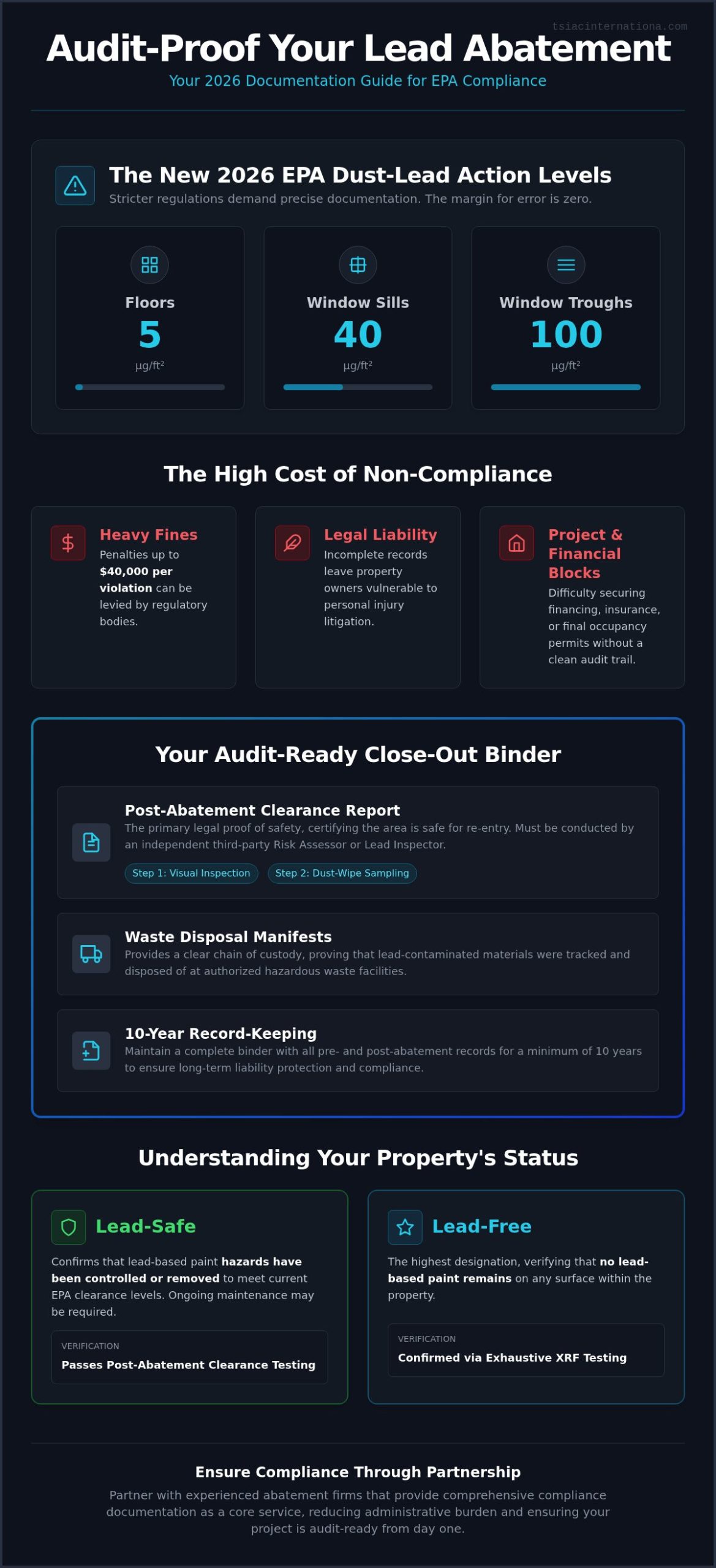
In 2026, a successful lead abatement project isn’t finished when the last containment barrier comes down; it’s finished when your documentation survives a rigorous federal audit. With the EPA’s new Dust-Lead Action Levels now set at a stringent 5 µg/ft² for floors and 40 µg/ft² for sills, the margin for technical error has effectively vanished. You likely feel the mounting pressure of these regulatory shifts and the liability concerns that follow any complex remediation. Understanding the specific documentation required after lead abatement project is the only way to transform that uncertainty into a definitive legal shield for your property and its occupants.
We recognize that the distinction between lead-free and lead-safe certifications often feels like a moving target, particularly with the recent transition to Dust-Lead Reportable Levels. This guide provides the professional clarity needed to assemble a complete, audit-ready documentation binder that facilitates successful final inspections. You’ll discover how to manage clearance reports, updated 2026 EPA pamphlets, and the 10 year record-keeping requirements necessary to ensure absolute certainty. We’ll move from the technical requirements of post-abatement testing to the specific certifications that guarantee your environment is verified safe for occupancy.
Key Takeaways
- Establish a centralized close-out binder to organize all pre- and post-abatement records, ensuring your property is audit-ready for federal or insurance reviews.
- Verify the mandatory two-step clearance process, which combines a rigorous visual inspection with dust-wipe sampling to meet the stricter 2026 EPA clearance levels.
- Secure all waste disposal manifests to prove that lead-contaminated materials were tracked and disposed of at authorized facilities in compliance with national safety regulations.
- Identify the specific documentation required after lead abatement project to accurately distinguish between lead-safe and lead-free status for future property transactions.
- Partner with experienced abatement firms that provide comprehensive compliance documentation as a core service, effectively reducing the administrative burden on property owners.
The Critical Role of Documentation in Lead Abatement Projects
In 2026, the physical removal of hazardous coatings is only half the objective. The administrative closure of a project carries equal weight, as the documentation required after lead abatement project serves as the definitive legal record of environmental safety. Without these records, a property owner remains vulnerable to civil penalties and personal injury litigation, regardless of the physical work performed. Regulatory bodies like the EPA and HUD now enforce thresholds so precise that verbal assurances offer zero protection in a court of law or during a regulatory audit.
The distinction between ‘Lead-Safe’ and ‘Lead-Free’ status is a frequent point of confusion that carries significant financial implications. A lead-safe certificate confirms that lead-based paint hazards have been controlled or removed to meet the 2026 Dust-Lead Action Levels of 5 µg/ft² for floors and 40 µg/ft² for interior window sills. Conversely, a lead-free designation requires verified proof that no lead-based paint remains on any surface, typically confirmed via exhaustive XRF testing. These designations dictate how a property is marketed and what ongoing maintenance is mandatory under federal law.
Proper record-keeping directly impacts property liquidity. Buyers and lenders in the current market view hazardous material history with extreme scrutiny. By documenting the specific lead abatement techniques employed, owners demonstrate a proactive approach to risk management. This transparency simplifies future sales and ensures that the environment meets the rigorous standards set by federal EPA guidelines and local building codes, which often intersect during large-scale renovations.
Liability Protection and Risk Management
Insurance providers increasingly view lead-abatement records as a prerequisite for coverage. A complete project history acts as a primary defense against future lead-exposure claims, which can result in fines of up to $40,000 per violation. If you’re missing a comprehensive audit trail, securing financing or refinancing becomes difficult. Lenders prioritize assets with a clear, documented path to environmental compliance to protect their investment from future litigation.
Project Closure and Occupancy Permits
Transitioning a site from a restricted construction zone to a habitable space requires a formal sign-off from local authorities. The documentation required after lead abatement project facilitates this occupancy approval by proving that all hazardous material abatement meets national standards. These records bridge the gap between technical execution and regulatory acceptance, ensuring that the final inspection is a professional formality rather than a project bottleneck.
The Post-Abatement Clearance Report: Your Primary Proof of Safety
The clearance report is the definitive technical document that certifies a work area is safe for re-entry. It serves as the primary component of the documentation required after lead abatement project, providing objective evidence that lead hazards were successfully mitigated. Under the 2026 EPA standards, this isn’t a mere formality; it’s a rigorous scientific verification. To maintain integrity, an independent third-party professional must conduct this testing. This separation of duties ensures that the firm performing the abatement isn’t verifying their own work, which is a critical requirement for legal and insurance compliance.
Obtaining professional abatement certifications is mandatory for those performing the work, but the clearance professional must also hold specific credentials as a Risk Assessor or Lead Inspector. The 2026 “Pass” criteria are significantly more demanding than in previous years. To secure occupancy approval, dust-lead levels must now fall below 5 µg/ft² for floors, 40 µg/ft² for interior window sills, and 100 µg/ft² for window troughs. If even one sample exceeds these Dust-Lead Action Levels, the entire work area must be recleaned and retested until compliance is achieved.
Visual Inspection Protocols
Before any lab samples are collected, a thorough visual inspection is mandatory. The inspector examines the work area for any visible dust, paint chips, or debris that might’ve been missed during the final cleaning. This step also verifies that all containment measures, such as plastic sheeting and tape, have been properly removed. If any settled dust is visible to the naked eye, the project fails the visual check immediately. Sampling only begins once the site is visually pristine, as even microscopic particles can lead to a failure in the subsequent laboratory phase.
Dust Wipe Sampling and Laboratory Analysis
The second phase involves collecting dust-wipe samples from specific surfaces within the work zone. These samples are sent to an accredited laboratory for analysis to determine the exact lead concentration in micrograms per square foot. Understanding how to interpret these reports is essential; they prove that the environment meets the current safety thresholds. Securing the documentation required after lead abatement project is much simpler when you partner with a firm that understands these lead abatement requirements from the start. If a sample fails, it’s often a sign that specialized HEPA vacuuming or wet-wiping protocols need to be repeated in that specific area to meet the 2026 standards.
Regulatory Compliance and Waste Management Records
The physical removal of lead-based paint is only part of the compliance equation. Once hazardous materials are stripped from a structure, they don’t simply disappear; they enter a strictly regulated waste stream. The documentation required after lead abatement project must include a comprehensive record of how this waste was handled, transported, and ultimately destroyed. These records prove that the property owner and the contractor fulfilled their environmental obligations, preventing the severe legal repercussions associated with improper hazardous waste disposal. Professional firms prioritize this paper trail because they know that an environmental audit examines the waste stream as closely as the project site itself.
Modern hazardous material management relies on the principle of “cradle-to-grave” responsibility. This means you’re technically responsible for the lead waste until it reaches its final, authorized destination. Professional abatement services include these records as a standard deliverable because they’re essential for demonstrating adherence to federal lead abatement regulations. These rules dictate the specific handling and disposal protocols required to prevent environmental contamination during the transport phase. Securing the full documentation required after lead abatement project ensures you have a complete audit trail for any regulatory body that may review the project in the future.
Chain of Custody for Hazardous Waste
A waste disposal manifest acts as a formal chain of custody, linking the project site to a certified hazardous waste hauler and an approved disposal facility. This document is your primary evidence that lead-contaminated materials didn’t end up in a standard municipal landfill, which would be a violation of federal law. When reviewing your project closure file, you should verify that it includes signed manifests from both the transporter and the receiving facility. Additionally, documentation of specialized containment, such as 6-mil poly bags or sealed drums, should be paired with records of non-contaminated material recycling to demonstrate comprehensive environmental stewardship.
Worker Certifications and Licensing Records
The validity of your abatement project rests on the credentials of the personnel who performed the work. Your final documentation package should contain copies of individual EPA certifications for every worker on-site, along with the firm’s lead-safe certification. This level of credentialing is a hallmark of high-risk remediation. For instance, just as specialized training and licensing are required for asbestos removal south carolina, lead abatement demands specific technical skills to prevent cross-contamination. Including these licenses in your project file protects you from claims that the work was performed by uncertified personnel, which could invalidate your insurance coverage or lead to significant civil fines.
Creating a Lead-Safe Close-Out Binder for Your Property
A centralized hazardous material documentation binder is more than an administrative archive; it’s a strategic asset that preserves property value and legal standing. The documentation required after lead abatement project is most effective when organized into a single, cohesive record that can be produced instantly during a regulatory audit or real estate transaction. While federal EPA rules require records to be kept for three years, and certain jurisdictions like New York City mandate ten years, 2026 best practices suggest maintaining these files permanently to defend against long-term liability claims. A well-organized binder converts technical data into a transparent proof of safety that builds trust with lenders, insurers, and future buyers.
Organizing your records chronologically ensures that the narrative of safety is easy to follow. Start with pre-abatement data, move into daily operational logs, and conclude with the final clearance certifications. Digital storage provides longevity and ease of sharing, but maintaining a physical copy on-site is often necessary for immediate presentation during building inspections. When presenting this binder to a prospective buyer or inspector, its professional organization reflects the technical precision with which the actual abatement was handled.
The Essential Document Checklist
To ensure your property is fully compliant and audit-ready, your close-out binder must contain specific operational records beyond just the final lab results. This checklist includes:
- Initial Inspection and Risk Assessment: The baseline reports that identified the lead hazards and dictated the scope of work.
- Occupant Protection Plan: A detailed document outlining the specific measures taken to protect residents and their belongings during the project.
- Daily Work Logs: Records of daily containment inspections, sign-in sheets for certified personnel, and verification of HEPA-filtered ventilation performance.
Ongoing Monitoring and Maintenance Plans
In cases where lead-based paint was encapsulated rather than fully removed, the documentation required after lead abatement project must include a long-term maintenance plan. This plan schedules periodic visual inspections to ensure the integrity of lead-safe barriers remains intact. Integrating these records with other hazardous material abatement south carolina data provides a comprehensive overview of the building’s environmental health. If you’re managing multiple compliance requirements, partnering with a firm that provides professional lead abatement services ensures that your documentation is as robust as the physical remediation itself. These records should be updated whenever maintenance occurs to maintain a continuous chain of safety verification.
Ensuring Compliance with Professional Abatement Partnerships
Selecting an abatement partner with over 15 years of industry experience is the most effective way to mitigate project risk. In a sector where technical precision affects both lives and property values, the administrative burden of compliance can’t be left to chance. Professional firms like TSIAC International don’t just perform the physical removal; they provide the exhaustive documentation required after lead abatement project as a core component of their project-based fees. This approach eliminates the anxiety of hidden costs or incomplete filings that often surface during later audits. By integrating regulatory reporting into fixed-price contracts, we ensure that every technical parameter is documented with methodological precision from the start.
The value of an experienced partnership lies in the certainty it provides. A contractor who has operated through multiple regulatory shifts understands that documentation is a primary asset for the property owner. It’s not just about passing a single test; it’s about building a defensible record of safety that survives for years. When you hire a specialized firm, you’re investing in a partner who handles the complex coordination between labs, inspectors, and disposal sites, ensuring that your close-out binder is complete and audit-ready upon project completion.
The TSIAC Approach to Regulatory Documentation
Our methodology focuses on creating a seamless audit trail that exceeds both federal and state requirements. We don’t just provide a stack of papers; we deliver standardized reporting formats designed for clarity and legal durability. To maintain total transparency, we coordinate directly with independent third-party testing firms for unbiased clearance verification. This ensures that every demolition process south carolina project we manage concludes with a safe, verified hazardous material close-out. By managing these complex relationships, we allow property owners to focus on their broader development goals while we handle the specialized protective procedures.
Transitioning to Selective Demolition or Renovation
Once you’ve secured the documentation required after lead abatement project, your site is officially ready for the next phase of development. This lead-safe certification acts as the primary authorization for following trades to enter the work area without specialized PPE. Whether you’re moving into commercial interior gutting services or structural renovation, having a clear, documented site is essential for maintaining your project timeline. Transitioning from hazardous material remediation to selective demolition requires a disciplined handover. We ensure that the environment is not just physically clean but legally cleared, giving you the absolute certainty needed to finalize your project with total compliance.
Securing Your Property’s Future with Defensible Compliance
Navigating the 2026 regulatory landscape requires more than just physical hazard removal; it demands a meticulous administrative record. By centralizing your clearance reports, waste manifests, and worker certifications into a professional close-out binder, you transform technical data into a definitive asset for liability defense. The documentation required after lead abatement project ensures your environment meets the strictest federal thresholds, protecting both your inhabitants and your property’s long-term market value.
Professional partnerships are the most reliable way to manage this complexity. With over 15 years of industry experience, TSIAC International provides comprehensive regulatory compliance documentation as a standard part of every engagement. Whether your project involves lead remediation, structural demolition, or selective interior gutting, we ensure every technical detail is captured with methodological precision. You don’t have to manage the burden of environmental reporting alone.
Take the next step toward a certified safe environment. Contact TSIAC International for Professional Abatement and Documentation Services to secure your project’s success. We’re ready to help you move forward with absolute certainty and total compliance.
Frequently Asked Questions
How long should I keep documentation after a lead abatement project?
You should retain all records for at least three years to satisfy federal EPA requirements, though certain jurisdictions mandate ten years. Because lead-exposure claims can arise decades later, maintaining your documentation permanently is the most responsible strategy for property owners. This ensures you have a defensible record of safety for future lenders, insurers, or buyers. A complete file includes the initial risk assessment, work logs, and all clearance reports.
What is the difference between a lead inspection and a lead clearance test?
A lead inspection identifies the presence and location of lead-based paint before any work begins, whereas a lead clearance test verifies that the area is safe for re-entry after the project. The clearance test is the final component of the documentation required after lead abatement project. It involves a rigorous two-step process: a visual inspection for debris and dust-wipe sampling analyzed by an accredited laboratory to meet 2026 safety standards.
Who is responsible for issuing the final certificate of lead abatement?
The final verification is typically provided by the independent, certified Risk Assessor or Lead Inspector who performs the clearance testing. While the abatement contractor provides work logs and waste manifests, the clearance professional issues the report that officially deems the area habitable. Professional firms like TSIAC International coordinate with these third-party experts to ensure that every project concludes with a verified, legally defensible certificate of completion.
Can I perform my own lead clearance testing to save costs?
You cannot perform your own clearance testing because federal regulations require an independent, certified third party to conduct the final evaluation. This rule prevents a conflict of interest and ensures the results are scientifically valid. Using a certified professional is the only way to secure the proper documentation required after lead abatement project. Attempting DIY testing invalidates your compliance status and exposes you to significant regulatory fines and insurance liability.
What happens if my property fails the post-abatement dust wipe test?
If a property fails the dust-wipe test, the work area must undergo a specialized recleaning process using HEPA-filtered vacuums and wet-wiping techniques. Once the cleaning is finished, the independent inspector must perform a new visual check and collect a second set of dust samples. This cycle repeats until the laboratory results fall below the 2026 EPA Dust-Lead Action Levels, ensuring the environment is safe for inhabitants.
Are waste disposal manifests required for residential lead abatement projects?
Yes, waste disposal manifests are a critical requirement for both residential and commercial projects. These documents track lead-contaminated debris from your site to an authorized disposal facility, proving that hazardous materials weren’t sent to a standard landfill. Professional contractors include these manifests in your final close-out binder as evidence of environmental responsibility. They’re essential for demonstrating that your project followed national hazardous waste management protocols.
Does a lead-safe certificate expire or is it permanent?
A lead-safe certificate signifies that lead hazards are currently controlled, which may require periodic re-inspections if lead-based paint remains encapsulated on-site. In contrast, a lead-free certificate is permanent because it verifies that all lead-based paint has been removed from the structure. Most property owners aim for lead-safe status for immediate compliance, but they must follow a long-term maintenance plan to ensure the protective barriers remain effective over time.
What specific EPA certifications should I look for in my abatement contractor’s documentation?
You must verify that your contractor holds an EPA Lead-Safe Certified Firm credential and that all on-site personnel have individual Lead Abater or Supervisor certifications. These records should be included in your project documentation to prove that the work was performed by qualified professionals. TSIAC International provides these credentials as a standard deliverable, ensuring your project file meets the rigorous standards required for occupancy approval and legal protection.
