
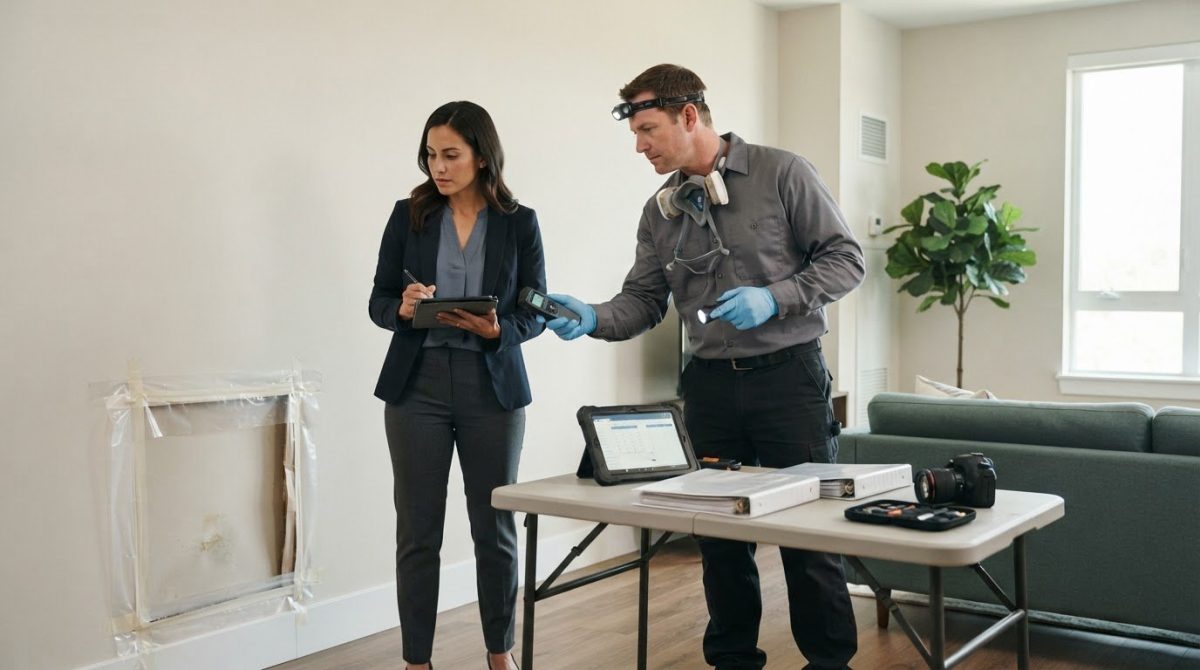
What turns a mold report into a liability claim: the growth itself, or the response that follows? For property managers, mold growth liability for property managers can depend on how quickly a moisture concern is addressed, what the lease and applicable requirements assign to each party, and whether the response is clearly documented. A delayed inspection or incomplete record can make an already difficult situation harder to assess.
Those concerns are understandable. Legal duties vary by jurisdiction and lease arrangement, and routine maintenance may not be enough when mold is widespread or the underlying moisture source remains unresolved. A consistent process helps teams respond methodically without assuming one procedure fits every property.
This guide explains common sources of mold-related claims, what to record after a tenant report, and how to decide when professional remediation may be appropriate. It also shows how to connect remediation to a documented corrective-action plan. TSIAC International brings more than 15 years of industry experience to mold remediation, helping property managers address affected areas while keeping the response focused on the property’s conditions.
Key Takeaways
- Mold growth liability for property managers depends on the facts, assigned responsibilities, and applicable jurisdiction, not simply the presence of mold.
- Build a clear evidence trail by recording report dates, communications, maintenance history, moisture sources, work performed, and follow-up.
- Keep legal duties, insurance terms, tenant communication, and building operations distinct when assessing a mold-related concern.
- Address the moisture source as part of corrective action. Surface cleaning alone may leave the underlying condition unresolved.
- Use professional mold remediation when affected materials or the scope of work call for it, and connect the work to a documented corrective-action plan.
Mold Growth Liability for Property Managers: Where Exposure Begins
Mold-related liability is the potential legal and financial exposure connected to a property’s condition and the actions taken, or not taken, in response. For property managers, that exposure may involve repair costs, disputes, or claims. However, the presence of mold alone doesn’t prove that anyone is legally liable.
A mold complaint is a report that needs a careful response. Proven liability requires evidence connecting a duty, a failure to meet it, and resulting harm under the law that applies. Relevant facts can include where moisture came from, how long it remained, what each party was responsible for, and how the report was handled. Mold growth liability for property managers is therefore a fact-specific issue, not a conclusion drawn from a photo or an occupant’s concern alone.
How moisture problems become management risks
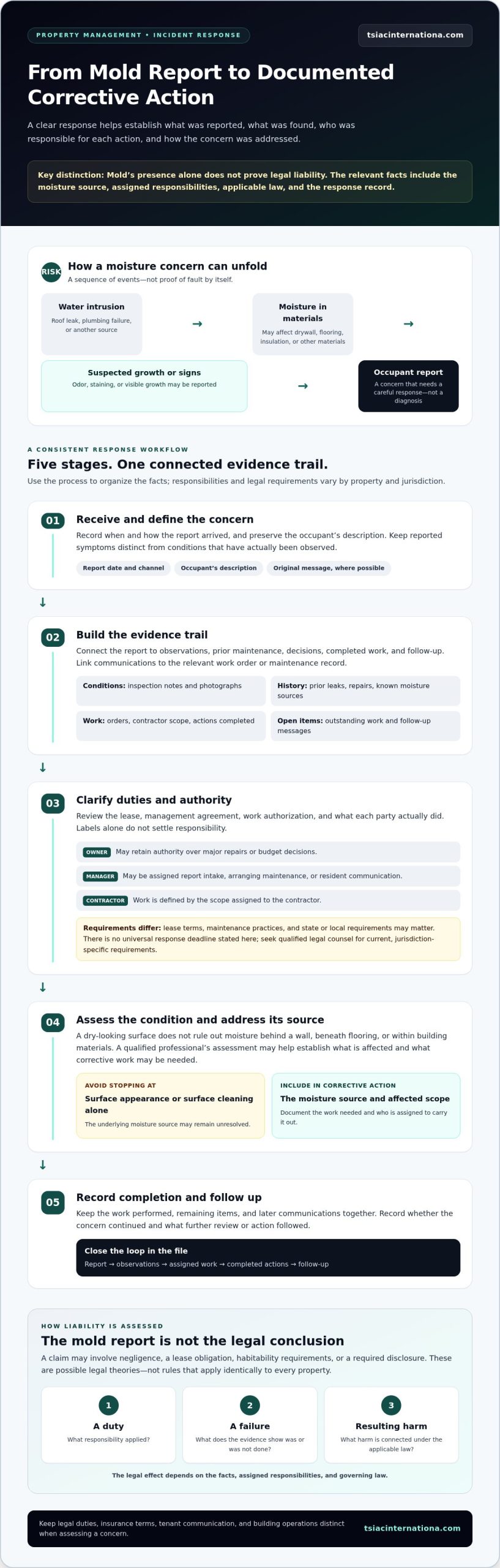
A risk sequence can begin with a roof leak, plumbing failure, or other water intrusion. Moisture may penetrate drywall, flooring, insulation, or other materials. Suspected mold growth may follow, and an occupant may report an odor, staining, or visible growth. The initial cause and later complaint are related, but they don’t by themselves establish who was responsible or whether a legal duty was breached.
A surface can appear dry while moisture remains behind a wall, beneath flooring, or within building materials. General background on Understanding Mold can help explain why moisture conditions matter, but it cannot determine the source or extent of a particular property condition. A maintenance concern is a reported or observed issue requiring attention. A confirmed condition requires appropriate assessment to establish what is affected and what corrective work may be needed. Don’t treat an unverified report as a diagnosis, or dismiss it solely because the visible surface looks dry.
Which property-management duties may matter?
Responsibility is often distributed. An owner may retain authority over major repairs or budget decisions, while a manager may be delegated responsibility for receiving reports, arranging maintenance, or communicating with residents. A contractor’s assigned scope may cover specific repair or remediation work. The lease, management agreement, work authorization, and actual conduct help clarify those roles; labels alone don’t settle responsibility.
Lease terms, maintenance practices, notice procedures, and applicable habitability requirements may all be relevant. A manager’s authority and response affect the factual record, but they don’t create a universal liability rule. State and local requirements can differ, and the legal effect of a delay or incomplete repair depends on the circumstances and governing law. Have qualified legal counsel review current, jurisdiction-specific requirements rather than relying on a general article as legal advice.
Operational clarity begins with knowing who receives a report, who can authorize corrective work, and how unresolved decisions are escalated. Define those responsibilities before a moisture incident so there are fewer gaps between an occupant’s notice, the manager’s response, the owner’s approval, and the contractor’s assigned work.
How Mold Liability Claims Arise: Duties, Notice, and Evidence
A mold-related claim may refer to negligence, a lease obligation, a breach of habitability requirements, or a failure to make a required disclosure. These are possible legal theories, not rules that apply identically to every property. Whether a theory is relevant depends on the governing law, the parties’ responsibilities, and the evidence about what happened.
Legal responsibility depends on the duties that apply and the documented facts showing what each party knew, did, and could reasonably have addressed. That distinction is central to evaluating mold growth liability for property managers. A tenant’s report is notice of a concern, not proof of mold or legal fault. A manager’s observation records visible conditions, while a qualified professional’s assessment may provide further information about the affected area and scope. These records answer different questions and shouldn’t be treated as interchangeable.
Notice, delay, and the response record
The date, content, and handling of each report can help establish what information reached the management team and what response followed. Keep the original message where possible, record follow-up conversations, and link each decision to its work order or maintenance record. There’s no universal response deadline that applies to every property; verify current state and local requirements with qualified legal counsel.
A useful incident file may include:
- The date and channel of each report, plus the occupant’s description of the concern.
- Inspection observations, photographs, and notes that distinguish reported symptoms from visible conditions.
- Maintenance history, including prior leaks, repairs, and known moisture sources.
- Work orders, contractor scope, actions completed, and any outstanding items.
- Follow-up communications that record what was addressed and whether the concern continued.
For example, a record showing that a leak was reported, a repair was authorized, and a later odor concern prompted further review creates a clearer timeline than separate, unconnected emails. The EPA Guide to Mold and Moisture provides general information about moisture and mold management; property-specific findings still require appropriate assessment.
Causation, health allegations, and damages
A claim may allege that a property condition, a party’s conduct, and a particular loss are connected. Establishing that connection can require evidence. An allegation of illness or exposure isn’t itself a medical diagnosis or proof of causation. Avoid describing mold as inherently toxic or making health conclusions from a photograph, odor, or occupant report. Document what was reported and observed, and preserve relevant assessment and work records.
Potentially disputed losses may involve damage to building materials, interruption of a resident’s use of a space, or relocation. Whether any loss is supported or recoverable depends on the facts, applicable law, and relevant agreements or policies. A contractor’s work record can document its assigned scope and completed work, but it doesn’t replace legal advice. When a documented corrective-action plan calls for mold remediation, TSIAC International provides mold remediation services as part of the property’s response.
Assessing Mold-Related Exposure: Legal Duties, Insurance, and Operations
A mold incident can raise several questions at once: what the law or contract requires, how an insurance policy responds, what residents need to know, and what building work is necessary. These questions overlap, but they are not interchangeable. A coverage decision does not determine who was responsible for a property condition, and a contractor’s assigned work does not define the owner’s or manager’s legal duties.
| Area | What to review |
|---|---|
| Legal duties | Applicable state and local requirements, lease terms, management agreements, and responsibility for repairs or disclosures. |
| Insurance response | Policy wording, exclusions, notice procedures, documentation requirements, and the insurer’s coverage decision. |
| Tenant relations | Resident communications, access coordination, reported disruption, and updates about corrective actions. |
| Building operations | Moisture source, affected areas, repair history, authorized work, contractor scope, and follow-up needs. |
What varies by jurisdiction and contract?
There is no single mold-specific federal rule or universal landlord standard that resolves every claim. Duties may depend on state and local requirements, the lease, and the management agreement. Those documents can assign different responsibilities for receiving notice, arranging repairs, authorizing work, or making disclosures. Have qualified legal counsel assess the requirements that apply to the property, including tenant remedies and required notices.
Separate the parties’ roles in the review. The owner may retain certain approval or repair responsibilities; the manager’s obligations depend on delegated authority and actual conduct. A contractor is accountable for its assigned scope of work, not every property-management decision. This distinction helps assess mold growth liability for property managers without treating one arrangement as a rule for all properties.
What insurance and operational reviews can clarify
Insurance terms vary by policy. Review the relevant wording for exclusions, notice procedures, documentation obligations, and how the policy addresses the reported event. Keep the owner’s policy response distinct from any manager’s potential exposure and from a contractor’s scope. A claim submission or coverage decision does not, by itself, establish legal responsibility or guarantee reimbursement.
Operational records can make the situation easier to evaluate. Track reported and confirmed affected areas separately, note access arrangements and any interruption to occupancy, and retain work authorizations and completion records. These details help explain the sequence of decisions without promising a particular coverage outcome. If the project also involves other regulated building materials, keep that scope distinct and document it under the applicable work plan, including the hazardous material abatement guide where relevant.
Use the review to identify unanswered questions: who can authorize the next action, what notice must be given, which records are still needed, and whether additional work falls outside the current contractor scope. Comparing legal, insurance, tenant, and operational factors supports a clearer corrective-action plan while leaving legal interpretation and coverage determinations to the appropriate decision-makers.
A Practical Mold Report Response: Document, Control, and Resolve
A consistent workflow turns a report into a traceable corrective-action plan. It also helps property teams distinguish what an occupant reported, what staff observed, and what later assessment or work established. For mold growth liability for property managers, the sequence and documentation matter as much as the decision to act.
First response: record the report and assess conditions
Use the same intake process for each report, then update the record as facts emerge. Avoid diagnosing health effects or assuring residents about safety before the relevant conditions have been assessed.
- Log the report. Record when and how it arrived, the reported location, visible signs or odor concerns, and any known water event. Preserve the occupant’s description in their own words where practical.
- Acknowledge and clarify. Confirm receipt, gather relevant details, and record the response. Note access arrangements or limits that may affect assessment or repair.
- Assess and document observations. Arrange an appropriate assessment. Separate reported concerns from staff observations and professional findings; date notes and retain photographs where appropriate.
- Address active moisture. Take reasonable steps to respond to ongoing water intrusion and prevent avoidable further damage. Record the apparent source, actions taken, and any issue that remains unresolved.
- Define the corrective scope. Base authorized work on the affected materials and identified moisture source. Surface cleaning alone may not address moisture or conditions behind or within materials, so don’t treat visible improvement as proof that the underlying issue is resolved.
- Close the loop. Retain work orders, communications, access records, and completion documentation. Record follow-up observations, outstanding items, and who is responsible for the next action.
Corrective work, records, and follow-up
Keep the incident file in chronological order. A useful record connects the initial report to assessment, decisions, authorized scope, work performed, and follow-up. If the scope changes, document what prompted the change and who approved it. This creates a clearer operational history than scattered messages or a work order marked complete without details.
Follow-up should verify the status of identified work and capture any continuing moisture concern or newly observed condition. If access wasn’t possible, a repair is incomplete, or the moisture source hasn’t been resolved, record that plainly and assign the next step. Escalate questions about legal duties, notices, or tenant remedies to qualified counsel rather than treating a maintenance record as a legal determination.
When the corrective-action plan calls for professional remediation, TSIAC International mold remediation is one part of a documented property response.
When Professional Mold Remediation Fits a Property Manager’s Plan
Professional remediation may fit a property manager’s plan when affected building materials require more than routine surface cleaning, when the scope extends beyond a small, clearly defined area, or when moisture has affected concealed or multiple materials. Recurring concerns or uncertainty about the extent of affected areas can also make a defined professional work scope appropriate. Base the decision on documented observations and assessment, not assumptions drawn only from a complaint or visible patch.
Remediation is one part of corrective action, not a substitute for resolving the moisture source. For example, work to address affected materials won’t by itself repair a plumbing leak or correct water entry through the building envelope. Track those actions separately, then connect them in the incident file so the record shows both the remediation scope and the steps taken to address the source. This separation supports clear decisions without implying that remediation alone prevents future growth or resolves a liability question.
How remediation supports a documented response
Before work begins, the property’s records should identify the reported concern, observations or assessment findings, affected areas, and the corrective work authorized. During and after the work, retain the contractor’s scope and completion documentation with the incident file. Record any remaining moisture-source repairs, follow-up actions, or unresolved conditions. A complete record clarifies what work was assigned and completed; it doesn’t guarantee a particular health outcome or provide legal protection on its own.
That distinction matters when assessing mold growth liability for property managers. A contractor documents and performs remediation within its assigned scope. The owner or management team remains responsible for decisions within its authority, including coordinating other needed repairs and maintaining the property’s records. Questions about legal duties, required notices, or tenant remedies belong with qualified counsel.
TSIAC’s relevant experience and service
TSIAC International provides mold remediation and brings more than 15 years of industry experience. The company serves customers nationally. For property managers, the practical connection is that remediation can be incorporated into a corrective-action plan, with the assigned work and related documentation retained alongside the property’s moisture-control records. This provides a clearer account of how the reported condition was addressed while keeping remediation, source repair, and legal review as distinct responsibilities.
Use the project record to align the work scope with the property’s identified conditions, document completion, and note any actions that remain outside the remediation assignment. That approach keeps the response organized and helps management teams track the incident from reported concern through corrective work and follow-up. Learn about TSIAC’s mold remediation service as part of a documented response plan.
Make the Next Response Easier to Manage
A moisture or mold report can test a property team’s process, especially when responsibility is divided among owners, managers, and contractors. Use the next routine operations review to confirm who receives reports, who can authorize corrective work, and how unresolved items are escalated. A clear internal handoff can help prevent gaps between a documented concern and action on the property.
Keep the response proportionate to the conditions and applicable requirements. Legal questions belong with qualified counsel; remediation work belongs within a clearly defined scope and documented corrective-action plan. This disciplined approach gives your team a practical foundation for managing mold growth liability for property managers without treating any single response as a guarantee against future claims.
When professional remediation is part of your plan, contact TSIAC International about mold remediation for your property.
Frequently Asked Questions
Is a property manager personally liable for mold growth?
A property manager’s personal exposure depends on the jurisdiction, delegated duties, conduct, and incident facts. The manager is distinct from the property owner and management company, and each may have different responsibilities or legal exposure. A tenant’s mold report alone doesn’t determine who is responsible. Preserve relevant records, including messages and work authorizations, and seek qualified legal advice if a specific claim arises or personal liability is alleged.
Can a tenant withhold rent because of mold?
Whether a tenant can withhold rent depends on state and local law, the lease, required notice, and the property’s condition. There is no safe universal answer for every rental. Don’t advise a tenant to stop paying, or assume that withholding is always allowed or prohibited. Document the complaint and response, then obtain jurisdiction-specific legal guidance before deciding how to handle rent, access, or tenancy communications.
Can a property manager be responsible if a tenant caused the moisture problem?
A tenant’s role in causing moisture is relevant, but it doesn’t automatically settle responsibility. The lease, history of notice, response to the reported issue, control of building systems, and applicable local law may also matter. Avoid assigning fault based on assumption, such as treating a tenant’s open window as the established cause of a leak. Record observations and communications, address active water issues, and involve counsel if responsibility is disputed.
Does property insurance cover mold damage or mold liability claims?
Coverage depends on policy wording, the cause of loss, exclusions, limits, notice requirements, and the claim’s facts. Property coverage for damage and liability coverage for claims are distinct and may respond differently. Don’t assume mold is covered or excluded without reviewing the applicable policy. Notify the appropriate policy contact in accordance with its procedures, and preserve records related to the reported condition, property damage, and actions taken.
Do property managers have to disclose a past mold problem?
Disclosure duties depend on jurisdiction, the condition’s nature and resolution, the transaction context, and applicable disclosure rules. Requirements may differ for a rental, a lease renewal, or a sale, so don’t assume a single nationwide rule. Maintain accurate records of repairs and remediation, including what work addressed and any remaining issues. Before making statements to tenants, buyers, or other parties, obtain legal guidance specific to the property and situation.
Does visible mold prove that a property is unsafe?
Visible growth warrants attention, but it doesn’t by itself establish a particular health outcome or legal conclusion. The affected materials, extent, moisture source, and occupants’ circumstances may all be relevant. Color alone can’t establish toxicity, and a property manager shouldn’t diagnose exposure from appearance. Record what is visible and where, address the moisture concern, and arrange an appropriate professional assessment when site conditions or scope call for further evaluation.
Should property managers use a mold test before arranging remediation?
Testing depends on the question, site conditions, and applicable requirements; it isn’t automatically necessary in every case. Sampling may provide information about a specific question, but it doesn’t repair a leak or establish the full scope of corrective work on its own. Don’t rely on a universal threshold or interpret a result as a medical finding. Follow applicable requirements and use qualified professionals to guide assessment and remediation decisions.
