
Did you know that a single procedural oversight in handling legacy materials can trigger civil penalties of up to $10,000 per violation from the South Carolina Department of Environmental Services (SCDES)? Managing a major renovation or structural demolition project is already technically demanding, and the added weight of shifting asbestos disposal regulations south carolina only increases the pressure on site owners and contractors. It’s natural to feel concerned about the intersection of federal NESHAP standards and state rules, especially when the health of your team and the financial stability of your project are on the line.
This guide provides the definitive roadmap to mastering the 2026 legal framework, ensuring your project remains fully compliant while maintaining the highest safety standards. We’ll examine the critical updates to Regulation 61-86.1, clarify mandatory notification timelines, and identify the certified disposal pathways required for a successful outcome. By the end of this article, you’ll have the professional clarity needed to manage hazardous materials with absolute precision and confidence. You’ll understand exactly which materials require professional intervention and how to secure the necessary documentation to mitigate all regulatory risks.
Key Takeaways
- Master the mandatory 10-working-day notification protocol required by SCDES for all demolition and renovation activities to avoid costly project delays.
- Navigate the technical complexities of asbestos disposal regulations south carolina regarding leak-tight packaging and 6-mil double-bagging standards.
- Clarify the legal distinctions between federal NESHAP exemptions and the rigorous state-specific rules that govern residential property disposal.
- Establish a professional verification framework for evaluating contractor licensing and insurance to ensure your project remains fully compliant and secure.
Overview of Asbestos Disposal Regulations in South Carolina (2026)
The regulatory landscape for hazardous material management in the Palmetto State has undergone a significant structural shift. As of 2026, the South Carolina Department of Environmental Services (SCDES) has fully assumed the oversight roles previously held by the Department of Health and Environmental Control (DHEC). This transition has brought a renewed focus on the enforcement of Regulation 61-86.1, which serves as the primary standard for asbestos projects across the state. While the federal EPA establishes the baseline through NESHAP, the asbestos disposal regulations south carolina enforces are often more rigorous, particularly regarding notification and waste shipment documentation. The 2026 landscape is defined by the full implementation of the July 1, 2024, updates to Regulation 61-86.1. These updates tightened the requirements for air sampling and containment inspections, particularly for friable waste, to close previous loopholes in site safety.
What Qualifies as Asbestos Waste in SC?
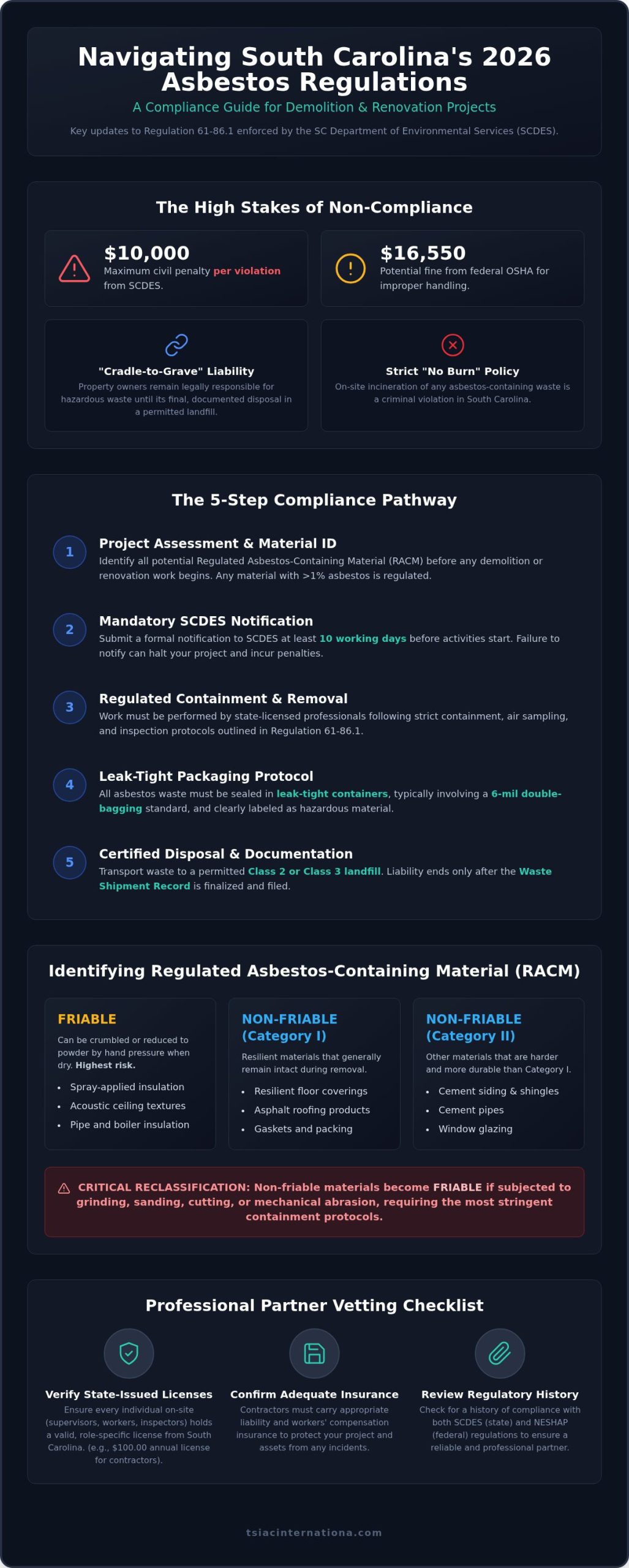
Before beginning any structural intervention, it’s vital to understand What is Asbestos? and how it’s classified under state law. South Carolina defines Regulated Asbestos-Containing Material (RACM) based on its physical state and potential for fiber release. Friable materials are those that, when dry, can be crumbled or reduced to powder by hand pressure. These include items like spray-applied insulation or acoustic ceiling textures. Non-friable materials are split into two categories; Category I includes resilient floor coverings, gaskets, and asphalt roofing, while Category II encompasses all other non-friable ACM such as cement siding or window glazing. In South Carolina, any material containing more than one percent asbestos by weight is legally classified as asbestos-containing material and requires regulated handling. If non-friable materials are subjected to grinding, sanding, or mechanical abrasion, they’re reclassified as friable and must follow the most stringent containment protocols.
Why Compliance is Non-Negotiable
The legal consequences of non-compliance are severe and extend far beyond the immediate construction site. SCDES maintains the authority to issue civil penalties reaching $10,000 per violation, and improper handling can also lead to federal OSHA fines of up to $16,550. Property owners must recognize that they hold “cradle-to-grave” liability for hazardous waste. This means your responsibility doesn’t end when the waste leaves your property; it only concludes once the material is interred in a permitted Class 2 or Class 3 landfill and a Waste Shipment Record is finalized. South Carolina also enforces a strict “No Burn” policy for any asbestos-containing waste, meaning on-site incineration is a criminal violation. Beyond the financial risk, improper disposal endangers the long-term health of the local community by risking the release of microscopic fibers into the soil and air. Working with a licensed professional isn’t just about safety; it’s a critical risk-mitigation strategy for your assets.
The SCDHEC Regulatory Framework: Regulation 61-86.1
The regulatory bridge between federal oversight and local execution is built upon S.C. Regulation 61-86.1. While the agency name has transitioned to the South Carolina Department of Environmental Services (SCDES), the technical standards within this regulation remain the definitive authority for all abatement activities. This framework establishes the “Standards of Performance” that every contractor must follow to maintain site integrity. It’s not merely about the removal of material; it’s about a disciplined sequence of notification, containment, and documented disposal. Understanding the asbestos disposal regulations south carolina enforces requires a clear grasp of how these state rules interact with OSHA’s worker protection standards. While OSHA focuses on the permissible exposure limit of 0.01 fibers per cubic centimeter for workers, SCDES ensures that the surrounding environment and the public are shielded from fiber release during transport and final interment.
Compliance begins with the licensing of personnel. Every individual on a project site must hold a valid, state-issued license corresponding to their specific role. Current 2026 licensing fees reflect this structured oversight, with contractors and building inspectors requiring a $100.00 annual license, while supervisors and workers are held to specific training and fee tiers. This ensures that only verified professionals handle the technical complexities of hazardous waste. Failure to verify these credentials before a project starts can result in immediate stop-work orders and significant civil penalties for the property owner.
SCDES Notification Procedures
The “10-working-day rule” is a cornerstone of South Carolina’s safety protocol. You must submit a formal notification to SCDES at least 10 working days before any demolition begins, regardless of whether asbestos is present. For renovations, this requirement is triggered when the amount of Regulated Asbestos-Containing Material (RACM) exceeds 160 square feet, 260 linear feet, or 35 cubic feet. In 2026, most filings are handled through a centralized electronic system, though paper submissions are still technically permitted. Common mistakes that derail timelines include failing to account for state holidays in the 10-day count or submitting incomplete Waste Shipment Records. Abatement project fees are calculated at 10 cents per linear, square, or cubic foot, with a maximum cap of $1,000.00 per project.
The Role of the Licensed Asbestos Consultant
State law mandates that a certified building inspector must conduct a thorough survey before any renovation or demolition activity occurs. This isn’t a suggestion; it’s a legal prerequisite for filing your project notification. A professional consultant identifies the specific type and condition of ACM, which dictates the containment strategy. TSIAC International serves as a disciplined partner in this process, managing the complex liaison with state regulators and ensuring all paperwork is technically accurate. For a broader look at managing these liabilities, see our guide on Hazardous material abatement in South Carolina. Securing a partner who understands the nuances of SCDES documentation is the most effective way to protect your project from regulatory scrutiny.
Mandatory Procedures for Legal Asbestos Waste Disposal
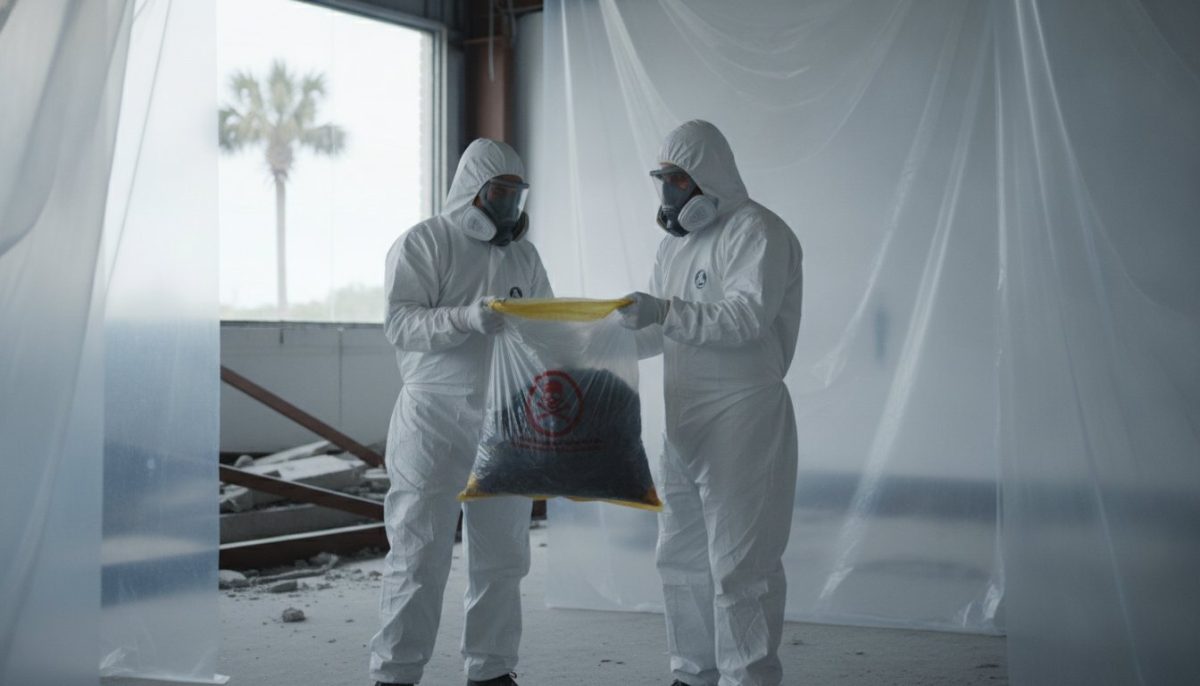
The transition from administrative notification to physical material handling represents the most critical phase of risk management. Under the asbestos disposal regulations south carolina enforces, all regulated waste must be managed to ensure zero visible emissions during every stage of the process. This begins with rigorous standardized packaging. All friable asbestos waste must be placed in leak-tight containers or double-bagged in 6-mil plastic bags while still wet. These containers must be clearly marked with OSHA and DOT warning signs that explicitly state the presence of asbestos fibers and the danger of inhalation. It’s not enough to simply bag the material; the seal must be airtight to prevent any fiber release during the mechanical stresses of transport.
Authorized disposal is another area where property owners often face confusion. In South Carolina, asbestos waste cannot be sent to standard municipal solid waste facilities. It must be interred in a Class 2 or Class 3 landfill that is specifically permitted by SCDES to accept hazardous fibers. A permanent record of this interment is maintained through the Waste Shipment Record (WSR). This document serves as the legal proof of proper disposal and is the only way to terminate the “cradle-to-grave” liability discussed in the opening sections of this guide. Without a signed WSR from an approved facility, your legal responsibility for the material remains open indefinitely.
Step-by-Step Packaging and Transport
The physical removal process relies on sophisticated “wetting” techniques. Technicians must saturate the ACM with amended water before and during disturbance to ensure that fibers remain heavy and suppressed. Once the material is double-bagged and sealed, it must be secured in a transport vehicle in a manner that prevents container rupture or shifting. You must also verify that the transporter holds valid SCDES credentials for hauling hazardous waste. Using an uncertified hauler nullifies your compliance efforts and exposes you to the significant civil penalties mentioned previously. Every transport vehicle must be lined and covered to provide an additional layer of containment during transit to the landfill.
The Manifest System: Ensuring a Paper Trail
The WSR is a comprehensive manifest that tracks the waste from the project site to the final disposal cell. Accuracy in this documentation is paramount; any discrepancy in the volume or type of material listed can trigger an agency audit. One critical regulatory milestone is the 35-day rule. If you don’t receive a signed receipt from the landfill operator within 35 days of the waste leaving your site, you’re required to contact the transporter and the landfill to determine the waste’s status. If it remains missing after 45 days, you must file an exception report with SCDES. Expert teams specializing in asbestos removal in South Carolina handle this entire chain of custody, providing you with a completed document package that serves as your permanent legal shield.
Residential vs. Commercial Rules: Debunking Disposal Myths
Misinterpretation of the “Residential Exemption” is a leading cause of regulatory friction for property owners in the Palmetto State. While federal NESHAP standards often exempt residential structures with four or fewer dwelling units, the asbestos disposal regulations south carolina enforces are considerably more stringent. The moment a licensed contractor is hired to perform work on a residential property, the exemption typically evaporates, and the project must adhere to the same rigorous notification and disposal protocols as a commercial site. This distinction is vital because SCDES views any professional involvement as a trigger for full regulatory oversight. If your renovation is part of a larger commercial development or a planned demolition for a future business space, the residential status is nullified immediately, regardless of the building’s current use.
The prevalence of hazardous materials in older structures makes these rules especially relevant. In areas like the Charleston peninsula, approximately 42% of commercial structures built before 1978 contain regulated materials. Whether you’re managing a historic storefront or a private residence, the legal hierarchy favors environmental safety over property type. Attempting to bypass these rules by classifying a project as “residential” when it has commercial intent is a high-risk strategy that frequently results in stop-work orders and significant civil penalties.
The Risks of DIY Asbestos Handling
Choosing to handle asbestos removal as a do-it-yourself project is a gamble with both your health and your finances. Residential owners often lack the specialized HEPA filtration and negative air pressure machines required to keep microscopic fibers from migrating throughout the living space. Once fibers are released, the cost of professional decontamination far exceeds the initial price of abatement. Furthermore, municipal landfills in South Carolina are trained to identify illegal asbestos disposal. Attempting to dump ACM in a standard waste stream can lead to criminal investigations and massive cleanup fees. Without the proper licensing and equipment, it’s impossible to guarantee that your home remains a safe environment after the work is completed.
Commercial and Industrial Obligations
For commercial entities, liability is absolute and non-transferable. Business owners must maintain meticulous records of all asbestos surveys and disposal manifests for the life of the building. When repurposing older industrial spaces, standard demolition isn’t enough; you often require specialized commercial interior gutting services to ensure that every layer of hazardous material is identified and removed before structural changes begin. This methodical approach protects the workers on-site and shields the company from long-term litigation risks. If you’re planning a project that involves legacy materials, consult with a certified abatement partner to verify your compliance status before the first wall comes down.
Selecting a Certified Partner for Asbestos Abatement
Choosing an abatement partner is the final and most critical safeguard against the legal and health risks described throughout this guide. In 2026, the technical gap between general contractors and specialized hazardous material professionals has widened significantly. When evaluating a potential partner, you must verify their current SCDES licenses and, more importantly, their pollution liability insurance. Standard general liability policies often exclude asbestos-related claims, leaving the property owner vulnerable if a fiber release occurs. A qualified contractor should provide a portfolio of completed Waste Shipment Records and a clear history of compliance with asbestos disposal regulations south carolina to prove their methodical reliability.
Abatement is rarely a standalone task; it’s frequently the precursor to a larger structural change. Understanding how remediation fits into the broader demolition process in South Carolina is essential for maintaining your project timeline. A partner who manages both the hazardous removal and the structural demolition provides a seamless transition that eliminates the risk of cross-contractor finger-pointing regarding site contamination. This integrated approach ensures that the 10-working-day notification period is utilized efficiently, allowing for mobilization the moment the regulatory wait period concludes.
The TSIAC Advantage: Safety and Compliance
TSIAC International brings over 15 years of disciplined experience to the most challenging work environments in the state. We don’t just remove material; we manage your entire regulatory profile. Our team specializes in high-risk containment systems and provides full documentation packages with every project, ensuring your “cradle-to-grave” liability is professionally closed. From the initial interior gutting to the final signed waste manifest, we maintain a fegyelmezett focus on environmental responsibility. We prioritize material recycling where safe and applicable, reducing the volume of waste sent to Class 3 landfills while strictly adhering to asbestos disposal regulations south carolina mandates.
Getting Started with Your Project
Initiating a project begins with a technical assessment of your site’s specific needs. Once a certified inspector has identified the RACM present, we provide a detailed fee estimate that reflects the actual scope of work, including all necessary SCDES notification filings. The timeline for mobilization typically follows the mandatory 10-working-day state notification period, though we begin preparing containment strategies and logistics immediately upon engagement. We don’t make promises we can’t keep, but we do guarantee that every technical parameter of your project will be handled with absolute precision. Contact TSIAC International for expert asbestos abatement services to secure a partner who treats your compliance as their primary mission.
Securing Your Project’s Regulatory Future
Mastering the technical landscape of asbestos disposal regulations south carolina requires a disciplined approach to documentation and physical containment. You’ve now identified the critical pillars of compliance: the mandatory 10-day notification protocol, the necessity of certified inspections, and the finality of the Waste Shipment Record manifest. The 2026 regulatory environment, governed by the updated Regulation 61-86.1, leaves no room for procedural error. By prioritizing professional intervention over high-risk DIY methods, you protect your project from stop-work orders and the long-term liability associated with hazardous waste.
TSIAC International brings over 15 years of hazardous material expertise to every site, providing the technical precision required for both structural and selective demolition. We handle the complex burden of providing DHEC-compliant documentation, ensuring that your chain of custody is legally bulletproof. Our turnkey services guide you from the initial survey through to the final interment of materials in a permitted facility.
Secure your property with professional asbestos abatement from TSIAC International and move forward with the absolute certainty that your site is safe and compliant. Your project deserves the reliability of a partner who understands the high stakes of environmental safety.
Frequently Asked Questions
Can I dispose of asbestos in my regular household trash in South Carolina?
No, you cannot dispose of asbestos in regular household trash or at a standard municipal collection center. South Carolina law requires all asbestos-containing waste to be interred in a Class 2 or Class 3 landfill that is specifically permitted by SCDES to accept hazardous fibers. Attempting to hide these materials in a standard waste stream is a violation of asbestos disposal regulations south carolina and can lead to significant civil penalties.
Do I need to notify SCDHEC before removing asbestos from my home?
Notification is mandatory for all demolitions, even if no asbestos is present. For renovations in residential homes, you must notify the South Carolina Department of Environmental Services (SCDES), formerly DHEC, if you hire a licensed contractor or if the amount of material exceeds 160 square feet or 260 linear feet. Failing to file the 10-working-day notification can result in immediate stop-work orders and fines.
What is the difference between friable and non-friable asbestos disposal?
Friable asbestos disposal requires the most rigorous containment because the material can be easily pulverized into airborne fibers by hand pressure. These materials must be saturated with amended water and double-bagged in 6-mil leak-tight containers. Non-friable materials, such as intact vinyl floor tiles, have fewer packaging restrictions unless they’re subjected to grinding, sanding, or mechanical forces that reclassify them as friable.
How do I find a landfill in South Carolina that accepts asbestos waste?
You can identify authorized disposal sites by consulting the official SCDES list of permitted Class 2 and Class 3 landfills. Not every landfill in the state is equipped or legally allowed to accept hazardous fibers. It’s the generator’s responsibility to confirm the facility’s current permit status and any specific site-level intake requirements before the waste shipment leaves the project site.
What are the specific labeling requirements for asbestos waste bags in SC?
Asbestos waste bags must feature standardized OSHA and DOT warning labels that identify the contents as a respiratory hazard. These labels must include the name of the waste generator and the specific location where the waste was removed. The text must explicitly warn against breathing the fibers and state that the material contains a known carcinogen to ensure safe handling by landfill personnel.
Are there specific permits required for transporting asbestos in South Carolina?
Yes, transporters must hold valid state credentials and follow strict hauling protocols to prevent fiber release. Vehicles must be fully enclosed or covered with a leak-tight liner that is secured to prevent any container rupture during transit. Using a hauler without the proper state-issued licensing can result in the rejection of the waste at the landfill and potential legal action against the property owner.
How long must I keep my asbestos waste shipment records?
You should keep your Waste Shipment Records (WSR) for at least 30 years to protect against future liability claims. While some regulations specify shorter periods for certain administrative tasks, property owners are advised to retain these documents as permanent proof of proper disposal. This paperwork is your only definitive defense if your project’s environmental impact is ever questioned in the future.
What happens if I accidentally disturb asbestos during a renovation?
If you accidentally disturb asbestos, you must stop all work immediately and evacuate the area to prevent further exposure. Don’t attempt to clean up the debris with a standard vacuum or broom, as this will spread microscopic fibers throughout the entire building. You should seal the room to prevent cross-contamination and contact a licensed abatement professional to perform air testing and technical decontamination.
