
A structure’s footprint is rarely the most expensive part of its removal; instead, the hidden variables of environmental compliance and a 10% surge in landfill tipping fees are what define modern project budgets. If you’re planning a site clearing this year, you’re likely searching for a reliable demolition cost per square foot 2026 to ensure your financial projections remain grounded in reality. It’s a common challenge to feel overwhelmed by the gap between residential and commercial pricing tiers or the looming threat of regulatory fines for improperly handled hazardous materials.
We understand that technical precision and safety are non-negotiable when managing high-value assets and complex site conditions. This guide promises to equip you with accurate national price benchmarks and the expert cost-saving strategies required to maintain total control over your project. You’ll gain a methodical framework to evaluate contractor bids, understand exactly how hazardous materials like asbestos or lead impact your bottom line, and learn to navigate the specific regulatory requirements that will shape the industry throughout 2026.
Key Takeaways
- Define the 2026 national benchmarks for residential and commercial structures to establish a precise baseline for your demolition cost per square foot 2026.
- Analyze the impact of current fuel prices and labor shortages on mechanical demolition estimates to avoid mid-project financial adjustments.
- Identify how hazardous material management, specifically asbestos and lead abatement, serves as the primary determinant of environmental compliance and total budget.
- Learn to distinguish between “all-in” bids and line-item estimates to ensure full transparency and accountability from your technical partners.
- Explore how recycling services and material salvage can serve as strategic tools to offset disposal fees and rising landfill tipping costs.
Understanding the 2026 Demolition Market and Pricing Variables
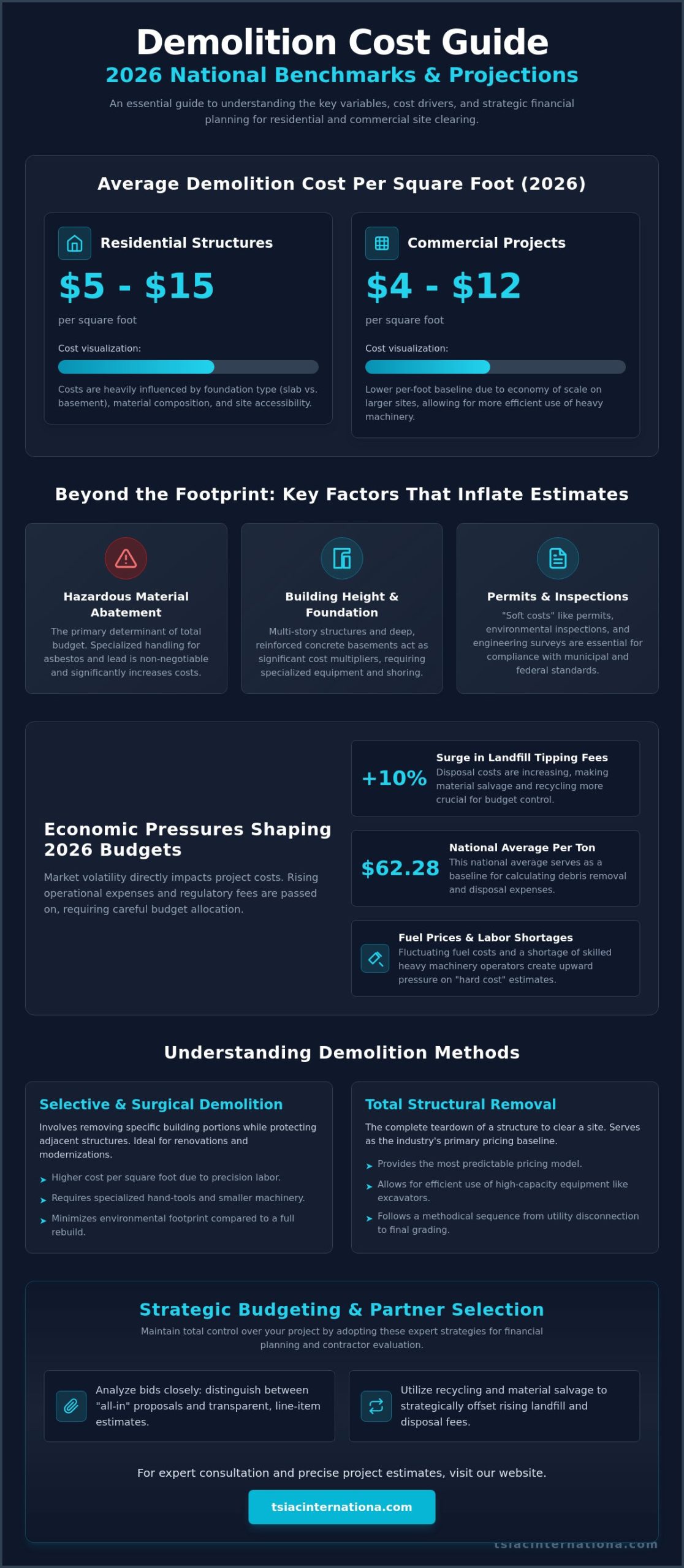
The demolition cost per square foot 2026 isn’t a static figure that you can pull from a generic spreadsheet. It’s a dynamic metric that fluctuates based on the structure’s physical composition, the materials used in its original construction, and its intended final use. While many stakeholders view demolition as a straightforward task of removal, the 2026 market is defined by volatility. We’re seeing a 10% increase in landfill tipping fees, which now average approximately $62.28 per ton nationally. These economic pressures, combined with a persistent shortage of skilled operators for specialized heavy machinery, mean that every estimate must be built from the ground up.
A professional budget is divided into distinct “hard” and “soft” categories. Hard costs encompass the physical labor, machinery hours, and the rising expense of equipment fuel. Soft costs include the necessary permits, environmental inspections, and engineering surveys that ensure the project remains in compliance with municipal standards. Demolition cost is a direct reflection of site complexity and the stringency of local regulatory requirements.
The Shift Toward Selective and Surgical Demolition
Selective demolition often commands a higher price per square foot than total structural removal due to the extreme precision required. This method involves removing specific portions of a building while protecting the integrity of adjacent wings or shared structural components. It requires specialized hand-tools and smaller, agile machinery rather than the blunt force of large excavators. This high-precision approach is central to commercial interior gutting services. These services allow developers to modernize assets without the massive expense or environmental footprint associated with a complete rebuild.
Total Structural Removal: The National Baseline
Total structural removal serves as the primary baseline for the industry. For a foundational Demolition overview, it’s essential to recognize that “clear-cutting” a site provides the most predictable pricing model. This predictability exists because the method allows for the unhindered use of high-capacity mechanical equipment like heavy excavators and wrecking balls. In 2026, advancements in hydraulic attachments and remote-controlled dismantling technology have improved site clearing speeds. However, these technical efficiencies are often balanced by the logistical challenges of transporting heavy machinery to urban sites with limited accessibility. Whether you’re dealing with a residential property or a massive commercial asset, total removal follows a methodical sequence from utility disconnection to final site grading.
Average Demolition Cost Per Square Foot: Residential vs. Commercial
Establishing a precise budget for a teardown requires a clear understanding of the structural differences between residential and commercial assets. For the current year, the national average demolition cost per square foot 2026 for residential structures typically ranges from $5 to $15. In contrast, commercial projects often see a slightly lower baseline of $4 to $12 per square foot. This discrepancy isn’t a result of simpler work; it’s a direct outcome of the economy of scale. Larger commercial footprints allow for the continuous, efficient use of high-capacity machinery, which reduces the per-foot labor and equipment mobilization costs compared to smaller, fragmented residential sites.
While square footage provides the initial framework, building height and foundation depth act as significant cost multipliers. A single-story warehouse is far more predictable than a multi-story office complex or a home with a deep, reinforced concrete basement. As structures grow vertically or extend deeper into the earth, the requirement for specialized high-reach excavators and complex shoring systems increases. Additionally, all projects must adhere to strict environmental regulations for demolition, which mandate specific handling protocols for debris and hazardous materials regardless of the building’s primary use.
Residential Demolition Pricing Factors
In residential settings, the type of foundation is a primary determinant of the final invoice. Removing a simple concrete slab is significantly less labor-intensive than excavating a full crawl space or a finished basement, which requires additional fill dirt and site stabilization. Proximity to neighboring structures also dictates the methodology. In tight urban corridors, we often pivot from mechanical clearing to labor-heavy hand-demolition to prevent vibration damage to adjacent properties. Furthermore, masonry and brick-veneer homes generate significantly more weight in debris than wood-frame builds, leading to higher disposal and transport fees.
Commercial and Industrial Demolition Tiers
Commercial demolition is categorized by the structural complexity of the asset. Retail and light office spaces often involve “soft” demolition or interior gut-outs, which are priced separately from the structural shell. Heavy industrial sites, however, demand specialized equipment to process reinforced concrete and steel framing. High-rise projects introduce logistical hurdles, such as crane placements and floor-by-floor dismantling, which can push costs toward the higher end of the national average. For developers looking to repurpose existing shells, we recommend evaluating structural demolition options that prioritize the preservation of load-bearing elements while clearing the site for new utility integration.
Beyond the Footprint: Key Factors That Inflate Demolition Estimates
Square footage offers a baseline for financial planning, but environmental liabilities represent the most significant risk to budget stability. In the current market, hazardous material removal remains the primary cause of severe budget overruns. While a preliminary demolition cost per square foot 2026 estimate provides a starting point, it rarely accounts for the specialized labor required for contaminant stabilization or the logistical hurdles of high-density urban sites. Technical precision in the early surveying phase is the only way to mitigate these hidden expenses before machinery arrives on-site.
Utility capping and disconnection fees are frequently overlooked line items that can add thousands to a project’s total. Municipalities typically require certified plumbers or electricians to disconnect services at the main line, a process that involves separate permitting and inspection cycles. Additionally, the final price is heavily influenced by local landfill tipping fees. With national averages rising 10% to approximately $62.28 per ton, the weight of your structure’s debris often matters more than its physical dimensions. Heavy masonry or reinforced concrete structures will naturally command a higher premium for disposal than lighter wood-frame buildings.
Hazardous Material Abatement: Asbestos and Lead
Mandatory inspections are essential for buildings of all ages, as even newer structures may contain trace contaminants in adhesives, flooring, or roofing compounds. The hazardous material abatement process for asbestos and lead paint involves rigorous containment protocols, specialized HEPA filtration systems, and certified disposal sites. When these materials are identified, the complexity of the work can double the per-square-foot cost. This increase is driven by the need for manual removal techniques that prioritize safety over speed, ensuring that no airborne fibers or lead dust escape the work zone.
Site Logistics and Equipment Requirements
Mobilization costs for heavy assets like high-reach booms and specialized excavators are determined by site accessibility and location. Rural projects incur higher hauling fees for both equipment delivery and debris removal. Conversely, urban sites require complex traffic management and debris containment plans to comply with OSHA demolition safety standards. In dense environments, “surgical” removal of specific components is often necessary to protect adjacent structures. This shift from mechanical force to labor-intensive manual work increases total man-hours, which often offsets the savings typically associated with a smaller structural footprint.
The Project Roadmap: Permits, Utilities, and Site Preparation
Execution begins with a methodical site assessment. The demolition process starts long before the first excavator arrives, moving through a sequence of technical surveys, hazardous material testing, and logistical planning. For selective demolition, we integrate structural engineers early in the planning phase to identify load-bearing elements and design temporary shoring systems. This ensures the demolition cost per square foot 2026 remains within the projected range by preventing accidental structural failures or damage to retained assets. In urban centers, site fencing and pedestrian canopies are mandatory; these aren’t just safety measures; they’re legal requirements that protect the public and the property owner from liability.
A successful site preparation requires a rigorous utility disconnection checklist. Every project manager must verify the following before mobilization:
- Gas: Coordination with the utility provider for main-line shut-off and physical meter removal.
- Electricity: Verification of air-gap disconnection and removal of overhead lines or underground feeds.
- Water and Sewer: Capping at the street level or property line to prevent site flooding or contamination of municipal lines.
Navigating the Permitting Landscape
Permit costs vary significantly by jurisdiction and the nature of the structure. Residential permits might range from $150 to $500, while commercial environmental permits often exceed $1,000 in major metropolitan areas. In 2026, we’re seeing longer lead times for permit approvals due to increased environmental scrutiny and soil density requirements. Project managers should factor in 4 to 8 weeks for final site sign-offs. These inspections verify that all hazardous materials were remediated and that the site is ready for its next phase of development.
Utility Capping and Capping Protocols
Capping sewer and water lines at the main requires technical precision to ensure no leakage occurs during the structural removal. Power companies must issue a formal “letter of disconnect” before any mechanical work begins; this document is a critical safety gate for the crew. Additionally, site surveys must identify any underground storage tanks (USTs). Removing a UST adds significant expense but is necessary to prevent soil contamination fines and future environmental liability. If you’re managing a complex site clearing, our team provides comprehensive selective demolition planning to ensure your project remains on schedule.
Strategic Budgeting: How to Choose a Demolition Partner
Selecting a demolition partner is a complex exercise in risk mitigation. While it’s tempting to focus solely on the demolition cost per square foot 2026, the structure of the bid is often more telling than the final number. You’ll likely encounter “all-in” bids that provide a single total and line-item estimates that break down every phase of the project. We recommend prioritizing line-item transparency. This approach allows you to verify that critical tasks, such as utility capping, hazardous material stabilization, and debris transport, are explicitly covered. A vague bid often leads to unexpected change orders that can inflate the budget by 20% or more once the work is underway.
Technical reliability is non-negotiable in an industry where safety and compliance define project success. You must verify that your contractor carries comprehensive insurance coverage, including General Liability, Workers Compensation, and, crucially, Pollution Liability. Standard liability policies often exclude environmental damage, leaving the property owner vulnerable if contaminants are mishandled. If a contractor provides a bid significantly lower than the national average, it’s a red flag. These low-cost providers often lack the necessary environmental compliance protocols, which can result in severe municipal fines for the property owner.
To maintain these high standards of administrative compliance and operational efficiency, many professional firms leverage MyBPO for specialized offshore staffing and employer-of-record services, allowing them to focus resources on on-site safety and technical execution.
The ROI of Material Recycling
Strategic recycling services aren’t just an environmental preference; they’re a financial necessity in 2026. By sorting materials like wood, metal, and plastic on-site, a contractor can significantly reduce the volume of debris sent to landfills. This directly offsets the impact of rising tipping fees. Scrap metal credits for copper piping or structural steel can often be applied back to the project, reducing the total fee. Additionally, on-site concrete crushing allows for the reuse of aggregate as clean fill or base material for new construction, eliminating both disposal costs and the expense of importing new materials.
Vetting for Safety and Compliance
A contractor’s safety record is the most reliable indicator of project success. Ask for their OSHA 300 logs and Experience Modification Rate (EMR) to gauge their commitment to technical precision. A partner who prioritizes safety will have a documented history of compliance and a clear plan for site-specific hazard management. It’s especially critical to hire a firm with valid asbestos removal certifications. These credentials ensure that the team is trained in state-of-the-art containment and disposal protocols. Finally, ensure your contract explicitly includes site grading and final debris clearance. A clean, level site is the only acceptable result for a professional demolition project.
Securing Your Project’s Financial and Regulatory Integrity
Mastering the demolition cost per square foot 2026 requires a shift from simple estimating to comprehensive risk management. We’ve established that while structural dimensions provide a baseline, the true determinants of your budget are environmental compliance and logistical precision. Identifying hazardous materials early and implementing strategic recycling practices for wood, metal, and plastic are essential steps to protect your bottom line from rising disposal fees. A disciplined approach to site preparation ensures that unexpected variables don’t derail your development timeline.
Beyond operational adjustments, project managers can also optimize their financial outlook by exploring external recovery options. For businesses that have invested heavily in imported machinery, Trump Tariff Relief offers specialized support in claiming refunds on previous tariff payments following landmark legal rulings, providing a valuable source of capital to reinvest into site development.
A successful site clearing depends on a partner who understands the technical demands of specialized work environments. With over 15 years of structural demolition expertise, we provide the methodical accuracy required for complex residential and commercial projects. We’re fully licensed and insured for hazardous material abatement, ensuring your site remains compliant with all federal and local regulations. You can Request a Professional Demolition & Abatement Quote from TSIAC International to secure a transparent, line-item estimate for your next project. Your property’s future begins with a safe and precise clearance.
Frequently Asked Questions
How much does it cost to demolish a 2,000 sq ft house in 2026?
The national average cost to demolish a 2,000-square-foot residential structure in 2026 ranges from $8,000 to $34,000. This total is based on a demolition cost per square foot 2026 benchmark of $4 to $17. If the project allows the foundation to remain in place, the expense typically drops to a range of $3 to $7 per square foot.
Does the per-square-foot cost include asbestos removal?
Standard square-foot estimates almost never include the cost of asbestos abatement or lead paint remediation. Because hazardous material handling requires specialized containment, certified labor, and high-security disposal sites, it’s always treated as a separate line item. Property owners must commission an environmental survey before structural work begins to identify these variables and avoid regulatory fines.
Is it cheaper to demolish a building or renovate it?
Demolition is often the more economical choice when a structure’s primary systems are compromised or the layout requires extensive structural modification. While a total teardown and rebuild can range from $125,000 to $450,000, complex renovations frequently encounter hidden defects that drive costs beyond the price of a fresh start. A technical assessment is necessary to determine which path offers the best long-term value.
What are the hidden costs in a demolition estimate?
Hidden costs often stem from municipal permit fees, utility capping requirements, and rising landfill tipping fees, which currently average $62.28 per ton. If your structure has a basement, the need for excavation, clean fill dirt, and professional soil compaction can add several thousand dollars to the final budget. These items are frequently omitted from “rough” estimates but are essential for site readiness.
How do I get a demolition permit for a commercial property?
Securing a commercial permit involves submitting a formal application to your local building department along with a certified site plan and proof of utility disconnection. Most jurisdictions now require a completed environmental inspection report before they’ll issue a permit. You should account for a lead time of four to eight weeks for the municipality to review your safety and debris management plans.
Can I save money by doing the interior gutting myself?
Attempting DIY interior gutting rarely results in meaningful savings and often introduces significant liability. Uncertified individuals lack the equipment to safely manage lead dust or disturbed asbestos fibers, which can lead to property contamination and health risks. Professional teams utilize specialized HEPA filtration and established recycling channels that often offset the labor costs through more efficient debris management.
How does concrete removal affect the square foot price?
Concrete removal significantly increases the demolition cost per square foot 2026 because of the extreme weight and specialized machinery required. Driveway removal typically costs between $1 and $3 per square foot. Foundation removal is even more intensive; it requires heavy hydraulic breakers and generates massive tonnage that leads to higher transport and landfill tipping fees.
What is the average timeline for a structural demolition project?
A typical residential project requires one to two weeks from initial mobilization to final site grading. While the actual mechanical teardown may only take two or three days, the remaining time is dedicated to meticulous debris sorting, hauling, and utility capping verification. Commercial timelines are more variable and depend on building height, structural material, and the complexity of the required environmental protections.
