
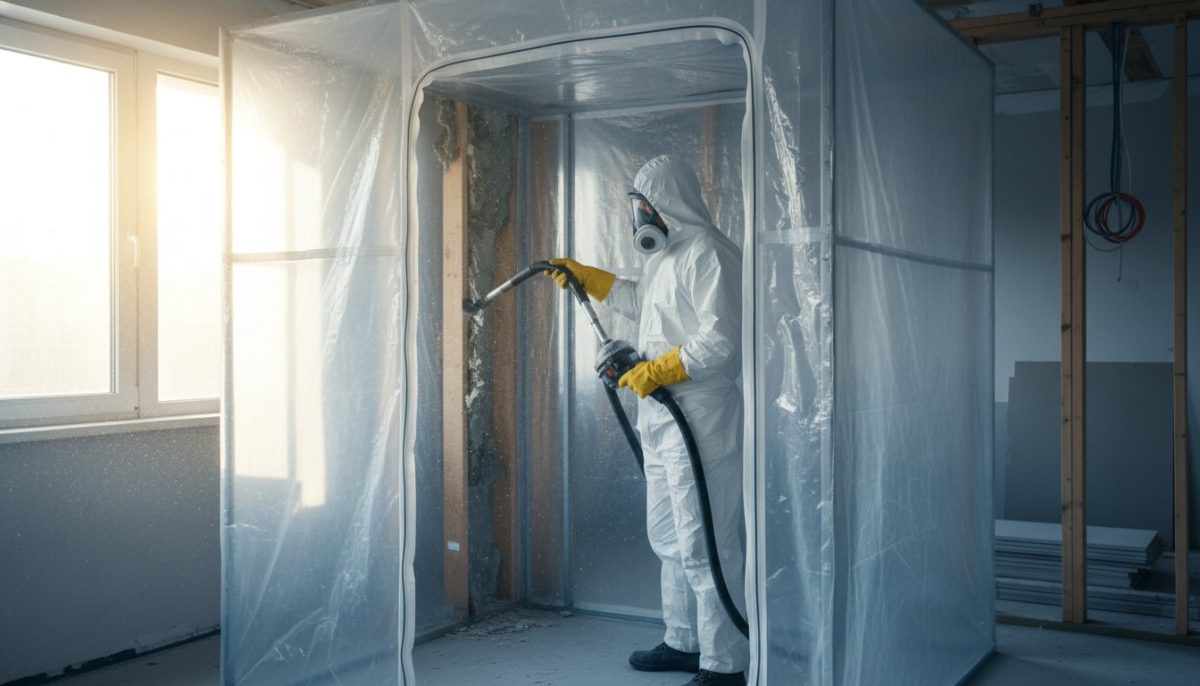
Approximately 40,000 Americans die each year from asbestos-related illnesses; a statistic that transforms a routine site inspection into a high-stakes safety event. It’s natural to feel overwhelmed by the threat of toxic exposure and the potential for significant budget disruptions. We understand that you need a plan that prioritizes safety without abandoning project logic. This definitive guide explains exactly what to do when you uncover asbestos during renovation to ensure your site remains compliant with the 2024 EPA chrysotile ban and OSHA’s strict 0.1 fiber per cubic centimeter exposure limit.
We’ll replace uncertainty with engineering precision. You’ll learn the immediate containment steps required to protect occupants, the breakdown of 2026 testing costs which currently average $483 nationally, and the technical requirements for certified abatement. We’ll also outline how to navigate federal NESHAP trigger levels so you can resume your structural goals with total confidence. This protocol provides the technical framework to manage legacy materials while maintaining the integrity of your workspace and your legal standing.
Key Takeaways
- Immediate cessation of all mechanical and manual activity is the only way to prevent hazardous fiber migration within the first 60 minutes of discovery.
- Master the critical technical steps of what to do when you uncover asbestos during renovation to ensure your site aligns with 2026 EPA and OSHA safety standards.
- Identify the differences between friable and non-friable materials to understand why disturbed fibers can remain airborne for up to 72 hours.
- Compare professional remediation strategies, such as complete surgical abatement versus industrial-grade encapsulation, to determine the safest path for your project.
- Secure your legal and financial interests by vetting contractors for state-specific licenses and specialized asbestos pollution liability insurance.
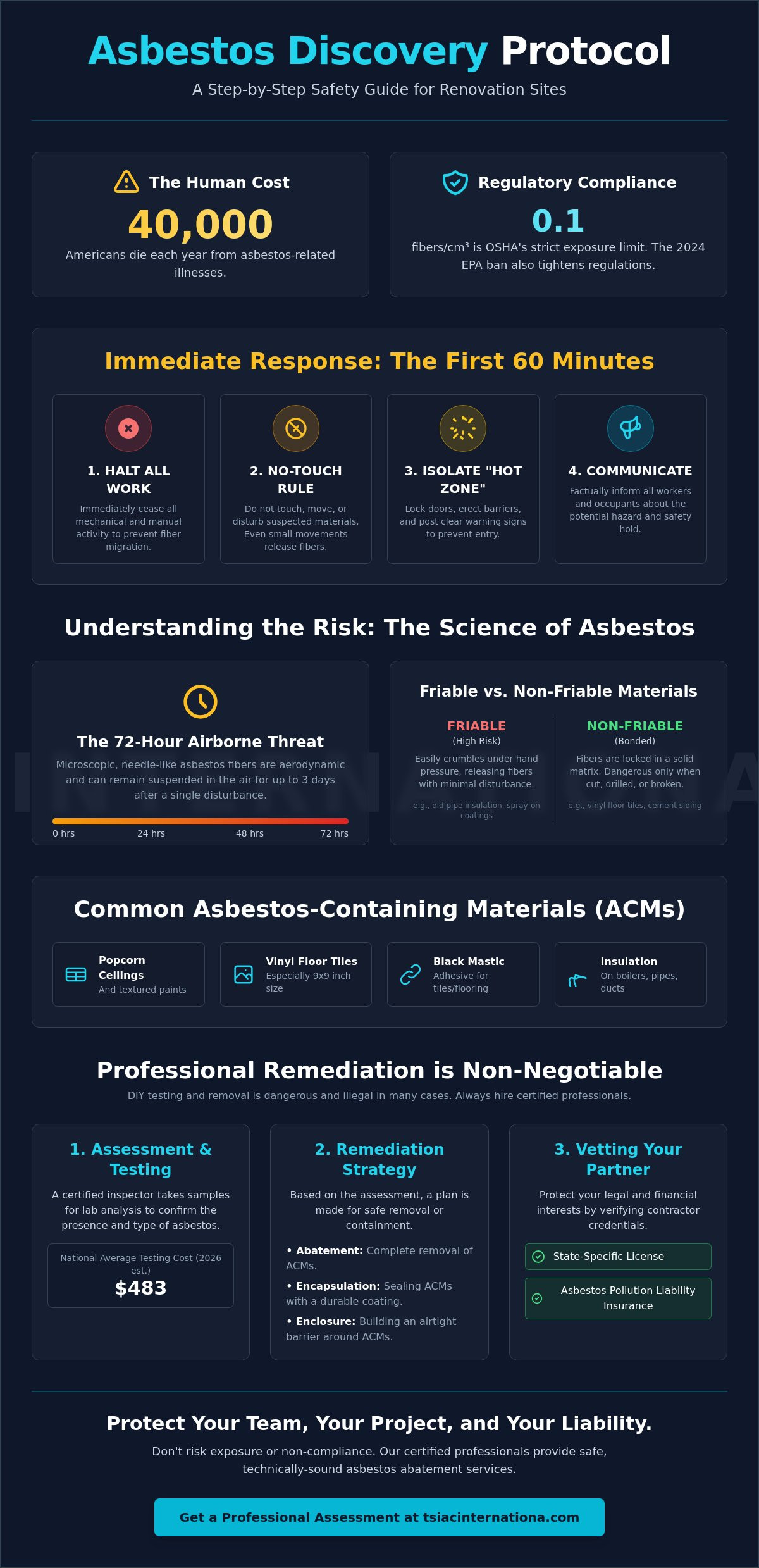
Immediate Response Protocol: The First 60 Minutes After Discovery
The moment a crew member identifies a suspicious material, the renovation must transition from a construction phase to a hazardous material containment phase. Halt all mechanical and manual activity within the immediate vicinity. Whether you’re performing selective demolition or a full interior gutting, the vibration from power tools or even the draft from a swinging sledgehammer can mobilize microscopic particles. Understanding what to do when you uncover asbestos during renovation starts with a complete work stoppage to prevent further degradation of the material.
Adhere strictly to the “No-Touch” Rule. Asbestos fibers are often invisible to the naked eye; they’re measured in microns and possess a jagged physical structure that allows them to remain suspended in the air for up to 72 hours. Attempting to move a piece of broken tile or a clump of “popcorn” ceiling texture increases the fiber concentration exponentially. To grasp the severity of this risk, professionals often study The Science of Disturbed Asbestos, which details how these minerals break into thin, durable filaments. Isolate the “Hot Zone” by locking doors and posting clear, technical signage to prevent unauthorized entry.
Communicate the discovery to all occupants and workers immediately. Avoid sensationalist language. Use a factual, engineering-based approach: state that a potential Asbestos-Containing Material (ACM) has been identified and that the site is now under a safety holding pattern. This transparency maintains trust while ensuring no one accidentally enters the contaminated area.
Securing the Airflow and Environment
The most common error in discovery is leaving the HVAC system running. Forced-air units act as distribution engines for hazardous fibers, pushing them into ductwork and unaffected rooms. Shut down the entire climate control system. Seal all supply and return vents using 6-mil polyethylene sheeting and industrial-grade tape. Don’t use a standard shop-vac or household vacuum on suspicious debris. These machines lack the specialized HEPA filtration required to trap asbestos; they’ll simply exhaust the fibers back into the room, creating a much larger remediation problem.
Personnel Decontamination Basics
If workers were in direct contact with dust, they mustn’t leave the site in contaminated clothing. Establish a temporary clean zone at the perimeter of the Hot Zone. Personnel should carefully remove outer garments and place them in double-layered hazardous waste bags for disposal. Use wet wipes or a damp cloth to clean any exposed skin before they transition to a non-contaminated area. This disciplined approach prevents cross-contamination and protects the workers’ homes and families from secondary exposure.
Understanding the Risk: The Science of Disturbed Asbestos
Once you understand what to do when you uncover asbestos during renovation, the next step is recognizing why the danger persists even after tools are powered down. Asbestos fibers are aerodynamic anomalies. Due to their microscopic mass and needle-like geometry, they don’t settle like common sawdust. They remain suspended in the air for up to 72 hours, which means a disturbance on a Monday morning can still pose a severe inhalation risk on a Wednesday afternoon. Current 2026 safety standards prioritize zero-exposure thresholds because leading health agencies, including the EPA and OSHA, maintain that no level of exposure is entirely safe.
The technical risk level of a material is determined by its physical state. Friability is the tendency of a material to crumble under hand pressure, releasing fibers. Highly friable materials, such as thermal system insulation found on old boilers, pose an immediate threat because they’re already in a state of decay. Conversely, “bonded” materials like vinyl floor tiles are less hazardous while intact, but they become dangerous the moment mechanical force is applied. If your project involves a complex interior gutting, you must assume all suspicious materials will become friable during the demolition process.
Common Residential and Commercial Culprits
In structures built before 1980, asbestos-containing materials are ubiquitous. Popcorn ceilings and textured paints were frequently used for their acoustic properties and fire resistance. Below the surface, 9×9 inch Vinyl Asbestos Tiles (VAT) often hide a secondary threat: the black mastic adhesive used to secure them. This mastic often contains chrysotile asbestos, which accounted for approximately 95% of asbestos use in the 20th century. Identifying these materials early and following a strict Immediate Response Protocol prevents the accidental contamination of the entire building envelope.
The ‘Invisible Threat’ Mechanism
The primary danger of asbestos is its invisibility. You can’t see, smell, or taste hazardous concentrations, even when they exceed the OSHA permissible exposure limit of 0.1 fibers per cubic centimeter. The transformation from a safe, “intact” state to a lethal airborne state happens during routine tasks like drilling, sanding, or sawing. These actions pulverize the mineral matrix, releasing millions of microscopic filaments into the breathing zone. Because these fibers are small enough to bypass the body’s natural respiratory filters, they lead to long-term illnesses that claim the lives of roughly 40,000 Americans annually according to April 2026 data.
Professional Assessment vs. DIY Testing Risks
The decision of how to verify the presence of asbestos often determines the project’s legal and safety trajectory. While online forums frequently suggest hardware store test kits, these DIY methods introduce unacceptable variables into a controlled environment. The act of sampling, specifically cutting or scraping a piece of material, is a disturbance event that can release millions of fibers without the benefit of negative pressure containment. DIY kits often yield false negatives because of poor sampling technique or limited laboratory sensitivity. When determining what to do when you uncover asbestos during renovation, professional assessment is the only method that provides a legally defensible chain of custody.
As of April 2026, the national average cost for a professional asbestos test is $483, with physical sample testing typically ranging from $250 to $776. This investment covers the expertise of a Certified Asbestos Inspector who understands the complex federal and state-level trigger levels. For instance, many states require specific certifications for inspectors working on public and commercial buildings where NESHAP thresholds apply. A professional ensures the sampling process doesn’t become the very source of contamination you’re trying to avoid by following rigorous engineering controls during the collection phase.
Commercial properties face even stricter requirements regarding the chain of custody. If you’re managing a site involving selective demolition, a paper trail from a NVLAP-accredited laboratory is mandatory for regulatory compliance. Without this, you risk heavy fines and potential litigation if workers are exposed to unidentified hazards. Air testing, which costs between $200 and $800, provides the empirical data needed to prove the site is safe for re-entry. It’s a technical safeguard that protects both human health and the project’s financial stability.
What Happens During a Professional Inspection?
An inspector begins with a visual survey to map all Suspect Asbestos-Containing Materials (SACM). They use wet-misting techniques to saturate the sample area, preventing fiber release during extraction. They’ll also evaluate the current fiber count in the environment through air clearance testing. This data is critical for choosing between various Remediation Strategies: Abatement, Encapsulation, and Enclosure. The final report provides a detailed inventory of all hazardous materials discovered on-site.
Understanding Lab Results: PLM vs. TEM
Laboratory analysis follows two primary protocols. Polarized Light Microscopy (PLM) is the standard for bulk material analysis, identifying mineral types like chrysotile. For air samples or extremely fine fibers, Transmission Electron Microscopy (TEM) is the required standard. TEM uses electron beams to visualize fibers as small as 0.2 microns in length, offering the highest level of precision available. Your survey report will detail these findings, providing a technical roadmap for what to do when you uncover asbestos during renovation to ensure total safety.
Remediation Strategies: Abatement, Encapsulation, and Enclosure
Deciding on the appropriate remediation path is a technical decision based on the material’s current condition and your planned scope of work. Understanding what to do when you uncover asbestos during renovation means choosing between three primary engineering controls: abatement, encapsulation, or enclosure. Complete abatement involves the surgical removal of hazardous materials under negative air pressure, followed by disposal in an EPA-approved landfill. This is the only permanent solution for eliminating the liability of legacy asbestos. Encapsulation and enclosure serve as management strategies that isolate fibers without removing them from the building’s footprint.
The disposal phase of an abatement project is governed by strict federal protocols. Contaminated waste must be double-bagged in 6-mil polyethylene and transported by licensed haulers to designated facilities. This ensures that the material doesn’t re-enter the environment during transit. For projects requiring structural demolition and hazardous material management, following these disposal timelines is critical for maintaining compliance with the EPA’s 2024 chrysotile ban. Asbestos cement sheets, for example, face a total ban on most uses as of 2026, making removal the most logical long-term strategy for these specific components.
When to Choose Removal (Abatement)
Removal is often the mandatory path during commercial interior gutting services. If a material is water-damaged or severely friable, it cannot be safely sealed or covered. Total removal also maximizes property value for future real estate transactions. It eliminates the need for ongoing asbestos management plans. Interior abatement typically costs between $5 and $20 per square foot; a specific number that provides a clear baseline for project budgeting in 2026.
When Encapsulation Makes Sense
Encapsulation involves applying specialized bridging or penetrating sealants to “lock” fibers into a solid matrix. This strategy is effective for non-friable materials that aren’t in the path of future construction activity. It’s often used for large-scale industrial ceilings where total removal might be structurally risky. Encapsulation costs significantly less, averaging $2 to $6 per square foot according to April 2026 data. However, this choice requires a commitment to regular inspections to ensure the sealant remains intact. If the barrier is breached, the site immediately reverts to a hazardous state.
Selecting a Qualified Abatement Partner
Once you’ve determined what to do when you uncover asbestos during renovation, the final phase involves vetting a contractor capable of executing the remediation with surgical precision. This isn’t a standard construction hire; it’s a high-stakes safety partnership. You must verify that the contractor holds both federal and state-specific licenses required for the 2026 regulatory environment. A critical checklist item is their insurance depth. Standard general liability policies often exclude asbestos. Ensure your partner carries specific “Asbestos Pollution” liability coverage to protect against long-term claims and legal exposure.
Professionalism on-site is visible through the infrastructure of containment. A qualified partner will establish a multi-stage “Clean Room” and a dedicated “Decon Trailer” to prevent any fibers from leaving the work zone on personnel. This setup is non-negotiable for maintaining the 0.1 fiber per cubic centimeter OSHA limit. Finally, project closeout requires a third-party air clearance test. This ensures the contractor isn’t grading their own homework. It provides the empirical proof needed to declare the space safe for re-entry and satisfies the documentation requirements of local building departments.
The TSIAC Standard of Remediation
With a 15-year history of managing complex hazardous material abatement, we approach every discovery with engineering discipline. Our teams prioritize environmental responsibility, ensuring that every ounce of waste follows the strict disposal protocols established by the 2024 EPA chrysotile ban. We don’t view abatement as an isolated task. Instead, we integrate it seamlessly into the larger demolition process. This holistic approach minimizes timeline disruptions and ensures that your structural goals remain on track despite unexpected technical variables.
Next Steps: Resuming Your Renovation
Resuming work requires more than just a verbal “all clear.” You must obtain a formal Clearance Report. This document is essential for your building permit office and serves as a permanent record of regulatory compliance. Once the third-party lab confirms the air quality meets safety standards, other trades like plumbers and electricians can safely enter the site without specialized PPE. Keeping this “Asbestos-Free” certification is vital for the future valuation and sale of the property. If you’ve uncovered suspicious materials and need an immediate, technical response, contact TSIAC International for a professional assessment to secure your site and your health.
Securing Your Site and Restoring Project Momentum
Understanding exactly what to do when you uncover asbestos during renovation transforms a potential crisis into a manageable technical variable. By prioritizing immediate containment and professional laboratory analysis, you protect both the occupants of your building and your legal standing under the 2024 EPA chrysotile ban. A discovery doesn’t have to end your project; it simply requires a shift toward specialized engineering controls and disciplined remediation protocols that satisfy 2026 safety standards.
At TSIAC International, we bring 15+ years of certified experience to every site, ensuring full OSHA and EPA compliance through every phase of the process. Our expertise in complex selective demolition allows us to isolate hazards without compromising the structural goals of your renovation. We provide the technical clarity and rigorous safety protocols needed to resolve environmental challenges with total precision. Don’t let unexpected materials compromise your timeline or your health. Secure Your Project with Professional Abatement Services today and move forward with the confidence that your site is under expert control. Your path to a safe, successful renovation is clear.
Frequently Asked Questions
Is it illegal to remove asbestos myself in a residential home?
Federal law generally allows homeowners to remove asbestos from their own single family residence, but it’s illegal to perform DIY removal in commercial buildings or residential structures with more than four units. Even in private homes, you must comply with strict hazardous waste disposal regulations that vary by state. DIY removal often leads to accidental contamination, which can cost more to remediate than a professional abatement project conducted under controlled conditions.
How long does the asbestos abatement process usually take?
A standard abatement project typically lasts between two and five days, though complex industrial sites require more extensive timelines. This schedule includes site preparation with 6-mil polyethylene sheeting, the actual removal under negative pressure, and the mandatory 24-hour waiting period for air clearance testing. Factors such as the volume of material and the difficulty of access directly influence the final engineering schedule.
What does asbestos look like when it is uncovered?
Asbestos does not have a singular appearance because it’s often integrated into other building materials. You might see gray, fibrous blankets wrapped around steam pipes, white chalky textures in popcorn ceilings, or brittle 9×9 inch floor tiles. Because fibers are microscopic, you cannot rely on a visual identification to confirm safety. If you’re unsure what to do when you uncover asbestos during renovation, treat any suspicious gray or white mineral material as hazardous until lab results confirm otherwise.
Can I stay in my house while asbestos is being removed?
Occupants must vacate the immediate work zone and any adjacent areas that share the same HVAC system during the removal process. While some localized removals allow residents to stay in other parts of the building, most professional protocols recommend total vacancy to ensure zero exposure. The site remains off-limits until a third-party laboratory issues a clearance report confirming air quality levels are below the 0.01 fibers per cubic centimeter threshold.
How much does professional asbestos removal cost in 2026?
According to April 2026 industry data, the average asbestos removal project costs between $1,214 and $3,273. Interior abatement typically ranges from $5 to $20 per square foot, while exterior projects involving roofing or siding can cost between $50 and $150 per square foot. These figures vary based on the friability of the material and the complexity of the required negative pressure containment systems.
What happens if I accidentally vacuumed up asbestos dust already?
If you’ve used a standard vacuum, you’ve likely contaminated the machine and redistributed fibers into the air. Stop using the vacuum immediately and don’t empty the canister, as this will release a concentrated cloud of dust. You’ll need to have the room air-tested and the vacuum disposed of as hazardous waste, as standard filters cannot trap particles as small as 0.1 microns and will simply exhaust them back into the room.
Does standard homeowners insurance cover asbestos discovery during renovation?
Most standard homeowners insurance policies exclude pollutants, which typically includes asbestos. Coverage is usually only available if the asbestos was disturbed by a covered peril, such as a pipe burst or fire. Review your specific policy for pollution endorsements or environmental riders. In most renovation scenarios, the cost of abatement is considered a maintenance or elective project expense rather than an insurable loss.
How do I know if a contractor is truly certified for asbestos work?
Verify their credentials by requesting a copy of their current state-issued asbestos contractor license and proof of specialized Asbestos Pollution liability insurance. You can also cross-reference their name with the EPA’s list of certified firms or your state’s Department of Environmental Quality. Knowing what to do when you uncover asbestos during renovation includes vetting these documents to ensure the contractor follows NESHAP and OSHA safety protocols with engineering precision.
