

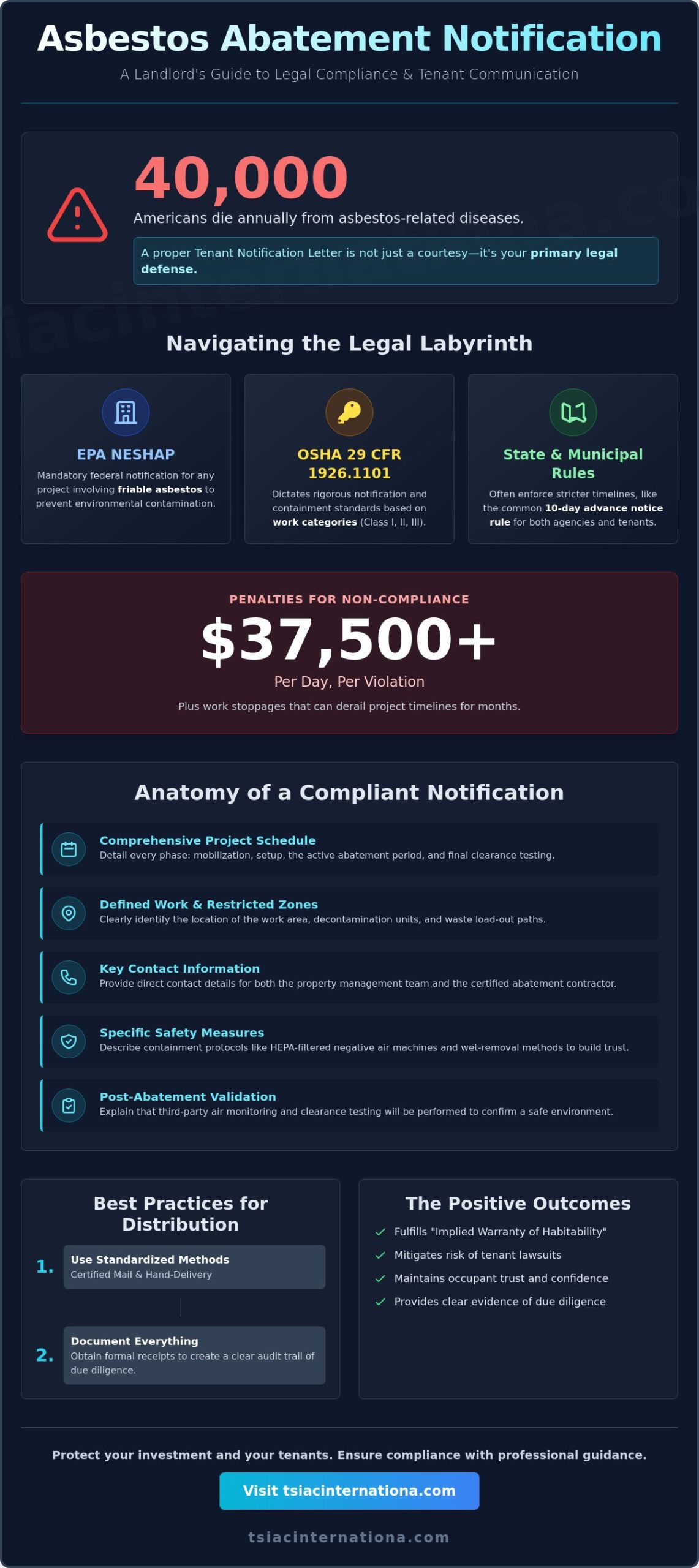
A tenant notification letter for asbestos removal is not a mere formality; it’s a critical legal instrument that serves as a landlord’s primary defense against liability. With nearly 40,000 Americans dying from asbestos-related diseases annually, the stakes for building owners are incredibly high. You’re likely concerned about causing unnecessary panic or facing a lawsuit due to a missed deadline. We understand that balancing 2025 state regulations with tenant relations requires a level of engineering precision that leaves no room for error.
You’ll master the legal requirements and communication strategies needed to execute a seamless abatement project. This article provides professional templates and expert guidance on navigating specific mandates, such as the varying notice periods mandated by different jurisdictions, which can range from a few days to a month. We’ll examine the technical details of OSHA Standard 29 CFR § 1910.1001(j) and show you how to maintain clear documentation of your due diligence to keep your project timeline on track. By following these proven protocols, you can manage the risks associated with pre-1981 buildings while maintaining the trust of your occupants.
Key Takeaways
- Identify the specific federal and state mandates, including EPA NESHAP requirements, to ensure your hazardous material disclosure is legally defensible and thorough.
- Utilize our professional tenant notification letter for asbestos removal template to communicate critical work schedules and restricted zones without causing unnecessary alarm.
- Establish a clear audit trail of due diligence by implementing standardized distribution methods like certified mail and hand-delivery with formal receipts.
- Learn how third-party air monitoring and certified abatement professionals provide the technical validation necessary to confirm a safe building environment post-removal.
The Legal Necessity of Tenant Notification for Asbestos Removal
A tenant notification letter for asbestos removal is more than a communication tool; it’s a technical disclosure required for legal compliance. It serves as the primary record that a building owner has fulfilled their duty to inform occupants about hazardous material disturbances. Under the Environmental Protection Agency (EPA) National Emission Standards for Hazardous Air Pollutants (NESHAP), specific notifications are mandatory for any project involving friable asbestos. This includes materials that can be crumbled by hand pressure, which pose the highest risk of fiber release. When you issue this letter, you’re aligning your building operations with federal safety protocols designed to prevent environmental contamination.
OSHA regulations under 29 CFR 1926.1101 further dictate the depth of information required based on work categories. Class I work, which involves removing thermal system insulation or surfacing materials, demands the most rigorous notification and containment standards. If your project falls under Class II or III, such as removing floor tiles or performing small-scale maintenance, the notice requirements remain strict but vary in technical scope. Failing to provide an accurate tenant notification letter for asbestos removal creates a significant liability gap. Regulators can impose civil penalties exceeding $37,500 per day per violation, and work stoppages can derail project timelines for months.
Federal vs. State Requirements
State-level agencies, such as the Department of Environmental Protection (DEP), often enforce much stricter timelines than the EPA baseline. You must identify whether your property falls under municipal, state, or federal jurisdiction by evaluating its usage and the total square footage of the abatement area. The 10-day rule is a common regulatory baseline requiring written notice to both state agencies and building occupants at least ten business days before any hazardous material disturbance begins. Staying ahead of these deadlines is vital for maintaining a smooth project flow without legal interference.
The Landlord’s Duty of Care
Issuing a tenant notification letter for asbestos removal fulfills the “implied warranty of habitability,” a legal standard that ensures a property is safe for its residents. You have a heightened responsibility to protect vulnerable populations, including children and the elderly, who are more susceptible to respiratory hazards. Understanding the broader asbestos laws and regulations helps you balance transparency with operational continuity. By providing clear, fact-based information, you mitigate the risk of tenant lawsuits while demonstrating that the project is under professional control. Clear documentation of this notice serves as your primary evidence of due diligence during any future legal or insurance audits.
Essential Components of a Professional Notification Letter
A high-quality tenant notification letter for asbestos removal functions as a technical roadmap for building safety and operational transparency. It must go beyond the basic logistics found in generic templates. To meet professional standards, you need to define the exact boundaries of the work areas and any restricted zones. This includes identifying the location of decontamination units and waste load-out areas. Clear communication ensures that tenants understand where the “hot zone” ends and the safe common areas begin. Providing a comprehensive project schedule is equally vital. This timeline should detail every phase: mobilization and setup, the actual abatement period, and the final clearance testing phase conducted by an independent industrial hygienist.
Your documentation should include direct contact information for both the property management team and the certified abatement contractor. Tenants feel more secure when they know exactly who is responsible for the technical execution. Describing the specific safety measures, such as the use of HEPA-filtered negative air machines and wet-removal methods, demonstrates a commitment to containment. Following EPA guidelines on occupant notification ensures that your disclosure meets federal expectations for hazard communication. If you’re managing a complex facility, partnering with an experienced team for asbestos abatement can simplify the technical coordination required for these notices.
Non-Alarmist Phrasing for Hazardous Work
Maintaining tenant trust requires a careful balance of transparency and calm. Use objective, professional terminology to describe the process. Instead of “toxic cleanup,” use “controlled abatement” or “material remediation.” This frames the project as a proactive maintenance step rather than an emergency response. Emphasize that the presence of air monitoring technicians is a safety benefit designed to provide real-time validation of air quality. It’s about projecting a sense of total control over the environment.
Regulatory Specifics to Include
Precision is key when listing regulatory data. Your letter should feature the abatement contractor’s license and certification numbers to prove they’re qualified for the task. Reference the specific asbestos survey or inspection report that identified the material. This provides a factual basis for the work. Finally, give tenants clear, actionable instructions. This might include keeping windows closed during specific hours or avoiding certain hallways while waste is being transported. These details protect the tenants and the integrity of the work zone simultaneously.
Template: Standard Tenant Notice for Asbestos Abatement
A professional tenant notification letter for asbestos removal must be structured as a formal technical briefing rather than a casual announcement. Using your company’s official letterhead is the first step in establishing authority and demonstrating that the project is being managed by a disciplined organization. This document serves as a “Fill-in-the-Blank” framework that you must customize based on the specific scope of your project. For instance, the language used for a minor pipe insulation repair will differ significantly from a full-scale floor tile removal. By following EPA Guidelines for Tenant Notification, you ensure that every required field is addressed with engineering precision.
Accuracy in your letter is paramount. You’ll need to specify whether the work involves friable or non-friable materials and detail the containment methods, such as poly-sheeting barriers or negative pressure systems. Including a “Frequently Asked Questions” attachment is a proven strategy to reduce follow-up inquiries and prevent building-wide anxiety. This attachment should address common concerns like air quality monitoring and the specifics of the final clearance testing. Clear communication at this stage prevents the spread of misinformation and keeps your project timeline on track.
The Core Template Structure
Every effective notice begins with a header that includes the date of issuance and the specific method of delivery, such as certified mail or hand-delivery. The body of the tenant notification letter for asbestos removal must clearly state the scope of work. It’s essential to describe the containment methods in objective terms to reassure occupants of the physical separation between the work zone and their living or working spaces. The closing should reiterate your commitment to safety and provide a signature line from a senior project manager or property owner to reinforce accountability.
Adaptations for Commercial vs. Residential Tenants
Commercial tenants require a focus on business continuity and the legal concept of “quiet enjoyment.” Your notice should explain how the abatement will minimize noise and foot traffic to avoid disrupting their operations. In contrast, residential tenants are primarily concerned with family safety and the protection of personal property. For those managing properties in the Southeast, understanding Hazardous Material Abatement in South Carolina can provide additional localized context for these requirements. Tailoring your approach to these different demographics ensures that you meet your legal obligations while maintaining a stable environment for all occupants.
Best Practices for Distribution and Documentation
Distributing a tenant notification letter for asbestos removal is a logistical process that requires rigorous documentation to withstand legal scrutiny. It’s not enough to simply draft the document; you must prove it was delivered to every affected party. Establish a notification timeline that allows for at least 7 days of lead time prior to mobilization, though many state agencies require 10 business days. For maximum legal protection, use certified mail with return receipt requested. This provides a verifiable paper trail that a tenant received the disclosure. Hand-delivery is a viable alternative, provided you obtain a dated signature upon receipt. While digital portals offer speed and convenience, they should serve as a secondary communication channel rather than the primary legal record.
Visibility is another critical component of compliance. You must post the notification in high-traffic common areas, including lobby elevators, mailrooms, and all primary entry points. These physical notices ensure that visitors and contractors who are not residents also remain informed of the work zones. Maintaining a “Notice Log” is a best practice that serves as your primary defense in the event of litigation. This log should include the date, time, method of delivery, and the name of the individual who performed the distribution. If you require expert assistance in managing these complex regulatory requirements, our team provides comprehensive asbestos abatement services that prioritize both safety and compliance.
Timing Your Notice Correctly
The timeline for tenant notification must be synchronized with the “Notice of Intent” (NOI) filed with state or local environmental agencies. Typically, the state must be notified 10 days before any asbestos disturbance, and tenant notice should coincide with this filing. In rare cases involving immediate threats to life or property, such as a burst pipe or structural collapse, the 24-hour emergency rule allows for an accelerated timeline where work begins almost immediately after a verbal or short-form written notice. Managing these tight windows requires a contractor who understands the interplay between emergency response and regulatory mandates.
Creating a Paper Trail
For high-risk projects or buildings with a history of tenant disputes, use a “Tenant Acknowledgment Form.” This document requires the resident to sign off that they have read and understood the safety protocols. If a tenant is hostile and refuses to sign, document the refusal in your Notice Log and have a witness verify the attempt. Photographing every posted notice in common areas provides timestamped evidence of your compliance. These photographs should clearly show the text of the notice and its location within the building to ensure there is no ambiguity during a future audit.
Partnering with a Certified Abatement Professional
A certified contractor brings more than just physical labor to an abatement project; they provide the regulatory expertise required to manage the administrative burden of hazard communication. When you prepare a tenant notification letter for asbestos removal, your contractor should be an active partner in the drafting process. They ensure that the technical descriptions of containment barriers and negative air pressure systems are accurate and defensible. By aligning the tenant notice with the official state permits, a professional firm prevents discrepancies that could trigger a regulatory inspection or a costly work stoppage. This partnership ensures that your legal disclosures match the actual engineering controls on-site.
Third-party air monitoring is a non-negotiable component of a high-integrity project. While the abatement team performs the removal, an independent industrial hygienist conducts real-time air sampling to validate that no fibers are escaping the containment zone. This objective data is the most powerful tool for reassuring concerned residents. It transforms the project from a perceived risk into a controlled technical operation. Utilizing professional asbestos removal services ensures that these safety layers are integrated into the project from the mobilization phase through to the final clearance. This technical rigor reduces your long-term property liability by creating a verifiable record of safety.
Contractor-Led Communication
Reliable contractors act as a technical buffer between the property owner and the occupants. They can provide technical data sheets or specifications for HEPA filtration units to any tenant who requests more depth than the standard tenant notification letter for asbestos removal provides. This level of transparency builds credibility and reduces the likelihood of building-wide anxiety. For complex projects where the demolition process involves both structural changes and hazardous material remediation, having a single point of technical authority is essential. It ensures that safety protocols remain consistent even as the work environment shifts.
Securing Your Property’s Future
The successful distribution of a notification letter is only the beginning of your documentation trail. Upon project completion, your contractor must provide a comprehensive “Close-out Document” package. This includes the final clearance report, which serves as a “Clean Bill of Health” for the building. This report is a vital asset during future property sales, insurance renewals, or leasing negotiations, as it proves the hazard was mitigated according to federal standards. Contact TSIAC International for a professional abatement consultation to ensure your next project is handled with engineering precision and total regulatory compliance.
Securing Your Project with Regulatory Precision
Executing a compliant abatement project requires a disciplined approach to both technical field work and administrative disclosure. You’ve learned that a professionally drafted tenant notification letter for asbestos removal acts as your primary legal shield; it ensures that EPA and OSHA standards are met while keeping occupants informed through factual, non-alarmist communication. By implementing standardized templates and maintaining rigorous distribution logs, you transform a potential liability into a manageable and fully documented process. This level of diligence is essential for maintaining building safety without compromising operational stability or tenant trust.
TSIAC International brings 15+ years of hazardous material experience to every site, ensuring that your remediation project is handled with engineering accuracy. Our protocols remain strictly OSHA and EPA compliant, and we provide comprehensive project documentation, including final clearance reports, to protect your long-term property interests. Get a Professional Quote for Your Abatement Project to ensure your facility meets the highest safety standards. Your commitment to proper notification today ensures a smoother, safer project completion tomorrow.
Frequently Asked Questions
How many days’ notice is required for asbestos removal?
Notice requirements vary significantly by state and municipal law. In the District of Columbia, building owners must provide 30 days’ notice under Section 800.9 of Title 20. New York State Labor Law § 904 requires 10 days’ notice for residential and business occupants. Always check your local jurisdiction to ensure the timing of your tenant notification letter for asbestos removal meets these specific regulatory thresholds.
Can a tenant refuse entry for asbestos abatement?
Tenants generally can’t refuse entry for hazardous material abatement if the work is necessary for health and safety or mandated by local building codes. Most lease agreements include a “right of entry” clause for essential repairs and maintenance. If a tenant remains uncooperative, landlords should document the refusal and consult legal counsel to enforce entry through a court order or a formal notice of lease violation.
Does the notice need to be in multiple languages?
Multi-language notification is often a legal requirement in jurisdictions with high linguistic diversity. For example, certain New York City regulations require notices in the top seven most spoken languages if the building houses a significant number of non-English speakers. Providing translations demonstrates a higher level of due diligence and ensures that all occupants clearly understand the safety protocols and work schedules being implemented.
What happens if asbestos is discovered during an ongoing renovation?
If workers discover suspect material during a renovation, all activity must stop immediately to prevent fiber release. You must secure the area and conduct a professional inspection. Once confirmed, you’ll need to issue an emergency tenant notification letter for asbestos removal. Emergency rules often allow for a shorter notice period, sometimes as little as 24 hours, to address the immediate environmental hazard safely.
Is the landlord required to pay for tenant relocation during removal?
Relocation costs are typically only required if the abatement process makes the unit uninhabitable under the “implied warranty of habitability.” If the work is localized and containment systems prevent exposure, tenants usually remain in place. However, if the HVAC system must be shut down for more than 12 hours or if essential facilities like the kitchen or bathroom are inaccessible, the landlord might be responsible for temporary housing.
What specific information must be on the posted warning signs?
OSHA Standard 1926.1101 requires specific language on all regulated area signs to warn of hazardous conditions. These signs must include the words “DANGER,” “ASBESTOS,” and “MAY CAUSE CANCER.” They also need to warn about “LUNG DISEASE HAZARD” and state that “AUTHORIZED PERSONNEL ONLY” are permitted. Signs must be large enough to be legible from a distance and posted at all primary entrances to the work zone.
How do I document that all tenants received the notification letter?
Documentation requires a formal “Proof of Service” log that tracks every delivery with engineering precision. You should keep all certified mail return receipts and signed hand-delivery logs as your primary evidence of compliance. For common areas, take timestamped photographs of the posted notices. These records provide a verifiable audit trail that can protect you against future litigation or claims that a tenant was not properly informed.
Can I use email as the sole method of tenant notification?
Email is rarely sufficient as a sole method of notification for hazardous material work. While it’s a helpful secondary communication tool, most state laws require a physical delivery method like certified mail or hand-delivery to ensure receipt. Relying strictly on digital portals could leave you vulnerable to claims that the tenant didn’t see the notice, potentially leading to work stoppages or fines from environmental agencies.
