

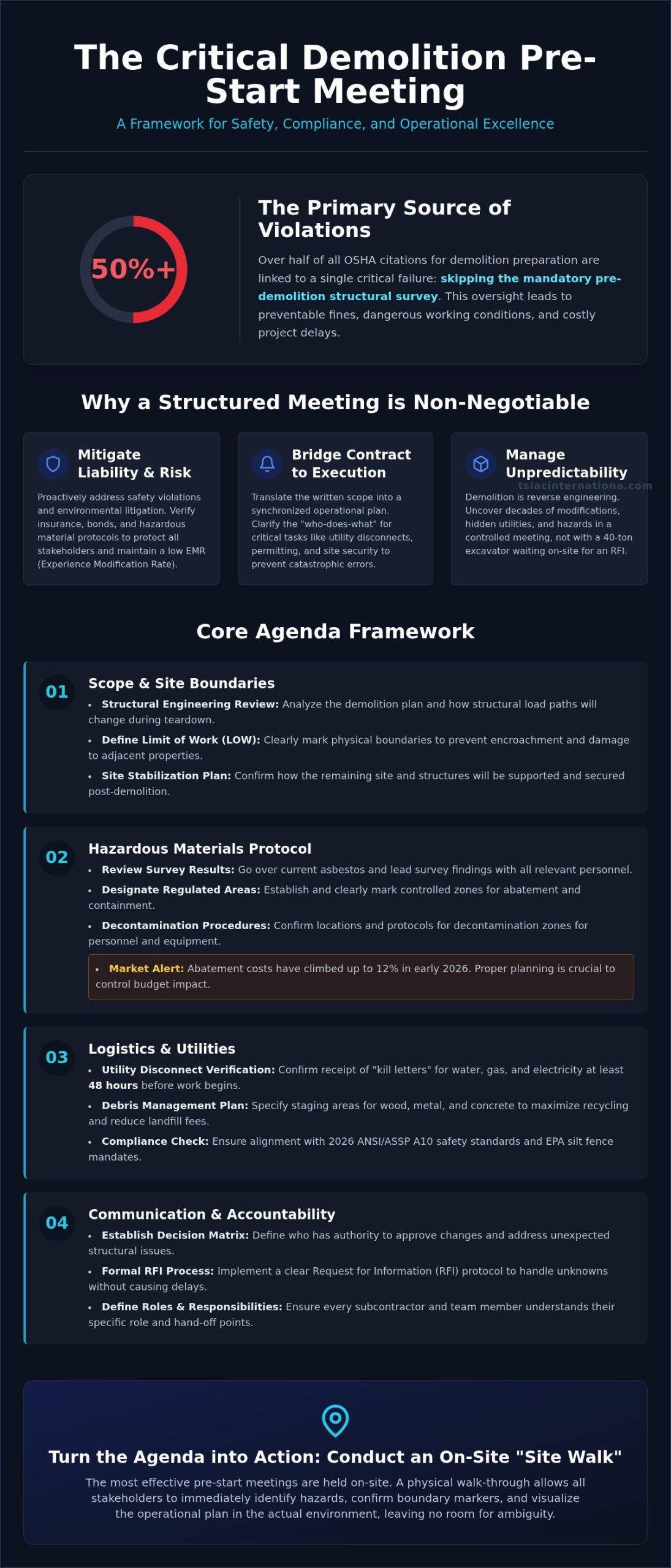
Over 50% of all OSHA citations for demolition preparation violations are linked to one critical failure: skipping the mandatory structural survey before partial or full removal begins. In a sector where technical precision involves lives and high value assets, you know that a project’s success is determined well before the first excavator arrives. The fear of discovered hazardous materials like asbestos or lead causing indefinite delays is a valid concern, especially as abatement costs in major markets have already climbed up to 12% in early 2026.
Mastering a comprehensive demolition pre-start meeting agenda is your primary defense against regulatory fines and costly scope creep. By establishing clear boundaries and communication protocols early, you ensure full compliance with the updated 2026 ANSI/ASSP A10 safety standards and EPA silt fence mandates. This guide provides a repeatable framework to align every stakeholder, reduce change orders, and manage the complex transition from a theoretical contract to a safe, high performance operation. We’ll examine the essential agenda items, from utility disconnect verification to the latest municipal “silent demolition” requirements, to keep your project on schedule and under control.
Key Takeaways
- Implement a structured demolition pre-start meeting agenda to transform contract specifications into a synchronized, safe operational plan before any heavy machinery is mobilized.
- Define precise “Limit of Work” boundaries and review structural engineering requirements to prevent accidental damage to adjacent properties and utilities.
- Establish rigorous hazardous material protocols by reviewing current asbestos and lead survey results to designate regulated work areas and decontamination zones.
- Create a formal Decision Matrix and RFI process to handle structural unknowns, ensuring all stakeholders know who has the authority to approve change orders.
- Conduct the pre-start meeting on-site to perform a physical “Site Walk,” which allows for the immediate identification of physical hazards and boundary markers.
The Foundation: Why a Structured Demolition Pre-Start Meeting is Non-Negotiable
The demolition pre-start meeting serves as the final alignment phase before heavy machinery or abatement crews mobilize on-site. It’s the critical juncture where a project shifts from a theoretical plan to a high-stakes physical operation. While many treat this as a formality, seasoned professionals recognize it as a risk-mitigation engine. This meeting is the last opportunity to verify that every technical parameter is understood by the owner, the general contractor, and the demolition team. Without a rigorous demolition pre-start meeting agenda, the transition from paper to pavement often results in preventable safety incidents.
Demolition differs fundamentally from new construction due to the inherent unpredictability of existing structures. A new build follows a linear, controlled path from the foundation up. In contrast, a Demolition process overview reveals a reverse engineering challenge where structural integrity can change with every wall removed. You aren’t just following a blueprint; you’re uncovering decades of modifications, hidden utilities, and potentially hazardous materials. Identifying these risks on paper during the pre-start phase saves thousands in field hours. It’s far more cost-effective to solve a structural conflict in a conference room than to pause a 40-ton excavator while waiting for an engineering RFI.
Bridging the Gap Between Contract and Execution
A successful project requires translating the written scope of work into a logical sequence of physical tasks. The meeting must clarify the “who-does-what” for critical items like utility air-gaps, digital permitting, and site security. If the responsibility for a water disconnect is ambiguous, the project faces immediate delays or catastrophic flooding. By walking through the sequence of structural or selective demolition, you set a tone of professional accountability. This ensures every subcontractor understands their specific boundaries and the precise timing of their involvement.
Mitigating Liability Through Proactive Planning
Professional site management is your primary defense against environmental litigation and safety violations. The demolition pre-start meeting agenda must include a verification of all site-specific insurance certificates and bonds. This proactive approach protects the property owner and helps maintain a low Experience Modification Rate (EMR). A low EMR isn’t just a number; it’s a reflection of a “Safety First” culture that prevents accidents before they occur. Confirming that specialized hazardous material containment protocols are ready for deployment ensures that the project remains compliant with 2026 regulatory standards from day one.
Core Agenda Items: Defining Scope, Logistics, and Site Boundaries
A precise demolition pre-start meeting agenda moves beyond general safety into the granular technicalities of the site. The structural engineering report serves as the anchor for this discussion. Every participant must review the demolition plan to understand how the building’s load paths will change during the teardown. Defining the Limit of Work (LOW) is equally critical. Without clearly marked boundaries, heavy machinery can easily encroach on adjacent structures, leading to vibration damage or accidental structural compromise. It’s not enough to say “demolish the building”; you must define exactly where the work stops and how the remaining site will be stabilized.
Debris management is another pillar of modern site operations that often lacks sufficient detail in standard meetings. In 2026, professional site management requires a sophisticated approach to sorting and hauling. Your demolition pre-start meeting agenda should specify the staging areas for wood, metal, and plastic to maximize recycling yields. This isn’t just about environmental stewardship; it’s about operational efficiency. Proper sorting at the source reduces landfill fees and keeps the site organized. Additionally, you must confirm the receipt of “kill letters” for all utilities. Verified digital disconnects for water, gas, and electricity must be in hand at least 48 hours before any structural impact occurs.
Selective Demolition and Interior Gutting Limits
When performing selective demolition, the distinction between structural and non-structural components must be absolute. The team should physically walk the interior to mark “save” items, such as architectural features or MEP systems that will remain active. For occupied buildings, the agenda must detail vibration control and dust mitigation protocols. High-efficiency particulate air (HEPA) filtration and temporary partitions are standard requirements to prevent cross-contamination between the work zone and occupied spaces. If you’re unsure about the structural implications of a specific interior wall, consulting with a partner experienced in selective demolition services can prevent a costly engineering error.
Mobilization and Site Logistics
Mobilization requires a logical flow for heavy machinery and debris containers. The meeting must establish specific ingress and egress routes that minimize disruption to local traffic and neighboring properties. Compliance with OSHA demolition safety standards dictates that staging areas for equipment and hazardous material containment units remain clear of overhead hazards and pedestrian paths. Finally, the team must review work hours and noise ordinances. Proactive neighbor notification protocols help manage expectations and reduce the likelihood of noise complaints that can trigger municipal stop-work orders.
Hazardous Material Protocol: Asbestos, Lead, and Environmental Safety
The discovery of hazardous substances is the most frequent cause of project paralysis and budget overruns. A robust demolition pre-start meeting agenda must prioritize the review of comprehensive survey results for asbestos removal and lead abatement. This involves cross-referencing EPA pre-demolition inspection guidelines with site-specific findings to establish regulated work areas. These zones require dedicated decontamination units and strict air monitoring schedules conducted by third-party inspectors to ensure zero exposure. If the demolition process uncovers suspicious, untested materials, the “Stop Work” protocol must be immediate. Ignorance of a material’s presence isn’t a legal defense. Establishing a clear chain of command for environmental unknowns is vital for maintaining regulatory compliance.
Containment and Abatement Coordination
Effective coordination between abatement contractors and structural teams prevents cross-contamination and hazardous exposure. The agenda should specify PPE requirements, which often differ significantly between abatement crews and general demolition operators. While abatement personnel utilize specialized respiratory protection, general crews must maintain safe distances until clearance is achieved. Every pound of toxic material must be accounted for through rigorous waste manifest tracking. This documentation ensures legal disposal at certified facilities and protects the project owner from future liability. Clear communication ensures that abatement is completed in logical phases, allowing structural work to proceed without breaching containment barriers.
Structural Integrity and Collapse Prevention
Safety extends beyond chemistry to the physics of the structure itself. The demolition pre-start meeting agenda must include a detailed review of the engineered takedown sequence. This plan prevents unplanned collapses by identifying which load-bearing elements must remain until specific phases are reached. Teams should physically inspect and monitor existing cracks or structural weaknesses in adjacent walls, often using vibration sensors or digital crack gauges. An emergency response plan is essential for handling structural anomalies. If a building behaves unexpectedly during teardown, the team needs a pre-approved protocol to stabilize the site and evacuate personnel without delay.
Communication and Accountability: Roles and Documentation Standards
Effective site management relies on a transparent communication structure established during the initial briefing. A comprehensive demolition pre-start meeting agenda must define the Decision Matrix to prevent operational paralysis. When structural or environmental unknowns appear, the team needs to know exactly who has the authority to approve change orders. Without this, a minor discovery can halt production for days while stakeholders debate costs. The RFI (Request for Information) process should be formalized to ensure that technical queries regarding load-bearing elements or hazardous materials are addressed by qualified engineers or environmental consultants immediately.
Daily reporting serves as the project’s legal diary. These reports must capture progress, safety huddles, and a log of all site visitors. Photographic documentation is equally vital for risk mitigation. Capturing high-resolution ‘before’ conditions of the site and adjacent structures is the most effective way to mitigate fraudulent damage claims. By documenting existing cracks or structural wear on neighboring buildings, you create a verifiable baseline that protects all parties involved. This level of detail ensures that any claim of new damage can be cross-referenced with the initial site state.
Establishing the Chain of Command
Every high-performance site requires a clear hierarchy. The agenda must designate the Site Safety and Health Officer (SSHO), who holds the authority to stop work for safety violations without prior approval. Identifying the primary points of contact for the Owner, General Contractor, and Demolition Contractor eliminates confusion during emergencies. Weekly progress meetings should be scheduled in a consistent format to review the look-ahead schedule and address any emerging logistical constraints. This rhythm keeps all stakeholders aligned on the engineered takedown sequence.
Regulatory and Compliance Documentation
Compliance isn’t optional; it’s the foundation of professional demolition. The team must confirm that all required permits are physically present on-site and that OSHA-required notifications are active. A site-specific safety plan (SSSP) must be accessible to all personnel at all times. For projects with sustainability goals, maintaining the ‘Green’ file is essential. This document tracks recycling percentages for metal, wood, and plastic, ensuring the project meets LEED or corporate environmental targets. If you need a partner who prioritizes this level of technical transparency and regulatory precision, contact TSIAC International to discuss your next project.
Turning the Agenda into Action: Best Practices for Meeting Execution
A demolition pre-start meeting agenda achieves its full potential only when executed within the physical context of the project site. While administrative alignment can happen in a remote office, the technical nuances of a teardown require visual confirmation. Holding the conference on-site allows the owner, general contractor, and demolition team to point directly at structural transition points and potential hazards. This physical grounding eliminates the ambiguity that often plagues complex projects. It’s the difference between discussing a utility line on a blueprint and standing over the specific valve that requires a lock-out/tag-out procedure.
Total subcontractor presence is mandatory for this session to be effective. When abatement crews, structural specialists, and hauling contractors are all present, the “I didn’t know” excuse is removed from the project vocabulary. This collective presence ensures that everyone understands the sequence of operations and the interdependencies between trades. For example, the structural team must know exactly when the abatement crew has cleared a specific zone before they can mobilize heavy equipment. Closing the loop with signed meeting minutes provides a legal and operational record of these agreements, ensuring that verbal instructions are never lost in the noise of a busy site.
Conducting the Site Walkthrough
The “Site Walk” is the most vital component of the execution phase. During this walkthrough, the team must perform physical lock-out/tag-out (LOTO) checks to verify that all utility disconnects are air-gapped and secured. This is also the time to identify overhead obstructions, such as low-hanging power lines, or evidence of underground storage tanks (USTs) that may not have been fully documented in the initial surveys. Finally, the team should perform a final check of the site fencing and silt-fence environmental protections. These barriers must comply with the 2026 EPA mandates to prevent runoff into municipal sewers, a common source of heavy fines during the early stages of structural removal.
Post-Meeting Follow-up and Sign-offs
Execution doesn’t end when the team leaves the site. Meeting minutes must be distributed to all stakeholders within 24 hours of the conference to maintain momentum. This document should summarize every decision made, especially regarding the Limit of Work (LOW) and the engineered takedown sequence. Obtaining formal signatures on the site-specific safety plan (SSSP) acknowledgment is a critical step for insurance and regulatory compliance. Finally, the master project schedule must be updated to reflect any logistical adjustments or structural discoveries made during the walkthrough. This ensures the project remains a well-coordinated, high-performance operation from the first impact to the final debris haul-off.
Securing Your Project Timeline Through Precision Planning
A successful teardown requires more than just a signed contract; it demands a rigorous transition from documentation to physical site control. By prioritizing a structured demolition pre-start meeting agenda, you transform potential liabilities into a synchronized operational plan. We’ve explored how identifying “Limit of Work” boundaries and establishing immediate “Stop Work” protocols for hazardous materials prevents the cascading delays that plague less disciplined projects. Precision in the planning phase translates directly to safety and efficiency on the ground. Experience matters.
When you require a partner that combines technical mastery with an unwavering commitment to regulatory compliance, our team is ready to mobilize. With over 15 years of specialized abatement and demolition experience, we provide national coverage for the most complex commercial and industrial projects. Our teams maintain rigorous adherence to OSHA and environmental standards to protect your assets and the surrounding community. Partner with TSIAC International for your next high-stakes demolition project to ensure every phase of your teardown is handled with methodical accuracy. You can proceed with confidence knowing your site is in expert hands.
Frequently Asked Questions
What is the primary goal of a demolition pre-start meeting?
The primary goal is final alignment and risk mitigation before heavy machinery or abatement crews mobilize on-site. It ensures all stakeholders understand the engineered takedown sequence, safety protocols, and site boundaries. This meeting prevents costly “discovery” delays by addressing structural and environmental unknowns on paper rather than in the field. It establishes a professional “Safety First” culture from the project’s inception to protect both lives and property values.
Who should attend the pre-construction conference for a demolition project?
Attendance must include the property owner, the general contractor, the demolition contractor’s project manager, and the Site Safety and Health Officer (SSHO). Additionally, specialized subcontractors for asbestos and lead abatement should be present. Structural engineers and utility representatives may attend if the project involves complex load-bearing removals or high-risk utility air-gaps. This collective presence eliminates the “I didn’t know” excuse later in the project and ensures everyone understands their specific roles.
How do you handle hazardous materials discovered during the pre-start phase?
If hazardous materials are identified during the site walk or survey review, the “Stop Work” protocol is immediately activated for that specific zone. The demolition pre-start meeting agenda should define the chain of command for environmental discoveries. You must engage a certified inspector to conduct testing and establish specialized hazardous material containment protocols. Abatement must be completed and cleared by a third-party inspector before structural demolition resumes in that area.
What documents must be present at the pre-start meeting?
Essential documentation includes the engineered demolition plan, asbestos and lead survey results, and active demolition permits. The team must also review the Site-Specific Safety Plan (SSSP) and utility “kill letters” verifying digital disconnects for water, gas, and electricity. If the project targets LEED certification, the “Green” file for tracking recycling percentages of wood, metal, and plastic should be initiated during this meeting to ensure accurate environmental reporting from day one.
How long does a typical demolition pre-start meeting last?
A typical meeting lasts between two and four hours depending on project complexity. The administrative portion usually takes 60 to 90 minutes to review the Decision Matrix, RFI process, and documentation standards. The remaining time is dedicated to a physical site walkthrough. This walkthrough is essential for identifying physical hazards, overhead obstructions, and “Limit of Work” markers that aren’t always clear on a blueprint, ensuring every subcontractor sees the site’s current state.
Can a demolition project start without a formal pre-start meeting?
While physically possible, starting without a formal meeting is a high-risk practice that often leads to OSHA citations or environmental litigation. Skipping this alignment phase is linked to over 50% of all demolition preparation violations. A formal conference is a regulatory and insurance necessity to confirm that all safety standards, such as the 2026 ANSI/ASSP A10 revisions, are fully integrated into the operational plan before any structural impact occurs on the property.
What is the difference between a safety huddle and a pre-start meeting?
A demolition pre-start meeting agenda focuses on high-level project alignment, roles, and long-term logistical planning before any work begins. In contrast, a safety huddle is a brief, daily gathering held on-site to discuss immediate tasks and specific hazards for that day’s work. The pre-start meeting sets the overarching safety framework, while the daily huddle ensures the crew executes that framework safely every morning as site conditions change during the teardown.
How often should site safety meetings occur after the initial pre-start?
Beyond the initial pre-start conference, safety huddles should occur daily before each shift begins. Weekly progress meetings are also standard for reviewing the look-ahead schedule and addressing emerging structural or environmental constraints. These recurring meetings ensure that the safety culture established on day one remains consistent as the structure is progressively removed. They provide a vital platform for discussing any structural anomalies or hazardous materials discovered during the physical removal process.
