

One mold patch can be the visible edge of a problem that extends beyond the surface. In an apartment building, a complaint in one unit may point to moisture or affected materials elsewhere. Mold remediation for apartment buildings starts by determining what is actually affected, rather than assuming the problem is limited to the visible spot or extends throughout the property.
That makes remediation a coordinated operation, not simply a cleanup confined to the room where growth appeared. Property teams need to understand whether concealed materials may be involved, when removal may be necessary, and how to schedule work across occupied units and shared spaces while keeping residents informed and the building safe.
This guide explains how assessment and moisture control shape the work scope, when affected materials may need removal, and how to coordinate projects in occupied properties. It also covers how remediation can be planned alongside related selective demolition. TSIAC International provides mold remediation, selective demolition, and interior gutting, drawing on more than 15 years of industry experience.
Key Takeaways
- Use moisture investigation and material inspection to determine whether concerns are limited to visible surfaces or extend into concealed areas.
- Plan mold remediation for apartment buildings around affected conditions and materials, rather than treating each reported unit as an isolated cleanup.
- Separate moisture correction, remediation, material removal, and repair so the scope addresses both affected materials and damaged building components.
- Coordinate approvals, resident communication, access, and scheduling across units, common areas, and shared systems.
- When affected materials require removal, TSIAC International can coordinate mold remediation with related selective demolition or interior gutting, with the scope tailored to project conditions.
Why mold remediation in apartment buildings requires a building-wide view
Mold remediation addresses affected materials and conditions that support mold growth; moisture correction addresses the water or dampness that allows the problem to persist. The tasks are related, but they are not interchangeable. Cleaning or covering a visible mark may change its appearance without resolving affected materials or the moisture source. Mold remediation for apartment buildings therefore starts with understanding how the reported area relates to the rest of the structure.
A concern in one apartment does not automatically mean neighboring units are affected. However, the location and possible moisture pathway matter. A leak near a plumbing chase, a ceiling below another unit, or a damp wall beside a shared space may warrant checking connected areas before setting the work scope. The goal is to establish what is affected, not to assume either a building-wide problem or a strictly isolated one.
That distinction is central to mold remediation, which involves more than treating a surface. Mold-like discoloration can resemble staining, residue, or other material changes, so appearance alone cannot reliably identify a spot or show how far a problem extends. A sound building-wide assessment separates observed conditions from conclusions that require further investigation.
How moisture moves through multifamily buildings
Leaks, condensation, and persistent dampness can introduce or maintain moisture in different parts of a multifamily building. A plumbing issue may affect finishes along a wall or ceiling. Condensation may recur where surfaces remain damp. Moisture near a shared space may call for attention beyond the room where it was first noticed.
Walls, ceilings, plumbing routes, and common areas can connect locations, but they do not prove that mold is present along the entire route. Building age and outward appearance also cannot establish whether mold exists or define its extent. Treat them as context, not a diagnosis. Assessment should follow the observed moisture conditions and affected materials.
When a visible spot may not show the full scope
Finishes can conceal materials behind them. If moisture has reached a wall cavity, ceiling assembly, or another building component, the visible mark may not show the full area requiring attention. A recurring damp patch, water staining, peeling finish, musty odor, or history of leakage can prompt further assessment, but none of these observations alone confirms concealed mold.
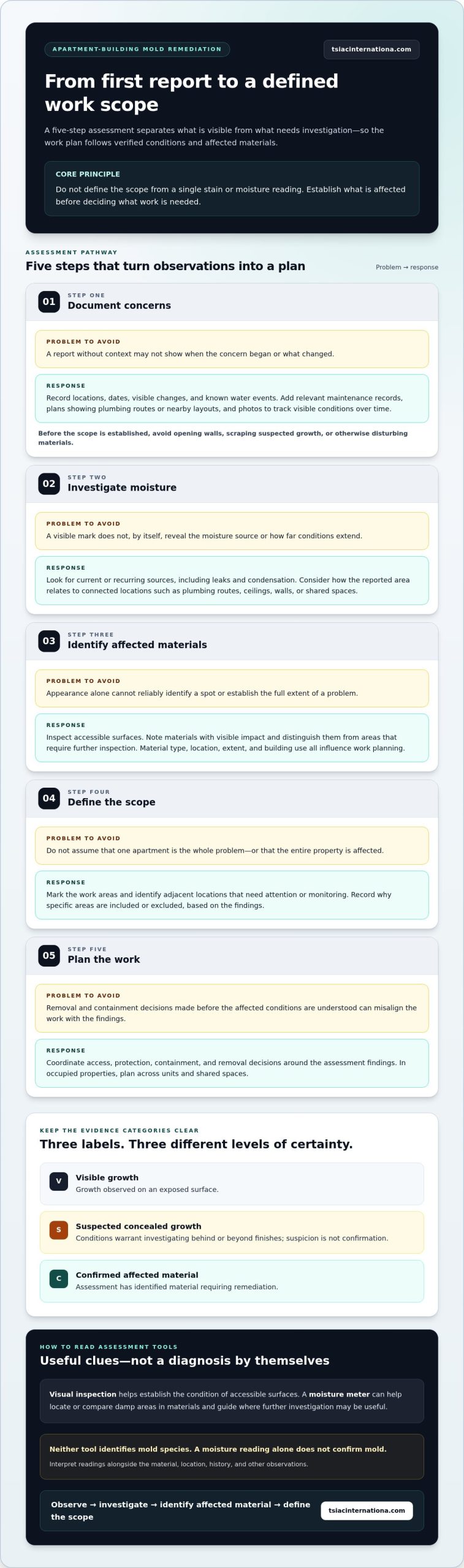
Keep three categories distinct in project records: visible growth, meaning growth observed on an exposed surface; suspected concealed growth, meaning conditions warrant investigating behind or beyond finishes; and confirmed affected material, meaning assessment has identified material requiring remediation. This distinction helps teams avoid treating a suspicion as a finding, while also preventing a small visible spot from prematurely defining the scope.
How mold assessment identifies affected areas and remediation scope
A useful assessment turns reports and observations into a defined work plan. It separates what is visible from what needs investigation, identifies affected materials, and records why specific areas are included or excluded. Remediation scope should follow verified conditions and affected materials, not assumptions based on a single stain or moisture reading.
Property teams can organize mold remediation for apartment buildings into five steps:
- Document concerns: Record locations, dates, visible changes, and known water events.
- Investigate moisture: Look for current or recurring sources, including leaks and condensation.
- Identify affected materials: Note which materials show visible impact and which require further inspection.
- Define the scope: Mark work areas and identify adjacent locations that need attention or monitoring.
- Plan the work: Coordinate access, protection, containment, and removal decisions around the findings.
Visual inspection helps establish the condition of accessible surfaces. A moisture meter can help locate or compare damp areas in materials and guide where further investigation may be useful. Neither tool identifies mold species, and a moisture reading alone does not confirm mold. Interpret readings alongside the material, location, history, and other observations. Professional organizations such as the National Association of Mold Remediators and Inspectors provide resources on practices in the field.
What property teams should document before work begins
Start a shared record of reported locations, when concerns were noticed, changes in appearance, and known leak or condensation events. Add relevant maintenance records, such as prior water-related repairs, and building plans that show plumbing routes or the layout around the affected area. Photos can help track visible conditions over time. Avoid opening walls, scraping suspected growth, or otherwise disturbing materials before the scope is established. Disturbance can complicate assessment and work planning.
How findings shape removal and containment decisions
Material type, location, extent, and building use all influence how work is planned. A finding on an accessible, nonporous surface presents different removal questions from a finding in porous drywall or above a ceiling. Adjacent areas may need further inspection if the moisture pattern, building assembly, or access conditions warrant it. Proximity alone, however, does not confirm that those areas are affected.
Containment is a project-specific measure used to manage dust and the movement of materials during work. Its design and extent depend on the conditions and work area; there is no single setup for every apartment building. Technical procedures and regulatory requirements also vary with the project and jurisdiction, so scope documents should identify the applicable guidance rather than rely on blanket thresholds.
When assessment identifies affected materials that require removal, TSIAC International can coordinate mold remediation with related selective demolition or interior gutting. The scope is shaped by project conditions, allowing property teams to plan remediation and removal as related parts of one defined project.
Remediation, removal, or repair: how apartment-building scopes differ
These terms describe related but distinct work. Separating them helps property teams approve a scope that addresses identified conditions without assuming every mold concern requires demolition. For mold remediation in an apartment building, assessment findings determine which tasks belong in the project and how to sequence them.
| Scope element | Purpose | Example |
|---|---|---|
| Moisture correction | Address the water source or conditions sustaining dampness. | Repairing a leak or correcting a recurring moisture condition. |
| Mold remediation | Address affected conditions and materials identified by the project assessment. | Cleaning or treating affected surfaces, or coordinating removal where material findings call for it. |
| Material removal | Remove building components included in the defined work scope. | Removing affected drywall or ceiling material when project findings and controls support removal. |
| Reconstruction or repair | Restore or repair building components after remediation and moisture-related work. | Replacing removed finishes or repairing damaged components. |
Remediation addresses affected conditions; repair addresses the source of moisture or damage to building components. Some projects require both, but completing one does not automatically complete the other. Removing affected material does not fix a leak, while repairing a leak does not address materials already affected. The property team’s scope should make responsibilities and sequencing clear.
When affected building materials may need removal
Removal may be considered when assessment identifies affected porous or damaged materials that cannot be adequately addressed in place. The decision depends on the material, its condition, location, and project findings. It does not mean every visible mold concern calls for demolition or full interior gutting. Where removal is warranted, it should follow the defined scope and appropriate work controls. Commercial interior gutting services offer further context on scoping removal work in building projects.
Selective demolition can address specific components while limiting work to the areas established in the scope. Interior gutting is a broader removal approach, not a default response to mold. Coordinating either activity with remediation planning clarifies which materials are to be removed, where boundaries fall, and what repair work may follow.
How mold work can intersect with other abatement
Before disturbing building materials, account for the possibility of other hazards that need separate assessment. Mold findings do not establish whether asbestos, lead, or another material hazard is present. Each hazard has its own assessment and handling requirements, which can affect work planning and sequencing. Hazardous material abatement guidance can provide additional context for planning related project work.
A coordinated scope can distinguish moisture correction, mold remediation, removal, and component repair while accounting for other material concerns identified for the project. TSIAC International provides mold remediation alongside selective demolition and interior gutting, with work shaped by project conditions.
How property teams can coordinate remediation in occupied buildings
In an occupied multifamily property, the approved scope is only one part of the plan. Property teams also need to coordinate unit access, shared spaces, resident notices, and building operations so work follows a clear sequence. For mold remediation for apartment buildings, whether residents can remain onsite depends on project conditions and work controls. Do not make occupancy assurances before those details are established.
Before scheduling work, assign a property contact to coordinate with the remediation team and organize these steps:
- Approve the scope: Confirm the locations and tasks covered, including material removal and related work.
- Map affected areas: Identify units, common areas, access routes, and shared systems relevant to the project.
- Set communication responsibilities: Decide who prepares notices, answers resident questions, and communicates schedule changes.
- Coordinate access and sequence: Schedule entry and work areas in a way that follows the project scope and building operations.
- Record changes: Document newly observed conditions and approve scope adjustments before work proceeds beyond the established plan.
Planning resident communication and access
Notices should tell residents which areas may be affected, what access is needed, and the expected work schedule established for the project. Keep the language factual. Explain that work is planned in designated areas, but avoid unsupported assurances about health effects, exposure, or whether residents can stay in their units. If concealed conditions change the scope or schedule, provide an update through the property team’s designated communication channel.
Unit boundaries do not always match work boundaries. Depending on the findings and approved scope, a crew may need access to a reported apartment, an adjoining area, a hallway, or a space serving a shared building system. Coordinate these interfaces with property operations, including building access procedures that affect the work. Sequence units and common areas deliberately instead of treating every entry as a separate task.
Keeping project records and managing related work
Maintain a project file that brings together assessment findings, the approved scope, relevant maintenance history, resident notices, access records, and work documentation. Note the specific areas addressed and tasks completed. If opening a finish reveals conditions that differ from the plan, record the observation, document the scope change, and coordinate the next step before expanding the work area.
When removal is part of the project, connect it to the remediation sequence and keep records that distinguish removal from subsequent repairs. A demolition process and safety guide provides related context for planning removal work. For information about coordinating mold remediation and related removal, visit TSIAC International.
How TSIAC approaches apartment-building mold remediation
For mold remediation for apartment buildings, project conditions determine the appropriate scope. Affected materials, the extent of removal, building access, and the relationship to other work can all shape coordination. TSIAC International provides mold remediation alongside selective demolition and interior gutting, services that can work together when the defined scope includes removing affected building materials. The company brings more than 15 years of industry experience to complex property work.
These related capabilities allow remediation and removal work to be planned together when project findings call for both. They do not mean every mold concern requires demolition, or that every building needs the same approach. The work follows the project’s documented conditions and boundaries.
Coordinating remediation with removal work
Where affected materials need to be removed, selective demolition can address specific components within a defined area. Interior gutting may be relevant when the project calls for broader interior removal, but it is not a default response to mold. The appropriate scope depends on which materials are affected and the conditions found in the building. Clear boundaries help property teams understand which areas are included and how related work fits together.
Mold remediation should also remain distinct from asbestos and lead abatement. Those are separate services with their own assessment, scope, and handling considerations; a mold finding does not establish whether either hazard is present. When materials and project conditions allow, TSIAC International’s site recycling practices include wood, metal, and plastic.
What property teams can prepare for a project discussion
A focused discussion is easier when the property team has organized the information already available. Useful materials include affected-area records, photos of observed conditions, known moisture or leak events, relevant maintenance history, and building plans showing the layout or shared systems near the work area. Note access constraints too, such as occupied units, common areas, or operational requirements that may influence sequencing.
Use these details to clarify proposed project boundaries, how work areas relate to one another, and whether removal may be part of the scope. If conditions differ from what the records suggest, address the scope in light of the new information rather than relying on assumptions. TSIAC International can discuss apartment-building mold remediation in the context of documented project conditions and related removal needs.
Learn more about apartment-building remediation projects with TSIAC International.
Turn building findings into a clear next step
Turn the property team’s findings into a shared project brief. Bring together the areas of concern, decisions still needed, access considerations, and the people responsible for approvals and resident updates. This gives everyone a practical reference as the scope moves from planning toward work and makes it easier to address changes without losing track of the building’s priorities.
For mold remediation for apartment buildings, clarity helps teams define project boundaries, identify how remediation relates to any removal work, and record questions that need resolution before scheduling. A measured plan supports coordination while keeping residents and building operations in view.
TSIAC International works with property teams on mold remediation and related removal needs. Start a conversation about your building’s remediation scope and take the next step toward a well-coordinated project.
Frequently Asked Questions
How long does mold remediation take in an apartment building?
There is no fixed duration. The schedule depends on the affected area, materials, access, and whether removal or related repairs are included. Work in one accessible room differs from a project involving several units or concealed building components. Resident access, shared areas, and newly discovered conditions can also affect sequencing. Use a project schedule tied to the defined scope, and keep residents informed if that schedule changes.
How much does mold remediation for an apartment building cost?
Project cost depends on the confirmed scope, including affected locations, material types, access requirements, and whether removal or related work is needed. A visible surface concern and a multi-unit project involving concealed materials are not comparable estimates. For planning, organize assessment findings and define the included work, such as moisture correction, remediation, and material removal. That gives property teams a clearer basis for reviewing project proposals without relying on a generic per-unit figure.
Can residents remain in an apartment building during mold remediation?
Sometimes, but occupancy depends on the work area, project controls, building layout, and how residents may be affected by access restrictions or construction activity. A plan might allow unaffected areas to remain occupied while limiting access to a specific work zone, but that cannot be assumed for every project. Base occupancy decisions on the project-specific work plan, communicate restrictions clearly, and revise arrangements if conditions change.
Does insurance cover mold remediation in an apartment building?
Coverage depends on the policy, the cause of the moisture, and any exclusions or limits. A policy may treat mold associated with a sudden, accidental covered event differently from damage linked to gradual leakage, persistent humidity, or maintenance issues. Keep records of the reported condition, known water events, assessment findings, and related repairs. Review the applicable policy language before budgeting on the assumption that remediation will be covered.
What records should a property manager keep during mold remediation?
Keep a dated project file with initial reports, photographs, assessment findings, the approved scope, resident communications, and records of work performed. Note when conditions discovered during work change the planned boundaries, and record the decision authorizing any scope revision. Retain documentation of moisture-source repairs and any close-out or post-work evaluations conducted. A clear timeline helps distinguish initial observations from later findings and supports consistent communication among property staff.
Can mold grow behind walls when there is no visible growth?
Yes. A leak or ongoing dampness inside a wall or ceiling assembly can affect concealed materials before growth becomes visible on the room-facing surface. Past water intrusion, recurring dampness, or a persistent musty odor can justify closer investigation, but these clues do not confirm mold behind a finish. Record the observations and avoid opening materials without considering the project scope and appropriate work controls.
What happens if mold returns after remediation?
Recurring growth calls for reassessing the area and moisture conditions rather than simply repainting or treating the visible spot again. The recurrence may relate to a moisture source that remains active, concealed affected material, or a new water event. Compare the location with project records, note any changes since the work, and arrange an assessment to determine whether additional remediation or moisture correction is needed. Recurrence alone does not establish the cause.
