
Did you know that a significant percentage of structures across the nation built before 1978 still contain lead-based paint hazards? For property owners planning extensive renovations, such as a commercial interior gut out charleston sc, these statistics aren’t just numbers; they represent significant legal and safety liabilities. With the EPA now enforcing civil penalties of up to $46,989 per violation per day as of early 2026, the cost of a technical oversight has never been higher. You’re likely feeling the pressure of balancing occupant health with the complex overlap of federal EPA rules and various state-level environmental protocols.
It’s understandable to feel uncertain about which testing methodology offers the best return on investment or how to meet the stricter 2026 dust-lead clearance levels. TSIAC International understands these challenges. This guide provides a definitive checklist to help you identify lead hazards with methodological precision while ensuring full regulatory compliance. We’ll walk through the latest 2026 standards, compare XRF scanning against laboratory sampling, and outline the exact steps required to transition from initial testing to professional abatement. By the end of this article, you’ll have a clear, actionable plan to protect your assets and maintain the highest safety standards for your property.
Key Takeaways
- Identify lead-based paint risks by verifying structural age and inspecting high-friction areas like window sashes and door frames before beginning construction.
- Evaluate the benefits of non-destructive XRF technology versus laboratory paint chip sampling to ensure the highest level of technical precision in your lead screening.
- Stay compliant with 2026 EPA RRP and SC DES regulations to protect your property from significant civil penalties and liability risks.
- Integrate professional lead testing as a mandatory safety phase prior to any commercial interior gut out charleston sc to safeguard site personnel and the surrounding environment.
- Learn how to interpret professional inspection reports to effectively prioritize permanent abatement strategies over temporary interim controls.
Understanding the Risks of Lead-Based Paint in Older Structures
Lead-based paint was once the gold standard for industrial and residential durability, favored for its moisture resistance and vibrant pigmentation. This chemical profile, while effective for surface protection, created a lasting environmental challenge for the modern construction industry. Any structure erected prior to the 1978 federal ban is technically categorized as a high-risk asset requiring specialized assessment. For property managers initiating a commercial interior gut out charleston sc, the presence of these materials dictates the entire project’s safety protocol. The 1978 Rule remains the critical benchmark because it marks the transition from hazardous lead-laden pigments to safer alternatives. Ignoring this timeline exposes owners to significant health and environmental hazards associated with paint, as lead particulates can migrate far beyond the immediate work zone through air currents and soil runoff.
The Science of Lead Deterioration
The danger of lead isn’t always visible to the naked eye. Friction surfaces, such as window tracks, door jambs, and stair treads, constantly grind against one another during daily use. This mechanical action creates a fine, invisible dust that settles on floors and ventilation systems. Charleston’s local climate, characterized by intense humidity and seasonal moisture spikes, accelerates the chemical breakdown of older coatings. As the paint film loses its structural integrity, it begins to peel, flake, or pulverize into a toxic powder. Lead-based paint is any coating containing at least 0.5% lead by weight. Once this threshold is met, the material requires professional handling to prevent widespread contamination of the facility.
Commercial vs. Residential Liability
Regulatory oversight varies depending on the building’s primary use, but the legal stakes remain high across all sectors. Residential properties and child-occupied facilities fall under stringent HUD guidelines, while commercial projects are governed by OSHA worker protection standards. During a commercial interior gut out charleston sc, contractors must implement specific containment and PPE protocols to remain compliant. Property owners who fail to conduct environmental due diligence face more than just health risks; they face massive financial penalties. Modern lease agreements and property transactions now frequently include clauses regarding lead safety, making professional testing a vital component of risk management and asset protection.
A Property Owner’s Checklist for Identifying Lead Hazards
Before scheduling a commercial interior gut out charleston sc, your first step is a forensic review of the building’s timeline. You’ll need to examine historical records, property deeds, or tax assessments to pinpoint the exact year of construction. In Charleston, where historic architecture is the norm rather than the exception, any structure built before 1978 carries a high probability of containing lead-based materials. It’s equally important to investigate the renovation history. Often, previous owners may have merely covered older lead paint with modern latex or drywall. While this provides temporary encapsulation, a full gut-out will inevitably disturb these buried layers, releasing hazardous particulates into the environment.
A thorough walkthrough of the facility should focus on high-friction areas where mechanical wear is most prevalent. Inspect window sashes, door frames, and stair treads for signs of abrasion. These surfaces are primary generators of lead dust because the constant movement of the components grinds the paint into fine particles. You should also evaluate the condition of paint in high-traffic common areas. Look for any surfaces that are peeling, chipping, or chalking. Chalking is a specific type of deterioration where the paint surface breaks down into a fine, toxic powder that easily transfers to hands or clothing upon contact.
Visual Indicators of Lead-Based Paint
Aged lead-based oil paints exhibit a unique failure pattern known as alligatoring, which resembles the scales of a reptile or a cracked desert floor. This heavy, rectangular cracking occurs because the lead-rich film becomes extremely brittle over decades. You should also look for lead dust accumulation in window wells, floor corners, and behind radiators where cleaning is infrequent. These areas act as reservoirs for toxic particulates that can be remobilized during a commercial interior gut out charleston sc. Identifying these signs early allows you to align your project with EPA lead inspection and abatement guidelines before structural disturbance begins.
External Risk Factors
The risk isn’t always confined to the interior of the building. Soil contamination often occurs near the drip line of older buildings where exterior paint has flaked off and settled into the ground over time. You must also evaluate outbuildings, fences, detached garages, and historical decorative elements that may have been treated with high-concentration lead products. Additionally, pay attention to neighboring demolition projects. Dust migration from a nearby site can settle on your property, creating new hazards. If your visual inspection reveals these indicators, consulting with experts in lead abatement is the most reliable way to quantify your risk and develop a compliant remediation strategy.
Professional Lead Testing Methods: XRF vs. Lab Analysis
Quantifying lead concentration with technical precision is the only way to mitigate risk before a commercial interior gut out charleston sc begins. Visual inspections provide a baseline, but professional testing methods provide the empirical data required for regulatory compliance and safety planning. Modern lead detection relies on two primary methodologies: field-based X-Ray Fluorescence (XRF) and destructive laboratory analysis. Each method serves a specific purpose in a comprehensive risk assessment, ensuring that every layer of a structure’s coating is accounted for before demolition crews arrive on site.
Beyond surface coatings, a thorough environmental assessment must include dust wipe sampling. This process measures the invisible lead particulates that have already settled in working spaces, providing a snapshot of current exposure levels. In complex urban environments, total site safety also requires soil and water testing to identify legacy contamination. These combined efforts create a defensive perimeter of data that protects property owners from future liability and ensures the safety of all site personnel.
The Advantages of XRF Technology
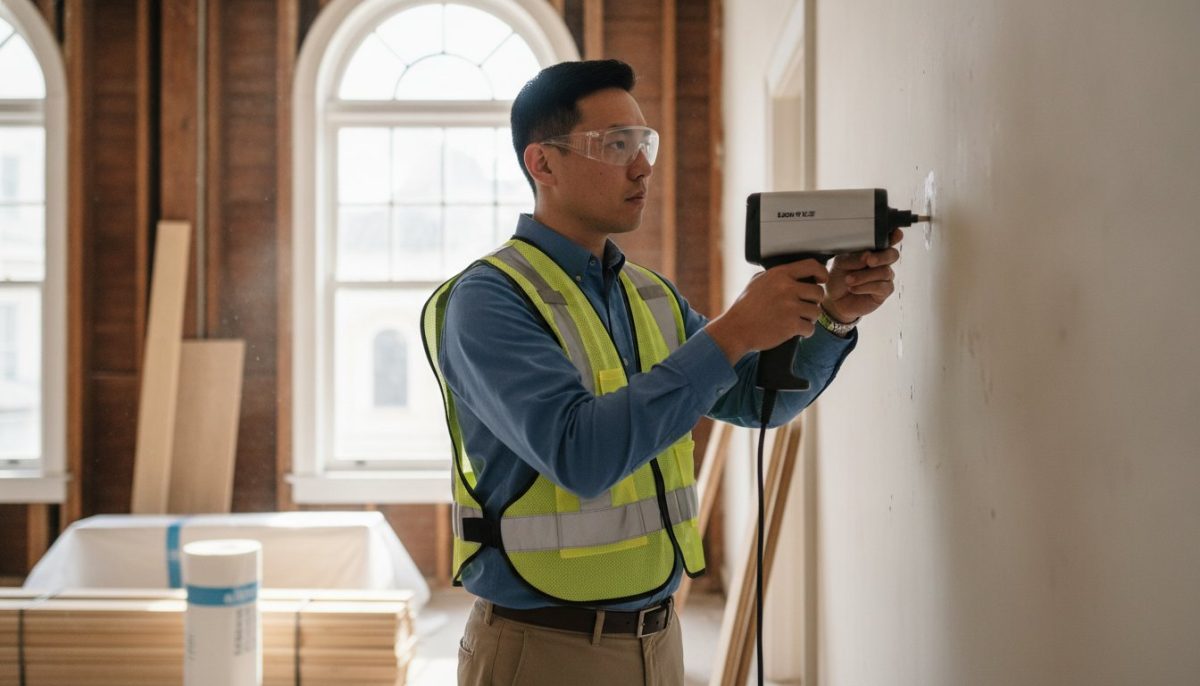
X-Ray Fluorescence (XRF) analyzers are the preferred choice for large-scale commercial interior gutting services because they offer non-destructive, real-time results. The device emits a controlled beam of X-rays that excites lead atoms within the paint, allowing for an instant readout of lead concentration. This technology is particularly valuable for historical properties where preserving the structural integrity of ornate trim or original plaster is a priority. However, the accuracy of XRF depends on rigorous field calibration. Technicians must perform regular checks against known standards and follow specific Performance Characteristic Sheets (PCS) to ensure the device is functioning within its validated parameters for the specific substrate being tested.
When Lab Analysis is Necessary
While XRF is highly efficient, certain conditions require the “gold standard” of laboratory chemical analysis. If an XRF reading is inconclusive or if the substrate is highly irregular, such as curved metal piping or heavily textured masonry, technicians will perform destructive paint chip sampling. These samples are sent to EPA-recognized laboratories where they undergo chemical digestion and analysis using Atomic Absorption Spectroscopy (AAS) or Inductively Coupled Plasma (ICP). Laboratory reports provide results in parts per million (PPM) or percent by weight, offering a definitive legal record of lead content. This level of verification is often essential for high-stakes projects or when preparing for a commercial interior gut out charleston sc in a facility with a complex renovation history.
Navigating Regulatory Requirements and Safety Standards in 2026
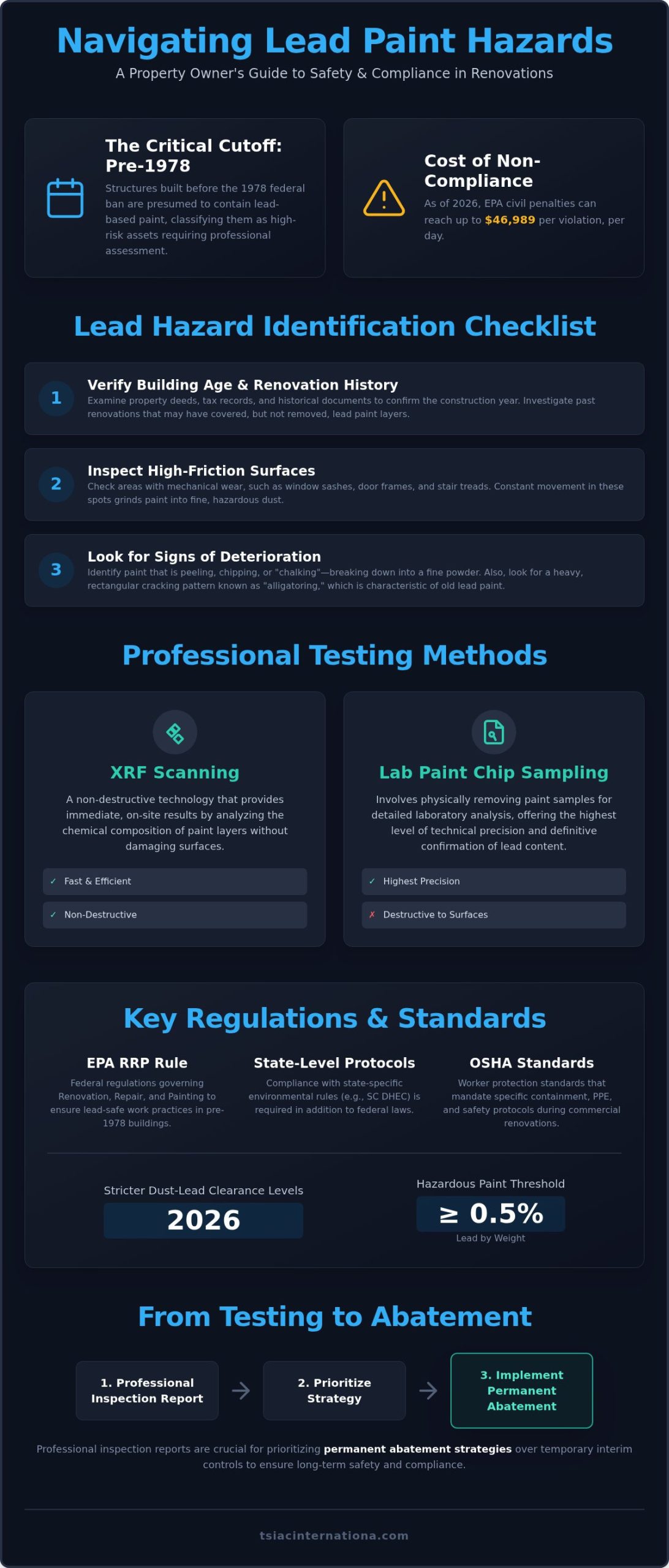
Compliance in 2026 isn’t a suggestion; it’s a structural necessity for any property manager’s risk mitigation strategy. The regulatory environment has tightened significantly, with the EPA’s Office of Enforcement and Compliance Assurance making pre-1978 renovations a top priority for fiscal year 2026. For those planning a commercial interior gut out charleston sc, the financial stakes are massive. As of January 12, 2026, civil penalties for violating the Renovation, Repair, and Painting (RRP) Rule have been adjusted to a maximum of $46,989 per violation, per day. This aggressive enforcement strategy aims to eliminate the “cost of doing business” mentality that previously led to corner-cutting in hazardous material management.
Beyond the immediate fines, meticulous documentation serves as your primary legal defense. You’re required to maintain all records related to lead-safe work practices for a minimum of three years. This includes proof that the “Renovate Right” pamphlet was distributed and that dust-wipe clearance reports were completed by an independent professional. If an unannounced EPA audit occurs, these records provide the empirical evidence needed to prove you followed the required safety protocols. Property managers must ensure that every contractor on site can produce valid certification credentials before any structural disturbance begins.
Federal vs. State Oversight
South Carolina is unique because it doesn’t operate a state-authorized lead program. This means the U.S. Environmental Protection Agency (EPA) directly administers all certification and training requirements within the state. While the South Carolina Department of Environmental Services (SC DES) handles local environmental oversight, the federal RRP Rule remains the governing standard for most renovation activities. Any project disturbing more than six square feet of interior paint in a pre-1978 building must be performed by an RRP-certified firm. In 2026, EPA certification is mandatory for all compensated work disturbing lead paint. Hiring uncertified labor for a commercial interior gut out charleston sc exposes the property owner to the full weight of federal litigation and potential insurance claim denials.
The Lead Disclosure Rule
The Section 1018 Disclosure Rule remains a cornerstone of property management liability. Before any lease is signed or a sale is finalized for a pre-1978 structure, you must provide a lead warning statement and a formal disclosure of any known lead-based paint or hazards. Tenants must also receive the “Protect Your Family from Lead in Your Home” pamphlet as part of their move-in documentation. Failure to comply doesn’t just result in heavy fines; it can lead to private lawsuits from occupants who claim health impacts due to undisclosed hazards. To ensure your facility meets these rigorous standards, you should partner with a qualified lead abatement specialist who understands the specific nuances of South Carolina’s 2026 regulatory landscape.
Transitioning from Testing to Professional Lead Abatement
Interpreting a professional lead inspection report is a technical task that requires a methodical approach to risk prioritization. Once the XRF data or laboratory results identify specific hazards, property managers must categorize these areas based on their potential for occupant exposure and structural disturbance. High-friction surfaces and deteriorating coatings require immediate attention, especially when planning a commercial interior gut out charleston sc. A comprehensive report doesn’t just list lead presence; it serves as the blueprint for your remediation strategy, allowing you to allocate resources where they’re most needed to ensure total site safety.
Property owners must choose between interim controls and permanent abatement. Interim controls, such as specialized cleaning or repainting, offer temporary relief but don’t eliminate the underlying hazard. For facilities undergoing significant structural changes, abatement is the only logical long-term strategy. This process involves the permanent elimination of lead-based paint hazards through specialized removal, component replacement, or high-durability encapsulation. When an interior gutting project is underway, integrating abatement into the demolition phase prevents the accidental release of toxic dust and ensures the project remains compliant with federal safety mandates.
Choosing a Certified Abatement Contractor
Selecting a project team requires verifying more than just basic business licenses. You need a partner with specialized hazardous material training and robust insurance coverage tailored for lead-related liabilities. Experience in large-scale structural removal is vital, as the complexities of a commercial interior gut out charleston sc demand a deep understanding of how lead dust behaves during mechanical demolition. For more detailed insights on selecting the right partner, consult our guide on hazardous material abatement south carolina. A contractor’s ability to demonstrate a 15-year track record in both residential and commercial sectors provides the reliability needed for high-stakes environmental projects.
The TSIAC International Approach to Safe Removal
Our methodology focuses on absolute containment and environmental responsibility. We implement airtight containment zones and utilize industrial-grade HEPA filtration systems to maintain negative air pressure, ensuring that no particulates escape the work area. We’re also committed to sustainable practices, actively recycling wood, metal, and plastic from our abatement sites to reduce the overall landfill impact of the project. Before we consider a site cleared, we perform rigorous final clearance testing. We adhere to the stricter 2026 EPA standards, which require clearance levels of 5 micrograms per square foot for floors and 40 micrograms per square foot for interior window sills. This technical precision ensures the property is verified safe for re-occupancy by your tenants or workers.
Securing Your Property Assets through Methodical Lead Management
Managing a pre-1978 facility in 2026 requires more than just awareness; it demands a disciplined approach to environmental safety. Identifying high-friction hazards early and utilizing advanced XRF technology protects your occupants from toxic exposure and your business from substantial federal penalties. Whether you’re planning a full-scale commercial interior gut out charleston sc or a targeted renovation, the transition from testing to professional removal must be seamless and technically precise.
As certified hazardous material specialists with over 15 years of industry experience, TSIAC International provides the technical rigor needed for complex abatement projects. We don’t just remove hazards; we also prioritize sustainability through our comprehensive site recycling programs for wood and metal. Our team ensures that every phase of remediation follows a logical, logistically sound sequence to minimize downtime and maximize safety. Contact TSIAC International for Professional Abatement Services to ensure your next project meets the highest safety and regulatory standards. Taking these proactive steps today secures your property’s value and ensures a safe environment for years to come.
Frequently Asked Questions
Is lead paint testing mandatory for all homes in South Carolina?
Lead paint testing isn’t universally mandatory for every home, but it’s a legal requirement before disturbing paint in any pre-1978 property. Federal RRP rules dictate that property owners must either assume lead is present or perform professional testing to rule it out. Additionally, the Lead Disclosure Rule requires owners to provide known lead hazard information to buyers or tenants before any sale or lease agreement is finalized.
Can I use a DIY lead test kit from a hardware store for official compliance?
DIY kits have very limited utility for official regulatory compliance. While the EPA recognizes specific kits for use by certified renovators to determine if RRP protocols apply to a project, they don’t fulfill the requirements for a full Lead Inspection or Risk Assessment. Professional testing using XRF analyzers provides the non-destructive, legally defensible data needed for a commercial interior gut out charleston sc.
What is the difference between a lead inspection and a risk assessment?
A lead inspection is a surface-by-surface investigation designed to identify the presence of lead-based paint on every painted component of a building. A risk assessment goes further by identifying the specific location, nature, and severity of lead hazards, including dust and soil contamination. The assessment also provides a formal management plan or remediation strategy tailored to the facility’s condition.
How much does professional lead paint testing typically cost in 2026?
In 2026, a professional lead inspection for a standard 2,000-square-foot property in Charleston typically costs between $300 and $600. For larger historic structures that require more extensive XRF scanning and mapping, the cost can reach approximately $850. A comprehensive risk assessment, which includes hazard analysis and remediation recommendations, generally ranges from $500 to $1,500 depending on the facility’s size.
What happens if lead paint is found during a commercial renovation or interior gut-out?
If lead is detected, you must immediately implement lead-safe work practices or professional abatement protocols to remain compliant. This requires hiring certified specialists to handle the commercial interior gut out charleston sc using specialized containment, HEPA filtration, and hazardous waste disposal. Following these 2026 standards is essential to avoid EPA civil penalties that can reach $46,989 per violation per day.
Do I need to move out of my building during lead paint testing or abatement?
Relocation isn’t necessary during the testing phase because XRF scanning is non-destructive and doesn’t generate hazardous dust. However, professional abatement often requires the work zone to be completely sealed off from occupants. Depending on the project’s scale, property managers may decide to vacate the building until final clearance testing confirms that lead dust levels meet the 2026 safety thresholds.
How long does a professional lead paint inspection usually take to complete?
A standard professional inspection typically takes between 2 and 4 hours for an average-sized property. The timeframe varies based on the number of painted surfaces and the complexity of the building’s architecture. Larger commercial facilities or historic properties with multiple additions require more time to ensure every substrate is accurately tested and documented in the final report.
What are the specific EPA RRP requirements for contractors in 2026?
Contractors must maintain firm-level EPA certification and ensure all workers are trained in lead-safe practices. In 2026, they must adhere to stricter dust-lead hazard standards, including clearance levels of 5 µg/ft² for floors and 40 µg/ft² for interior window sills. They’re also legally required to distribute the “Renovate Right” pamphlet and maintain detailed records of their safety protocols for at least three years.
