
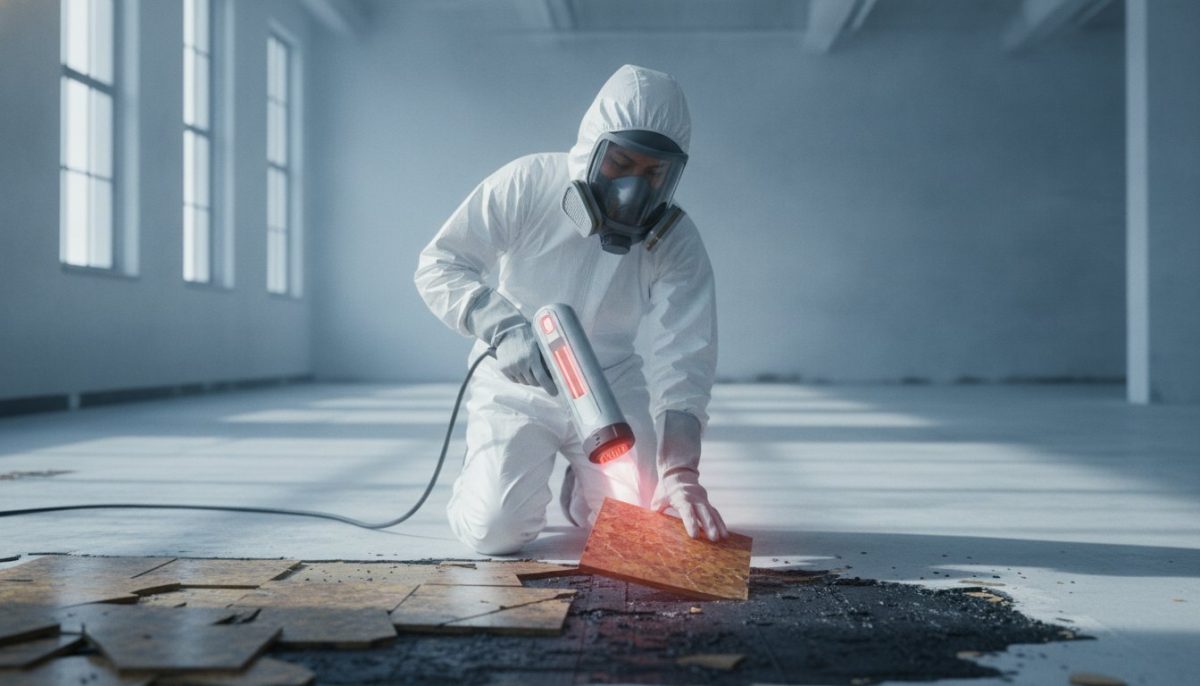
Did you know that flooring installed in buildings constructed as late as the year 2000 still carries a high probability of harboring hazardous fibers? When you’re facing a renovation, the discovery of old vinyl or the stubborn black mastic adhesive underneath can feel like an insurmountable legal and health obstacle. We understand the concern that comes with asbestos in floor tiles removal, especially when the safety of your occupants and the integrity of your property are at stake. It’s not just a cleanup task; it’s a precise engineering operation designed to prevent microscopic contamination from entering the air you breathe.
You’ve likely felt the pressure of managing strict EPA mandates and OSHA exposure limits while trying to keep your project on schedule. This guide eliminates that uncertainty by providing a technical roadmap for modern abatement protocols in 2026. You’ll gain a clear understanding of how to identify Presumed Asbestos Containing Material (PACM), manage specialized removal equipment, and ensure full regulatory compliance. We’ll walk through the entire process from initial testing to final air clearance, giving you the confidence that your site is verified safe for re-occupancy.
Key Takeaways
- Learn why visual inspections are insufficient for diagnosing hazardous flooring and how to identify Presumed Asbestos Containing Material (PACM) in structures built before 2000.
- Understand the chemical binding of asbestos in vinyl resins and the technical requirements for remediating the underlying “black mastic” cutback adhesive.
- Master the industry-standard protocols for professional asbestos in floor tiles removal, utilizing wet methods and specialized tools like infrared heat to maintain OSHA compliance.
- Navigate the legal and liability landscape of 2026, including the mandatory requirement for pre-demolition asbestos surveys and hazardous waste disposal standards.
- Evaluate potential abatement partners based on safety metrics like EMR ratings and the operational benefits of integrated abatement and structural demolition services.
Identifying Asbestos in Floor Tiles: Risks and Indicators
Vinyl Asbestos Tile (VAT) represents one of the most common legacy materials encountered during modern renovation projects. From the 1930s through the late 1980s, asbestos was a preferred additive in flooring manufacturing because it provided exceptional durability, chemical resistance, and thermal insulation. These tiles were installed in millions of properties, ranging from high traffic commercial corridors to residential basements. While these materials were engineered to last, their presence today requires a rigorous approach to safety. For those seeking a foundational perspective on the mineral itself, Understanding Asbestos helps clarify why these fibers were so widely utilized in construction materials.
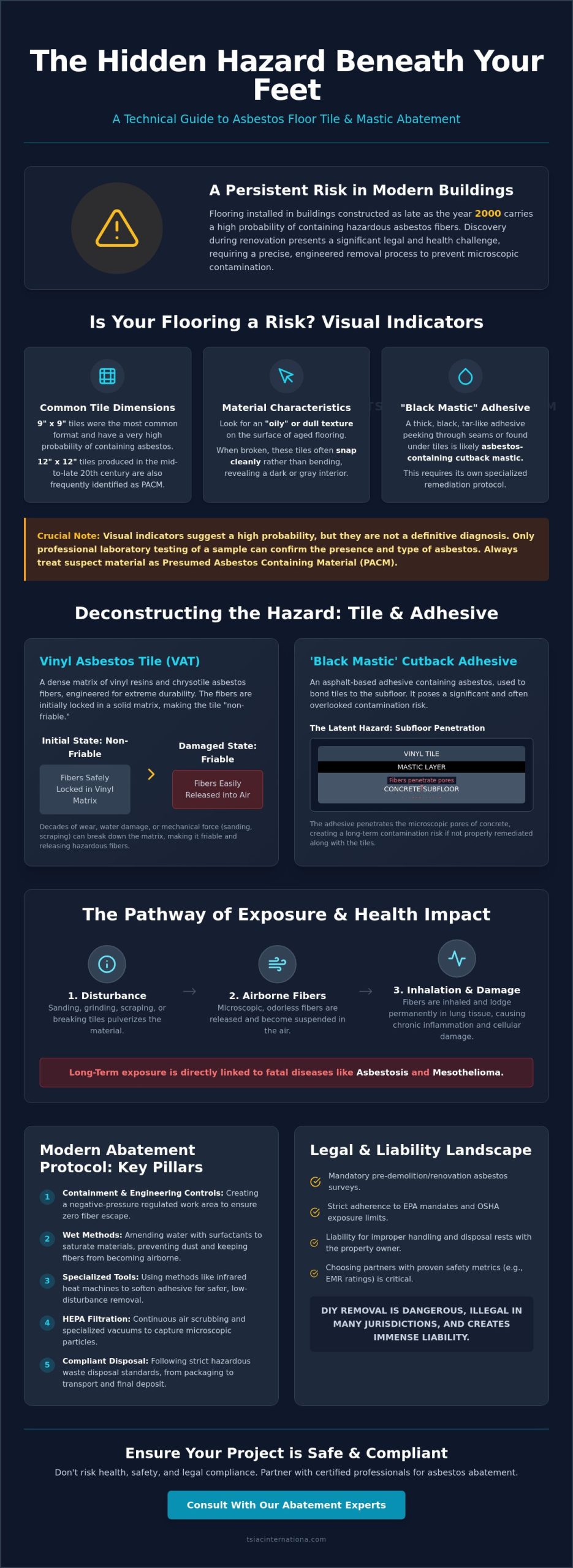
A definitive diagnosis of VAT cannot be achieved through visual inspection alone. Many property owners mistakenly assume that if a tile isn’t crumbling, it’s safe to handle. This is a dangerous misconception. Asbestos fibers are microscopic and odorless; they don’t provide any sensory warning when they’re present in the air. The chemical binding of asbestos within vinyl resins originally classified these tiles as non-friable, meaning the fibers were locked in a solid matrix. However, decades of foot traffic, water intrusion, or the use of harsh cleaning chemicals can cause the material to become brittle. When the tile reaches this state, any mechanical force can transition it into a friable condition, where hazardous fibers are easily released. This is why professional asbestos in floor tiles removal is the only way to ensure the polymer matrix isn’t disturbed in a way that contaminates the entire building.
Visual Indicators and Common Dimensions
While lab testing is the only way to confirm asbestos content, certain physical characteristics serve as high probability indicators. The most classic sign is the 9×9 inch tile format. While not every 9×9 tile contains asbestos, the vast majority produced during the mid-century era do. We also frequently identify asbestos in 12×12 inch tiles from the mid-to-late 20th century. You should look for an “oily” or dull texture on the surface of aged flooring. When these tiles break, they often snap cleanly rather than bending, revealing a dark or gray interior. If you see a black, tar-like adhesive peeking through the seams, you’re likely looking at asbestos-containing cutback mastic, which requires its own specialized remediation protocol.
The Health Risks of Disturbed Fibers
The primary danger arises when the material is subjected to mechanical disturbance. Activities like sanding, grinding, or aggressive scraping pulverize the vinyl and the asbestos fibers within. Once airborne, these respirable fibers can be inhaled and lodged deep within lung tissue. Because the body cannot break down these mineral shards, they cause chronic inflammation and cellular damage over time. This exposure is directly linked to severe long-term health conditions, including asbestosis and mesothelioma. To understand how these risks are managed under specific state guidelines, you can review our guide on Asbestos Removal in South Carolina: The Complete 2026 Safety & Regulatory Guide. Proper asbestos in floor tiles removal focuses on containment and saturation to ensure these invisible threats never become airborne.
Understanding the Composition: Vinyl Asbestos Tiles (VAT) and ‘Black Mastic’
The structural integrity of Vinyl Asbestos Tiles (VAT) relies on a dense matrix of vinyl resins and chrysotile fibers. This chemical binding was engineered to create a permanent, wear-resistant surface capable of withstanding extreme pressure and chemical exposure. However, the complexity of asbestos in floor tiles removal extends far beyond the tiles themselves. The real challenge often lies beneath: the black mastic adhesive. This asphalt-based “cutback” adhesive was the industry standard for decades. It doesn’t just sit on top of the subfloor; it penetrates the microscopic pores of concrete substrates, creating a long-term contamination risk if handled incorrectly.
Leaving this adhesive behind while only removing the top layer of tiles creates a latent hazard for future property owners. If a general contractor later attempts to level the floor with a standard grinder, they’ll inadvertently release high concentrations of respirable fibers into the environment. This is why professional abatement must address both the primary material and the secondary bonding agent. Ensuring the site is truly safe for re-occupancy requires a deep cleaning of the substrate that general demolition crews aren’t equipped to handle. For projects requiring comprehensive site preparation, partnering with an experienced asbestos abatement specialist ensures every layer of risk is managed with technical precision.
The ‘Black Mastic’ Problem: Asbestos in Adhesives
Cutback adhesive is a bitumen-based product that frequently contains a higher percentage of asbestos than the tiles it secured. Unlike the tiles, which eventually become brittle and non-reactive, mastic often remains semi-pliable or “sticky” for decades. This chemical state makes it impossible to remove through standard mechanical means without specialized intervention. Standard floor grinders are strictly prohibited for use on asbestos-containing mastic. The friction generates intense heat and dust, turning a non-friable adhesive into an immediate airborne threat. Professional remediation requires chemical strippers or specialized mechanical scraping under HEPA-filtered negative pressure containment to prevent fiber migration.
VAT vs. Modern Vinyl Flooring
Distinguishing between VAT and modern luxury vinyl tile (LVT) requires an understanding of material science. Modern products are designed for flexibility and often lack the mineral density of their predecessors. VAT is notoriously rigid. Professionals often use a “snap test” in controlled environments to identify the material. VAT will snap with a sharp, clean break, while modern vinyl typically bends or tears. Because modern flooring lacks the hazardous mineral content, the removal protocols are vastly different. If you’re uncertain about the composition of your flooring, consulting a professional for hazardous material abatement in South Carolina is a critical first step before any demolition begins.
Professional Abatement vs. DIY: Safety, Liability, and Regulations
The decision between professional intervention and a DIY approach often comes down to a fundamental misunderstanding of the physics involved in asbestos in floor tiles removal. Professional abatement teams utilize the “wet method,” a technical protocol where amended water or specialized surfactants are applied to saturate the material. This process ensures that any fibers disturbed during the removal remain trapped in a liquid state, preventing them from becoming respirable. In contrast, DIY attempts frequently involve dry scraping, prying, or even power-sanding. These actions immediately pulverize the vinyl matrix and the underlying mastic, creating an invisible cloud of hazardous dust that can linger in a property for weeks.
Legal liability is another factor that property owners must weigh heavily. For commercial and multi-unit residential properties, federal law requires a comprehensive asbestos survey before any demolition or renovation work begins. Operating without this documentation isn’t just a safety risk; it’s a regulatory violation that can result in significant fines and project shutdowns. Licensed contractors maintain a strict chain-of-custody for all hazardous waste, ensuring that contaminated materials are transported in double-bagged, labeled containers to authorized landfills. A DIY project lacks this documented trail, potentially leaving the property owner liable for environmental contamination long after the project ends.
Regulatory Compliance and National Standards
Abatement activities are governed by a complex framework of EPA and OSHA regulations designed to protect both workers and the public. Central to these is the National Emission Standards for Hazardous Air Pollutants (NESHAP), which dictates how asbestos-containing materials must be handled during demolition. We work alongside certified industrial hygienists who provide third-party oversight, conducting air monitoring during the project and final clearance testing afterward. This level of technical scrutiny ensures that the work environment remains within the OSHA permissible exposure limit of 0.1 fibers per cubic centimeter. These standards are not suggestions; they are the baseline for professional hazardous material management in 2026.
The Risks of Secondary Contamination
The most significant hidden cost of an improper removal is secondary contamination. When fibers are released during a failed DIY attempt, they don’t simply settle on the floor. They are tracked into carpets, absorbed by upholstered furniture, and pulled into the HVAC system. Once asbestos enters the ductwork, it can be distributed throughout the entire building every time the climate control system cycles. Remediating a building after such an event requires a massive HEPA-vacuuming and air-scrubbing operation that far exceeds the cost of an initial professional abatement. To understand the broader context of property preparation and safety, you should examine The Demolition Process in South Carolina: A 2026 Comprehensive Guide. Choosing a professional for asbestos in floor tiles removal is a decision rooted in long-term risk mitigation and financial stability.
The Professional Asbestos Floor Tile Removal Process
The mobilization phase of a professional abatement project is a rigorous engineering exercise. Before a single tile is lifted, the work area is isolated using 6-mil polyethylene sheeting to create airtight barriers. We install multi-stage airlocks at all entry and exit points to ensure that no fibers escape the regulated area. High-visibility warning signage is posted to alert personnel and the public that a hazardous material remediation is in progress. This systematic approach to asbestos in floor tiles removal ensures that the risk is contained from the moment our team arrives on site.
Once the environment is secured, our technicians utilize specialized tools designed to minimize material breakage. Long-handled floor scrapers allow for controlled prying, while infrared heat machines can sometimes be used to soften the adhesive, allowing tiles to be lifted intact. Every piece of debris is immediately placed into 6-mil poly bags, which are then double-bagged and sealed with duct tape. Each container receives a specific hazardous material label before it leaves the containment area. If you are planning a renovation that involves legacy flooring, our team provides the professional asbestos abatement services required to keep your project compliant and your air clean.
Containment and Environmental Controls
Environmental control is maintained through the use of negative air pressure machines equipped with HEPA filtration. These units pull air from the work area and vent it outside, creating a vacuum effect that prevents cross-contamination to adjacent rooms. To further suppress dust, we use amended water containing specialized surfactants. These chemicals reduce the surface tension of the water, allowing it to penetrate the vinyl matrix more effectively than standard water. This constant saturation is the primary defense against fiber release during the physical removal process.
Precision Removal and HEPA Filtration
The technical difference between a HEPA-filtered vacuum and a standard shop-vac is a matter of life safety. A true HEPA filter captures 99.97% of particles as small as 0.3 microns, whereas a standard vacuum will simply exhaust asbestos fibers back into the room. During removal, we employ the “shingling” method, working in small sections to lift tiles in a way that keeps them as whole as possible. For the underlying mastic, we choose between chemical solvents that liquefy the adhesive or mechanical bead-blasting within a closed-loop HEPA system. The choice depends on the porosity of the concrete and the requirements of the new flooring installation.
Clearance Testing and Site Certification
No project is considered complete until the site passes a multi-stage clearance protocol. We coordinate with third-party consultants to perform Phase Contrast Microscopy (PCM) or Transmission Electron Microscopy (TEM) air testing. PCM is the standard for rapid results, while TEM offers the highest level of precision by identifying fibers at a sub-microscopic level. A thorough visual inspection ensures that no dust or residue remains on any surface. Once the air samples return results below the regulated limit, we provide a final abatement report. This document serves as a permanent record of safety for your property files.
Selecting a National Hazardous Material Abatement Partner
Selecting a partner for asbestos in floor tiles removal is a decision that impacts the long-term safety and legal standing of a property. In the high-stakes environment of hazardous material management, a contractor’s safety record is the most reliable predictor of project success. We utilize the Experience Modification Rate (EMR) as a primary benchmark for operational discipline. An EMR below 1.0 indicates that a company maintains a workplace safety record superior to the industry average, reflecting a fegyelmezett approach to technical protocols. This metric is essential for property owners who want to minimize their liability and ensure the well-being of their future occupants through methodical precision.
The complexity of modern construction often requires more than just a cleanup crew. It demands a partner capable of managing the transition from hazardous material remediation to structural preparation. When a single entity handles both the abatement and the subsequent demolition, the risk of communication gaps and cross-contamination is virtually eliminated. This integrated approach ensures that the project timeline remains stable and that the site is handed over in a condition that is ready for immediate reconstruction. TSIAC International represents this gold standard, providing the technical command necessary for the most challenging environmental conditions.
Evaluating Contractor Credentials
A reputable abatement firm must possess more than just a basic license. You should verify that your partner carries specialized pollution liability insurance, which provides coverage specifically for asbestos-related incidents. Bonding capacity is another indicator of financial stability and professional reliability. With over 15 years of experience in high-stakes environments, our team understands the nuances of federal and state regulations. For a deeper look at how these standards are applied in practice, you can explore why we are considered TSIAC International Charleston: The Gold Standard in Demolition & Abatement. This level of transparency is what defines a true industry leader.
From Abatement to Structural Demolition
The efficiency of a project is greatly enhanced when your abatement partner also provides selective demolition and interior gutting services. Once the asbestos in floor tiles removal is complete and clearance has been achieved, our teams can seamlessly transition into concrete removal or metal framing preparation. This continuity reduces mobilization costs and simplifies project management for the property owner. We also prioritize environmental responsibility by implementing robust recycling services. After the hazardous materials are safely disposed of, we manage the separation and recycling of wood, metal, and plastic components. This commitment to sustainability ensures that your project meets modern environmental standards while maintaining the highest level of safety. If you’re managing a large-scale commercial or residential renovation, contact our team to discuss a comprehensive abatement and demolition strategy.
This level of safety is particularly vital when preparing commercial spaces for specialized training environments, such as an esthetician school raleigh nc, where maintaining a clean and hazard-free facility is essential for both students and staff.
Ensuring Technical Compliance and Occupant Safety
Managing the risks of legacy flooring requires a shift from viewing it as a simple renovation hurdle to treating it as a specialized engineering challenge. Success in asbestos in floor tiles removal depends on the rigorous containment of fibers and the thorough remediation of underlying adhesives that often remain reactive for decades. By prioritizing professional air clearance and third-party verification, you protect both your legal interests and the health of everyone who enters your building. A methodical approach ensures that your property transition is seamless and technically sound.
TSIAC International brings over 15 years of industry experience to every project, ensuring that hazardous material containment and disposal meet the highest national standards. We don’t just clear the site; we’re committed to environmental recycling of site debris to minimize the ecological footprint of your demolition. When you’re ready to secure your property with a partner who values technical precision and transparency, Contact TSIAC International for a Professional Abatement Quote. Your project deserves the stability and reliability that only a seasoned expert can provide. Take the first step toward a safe and compliant environment today.
Frequently Asked Questions
Can I just install new flooring over asbestos tiles?
Encapsulation is a viable alternative if the existing flooring is in good condition and won’t be disturbed by the new installation. Installing a floating floor or new subfloor over intact tiles prevents the release of fibers into the environment. However, this method only delays the eventual necessity of professional asbestos in floor tiles removal and must be disclosed to future property owners during transactions.
How long does the asbestos floor tile removal process take?
Most small to medium-scale abatement projects are completed within one to three business days. This timeline accounts for the mobilization of containment barriers, the physical removal of materials, and the mandatory waiting period for final air clearance testing. Larger commercial facilities or complex industrial environments require a detailed project schedule based on square footage and the presence of porous substrates.
What is the difference between friable and non-friable asbestos tiles?
Non-friable asbestos is bound within a solid material like vinyl and cannot be crumbled by hand pressure. Most floor tiles start as non-friable but become friable when they are sanded, ground, or subjected to extreme mechanical force. Friable materials pose a significantly higher risk because they release respirable fibers into the air with minimal disturbance, requiring more stringent containment protocols.
Do I need an asbestos survey if I am only removing a small area of flooring?
Federal and state regulations generally require a thorough asbestos survey before any renovation or demolition activity, regardless of the project’s physical size. even a small area of flooring can contain enough fibers to contaminate an entire HVAC system if handled incorrectly. Obtaining a certified laboratory analysis ensures your project remains in compliance with OSHA and EPA standards from the outset.
Is the black adhesive (mastic) under my tiles also asbestos?
Black “cutback” mastic adhesive used before the mid-1980s has a high probability of containing asbestos fibers. This material is often more difficult to remediate than the tiles because it penetrates the microscopic pores of the concrete subfloor. Professional asbestos in floor tiles removal must address this adhesive layer to ensure the site is truly safe for the installation of new flooring materials. Once those new surfaces are in place, companies like Anderson Carpet & Tile Cleaning can provide the ongoing professional care needed to keep your carpets and tiles in peak condition.
Can I stay in my home or office during the abatement process?
Occupants should not remain in the immediate vicinity of the regulated work area during the abatement process. While containment barriers and negative air pressure machines are highly effective, the risk of accidental exposure is best managed by vacating the space. You can typically return once a third-party consultant has issued a final air clearance report verifying that fiber levels are below the permissible limit.
What happens if I accidentally broke an asbestos floor tile?
If a tile breaks, you should immediately stop work and avoid using a standard vacuum or broom, as these will spread fibers throughout the room. Lightly mist the area with water to keep the material saturated and cover it with a plastic sheet to prevent air movement. Contact a licensed abatement professional to perform a controlled cleanup and ensure that no microscopic contamination has migrated to other parts of the building.
