
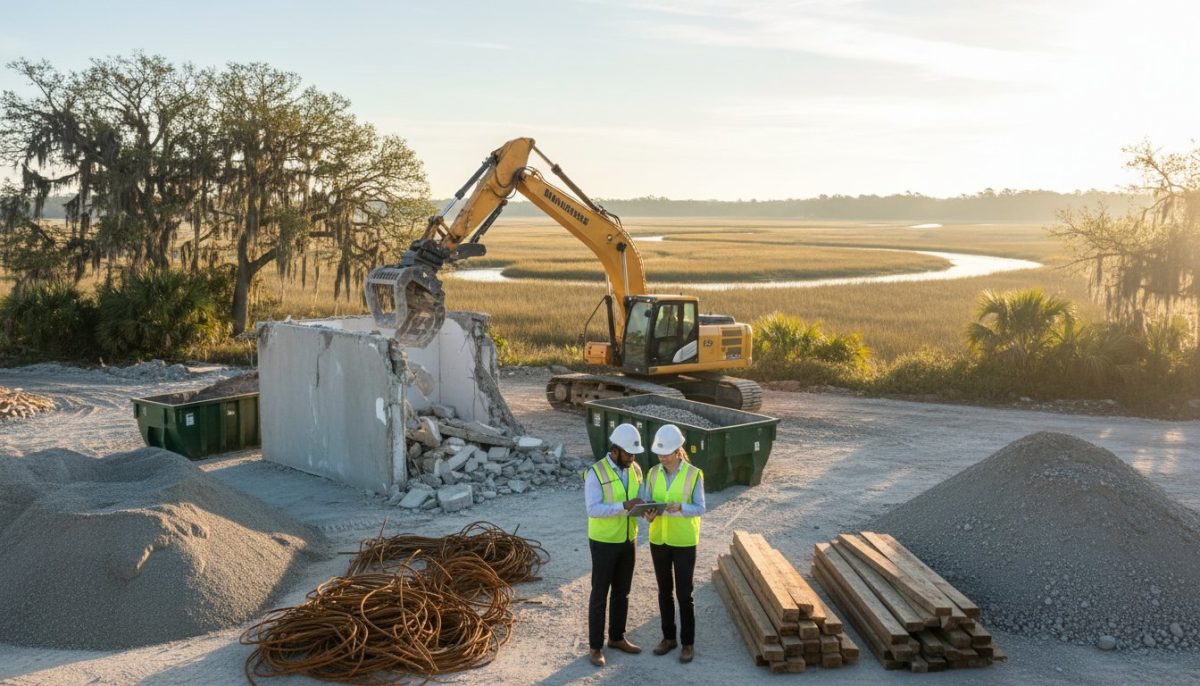
Did you know that nearly 30% of South Carolina’s total waste stream originates from construction and demolition sites, yet up to 75% of those materials never need to reach a landfill? Most project managers accept high landfill tipping fees as an unavoidable cost of doing business. You’re likely balancing the pressure of tight deadlines with the complexity of on-site material sorting and the 2024 South Carolina Department of Environmental Services (SCDES) regulatory updates. It’s a technical challenge that demands engineering precision rather than just a basic disposal plan, especially when dealing with specialized structures or difficult sites.
Implementing a structured approach to demolition debris recycling sc isn’t just an environmental choice; it’s a strategic financial decision. This guide shows you how professional material recovery practices can slash your project overhead by 15% or more while ensuring 100% compliance with state mandates. We’ll examine the technical processes for recovering concrete, steel, and asphalt to transform your waste management into a streamlined, sustainable asset that strengthens your corporate reputation through measurable, audited results.
Key Takeaways
- Understand South Carolina’s specific C&D regulatory standards to ensure full project compliance while contributing to the diversion of significant industrial waste from landfills.
- Identify high-value recovery streams, such as ferrous metals and masonry, and learn how on-site crushing can transform debris into cost-saving fill material.
- Learn how stringent safety protocols for asbestos and lead contamination are vital to protecting the value and feasibility of your **demolition debris recycling sc** efforts.
- Evaluate the operational advantages of source separation versus commingled recycling to determine the most efficient material management strategy for your site.
- Discover how an integrated approach combining professional abatement with structural demolition ensures a seamless, safe, and environmentally responsible project outcome.
Demolition Debris Recycling in South Carolina: Standards and Benefits
South Carolina’s regulatory environment for waste management underwent a significant transition on July 1, 2024, when the South Carolina Department of Environmental Services (SCDES) assumed oversight of the state’s material recovery frameworks. This change reflects a growing urgency to address the 600 million tons of construction and demolition waste generated annually across the United States. Managing these volumes requires more than simple disposal; it demands a disciplined engineering approach to resource recovery. Proper demolition debris recycling sc protocols ensure that structural components are diverted from Class 2 landfills, preserving local airspace and reducing the environmental footprint of large-scale industrial projects.
What Qualifies as C&D Debris in SC?
The SCDES defines construction and demolition (C&D) debris as solid waste resulting from the construction, remodeling, repair, or demolition of structures and roads. It’s a specific classification that excludes municipal household waste and hazardous substances. To maintain site safety and regulatory compliance, contractors must distinguish between "inert" materials and restricted waste. Common components eligible for recovery include:
- Structural steel, rebar, and miscellaneous metals
- Portland cement concrete and masonry units
- Brick, stone, and clean soil
- Glass and asphalt shingles
- Untreated wood and clearing debris
Inert debris, such as cured concrete and brick, is treated as a priority in the recycling stream. These materials don’t decompose or produce leachate, making them ideal for crushing into high-quality aggregate. Using recycled concrete as a stabilized sub-base for new pavement is a standard practice that meets rigorous load-bearing specifications.
The Economic Case for Material Recovery
Financial performance in the construction sector is tied directly to waste efficiency. Tipping fees at South Carolina landfills typically range from $35 to $60 per ton, depending on the county and material type. By contrast, demolition debris recycling sc facilities often provide lower intake rates for clean, pre-sorted loads. Projects that implement rigorous onsite sorting can reduce their total waste management costs by 18% to 24%.
Beyond immediate savings, sustainable material management opens doors to federal tax incentives and LEED v4.1 credits. Achieving a 50% diversion rate for non-hazardous debris earns points that increase the long-term valuation of a property. It’s a strategy that transforms a liability into a logistical asset.
Primary Recyclable Materials in Structural and Selective Demolition
Effective demolition debris recycling sc depends on the precise identification and separation of waste streams at the source. The South Carolina Department of Health and Environmental Control (SCDHEC) estimates that construction and demolition debris makes up approximately 25% of the state’s total waste. Managing these materials requires a disciplined engineering approach to maximize recovery rates and maintain site safety. Success isn’t found in bulk disposal; it’s found in the systematic extraction of secondary raw materials.
- Concrete and Masonry: Operators crush these materials into 1.5-inch or 3-inch aggregate for use as on-site fill or stabilized road base.
- Ferrous and Non-Ferrous Metals: This stream includes structural I-beams, rebar, and specialized alloys that command the highest market prices.
- Untreated Wood and Lumber: Clean timber, often comprising 15% of a building’s mass, is ground into mulch or utilized for industrial biomass fuel.
- Gypsum Wallboard and Plastics: Specialized processing facilities in the Southeast now accept clean drywall for manufacturing new feedstock, provided it’s free of lead-based paint and adhesives.
High-Value Metal Recovery
Metals represent the most profitable component of any structural teardown. Structural steel, copper piping, and aluminum wiring maintain high scrap value even during market shifts. During the 2023 fiscal year, scrap steel prices averaged between $380 and $440 per ton. Technical teams achieve maximum purity by extracting these materials before general demolition begins. This selective approach prevents cross-contamination and ensures the highest possible return. Timing the sale based on London Metal Exchange (LME) data ensures the project’s financial stability and offsets total project costs.
Aggregate Recycling: Concrete and Brick
On-site mobile crushing units eliminate the need for hundreds of heavy vehicle trips. This process transforms old foundations into high-quality fill that meets SCDOT Standard Specifications for Highway Construction. Utilizing 1,000 tons of recycled concrete on-site can save a project over $18,000 in hauling and disposal fees. It also reduces carbon emissions by roughly 42% compared to importing virgin stone. For projects involving complex industrial execution, on-site recycling provides a logistical advantage that keeps tight schedules on track. It’s a method that turns a waste liability into a structural asset.
Navigating Hazardous Materials: Asbestos and Lead Constraints
Safety dictates the entire project lifecycle. You can’t achieve efficient demolition debris recycling sc if hazardous contaminants infiltrate the waste stream. A single fragment of asbestos-containing material (ACM) can render an entire 30-yard roll-off container unrecyclable, forcing the entire load into a specialized landfill at three times the standard tipping fee. We prioritize the stabilization of the site before any mechanical demolition occurs. This isn’t just a safety preference; it’s a structural necessity for material recovery.
The South Carolina Department of Health and Environmental Control (SCDHEC) enforces strict protocols regarding waste commingling. Mixing hazardous waste with clean masonry or steel triggers civil penalties that often reach $10,000 per day per violation. Protecting the integrity of the recycling stream requires rigorous isolation of lead-based paint and asbestos. If these materials aren’t stripped first, the resulting dust contaminates the aggregate, making it useless for future construction applications.
Pre-Demolition Abatement Requirements
South Carolina law requires a certified asbestos building inspection for all public and commercial renovations or demolitions. This mandate applies regardless of the structure’s age. If the project involves more than 160 square feet of surface area or 260 linear feet of pipe insulation, you must submit a notification to SCDHEC at least 10 working days before work starts. Safe containment ensures friable fibers don’t settle on clean concrete or steel. For detailed procedures, consult our Asbestos Removal in South Carolina: A Complete Guide.
Handling Lead-Contaminated Debris
Structures built before 1978 carry a high probability of lead-based paint. We utilize X-Ray Fluorescence (XRF) analyzers to identify lead concentrations in wood and masonry. If lead levels exceed 1.0 mg/cm², the material is classified as hazardous and requires specialized disposal at a Subtitle C landfill. Selective gutting allows us to strip contaminated architectural elements manually. This process protects workers from inhaling toxic dust and keeps the bulk of the masonry clean for demolition debris recycling sc.
Worker safety remains the primary focus during these phases. We implement several protocols to ensure a clean site:
- XRF Testing: Rapid on-site analysis of all painted surfaces.
- HEPA Filtration: Using high-efficiency vacuums during selective gutting to capture 99.97% of particles.
- Segregated Storage: Placing lead-impacted wood in sealed, 6-mil poly-lined containers to prevent leaching.
- Worker Decontamination: Mandatory wash stations to prevent the spread of lead dust outside the hot zone.
Best Practices for Job Site Material Management
Efficient demolition debris recycling sc requires a disciplined approach to onsite logistics. It’s not just about disposal; it’s about material recovery through engineering precision. Successful projects treat the job site as a processing facility where every movement is calculated to prevent cross-contamination. This level of control ensures that 95% of extracted steel and 80% of concrete aggregates remain viable for secondary markets. Without a structured flow, valuable materials quickly turn into expensive liabilities.
Source Separation Strategies
Maximizing material value starts at the point of removal. We recommend setting up designated 10×10 foot drop zones for specific material types, such as ferrous metals, clean concrete, and untreated timber. Crews receive 15-minute technical briefings to distinguish between clean loads and contaminated debris, ensuring that gypsum or hazardous insulation doesn’t compromise a 40-yard container of recyclable brick. For complex structures, use hydraulic shears and high-reach excavators for surgical material extraction. This mechanical precision allows operators to pull structural steel directly from the frame, maintaining high purity levels that command better rebates at SC processing centers.
The Logistics of Debris Hauling
Choosing the right equipment determines the project’s bottom line. While 20-yard roll-off containers offer flexibility on tight urban sites in Charleston or Greenville, high-capacity 100-yard trailers are 30% more cost-effective for large-scale industrial clearances. Every haul must be directed to a facility verified by the 2024 SC DHEC list of permitted C&D recycling centers. Developing a rigorous Debris Management Plan becomes a critical legal safeguard by 2026, as South Carolina regulatory bodies will require documented proof of 75% material diversion for all commercial permits exceeding 5,000 square feet. This documentation provides the data trail necessary for municipal audits and environmental compliance certifications.
Maintaining strict site protocols is the only way to guarantee safety and profitability during complex teardowns. For projects requiring this level of technical oversight, partner with a team that provides reliable demolition solutions tailored to South Carolina’s regulatory environment.
Rigorous tracking is the final pillar of professional material management. Digital manifests should record the weight, material type, and destination facility for every load leaving the site. This data isn’t just for internal review; it’s the primary evidence used during state-level environmental audits. By maintaining a transparent chain of custody, contractors prove their commitment to demolition debris recycling sc while protecting the client from potential liability issues associated with illegal dumping or improper waste handling.
Implementing Large-Scale Material Recovery with TSIAC International
Executing a successful strategy for demolition debris recycling sc requires more than just brute force; it demands a disciplined, integrated approach. TSIAC International brings over 15 years of specialized experience to structural and selective demolition projects across the region. By combining hazardous material abatement with material recovery, project timelines are condensed and operational risks are mitigated. This technical synergy ensures that site remediation and recycling efforts occur simultaneously, which reduces downtime for developers and general contractors. Every job site operates under a strict mandate for environmental responsibility, treating waste not as a burden but as a recoverable asset.
The company relies on professional-grade heavy machinery and expert crews trained in precise dismantling techniques. This mechanical advantage allows for the clean separation of materials at the source, which is critical for maintaining the purity of recycled aggregates. Whether the project involves a high-rise structure or a specialized industrial facility, the focus remains on engineering a solution that maximizes material life cycles.
A Comprehensive Service Suite
TSIAC International manages everything from complex interior gutting to total structural removal with engineering precision. Their teams are equipped to handle the removal of over 20 distinct material categories, ensuring that hazardous substances like asbestos or lead-based paint are remediated before the main demolition begins. Every project adheres to national-standard safety protocols, maintaining a zero-incident culture. This rigorous methodology allows for the recovery of high-value materials, such as structural steel and clean concrete, that meet strict industry specifications for reuse in new construction projects.
Partnering for Sustainability
Developers in South Carolina face increasing pressure to meet LEED certification and local environmental mandates. TSIAC provides the transparent reporting necessary to document diversion rates and material destinations for project stakeholders. By maximizing demolition debris recycling sc, clients frequently see a reduction in landfill tipping fees by 30% or more. The firm’s commitment to sustainability is backed by data, providing a clear audit trail for every ton of material processed. This level of transparency ensures that environmental goals are met with verifiable results rather than vague promises.
Contact TSIAC International for a customized demolition and recycling quote to ensure your next project is handled with technical expertise and professional reliability.
Advancing Your Next Project with Sustainable Material Recovery
Effective management of structural waste isn’t just a regulatory checkbox; it’s a strategic advantage for any South Carolina job site. By segregating concrete, steel, and timber, projects can redirect up to 75% of waste materials away from local landfills. This process demands rigorous adherence to safety protocols, especially when dealing with hazardous substances. Our team maintains comprehensive Asbestos and Lead Abatement Certification to ensure every site meets DHEC standards without costly delays.
Implementing a robust strategy for demolition debris recycling sc requires technical precision and heavy-duty logistics. TSIAC International brings over 15 years of industry experience to the field, specializing in complex structural removals that require engineering accuracy. We’ve successfully managed large-scale recoveries across the Southeast, proving that efficiency and environmental responsibility work together. You deserve a partner who prioritizes safety and professional reliability on every square foot of the site.
Request a Professional Demolition Quote from TSIAC International to secure a partner with a proven track record in high-stakes material management. We’re ready to bring our technical expertise to your project today.
Frequently Asked Questions
What exactly is considered construction and demolition (C&D) debris?
Construction and demolition debris consists of waste materials generated during the renovation, repair, or destruction of structures and roads. This category includes heavy materials like concrete, steel, wood, and asphalt, alongside finishing components such as drywall and carpeting. The EPA reported that the United States generated 600 million tons of C&D debris in 2018, which is double the amount of municipal solid waste produced annually across the country.
Is recycling demolition debris actually cheaper than taking it to a landfill?
Recycling is often more cost-effective because it avoids high tipping fees and generates revenue from salvaged materials. In South Carolina, landfill fees average $45 per ton, while demolition debris recycling sc facilities frequently offer lower rates for sorted loads. You’ll reduce transportation costs by processing concrete on-site into aggregate, which saves approximately $15 per ton in haul-away expenses and new material purchases for the next phase.
Can I recycle wood that has been painted with lead-based paint?
You can’t recycle wood contaminated with lead-based paint because it’s classified as hazardous waste under federal safety standards. Materials painted before 1978 are subject to strict SCDHEC disposal protocols to prevent environmental contamination. These items must be separated and transported to a Subtitle D landfill, as recycling facilities won’t accept any wood that tests positive for lead concentrations exceeding 5,000 parts per million during initial screening.
How much of a building can typically be recycled during demolition?
A standard industrial project can achieve a diversion rate of 75% to 90% when using deconstruction techniques instead of traditional wrecking. Metals like steel and copper have a 100% recovery rate, while clean concrete is crushed into usable road base. Implementing a demolition debris recycling sc strategy ensures that only about 15% of the total building mass, primarily insulation and mixed plastics, ends up in a landfill at the project’s conclusion.
What are the South Carolina regulations for disposing of unrecyclable debris?
Unrecyclable materials must be managed according to SCDHEC Regulation 61-107.19, which governs solid waste management. This law requires that all non-recoverable C&D waste goes to a permitted Class 2 or Class 3 landfill. Site managers must keep disposal manifests for at least 3 years to prove compliance during state inspections, ensuring that no hazardous substances enter the local groundwater systems or violate the structural integrity of the disposal site.
Do I need a special permit to recycle concrete on my project site?
You’ll need a General Permit for Crushing and Grinding from the SCDHEC Bureau of Air Quality if your equipment exceeds certain capacities. Specifically, any portable crusher processing more than 150 tons of material per hour requires a formal registration. We manage these permits to ensure dust control measures meet the 20% opacity limit required by state law, maintaining site safety and legal standing throughout the crushing operation.
How does asbestos abatement affect the overall recycling timeline?
Asbestos abatement typically adds 14 days to your project schedule due to mandatory regulatory waiting periods. South Carolina law requires a 10-working-day notification to SCDHEC before any disturbance of regulated asbestos-containing material begins. Once the 48-hour post-abatement air clearance testing is finished, the remaining structure can be safely processed for recycling without the risk of contaminating the clean debris streams with hazardous fibers.
What materials are currently banned from South Carolina C&D landfills?
South Carolina law prohibits the disposal of 5 specific categories of waste in C&D landfills, including whole tires and lead-acid batteries. You can’t dispose of liquid waste, hazardous chemicals, or regulated asbestos-containing material in these facilities. These bans, enforced under Regulation 61-107.19, protect the environment and prevent toxic leaching into the surrounding soil. All banned items must be diverted to specialized hazardous waste processing centers.
