
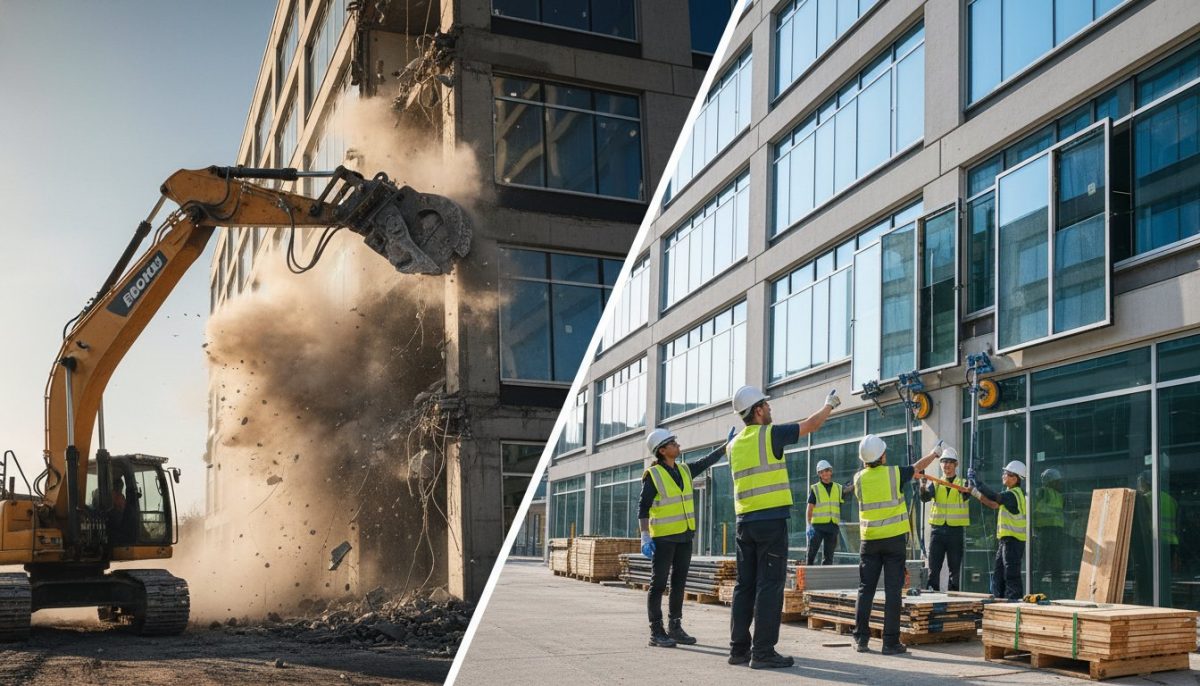
Demolition accounts for over 90% of the 600 million tons of construction and demolition waste generated annually in the U.S., a figure that’s more than double the amount of municipal solid waste. You likely recognize that clearing a site is no longer just about the fastest path to a vacant lot. With rising landfill tipping fees and the 2026 implementation of the One Big Beautiful Bill Act, the debate of deconstruction vs demolition is now a complex financial and regulatory calculation. Choosing the wrong method can lead to unexpected liabilities, especially when dealing with hazardous materials or strict LEED requirements.
This guide provides a professional framework to help you choose the strategy that aligns with your specific project goals. You’ll understand the technical differences between systematic dismantling and traditional structural removal. We’ll examine how to navigate the new 0.5% AGI floor for material donations, manage asbestos abatement protocols, and leverage industrial recycling services to maximize recovery. This analysis ensures you have the data needed to minimize risk, manage material cost inflation, and optimize the value of your structural assets through methodical planning.
Key Takeaways
- Learn the technical differences between deconstruction vs demolition to determine if your site requires rapid mechanical clearing or systematic material salvage for LEED compliance.
- Identify how selective demolition provides a surgical approach to interior gutting, enabling precise component removal while maintaining the primary structure’s integrity.
- Recognize why hazardous material inspection and professional abatement are non-negotiable prerequisites to ensure safety and prevent costly regulatory delays.
- Evaluate the shifting financial landscape of 2026, including new tax deduction thresholds and rising disposal fees, to optimize your project’s cost-benefit ratio.
- Discover how integrated recycling services and professional site clearance strategies can minimize liability while maximizing the recovery of high-value structural materials.
Defining the Methods: Deconstruction vs. Demolition
Structural removal has evolved far beyond the blunt force of the wrecking ball. In 2026, the industry views site clearance as a precise engineering discipline rather than a simple act of destruction. The decision between deconstruction vs demolition functions as a strategic choice that balances project velocity against material recovery goals. While traditional methods prioritize rapid site turnover, the shift toward a circular economy has redefined “wrecking” as an outdated concept. Modern professionals now view structures as repositories of valuable materials that require methodical management to mitigate the 600 million tons of C&D waste generated annually.
The Mechanics of Modern Demolition
Mechanical demolition remains the standard for projects requiring high-speed site clearing and immediate structural removal. This method utilizes high-reach excavators equipped with hydraulic shears and concrete pulverizers to systematically dismantle multi-story buildings. It’s an engineered process where structural physics dictates the removal sequence to ensure site stability and worker safety. Before any high-impact removal begins, specialized teams develop detailed plans that account for load-bearing transitions and vibration control. This approach is highly efficient for clearing sites where materials are contaminated or the structural integrity is too compromised for manual labor. While it generates significant debris, the speed of execution often offsets the rising landfill tipping fees for time-sensitive commercial developments.
The Anatomy of Deconstruction
In contrast, Deconstruction (building) is the systematic “un-building” of a structure to maximize material salvage. This labor-intensive process begins with soft-stripping, which involves the careful removal of non-structural elements like fixtures, flooring, and cabinets. Once the interior is cleared, the structural deconstruction phase begins. Teams hand-disassemble timber frames, masonry, and steel components to preserve their physical properties for resale or reuse.
The primary metric for success in this method is the salvage rate. While standard demolition might only recycle bulk concrete and metal, deconstruction can achieve a 90% or higher recovery rate for all building materials. This methodical approach requires complex on-site logistics for sorting and protecting salvaged goods. It’s a strategy that transforms a liability into an asset, particularly for older structures containing high-value materials like old-growth timber or hand-pressed brick. By preserving the embodied carbon within these materials, deconstruction aligns with 2026 green building standards and municipal mandates increasingly seen in cities like Portland, Seattle, and San Antonio.
Selective Demolition: The Strategic Middle Ground
The choice between deconstruction vs demolition often overlooks the technical bridge between these two extremes: selective demolition. This method involves the surgical removal of specific building components while leaving the primary structure intact. It’s an engineered approach that requires high levels of precision and structural knowledge to ensure that the remaining portions of the building stay stable. By focusing on specific sections, developers can balance the speed of mechanical removal with the material recovery benefits of systematic dismantling. This strategy is particularly vital for historic preservation and adaptive reuse projects where the building’s shell holds significant architectural or cultural value.
Safe execution depends on rigorous shoring and bracing protocols. Before any load-bearing element is touched, temporary supports must be installed to redistribute structural weight. This process prevents unintended collapses and protects the integrity of the building’s envelope. Regulatory bodies, such as the CT DEEP on Deconstruction, emphasize that these activities fall under specific demolition standards that require careful planning for hazardous materials and structural stability. When handled correctly, selective removal allows for modern upgrades without the environmental cost of a total tear-down.
Interior Gut-Outs and Tenant Improvements
In commercial settings, selective demolition frequently takes the form of commercial interior gutting services. This process involves stripping a structure down to its studs or concrete slab while protecting vital mechanical, electrical, and plumbing (MEP) systems. Precision is paramount here. Teams utilize robotic demolition units and specialized hand tools to navigate tight spaces without damaging shared utilities. Managing dust and noise is a critical operational requirement, especially in occupied buildings. High-efficiency particulate air (HEPA) filtration and temporary sound barriers are standard tools used to maintain a safe, professional environment during high-intensity interior work.
Structural Modifications and Wing Removal
Removing a building’s wing or an outdated addition presents unique technical challenges. It requires a clear separation of structures that may share footings or load-bearing walls. Engineers must analyze the original blueprints to understand how the removal will impact the remaining building’s center of gravity. This method is often more cost-effective than total demolition because it preserves the most valuable parts of the real estate while allowing for modern expansions. If you’re managing a complex renovation that requires this level of technical accuracy, consulting with a partner experienced in selective structural removal can help mitigate long-term liability.
- Protects the primary building envelope for future use.
- Reduces landfill waste by focusing only on necessary removals.
- Allows for the modernization of MEP systems without structural replacement.
- Facilitates compliance with LEED and other green building certifications.
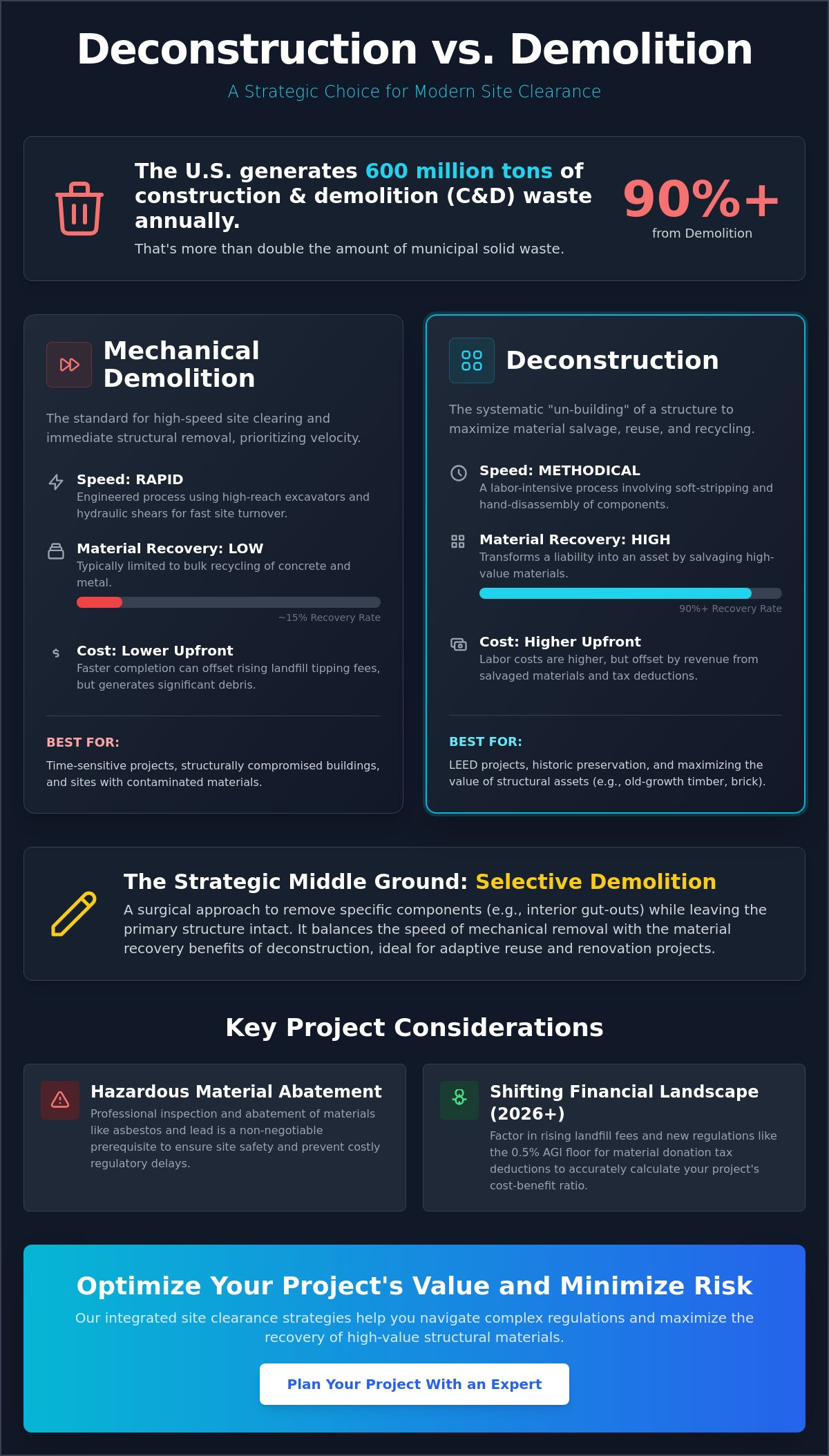
The Abatement Prerequisite: Handling Asbestos and Lead
Before any structural removal begins, a comprehensive hazardous material survey is the mandatory first step for legal and safety compliance. Whether a project involves deconstruction vs demolition, the presence of toxic substances like asbestos or lead-based paint dictates the entire operational sequence. You can’t systematically “un-build” a structure if that process releases airborne fibers or toxic dust into the environment. Failing to identify these materials early doesn’t just invite regulatory fines; it creates a significant health liability for everyone on site. According to the EPA’s guidelines on the Sustainable Management of C&D Materials, managing the 600 million tons of debris generated annually requires a clear understanding of what can be safely recovered and what must be treated as hazardous waste.
Integrating asbestos removal in South Carolina into your project timeline prevents the 11th-hour delays that often plague structural removals. In a deconstruction scenario, the requirement for abatement is even more stringent because manual handling increases the risk of exposure compared to mechanical demolition where operators remain in sealed cabs. If you’re planning a complex removal, securing a partner for professional abatement services is essential to maintain site safety and project momentum.
Asbestos Abatement in Structural Removal
Asbestos identification focuses on distinguishing between friable and non-friable materials. Friable asbestos, such as pipe insulation or sprayed-on fireproofing, easily crumbles and becomes airborne, requiring strict containment protocols. Non-friable materials like floor tiles or transite siding are more stable but still require professional handling during disassembly. Effective abatement involves creating negative air pressure zones and utilizing HEPA filtration to ensure no fibers escape the work area. Professional documentation throughout this process serves as your primary defense against future environmental liabilities.
Lead and Mold Remediation
Lead-based paint is a primary obstacle when attempting to salvage historic wood and masonry. If these materials are contaminated, they cannot be sold or reused in new construction without extensive and often cost-prohibitive treatment. Similarly, mold remediation must be completed before structural disassembly to prevent the spread of spores. These factors directly impact the final recycling rate of a project. When hazardous material abatement in South Carolina is handled correctly, it ensures that the remaining “clean” materials can be diverted from landfills and processed through industrial recycling channels.
- Mandatory inspections prevent cross-contamination of salvageable materials.
- Negative air pressure environments protect both workers and the surrounding community.
- Accurate manifest tracking provides a clear chain of custody for hazardous waste disposal.
- Early abatement allows for higher material recovery rates in deconstruction projects.
Selection Matrix: Choosing the Right Method for Your Project
Choosing between deconstruction vs demolition requires a methodical evaluation of project variables. It’s not a binary choice but a technical calculation of time, cost, and regulatory compliance. Project managers must weigh the immediate speed of mechanical removal against the long-term financial benefits of material recovery. In 2026, this decision is heavily influenced by the One Big Beautiful Bill Act (OBBBA), which established a 0.5% AGI floor for charitable deductions on salvaged materials. For high-net-worth property owners, this means the tax benefits of deconstruction only trigger for donation values exceeding that threshold, with benefits capped at 35% for those in the highest marginal tax bracket.
Site constraints also play a defining role. Urban density often dictates the removal strategy due to noise ordinances and dust control requirements. While mechanical demolition is faster, deconstruction offers a quieter, more contained alternative that may be necessary in sensitive neighborhoods. Additionally, meeting LEED v4.1 requirements for construction and demolition waste management often necessitates a hybrid approach. With construction material cost inflation forecasted between 2% and 4% for 2026, reclaiming structural steel or high-grade timber can provide a significant hedge against the rising costs of new building supplies.
When to Prioritize Traditional Demolition
Standard structural demolition is the logical choice for projects with immediate redevelopment deadlines or when dealing with safety-compromised structures. If a building is structurally unstable, manual disassembly poses an unacceptable risk to personnel. Furthermore, structures with high levels of un-remediable contamination are poor candidates for salvage. In large-scale industrial environments, the use of hydraulic shears and concrete pulverizers is often the only viable method to clear the site within an efficient timeframe. If the building lacks high-value architectural components, the speed of mechanical removal remains the most cost-effective path to site clearance.
When Deconstruction is the Superior Choice
Deconstruction is the superior strategy when a structure contains high-value salvage potential, such as antique heart pine, hand-cut stone, or reusable structural steel. It’s also the required path in municipalities like Portland, Seattle, San Antonio, and Palo Alto, which have implemented strict deconstruction ordinances for older properties. For projects where environmental impact and carbon footprint reduction are primary KPIs, the systematic dismantling of the building ensures the highest possible material recovery rate. If you need a technical assessment to determine the most viable path for your property, contact our team for a professional structural removal consultation.
- Timeline: Demolition (days) vs. Deconstruction (weeks/months).
- Tax Strategy: Evaluating the 0.5% AGI floor for material donations.
- Regulatory: Compliance with local deconstruction mandates for pre-1940 structures.
- Logistics: Space availability for on-site material sorting and preservation.
The TSIAC Advantage: Integrated Site Clearance
The technical complexity of modern site clearance requires more than just heavy machinery; it demands a unified operational framework. Whether your project necessitates deconstruction vs demolition, TSIAC International provides a single-source solution that integrates hazardous material management with structural removal. This approach eliminates the coordination gaps that often occur when multiple vendors handle abatement, interior gutting, and final site clearing. By managing every phase under one contract, we maintain a continuous chain of custody for all materials, ensuring that site safety and environmental goals are met with methodical precision.
Our commitment to the circular economy is reflected in our on-site recycling services. We don’t just clear land; we process materials for recovery. By utilizing specialized equipment to sort and crush concrete or separate structural steel on-site, we significantly reduce the volume of debris sent to landfills. This integrated strategy is particularly valuable for developers seeking LEED certification or those operating in regions with strict waste diversion mandates. Our position among demolition contractors Charleston SC is built on this foundation of technical excellence and environmental responsibility, allowing us to navigate the unique structural challenges of both historic and industrial properties.
A Legacy of Professionalism and Safety
With over 15 years of experience in high-stakes structural removal, TSIAC has developed a reputation for unwavering reliability. Safety isn’t a secondary consideration; it’s the core of our engineered demolition plans. These plans exceed standard OSHA requirements by incorporating advanced structural physics and load-bearing analysis into every phase of the project. Our crews undergo rigorous training in hazardous material handling, ensuring that asbestos and lead abatement are completed without compromising site safety. We also prioritize the surrounding community by deploying advanced dust control systems and noise mitigation strategies, which are essential for maintaining professional standards in high-density urban environments.
Requesting Your Professional Estimate
Accurate project forecasting begins with a detailed site walk-through. This allows our technical team to identify hidden variables, such as structural anomalies or undetected hazardous materials, that could impact the deconstruction vs demolition timeline. When preparing your Request for Proposal (RFP), including your asbestos survey reports, original structural drawings, and specific salvage goals will ensure the most precise quote possible. A thorough initial assessment prevents the mid-project change orders that often derail commercial budgets. Contact TSIAC International today for a comprehensive project evaluation to discuss your structural removal requirements with an experienced partner.
- Single-source accountability for abatement, gutting, and removal.
- Engineered demolition plans that prioritize structural stability.
- On-site recycling services to maximize material recovery.
- Proven expertise in managing complex commercial and industrial sites.
Advancing Your Site Clearance Strategy
Successful site clearance in 2026 requires a sophisticated balance between operational speed, material recovery, and strict regulatory compliance. The choice of deconstruction vs demolition isn’t merely a matter of choosing equipment; it’s a strategic decision that impacts your project’s tax benefits, landfill fees, and environmental footprint. By prioritizing thorough hazardous material abatement and leveraging selective removal techniques, you can transform a complex liability into a streamlined asset. Modern projects demand this level of technical foresight to navigate rising costs and evolving municipal mandates.
TSIAC International provides 15+ years of specialized industry experience to guide your project from initial inspection to final clearance. Our teams act as certified asbestos and lead abatement specialists who maintain a comprehensive environmental recycling commitment on every site. We ensure that your structural removal is handled with the methodical precision and safety standards your investment deserves. Partner with TSIAC International for Safe, Professional Structural Removal and secure a reliable foundation for your next development phase.
Frequently Asked Questions
What is the main difference between deconstruction and demolition?
The fundamental difference between deconstruction vs demolition lies in the methodology and the final objective. Traditional demolition uses heavy machinery to clear a site rapidly for new development. Deconstruction is the systematic dismantling of a structure to preserve the physical integrity of its components for reuse. While demolition treats the building as waste, deconstruction views it as a source of valuable structural materials.
Is deconstruction always more expensive than traditional demolition?
Upfront labor costs for deconstruction are typically higher than mechanical removal due to the manual effort required. However, these expenses are often mitigated by reduced landfill tipping fees and the resale value of salvaged materials. In 2026, property owners can also leverage tax deductions for donated materials, though the One Big Beautiful Bill Act now requires these to exceed 0.5% of Adjusted Gross Income.
Can I salvage materials if my building has asbestos?
You cannot salvage materials that are contaminated with asbestos or lead-based paint. These substances must be professionally abated before any dismantling occurs to prevent environmental hazards. Only clean structural elements identified during the initial hazardous material survey are eligible for recovery. Attempting to salvage contaminated components is a direct violation of safety regulations and creates significant legal liability for the property owner.
How much of a building can typically be recycled during demolition?
Standard mechanical demolition typically recovers a portion of materials, primarily bulk concrete and scrap metal. In contrast, a methodical deconstruction vs demolition approach can achieve recovery rates exceeding 90%. The actual percentage depends on the building’s composition and the presence of hazardous materials. Utilizing on-site recycling services for concrete and masonry significantly increases the total diversion rate from local landfills.
Do I need different permits for deconstruction vs. demolition?
Permit requirements vary by municipality, but deconstruction often requires specific documentation not found in standard demolition applications. Cities like Portland and San Antonio have enacted ordinances that mandate deconstruction for older structures. You should check local building codes to see if a waste management plan or a specific deconstruction permit is required. Professional contractors handle these filings to ensure compliance with local environmental standards.
How long does a typical commercial deconstruction project take?
A commercial deconstruction project generally takes several weeks to a few months to complete, depending on the structure’s size and complexity. This is significantly longer than mechanical demolition, which can often be finished in a matter of days. The extended timeline accounts for the careful removal of fixtures, the manual disassembly of structural frames, and the on-site sorting of salvaged materials for transport.
What materials are most commonly salvaged during deconstruction?
The most commonly salvaged materials include old-growth timber, structural steel, hand-pressed bricks, and architectural fixtures. Hardwood flooring and heavy timber beams are particularly valuable in the 2026 resale market. Non-structural items like cabinets, high-end lighting, and plumbing fixtures are also frequently recovered during the initial soft-strip phase. Successful salvage depends on the physical condition of the items and the absence of hazardous coatings.
How does selective demolition differ from interior gutting?
Selective demolition is a broad engineering term for the surgical removal of specific building sections, which can include structural wings or additions. Interior gutting is a specific type of selective removal focused on stripping a space down to its core elements, such as studs or concrete slabs. While gutting prepares a space for tenant improvements, selective demolition may involve more complex shoring to maintain the integrity of the remaining building envelope.
