
What if the most significant risk to your project timeline isn’t the structural teardown itself, but the microscopic spores hidden behind the drywall? Discovering hazardous growth mid-work is a common pain point that often leads to immediate site shutdowns and mounting costs. Successfully handling mold during demolition in Charleston, SC, requires more than just a quick cleanup; it demands a surgical approach to containment and a deep understanding of evolving 2026 regulations.
It’s understandable to feel overwhelmed by the transition from DHEC to the South Carolina Department of Environmental Services (SCDES) or the potential impact of pending certification laws like Bill 5109. This guide provides the technical protocols necessary to identify, contain, and remediate mold without compromising the rest of your structure. You’ll learn how to maintain OSHA compliance, manage hazardous waste disposal, and resume your demolition schedule with the confidence that your site is both safe and legally sound.
Key Takeaways
- Identify the critical differences between surface microbial growth and deep-seated structural mold to avoid unforeseen project halts.
- Implement advanced containment protocols, including 6-mil polyethylene barriers and negative air pressure, for handling mold during demolition charleston sc.
- Determine the most efficient path between surgical selective demolition and full interior gutting to protect structural integrity.
- Navigate the updated 2026 OSHA and SCDES regulatory landscape to ensure site safety and avoid severe civil penalties.
- Maintain environmental standards by systematically sorting and recycling non-contaminated debris even within complex remediation zones.
Identifying Microbial Risks in Structural and Selective Demolition
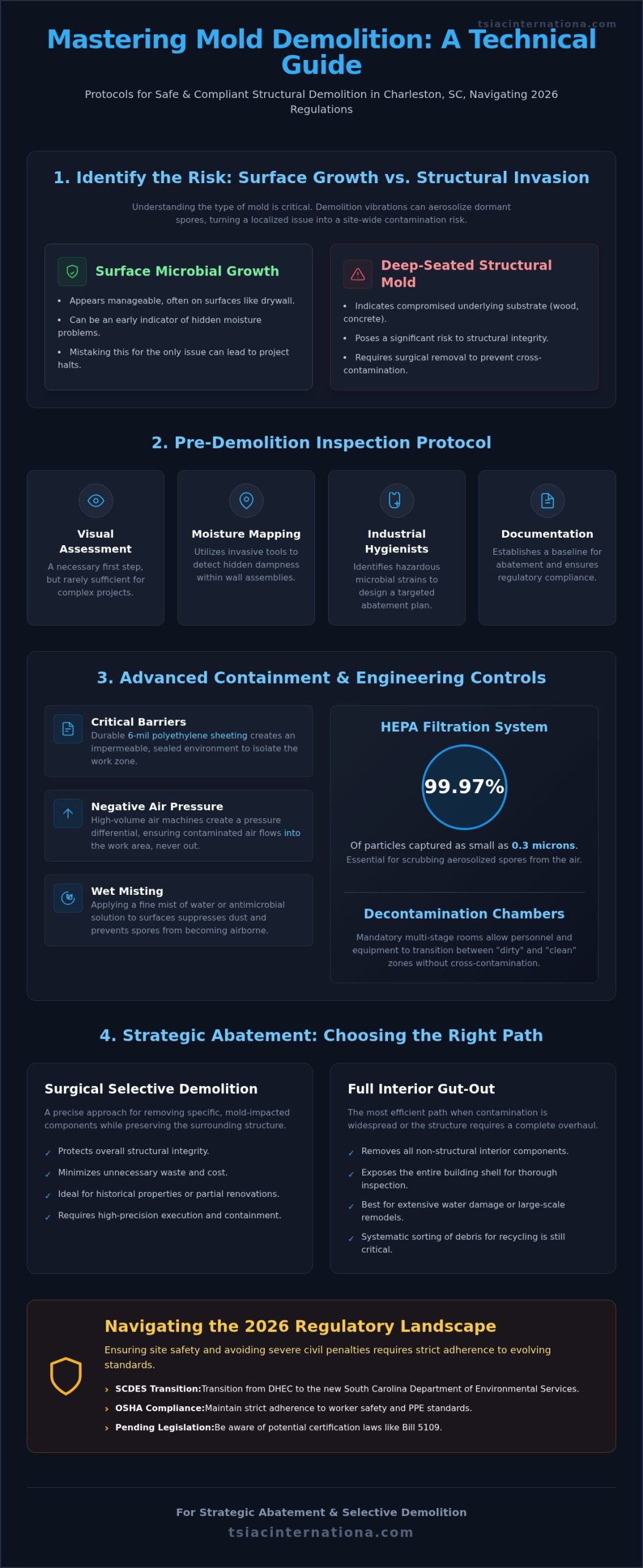
Structural demolition involves more than just physical force; it requires the management of invisible hazards. High-impact removal techniques, such as the use of heavy machinery or pneumatic tools, generate intense vibrations. These vibrations aerosolize dormant spores, which can quickly overwhelm a site if not properly contained. When handling mold during demolition charleston sc, the primary challenge lies in differentiating between superficial growth and deep-seated structural colonization. While surface mold might appear manageable, deep-seated growth often indicates that the underlying substrate is compromised. This is especially critical during selective demolition, where the goal is to remove specific components while preserving others. High-precision identification ensures that mold-impacted materials are extracted without cross-contaminating the remaining structure. A thorough understanding of Mold growth, assessment, and remediation is essential for any contractor operating in Charleston’s humid climate, where historical water damage often correlates with weakened structural integrity.
Common Locations for Mold in Commercial Gut-Outs
Mold rarely stays localized. In commercial environments, HVAC systems and plenum spaces act as primary vectors, allowing spores to migrate through entire floors. During an interior gut-out, we frequently discover extensive growth behind industrial-grade drywall and within metal framing cavities where condensation has collected over years. Sub-flooring and concrete slabs are also high-risk zones. Moisture often becomes trapped between flooring layers or within the pores of concrete through capillary action, creating a hidden reservoir for microbial activity that only becomes visible once the demolition phase begins.
Pre-Demolition Inspection Protocols
Effective risk management starts before the first swing of a hammer. A visual assessment is a necessary first step, but it’s rarely sufficient for complex projects. We utilize invasive moisture mapping to detect hidden dampness within wall assemblies. Engaging industrial hygienists is a standard protocol for high-stakes projects; they identify specific hazardous microbial strains and provide the data needed to design a targeted abatement plan. Documenting the extent of the mold is vital. This documentation establishes a baseline for abatement, ensures regulatory compliance, and protects the project timeline by preventing surprise discoveries during the structural removal phase.
Handling Mold During Demolition: Advanced Containment Protocols
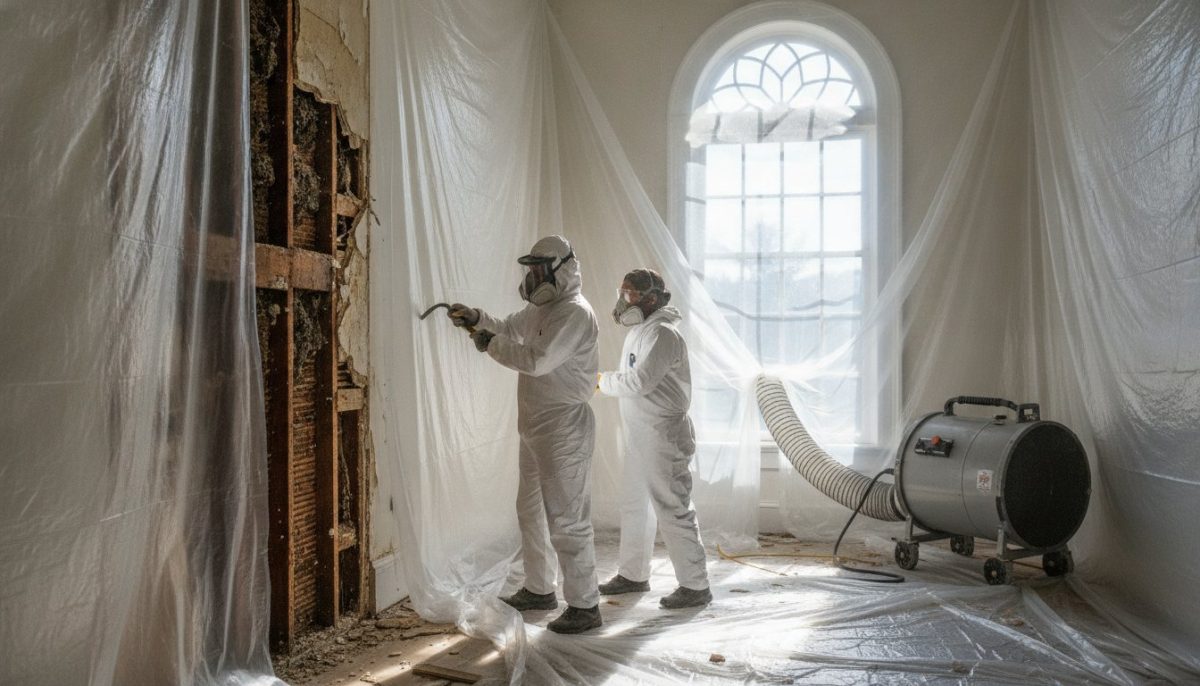
Effective containment is the primary defense against the spread of microbial contaminants once the demolition phase begins. When professionals are handling mold during demolition charleston sc, they must transition from identification to active isolation to prevent spores from migrating into unaffected areas of a building. We establish “Critical Barriers” using 6-mil polyethylene sheeting, which provides a durable, impermeable layer that can withstand the physical rigors of a construction site. These barriers aren’t merely partitions; they’re the foundation of a sealed environment that protects both the workers and the structural integrity of the remaining property. For projects requiring high-precision execution, our selective demolition services integrate these rigorous containment protocols from the initial planning stage.
The science of negative air pressure is what truly secures these zones. By using high-volume air machines, we create a pressure differential that forces air to flow into the work area, never out of it. This vacuum effect ensures that any aerosolized spores remain trapped within the containment. Adherence to EPA mold guidelines ensures that these strategies meet federal safety expectations, particularly when utilizing HEPA filtration systems to scrub the air. These scrubbers are capable of capturing 99.97% of particles as small as 0.3 microns, which is essential during the high-impact removal of drywall or timber. Decontamination chambers are also mandatory. These multi-stage rooms allow personnel and equipment to transition between “dirty” and “clean” zones without carrying microscopic debris on their gear.
Engineering Controls for Spore Suppression
Engineering controls reduce the reliance on PPE alone. We employ wet-misting techniques, which involve applying a fine mist of water or an antimicrobial solution to surfaces before and during demolition to keep dust and spores from becoming airborne. Sizing air scrubbers for large-scale commercial interior gutting projects requires precise CFM (cubic feet per minute) calculations to ensure at least four air changes per hour. We use digital manometers to monitor pressure differentials constantly. This data-driven approach ensures that the containment integrity remains uncompromised, even as heavy structural components are removed.
Personal Protective Equipment (PPE) Standards
PPE selection depends on the severity of the mold colonization and the intensity of the demolition. While N95 respirators are suitable for low-risk inspections, heavy demolition environments require P100 respirators to filter out both particulate matter and oily aerosols. Workers must wear full-body protective suits, such as Tyvek, with sealed seams to prevent skin contact. The logistics of safe doffing are strictly controlled in the decontamination chamber to prevent self-contamination. OSHA requires employers to provide suitable personal protective equipment and comprehensive safety training to all personnel working in environments where microbial hazards are present.
Selective Demolition vs. Full Gut-Outs: Choosing the Right Abatement Path
The decision between surgical removal and a total gut-out represents a critical strategic milestone in handling mold during demolition charleston sc. It isn’t merely a matter of project speed; it’s a technical assessment of substrate porosity and the extent of microbial penetration. When growth is localized to specific non-load-bearing partitions, a surgical approach allows for the extraction of contaminated materials while preserving the surrounding structural integrity. This method requires a high degree of control to manage the interface between clean and impacted zones, particularly in occupied commercial buildings where cross-contamination could lead to significant liability. Professionals must weigh the cost-benefit of detailed cleaning against the total replacement of building materials. While non-porous materials like metal framing can often be remediated, porous items like drywall or insulation almost always require complete removal once colonization is confirmed.
The Selective Demolition Methodology
Precision is the defining characteristic of this approach. We utilize specialized tools, such as HEPA-filtered plunge saws, to make clean cuts that minimize dust aerosolization. This high-precision methodology is essential when preserving architectural features or historical elements common in Charleston’s commercial districts. By integrating selective demolition with active abatement, we ensure that only the compromised sections are removed. This surgical removal prevents the unnecessary destruction of healthy structural components, such as heavy timber beams or masonry, while still achieving the required microbial clearance for the next phase of construction.
Full Gut-Out Procedures for Extensive Contamination
When moisture mapping reveals systemic growth within wall cavities or plenum spaces, a full interior gut-out becomes the only viable path forward. This process involves stripping the structure down to its studs or concrete skeleton to ensure no hidden reservoirs of mold remain. During these intensive projects, handling contaminated metal framing and acoustic ceiling tiles requires strict adherence to OSHA mold safety guidelines to protect the workforce from high concentrations of airborne spores. Debris management is a priority here. We systematically sort materials, separating mold-impacted waste for specialized disposal while reclaiming wood, metal, and plastic from non-contaminated areas. This disciplined approach reflects our 15 years of industry experience, ensuring that even the most extensive gut-out projects remain environmentally responsible and structurally sound.
Regulatory Compliance and Safety Standards for Hazardous Material Management
Regulatory oversight for handling mold during demolition charleston sc has entered a new phase in 2026 with the transition of environmental authority to the South Carolina Department of Environmental Services (SCDES). While the SCDES provides the framework for demolition notifications, the burden of microbial and hazardous dust management falls under the 2026 OSHA General Industry Standards. These updated standards place a heavy emphasis on controlling aerosolized particulates that carry biological and chemical hazards. We prioritize the proper labeling, hauling, and disposal of mold-contaminated building debris to ensure that every project meets these rigorous federal and state requirements. Maintaining a precise “Chain of Custody” for hazardous waste is a core component of our methodology; it serves as a critical document that limits owner liability by proving that contaminated materials were transported and disposed of at licensed facilities.
Adhering to these standards prevents the severe civil penalties associated with safety violations. In 2026, a single serious OSHA violation can carry a maximum penalty of $16,550, while willful violations can escalate to $165,514. Beyond the financial risk, a disciplined approach to compliance ensures that the project remains on schedule and avoids the stop-work orders that often follow a discovery of unmanaged hazardous materials. Ensure your project remains compliant by consulting with our team for hazardous material management.
Integrating Asbestos and Mold Abatement
In Charleston’s older commercial structures, mold is frequently a secondary indicator of degraded asbestos-containing materials. Moisture that fuels microbial growth often compromises the binders in asbestos insulation or floor tiles, making them friable and exceptionally dangerous during demolition. It’s vital to remember that an asbestos inspection report in South Carolina is only valid for 36 months; if your survey is older, a new one is required before work begins. Coordinating asbestos removal with microbial remediation allows for a unified containment strategy, reducing the need for redundant barrier systems and streamlining the regulatory documentation required for dual-hazard sites.
Environmental Responsibility and Recycling
Modern demolition requires a balance between safety and sustainability. Even on sites impacted by mold, we strive to reduce landfill impact through strategic material sorting. Non-porous materials like metal framing and certain hard plastics can often be safely recycled after undergoing professional antimicrobial treatment. We follow a strict protocol for separating wood, metal, and plastic that has not been colonized by mold, ensuring these resources are diverted to recycling centers rather than landfills. This commitment to resource recovery is a hallmark of the demolition process in modern projects, where environmental responsibility is as important as technical precision.
Strategic Abatement: The TSIAC International Approach to Complex Projects
TSIAC International brings over 15 years of industrial experience to the most challenging environments in South Carolina. Our approach to handling mold during demolition charleston sc is defined by a methodical integration of structural engineering and hazardous material abatement. We don’t view remediation as a standalone cleaning task. Instead, we treat it as a critical phase of the demolition process that requires surgical precision. This perspective allows us to provide fixed-price contracts that encompass the full scope of remediation, debris sorting, and recycling logistics. By accounting for these variables upfront, we eliminate the budget creep that often occurs when hidden hazards are discovered mid-project. Our word is a guarantee of technical accuracy and project stability.
Our methodology focuses on minimizing downtime for both commercial renovations and residential rebuilds. We understand that every day a site remains closed represents lost revenue or delayed occupancy. By utilizing advanced containment and high-capacity air scrubbing, we often maintain project momentum in adjacent areas while the impacted zones are cleared. This balanced approach ensures that safety never comes at the expense of the project timeline. Our “Safety-First” methodology is designed to contain both microbial and chemical hazards simultaneously, providing a comprehensive solution for buildings where mold, asbestos, or lead may coexist.
Expertise in Structural Integrity
Stability is paramount during aggressive interior gut-outs. We employ specialized equipment for concrete removal and metal framing disposal, ensuring that load-bearing elements remain undisturbed even as contaminated substrates are stripped away. Our teams are trained to navigate the complexities of structural demolition where microbial growth has compromised secondary supports. We leave every site as a “clean slate,” free from both physical debris and microscopic hazards. This provides a safe, documented foundation for the next phase of construction, ensuring that following trades can enter the site without risk.
Partnering for Success
We act as a disciplined partner for general contractors and government agencies managing large-scale projects. Transparency is maintained through comprehensive reporting and compliance documentation that meets the 2026 SCDES and OSHA standards. Our involvement doesn’t end with the physical removal of materials. We provide full support for post-remediation verification (PRV), ensuring that third-party industrial hygienists can confirm the site is clear for re-occupancy. This rigorous commitment to professional standards is why we remain the preferred choice for complex demolition and abatement projects throughout the Charleston region.
Securing Your Project Foundations for 2026 and Beyond
The successful execution of a demolition project in Charleston’s humid climate hinges on the technical integration of structural removal and environmental safety. Effective management involves more than just debris removal; it requires specialized containment, negative air pressure protocols, and a disciplined adherence to the 2026 SCDES regulatory landscape. By prioritizing surgical selective demolition and maintaining a strict chain of custody for hazardous debris, property owners can effectively mitigate both biological risks and legal liabilities. Handling mold during demolition charleston sc is a high-stakes operation that demands the precision of an experienced partner who understands the intersection of material science and site safety.
TSIAC International brings over 15 years of certified experience to every site, ensuring that even the most complex microbial challenges are managed with methodical precision. Our specialized hazardous material containment and comprehensive material recycling program ensure your project remains safe, compliant, and environmentally responsible. We provide the technical certainty needed to transition from a compromised structure to a clean slate for future development. Request a Professional Demolition and Abatement Quote from TSIAC International to ensure your next project starts on a stable, hazard-free foundation. We look forward to helping you resume your timeline with total confidence.
Frequently Asked Questions
Can you perform demolition if mold is present in the building?
Yes, but you must first establish specialized containment and abatement protocols to prevent the dispersal of spores. Standard demolition techniques are too high-impact for mold-impacted environments because they aerosolize contaminants. We integrate abatement directly into the demolition plan to ensure that hazardous materials are removed under controlled conditions before the main structural teardown proceeds.
What is the difference between mold remediation and mold abatement in a demolition context?
Remediation typically focuses on cleaning and restoring a structure to a habitable state for continued occupancy. In a demolition context, abatement refers to the physical removal and specialized disposal of contaminated materials to prevent cross-contamination during the teardown. While remediation is about restoration, abatement is a surgical extraction process designed to eliminate environmental liabilities before further work occurs.
How do negative air machines work during a commercial gut-out?
Negative air machines utilize high-capacity fans to pull air from the workspace through HEPA filters before exhausting it outside the building. This process creates a pressure differential where the air pressure inside the containment zone is lower than the surrounding areas. As a result, air only flows into the work zone, effectively trapping microscopic spores and dust within the sealed environment.
Is a mold inspection required by law before a residential demolition?
South Carolina law does not currently mandate a standalone mold inspection for residential demolition. However, the SCDES requires an asbestos survey for most regulated structures, and an updated Hazard Communication Standard went into effect in May 2026. Because mold and asbestos often coexist in older Charleston properties, a comprehensive hazardous material assessment is a standard professional practice to ensure site safety.
Can moldy wood or drywall from a demolition site be recycled?
Porous materials like drywall and insulation that have been colonized by mold cannot be recycled and must be disposed of as hazardous waste. However, non-porous materials such as metal framing or concrete can often be cleaned and diverted to recycling centers. We prioritize the systematic sorting of non-contaminated wood, metal, and plastic to reduce landfill impact while following strict disposal laws for impacted debris.
How long does the mold abatement process typically add to a demolition timeline?
The timeline depends on the extent of the growth, but professional abatement typically adds three to seven working days for containment setup and material extraction. A well-coordinated strategy for handling mold during demolition charleston sc allows these steps to occur concurrently with other site preparation tasks. This integrated approach minimizes overall downtime and prevents the much longer delays associated with unexpected site shutdowns.
What happens if mold is discovered after the demolition has already started?
Work must stop immediately in the affected zone to prevent the further spread of spores. The area is isolated using 6-mil polyethylene sheeting, and an industrial hygienist is often brought in to assess the severity of the growth. Once a targeted abatement plan is executed and the area is cleared, the demolition schedule can resume safely without risking the health of the crew or the structural integrity of the site.
How does TSIAC International ensure mold doesn’t spread to adjacent office spaces?
We utilize a multi-layered defense strategy that includes 6-mil polyethylene critical barriers and digital manometer monitoring to maintain constant negative air pressure. Our team also employs multi-stage decontamination chambers for all personnel and equipment moving between zones. This methodical approach to handling mold during demolition charleston sc guarantees that adjacent occupied spaces remain uncontaminated even during high-impact interior gutting projects.
