
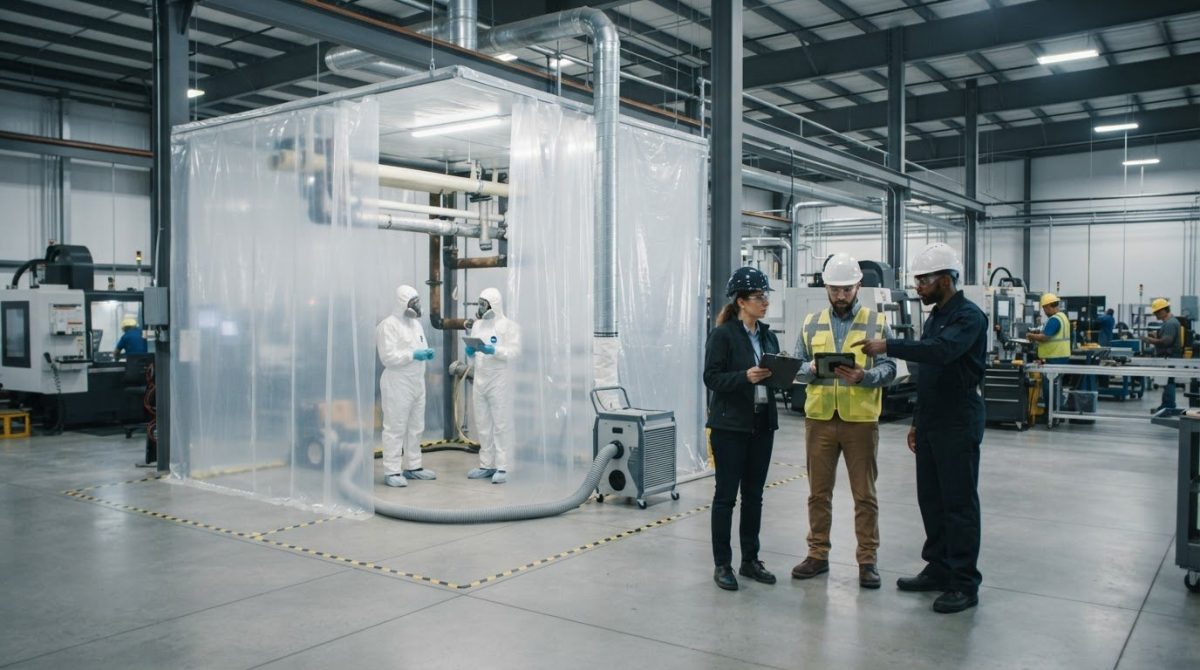
In a manufacturing plant, the safest abatement plan isn’t necessarily the one that removes material fastest. It’s the one that defines the affected area, controls the work, and accounts for the facility’s operating conditions. That’s why asbestos abatement for manufacturing facilities should begin with the materials involved, the planned work, and the conditions at the site.
When renovation or maintenance must fit around production, uncertainty about hidden or inaccessible asbestos can complicate the next steps. Contractor plans are also difficult to compare when they describe different scopes, containment measures, worker protections, or waste records. Start by establishing which materials and areas are involved, what work could disturb them, and where the project boundaries sit.
This guide explains how to assess facility needs, compare abatement approaches, and plan work around production, maintenance, or renovation. It covers what to look for in the scope, controls, communication plan, and safe handling and disposal records. TSIAC International brings more than 15 years of industry experience to asbestos abatement, including regulatory compliance documentation and safe disposal. If a project also requires selective demolition or interior gutting, those scopes can be coordinated with the abatement work.
Key Takeaways
- Define the planned renovation or maintenance first, then assess asbestos-containing materials that could be affected. Material condition, location, and facility use shape the scope.
- For asbestos abatement for manufacturing facilities, compare plans by how clearly they explain boundaries, facility interfaces, controls, documentation, and related work.
- Use a project-specific sequence from assessment and scope development through controlled execution and closeout, rather than assuming one method fits every plant.
- Coordinate facilities, EHS, operations, maintenance, and project-management stakeholders on affected areas, access, sequencing, and completion records.
- When abatement intersects with selective demolition or interior gutting, define those interfaces in the overall project plan and documentation.
Why asbestos abatement planning matters in manufacturing facilities
Asbestos abatement is controlled work to address identified asbestos-containing materials (ACM) that could be disturbed or otherwise require management. It is not another name for renovation, repair, or demolition. The scope depends on which materials are present, their condition and location, what the project will disturb, and how the area is used. Material beside a production line, for example, can involve different access and coordination needs from material in an isolated, unused space.
Planning has two related aims: protecting workers and other occupants from potential exposure, and coordinating project activities with facility operations. Production needs may affect access and sequencing, but they don’t determine the protective controls required for the abatement work. Those controls must reflect the materials and conditions at the site. A general overview of asbestos abatement procedures explains common concepts such as containment and removal, while a project plan must address the actual work area and applicable requirements.
Requirements can vary with the material, planned work, jurisdiction, and rules that apply to the project. That is why asbestos abatement for manufacturing facilities calls for a defined scope, not a one-size-fits-all method.
What makes a manufacturing facility abatement project different?
Manufacturing spaces often connect production areas with utilities, equipment, maintenance access, travel routes, and occupied workspaces. Abatement near a utility run or shared corridor may affect more than the immediate work location. Before work begins, map the affected area, identify interfaces with adjacent spaces and systems, and clarify where the work boundaries begin and end.
Maintenance shutdowns or renovation windows can shape the sequence and timing of tasks. They don’t remove the need to plan for worker and occupant protection, and they don’t guarantee that production will continue without disruption. A realistic plan considers access, work boundaries, and operational interfaces together.
When should facility leaders consider an abatement assessment?
Consider an assessment before planned disturbance, including renovation, repair, or demolition, when materials in the affected area may contain asbestos. Appearance alone can’t reliably establish whether a material contains asbestos, so visual inspection should not be treated as confirmation. Assessment findings help identify materials relevant to the planned work and inform the scope and controls.
Facility teams should also identify the federal, state, and local requirements relevant to their specific project. Applicable rules can vary with the work and jurisdiction, so the project plan should reflect the requirements that govern the work at hand.
How asbestos abatement scope and controls are developed for a plant
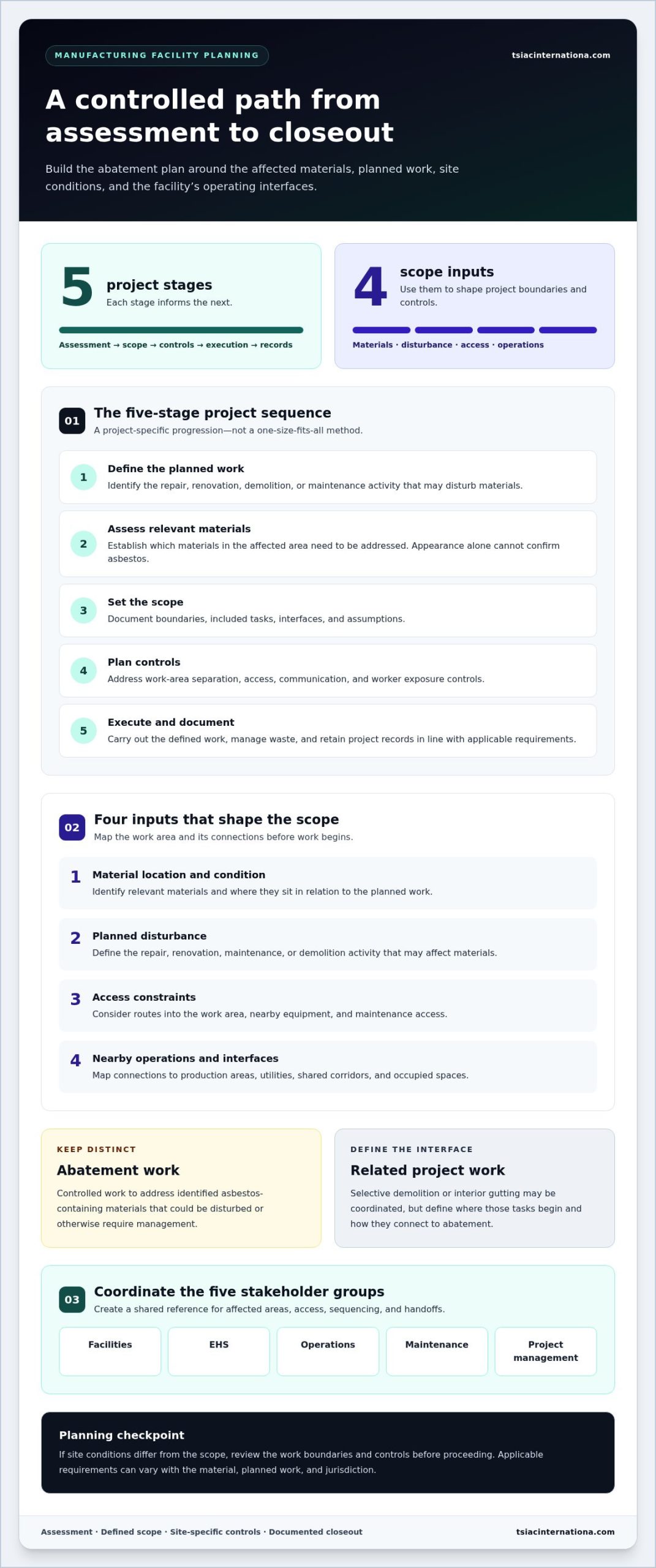
A controlled project moves from assessment to defined work boundaries, protective controls, execution, and records. Each stage informs the next. For asbestos abatement for manufacturing facilities, the plan must reflect identified materials and actual site conditions, rather than assume that one removal method or containment arrangement fits every plant.
- Define the planned work: Identify the repair, renovation, demolition, or maintenance activity that may disturb materials.
- Assess relevant materials: Establish which materials in the affected area need to be addressed.
- Set the scope: Document work boundaries, included tasks, interfaces, and assumptions.
- Plan controls: Address work-area separation, access, communication, and exposure controls.
- Execute and document: Carry out the defined work, manage waste, and retain project records in line with applicable requirements.
Assessment findings and site conditions guide the plan. If conditions differ from the scope, review the work boundaries and controls before proceeding.
How do facility conditions shape the scope of work?
Scope depends on material location and condition, planned disturbance, access constraints, and nearby operations. Material above a production area, for instance, may have different access and interface needs from material in a space already isolated for renovation. The plan should identify affected areas and how they connect to equipment, utilities, routes, and occupied spaces.
Targeted abatement is distinct from broader selective demolition or interior gutting. If a project requires both, define which tasks address asbestos-containing materials and where demolition work begins. Clear boundaries give facilities, EHS, operations, maintenance, and project-management teams a shared reference for access, sequencing, and handoffs.
What controls and records belong in the project plan?
The plan should explain how the work area will be separated, how access will be managed, how affected stakeholders will receive information, and how worker exposure will be controlled. Specific measures depend on the materials, work methods, and site conditions. Applicable OSHA and EPA requirements also depend on the project and jurisdiction; the OSHA asbestos standards for general industry provide a primary reference for evaluating relevant worker-protection requirements.
Waste handling belongs in the scope, not as an afterthought. Account for safe handling, disposal, and the records required for the work. Documentation should correspond to the materials addressed, completed activities, and governing requirements. TSIAC International’s asbestos abatement work includes safe disposal and regulatory compliance documentation, supporting a traceable project closeout. Learn more about TSIAC International asbestos abatement services.
How to compare asbestos abatement plans for manufacturing facilities
Compare how each plan translates assessment findings into defined work, controls, and coordination. For asbestos abatement for manufacturing facilities, a general promise to remove material doesn’t show whether the work fits the affected area, nearby operations, or renovation sequence. Use the criteria below to identify what each plan spells out and where assumptions or interfaces need clarification.
| Comparison area | What a clear plan should explain |
|---|---|
| Scope clarity | Materials and areas addressed, work limits, exclusions, assumptions, and interfaces with adjacent work. |
| Facility coordination | How access, equipment, utilities, affected personnel, and operating constraints factor into sequencing. |
| Work controls | How the work area, access, communication, and exposure-control planning will be addressed for the project. |
| Documentation | Which project and disposal records will be maintained, consistent with applicable requirements. |
| Related services | How abatement interfaces with selective demolition or interior gutting if the project includes that work. |
A defined scope makes plans easier to compare because it separates included tasks from exclusions and clarifies what is affected at each interface. For example, if renovation includes removing finishes around an identified material, the scope should distinguish abatement from surrounding renovation or demolition. Without that boundary, teams may face unclear handoffs, access needs, or assumptions about which tasks are included.
Which details make an abatement scope easier to evaluate?
Look for descriptions tied to specific materials and locations, not just a broad statement that the facility will be treated. The plan should relate work limits to access routes, nearby equipment and utilities, and personnel who may be affected. This detail helps facilities and operations teams judge whether the proposed sequence fits constraints such as a restricted route or equipment that must remain accessible.
How should buyers assess coordination and documentation?
Compare the communication and sequencing approach with the facility’s operating conditions. A plan should explain how affected teams are informed, how work interfaces are managed, and what records document completed work and disposal. Requirements vary by project and jurisdiction; the EPA Asbestos NESHAP regulations provide federal context for certain renovation and demolition activities, but applicability must be determined for the specific project.
TSIAC International performs asbestos abatement and selective demolition, allowing related scopes to be coordinated when a project calls for both. Its work includes safe disposal and regulatory compliance documentation. For additional material-handling context, read the hazardous material abatement guide.
How to coordinate abatement with manufacturing operations and renovation
Bring the relevant facility stakeholders into planning before scheduling work. Facilities, EHS, operations, maintenance, and project management each contribute different information, including site access, protective requirements, production dependencies, equipment needs, and renovation milestones. Their input connects the abatement scope to facility conditions instead of treating the work area as separate from the plant around it.
A practical sequence is to:
- Identify stakeholders and assign communication responsibilities.
- Define affected areas, access routes, adjacent spaces, and relevant equipment or utilities.
- Record operational dependencies and planned shutdown or renovation windows.
- Sequence abatement and related work, then communicate and record schedule changes.
- Document completion and the project records required for the work.
What should the facility team align before work begins?
Agree on work boundaries, access routes, equipment requirements, and how nearby spaces will interface with the work area. Operations and maintenance can identify dependencies such as equipment access or planned shutdowns, while EHS and facilities coordinate relevant protective and site requirements. The project plan should name who receives schedule updates, how changes are communicated, and where revisions are recorded. A schedule window informs planning, but doesn’t establish a standard project duration or guarantee continuous production.
How does abatement fit into demolition or renovation sequencing?
Abatement addresses identified asbestos-containing materials; selective demolition removes designated building components. They are related but distinct scopes. Depending on assessment findings, project conditions, and applicable requirements, abatement may need to precede demolition or interior gutting that could disturb those materials. Make the sequence and handoff explicit, so later work doesn’t proceed on assumptions about abatement boundaries or completion. For renovation coordination context, see the commercial interior gutting guide.
For asbestos abatement for manufacturing facilities, a coordinated plan connects the material scope to operational dependencies and the next phase of work without assuming production can continue unchanged. TSIAC International performs asbestos abatement, selective demolition, and interior gutting, and its abatement work includes safe disposal and regulatory compliance documentation. Review TSIAC’s abatement services.
Plan manufacturing facility asbestos abatement with TSIAC International
A sound project plan connects five elements: the materials and areas involved, work controls, operational coordination, project documentation, and related renovation or demolition needs. For asbestos abatement for manufacturing facilities, these elements must fit assessed site conditions and the planned work. A production schedule can inform sequencing, but it doesn’t replace clear work boundaries and protective measures.
TSIAC International brings more than 15 years of industry experience to facility work. That experience informs the work, but does not replace project-specific assessment and planning. TSIAC provides asbestos abatement with safe disposal and regulatory compliance documentation. If a project also requires selective demolition or interior gutting, those scopes can be coordinated with the abatement work.
What can facility teams expect from a project-focused approach?
A project-focused approach starts with the defined materials and affected areas, then accounts for interfaces with adjacent spaces, equipment, utilities, and planned work. Clear scope and communication help facility teams understand how abatement relates to operational needs and any subsequent renovation phase. Controls, sequencing, and documentation reflect site conditions and applicable requirements rather than an assumption that every facility needs the same approach.
This distinction matters when abatement is part of a larger project. Removing identified asbestos-containing materials and performing selective demolition are separate activities, even when both are needed. Interior gutting may also form part of a renovation scope. Aligning boundaries and handoffs helps teams plan connected work without treating the services as interchangeable or assuming uninterrupted production.
What information helps move a facility project forward?
Facility teams can prepare information that helps define the project’s starting point, including:
- Available records or findings about materials in areas affected by planned work.
- The locations and boundaries of the proposed renovation, repair, or demolition.
- Access constraints, nearby equipment or utilities, and adjacent occupied or operating spaces.
- Known production dependencies, maintenance needs, and planned shutdown or renovation windows.
- Any related selective demolition or interior gutting needs, along with relevant documentation requirements.
Project scope and execution details are tailored to the materials, site conditions, and work requirements. Reviewing this information together supports a clear discussion of boundaries, coordination, safe handling, disposal, documentation, and next steps.
Discuss your manufacturing facility abatement project with TSIAC International to develop a project-specific scope and consider how abatement fits the facility’s broader work plan.
Move Forward With a Clear, Controlled Abatement Plan
Effective asbestos abatement for manufacturing facilities starts with a facility-specific scope: identify materials and affected areas, define work boundaries and controls, then coordinate access, sequencing, and documentation with the teams responsible for operations and renovation. A clear plan also distinguishes abatement from selective demolition or interior gutting, so project interfaces are understood before work proceeds.
TSIAC International brings more than 15 years of industry experience to asbestos abatement projects. Its work includes safe disposal and regulatory compliance documentation, supporting a traceable closeout alongside the physical work. Material findings and site conditions shape each project’s scope and next steps.
Gather available material information, planned work areas, and known operational constraints to start a focused project discussion. Discuss your manufacturing facility abatement project with TSIAC International and take the next step toward a coordinated plan.
Frequently Asked Questions
What does asbestos abatement involve in a manufacturing facility?
Asbestos abatement involves planned, controlled work to address identified asbestos-containing materials that could be disturbed or require management. Depending on assessment findings and project conditions, work may involve isolating an area, controlling access and potential exposure, handling affected materials, and managing waste and records. In a manufacturing plant, the plan also needs to account for nearby equipment, utilities, access routes, and occupied areas so boundaries and interfaces are clear.
How is asbestos abatement different from asbestos removal?
Asbestos abatement is the broader term for work that addresses asbestos-containing materials, while removal is one possible abatement approach. Depending on the material, its condition, planned disturbance, and applicable requirements, a project may call for removal or another control strategy. The appropriate scope is based on assessment findings and site conditions, not a universal rule that every identified material must be removed. Abatement should not be confused with general renovation or demolition.
Can manufacturing operations continue during asbestos abatement?
Sometimes work may be planned while other areas remain in operation, but that depends on the work area, its relationship to production spaces, required controls, and facility conditions. Continued operation should never be assumed or promised in advance. The project team must evaluate boundaries, access, nearby equipment and utilities, and potential effects on workers and occupants. Those findings inform whether operations can continue in some areas, need adjustment, or must pause during specific work.
How do facility teams plan abatement around production schedules?
Facility teams should coordinate the project schedule with operations, facilities, EHS, maintenance, and project management. First define the affected area and access needs, then identify production dependencies, equipment constraints, and planned maintenance shutdowns or renovation windows. Use that information to sequence abatement and related work, assign communication responsibilities, and record schedule changes. The schedule helps organize the work, but required protective controls and project duration depend on site-specific conditions.
What information should an asbestos abatement project scope include?
A project scope should identify the materials and areas addressed, work boundaries, included tasks, exclusions, assumptions, and interfaces with adjacent renovation or demolition work. It should also explain how access, equipment, utilities, affected personnel, work-area controls, communication, waste handling, and project records are addressed. Clear details help facility teams understand what the work covers and how it fits the operating environment. Documentation and disposal records should reflect the project and applicable requirements.
Which OSHA and EPA requirements may apply to manufacturing facility abatement?
Applicable requirements depend on the work, materials, quantities, jurisdiction, and other project conditions. OSHA’s asbestos standards include a general-industry standard, 29 CFR 1910.1001, and a construction standard, 29 CFR 1926.1101; which applies depends on the work being performed. EPA’s Asbestos NESHAP may apply to certain renovation or demolition activities. State and local rules may also be relevant, so project-specific applicability should be established rather than assumed.
How does asbestos abatement fit into a plant renovation or selective demolition project?
Abatement may need to occur before renovation or selective demolition disturbs identified asbestos-containing materials, depending on assessment findings, work methods, and applicable requirements. The scopes are related but distinct: abatement addresses asbestos-containing materials, while selective demolition removes designated building components. A coordinated plan defines work boundaries, sequence, access, and handoffs between tasks. If interior gutting is also part of the renovation, its scope and interfaces should be considered in the overall project plan.
