
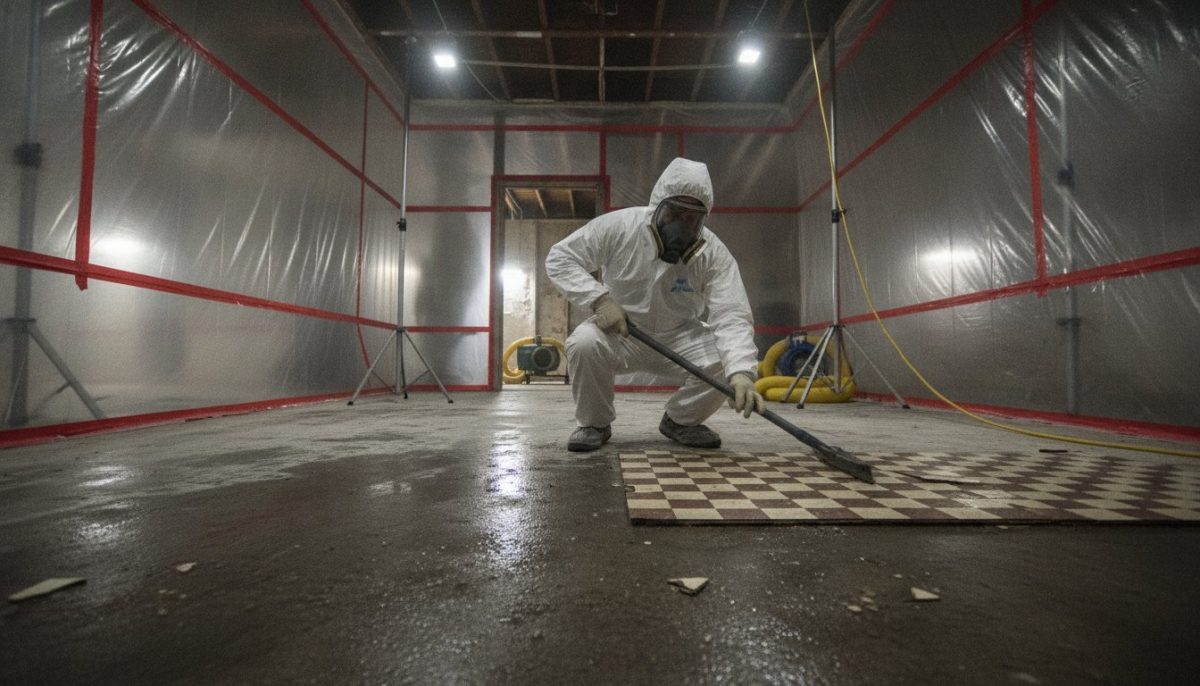
Assuming that your 9×9 vinyl flooring is merely a dated design choice is a gamble that could lead to significant regulatory penalties and health liabilities. In South Carolina, the transition from DHEC to the South Carolina Department of Environmental Services (SCDES) in 2026 has introduced more rigorous oversight for hazardous material handling. Managing asbestos floor tile removal south carolina requires more than just physical labor; it demands a disciplined engineering approach to contain microscopic fibers that become friable during the demolition process.
It’s understandable to feel overwhelmed by the technical distinction between 9×9 and 12×12 tiles or the complexities of NESHAP-sized project notifications. You want a clear path to a fiber-free environment without the fear of OSHA or SCDES intervention. This guide delivers expert guidance on navigating the latest safety protocols and professional abatement standards. We’ll walk through the mandatory 10-day notification windows, the specific licensing requirements for supervisors, and the rigorous documentation required for Class 3 landfill disposal to ensure your property records remain unblemished and your environment stays secure.
Key Takeaways
- Learn to identify high-risk flooring materials like 9-inch by 9-inch vinyl tiles and black mastic adhesive common in pre-1980 structures.
- Understand the 2026 SCDES regulatory thresholds and mandatory 10-day notification requirements that govern professional asbestos floor tile removal south carolina.
- Discover the specialized engineering controls and “wet methods” used by experts to prevent hazardous fiber release during selective demolition.
- Identify the essential credentials for abatement contractors, including verified state-issued licenses and comprehensive pollution liability insurance.
- Ensure full legal compliance and property record accuracy through documented waste disposal at SCDES-permitted Class 3 landfills.
Identifying Asbestos-Containing Floor Tiles (ACFT)
The history of asbestos in flooring is rooted in the mid-20th century, where mineral fibers were integrated into building materials for unmatched durability and thermal resistance. Structures built or renovated before 1980 are statistically high-risk environments for Asbestos-Containing Floor Tiles (ACFT). During this era, asbestos was the preferred additive for vinyl and asphalt-based products because it was inexpensive and virtually indestructible. Today, these legacy materials represent a significant hurdle for property owners during renovation or demolition.
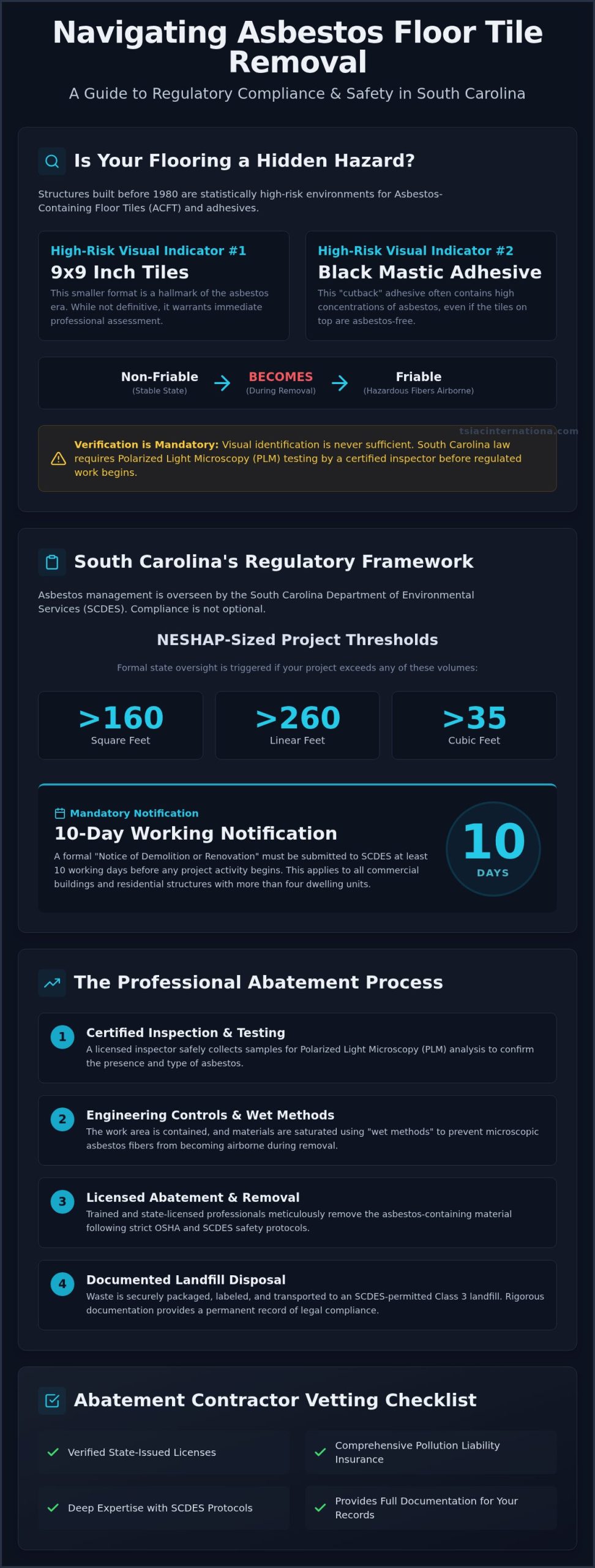
Visual indicators often serve as the first warning sign for property managers and homeowners. The 9-inch by 9-inch tile format is a hallmark of the asbestos era; while 12-inch tiles can also contain the mineral, the smaller size is almost synonymous with its presence. Equally critical is the adhesive beneath the flooring. Black mastic, or cutback adhesive, frequently contains chrysotile asbestos. This substance remains hazardous even if the tiles themselves appear intact. Discovery frequently occurs during the early stages of commercial interior gutting or residential remodels. When contractors begin selective demolition, they often find these layers hidden beneath modern laminate or carpeting. It’s at this stage that the asbestos abatement process becomes a legal and safety necessity.
In their resting state, floor tiles are typically classified as non-friable, meaning they cannot be crumbled by hand pressure. However, the mechanical force required for asbestos floor tile removal south carolina often renders them friable. Once the material is shattered or the adhesive is ground, microscopic fibers become airborne, creating a significant inhalation risk. South Carolina regulators view any material that could become friable during removal as a potential threat to public health.
Common Materials Containing Asbestos
Vinyl asbestos tiles (VAT) and asphalt-based flooring were industry standards for decades. The hidden danger isn’t always the tile itself but the mastic used to secure it. A floor might look fine and structurally sound, but disturbing it without a professional assessment is a liability. Even if the tiles are non-asbestos, the black glue underneath often contains high concentrations of fibers that require specialized handling to mitigate environmental contamination.
Testing and Verification Protocols
Visual identification is never sufficient for regulatory compliance. South Carolina law requires polarized light microscopy (PLM) testing to confirm asbestos content before any regulated demolition begins. For commercial structures and large-scale residential projects, SCDES requires certified inspectors to conduct the survey. Safe sampling involves wetting the material and using localized containment to prevent fiber release. It’s a task that should never be attempted by unlicensed personnel, as improper sampling can contaminate an entire room in seconds.
South Carolina Asbestos Regulations and Compliance
In South Carolina, the legal framework for asbestos management is overseen by the South Carolina Department of Environmental Services (SCDES). This agency, which assumed these responsibilities from DHEC in 2026, enforces strict protocols to prevent environmental contamination. If you’re planning asbestos floor tile removal south carolina, you must understand that the state doesn’t view this as a standard construction task. It’s a regulated environmental remediation project that requires technical precision and administrative accuracy.
Compliance triggers at specific volume thresholds. For any project involving more than 160 square feet, 260 linear feet, or 35 cubic feet of regulated asbestos-containing material, the state requires formal oversight. These numbers are the baseline for what the agency considers a NESHAP-sized project. Even if your project falls below these specific measurements, following EPA asbestos safety guidelines remains essential to protect occupants and workers from latent health risks associated with fiber release.
SCDES Permitting and Notification
Notification is a non-negotiable step in the abatement process. Property owners or licensed contractors must submit a formal “Notice of Demolition or Renovation” to SCDES at least 10 working days before any physical activity begins. This rule applies to all commercial buildings and residential structures with more than four dwelling units. For commercial property owners, the consequences of skipping this step are severe. Fines can reach thousands of dollars per day, and the state has the authority to issue immediate project shutdowns, which can derail construction timelines for weeks.
Regulated vs. Non-Regulated Waste
South Carolina classifies asbestos-containing waste as “special waste,” which dictates exactly where and how it can be discarded. You cannot simply toss old tiles into a standard construction dumpster. While some non-friable flooring might be accepted at specific facilities, the “grinding and cutting” rule changes the waste classification instantly. If the removal process involves mechanical force that makes the material friable, the debris must be wetted, double-bagged in 6-mil polyethylene, and transported to a Class 3 landfill permitted by SCDES. A documented “chain of custody” or waste shipment record is required for your property records to prove the material reached its destination safely. Partnering with SCDES regulatory compliance experts ensures every permit and disposal record meets these rigorous 2026 standards, protecting you from future liability.
Beyond state-specific rules, OSHA standards dictate worker protection on every abatement site. This includes mandatory respiratory protection, specialized PPE, and air monitoring to ensure exposure limits aren’t exceeded. These layers of regulation exist to transform a high-risk activity into a controlled, safe engineering process.
The Professional Abatement and Removal Process
Professional asbestos abatement is a controlled engineering process designed to isolate hazardous materials from the surrounding environment. When executing asbestos floor tile removal south carolina, the primary objective is to prevent the release of microscopic fibers into the air. This starts with pre-removal containment. Technicians seal all HVAC vents, windows, and doorways using 6-mil polyethylene sheeting, creating what we call critical barriers. These seals ensure that any disturbed fibers remain trapped within the designated work zone.
Once the area is sealed, we deploy negative air machines equipped with HEPA filtration. These units extract air from the work zone and pass it through medical-grade filters before exhausting it outside. This creates a pressure differential that ensures no air escapes the containment area through small gaps or during entry and exit. Aligning these technical steps with South Carolina Asbestos Regulations is mandatory for maintaining site safety and legal standing.
Establishing a Safe Work Zone
A disciplined workspace requires more than just plastic sheeting. We establish three-stage decontamination units where personnel can safely transition from the work zone to clean areas. This prevents cross-contamination of clothing and equipment. Clear warning signage and physical barriers restrict access to only licensed abatement professionals. Every entrance is monitored to ensure the integrity of the containment remains intact throughout the shift.
Surgical Removal of Tiles and Mastic
Removing the tiles requires a surgical mindset. We use wet methods, keeping the flooring saturated with amended water to trap fibers in a liquid state. This prevents them from becoming airborne. Technicians carefully pry tiles up to minimize breakage, as shattered tiles are far more likely to release friable fibers. For the underlying adhesive, we often choose between chemical solvents and mechanical scraping. While mechanical methods are faster, they require enhanced containment; chemical methods liquefy the mastic, making it easier to manage without dust. Mastic removal is the critical final step in flooring abatement that ensures the concrete substrate is entirely free of hazardous residue.
The process concludes with a thorough HEPA-vacuuming and wet-wiping of all surfaces. Before we strike the containment, final clearance testing is conducted. An independent lab analyzes air samples to verify that fiber counts are below the permissible limit. This documented proof confirms the space is safe for re-occupancy by other trades or residents. When managing asbestos floor tile removal south carolina, these final tests are the only way to guarantee a clean environment.
Selecting an Abatement Contractor in South Carolina
Choosing a partner for asbestos floor tile removal south carolina is a decision that impacts your project’s legal standing and environmental safety. A qualified contractor must hold a current South Carolina asbestos abatement contractor license issued by SCDES. This certification isn’t a mere formality; it’s proof that the firm understands the rigid engineering controls required by state law. Beyond licensing, verify that the firm carries comprehensive liability insurance that specifically includes pollution coverage. Standard commercial general liability policies often contain “asbestos exclusions,” leaving property owners vulnerable if a fiber release occurs during the removal process.
Evaluating past performance on structural and selective demolition projects provides insight into a contractor’s technical discipline. You need a team that views abatement as a surgical procedure rather than a blunt force demolition task. Transparency in debris management is equally vital. A reputable firm will be open about their recycling practices for non-hazardous materials and their strict adherence to Class 3 landfill protocols for toxic waste.
Key Questions for Your Contractor
- Do you provide a comprehensive post-project compliance package that includes waste shipment records and air clearance reports?
- What is your specific protocol for site safety and worker protection if unexpected asbestos is discovered during interior gutting?
- Can you provide documentation of your SCDES-approved training records for all supervisors and workers on site?
A disciplined contractor won’t hesitate to provide these records. They understand that documented disposal is the only way to protect your property records from future liability claims. If a contractor suggests “saving money” by bypassing these protocols, they’re exposing you to significant legal risk.
The Advantage of Single-Source Demolition and Abatement
Managing a project with separate demolition and abatement teams often leads to scheduling friction and increased mobilization costs. Using a single-source provider who handles both selective demolition and hazardous material removal streamlines the entire project timeline. This approach eliminates the communication gaps that occur when one trade discovers a hazard that another trade wasn’t prepared to handle. You’ll see significant efficiencies in debris hauling and site management when one team is responsible for the entire waste stream.
With over 15 years of industry experience, TSIAC International provides the technical precision required for high-stakes remediation. Contact our SCDES regulatory compliance experts to discuss a fixed-price contract for your selective demolition and abatement needs. Our methodical approach ensures that your project stays on track, within budget, and in full compliance with the latest 2026 safety standards.
TSIAC International: Disciplined Abatement and Removal
TSIAC International brings over 15 years of technical industry experience to every project site. We don’t just perform labor; we execute a methodical engineering plan for asbestos floor tile removal south carolina. Our team treats hazardous material remediation as a technical challenge that requires absolute control and methodological precision. Whether we’re handling a large-scale commercial gut-out or a targeted residential floor removal, our focus remains on maintaining a secure, fiber-free environment through every phase of the project.
Our reputation is built on unwavering reliability and a commitment to safety. We operate as a responsible partner for property owners, ensuring that the most difficult technical challenges are kept under control. By integrating our deep professionalism with the latest 2026 regulatory standards, we provide a service that guarantees both physical safety and legal peace of mind.
Expertise in Structural and Selective Removal
Managing complex interior gut-outs requires a deep understanding of load-bearing structures and material science. We specialize in selective demolition, where we remove hazardous flooring and adhesives without compromising the building’s structural integrity. Our portfolio includes diverse contracts for government agencies, commercial developers, and private homeowners. We use advanced machinery and specialized tools designed for safe tile removal, ensuring the substrate is prepared for its next phase. This surgical approach minimizes the risk of accidental fiber release and keeps projects on their designated timelines without unnecessary delays.
Sustainability in Hazardous Remediation
Environmental responsibility is a core pillar of our operational philosophy, addressing a critical gap in the standard abatement industry. While asbestos itself must be sequestered in Class 3 landfills, the rest of the debris from a gut-out doesn’t have to be wasted. We take the time to sort and recycle wood, metal, and plastic from every site. This practice reduces the overall landfill impact and supports the sustainability goals of our clients. For more detailed insights into our methodology, read our Hazardous Material Abatement in South Carolina guide.
Responsible management of toxic waste is a mandatory requirement under SCDES rules, and we provide the documented proof to back it up. Every project concludes with a comprehensive documentation package. This includes waste shipment records, disposal receipts, and final air clearance reports. These documents provide a permanent record for your property files, confirming that the asbestos floor tile removal south carolina was handled with the highest professional standards. We don’t just promise compliance; we deliver it through a disciplined, transparent process that protects your assets and your health.
Securing Your Property’s Future with Professional Abatement
Managing a renovation in pre-1980 structures requires more than just a standard demolition crew. It demands a disciplined engineering approach to isolate hazardous fibers and maintain full regulatory compliance. We’ve outlined the critical nature of SCDES oversight, the technical precision of wet removal methods, and the necessity of documented disposal at Class 3 landfills. These steps aren’t optional; they’re the foundation of a safe, legal, and environmentally responsible project. By prioritizing these standards, you protect both the occupants of your building and your long-term property value.
When you’re ready to proceed with asbestos floor tile removal south carolina, partnering with a team that understands the intersection of selective demolition and hazardous remediation is vital. With 15+ years of industry experience, TSIAC International operates as your SCDES compliance expert, providing comprehensive environmental recycling and surgical precision on every site. You don’t have to navigate these complexities alone. Secure a professional quote for your abatement project today to ensure your property remains a safe and valuable asset. Your path to a clean, compliant environment starts with a single, expert decision.
Frequently Asked Questions
Can I remove asbestos floor tiles myself in South Carolina?
Homeowners in South Carolina are generally exempt from notification rules for private residences with four or fewer units. However, professional handling is strongly advised due to the high risk of fiber release during the removal process. If you choose a DIY approach, you still must follow strict disposal protocols at a Class 3 landfill. Improper handling can contaminate your living space, making professional asbestos floor tile removal south carolina the safer choice for long-term health and property value.
How much does professional asbestos floor tile removal cost?
The total cost for abatement is determined by several factors, including the condition of the material, total square footage, and accessibility. Licensed contractors provide detailed estimates only after a site inspection to evaluate the specific needs of the property. Variables such as whether the mastic adhesive is also asbestos-containing and the complexity of the containment setup will influence the final project fee. It’s essential to obtain a fixed-price contract that includes all regulatory documentation and disposal fees.
Is it safe to floor over existing asbestos tiles?
Encapsulation is often a viable alternative to removal if the tiles are in good, non-friable condition. You can install new flooring over existing asbestos tiles provided the surface is properly sealed and the legacy tiles remain undisturbed. However, this only delays the inevitable need for abatement during future structural demolition or deep renovations. If the tiles are cracking or peeling, covering them is no longer a safe option, as they may release fibers into the subfloor environment.
What happens if I accidentally break an asbestos floor tile?
If a tile breaks, immediately stop all work and mist the area with water to prevent microscopic fibers from becoming airborne. You should avoid vacuuming or sweeping the debris, as this spreads particles throughout the room. Cover the area with heavy plastic sheeting and tape the edges to isolate the site from the rest of the building. At this point, contact a licensed abatement professional to perform a proper cleanup and air clearance test to ensure the environment is secure.
How do I know if my floor tiles contain asbestos without testing?
While you cannot confirm asbestos content without laboratory testing, certain visual indicators are strong red flags. Flooring installed before 1980, particularly 9-inch by 9-inch vinyl tiles, has a high probability of containing asbestos. Additionally, the presence of black mastic adhesive underneath the flooring is a common characteristic of asbestos-era installations. Because “looking fine” isn’t a guarantee of safety, professional polarized light microscopy (PLM) testing is the only way to verify the material’s composition before starting a renovation.
What is the difference between friable and non-friable asbestos flooring?
Non-friable asbestos is bound in a solid matrix, such as vinyl, and cannot be easily crumbled by hand pressure. Most floor tiles start as non-friable. However, they become friable when subjected to mechanical forces like grinding, sanding, or heavy breakage during demolition. Once friable, the material poses a much higher inhalation risk because the fibers are easily released into the air. This transition is why professional asbestos floor tile removal south carolina requires specialized “wet methods” to keep materials saturated.
Does SCDES require a permit for residential floor tile removal?
SCDES typically exempts private residential properties with four or fewer dwelling units from formal notification and licensing requirements. However, this exemption does not apply if the residential structure is being demolished for commercial development. For all other structures, a “Notice of Demolition or Renovation” must be filed with the state at least 10 working days before work begins. Regardless of the permit requirement, all asbestos waste must be disposed of at a permitted Class 3 landfill according to state protocols.
How long does the asbestos abatement process typically take?
The timeline for a project includes a mandatory 10-day state notification period for regulated structures. Once on-site, the physical removal of floor tiles typically takes between two and five days, depending on the square footage and the difficulty of mastic removal. This timeframe includes the setup of critical barriers, the actual abatement process, and the final air clearance testing. Large-scale commercial projects or complex selective demolition jobs may require additional time for specialized equipment mobilization and waste hauling.
