
A single overlooked SCDES filing or a miscalculated utility disconnect can halt a multimillion-dollar project before the first excavator even touches the ground. You likely understand that the transition from a standing structure to a clear lot is fraught with hidden liabilities, from shifting 2026 environmental standards to the complex logistics of hazardous material containment. Proper demolition site preparation south carolina requires more than just heavy machinery; it demands a rigorous, engineering-first approach to ensure every permit and safety protocol is documented and executed with precision. Relying on 15 years of field experience, we recognize that compliance isn’t just a paperwork hurdle but the foundation of a zero-incident project site.
This guide provides the technical roadmap you need to master the regulatory, engineering, and environmental steps required to prepare a South Carolina site for safe and compliant structural removal. You’ll learn how to navigate the critical intersection of asbestos abatement, utility management, and material recovery strategies. We’ll break down the methodology for transforming a high-risk liability into a shovel-ready asset while maximizing the recovery of wood, metal, and concrete to offset your total disposal costs.
Key Takeaways
- Master the 2026 transition from DHEC to SCDES to ensure your project remains compliant with updated South Carolina environmental standards.
- Implement rigorous hazardous material surveys for asbestos and lead to prevent costly regulatory delays and health risks.
- Execute a precise engineering strategy for demolition site preparation south carolina, including structural shoring and selective bracing for complex sites.
- Utilize a systematic 5-step checklist to coordinate utility disconnects and municipal permitting for a truly shovel-ready site.
- Optimize project economics through advanced on-site material recovery, turning debris into recyclable assets like metal, wood, and concrete.
Navigating South Carolina Demolition Regulations in 2026
The regulatory landscape in South Carolina has undergone a significant transformation with the dissolution of DHEC and the emergence of the South Carolina Department of Environmental Services (SCDES). For property owners and developers, this transition in 2026 demands a recalibrated approach to compliance. You can’t rely on legacy processes; you must align your project with the specific ePermitting workflows and oversight protocols of the new agency. This shift ensures that environmental protection and public safety remain at the forefront of every structural removal.
A critical component of demolition site preparation south carolina involves identifying whether your structure qualifies as a “Regulated Facility.” Under state law, this classification encompasses nearly all commercial, industrial, and public buildings. It also includes residential structures containing more than four dwelling units. Even if you believe your site is free of hazardous materials, the state requires formal notification for any structural removal involving a regulated facility. Failing to distinguish these categories accurately is a common cause of project delays.
Ignoring these mandates carries heavy financial weight. OSHA and state-level penalties for improper abatement or failure to notify can scale into tens of thousands of dollars per violation. A single oversight regarding an asbestos survey can trigger a stop-work order, bleeding your budget through equipment standby costs and legal fees. Starting your site preparation with a comprehensive regulatory audit isn’t just a suggestion. It’s a defensive necessity that protects your investment from administrative friction.
The SCDES Notification Window
The SCDES requires a mandatory 10-working-day notification period before any demolition activity begins. This window allows state inspectors to review your hazardous material survey and site plan. For large-scale structural removals or projects involving complex abatement, we recommend initiating contact 30 days in advance to prevent bottlenecking. Utilizing the SCDES ePermitting system is the most efficient way to track your status and secure digital approval stamps, which are essential for your on-site compliance binder.
State vs. Federal Oversight
While SCDES manages day-to-day enforcement, the federal EPA NESHAP standards provide the overarching framework for hazardous air pollutants. Your site preparation must satisfy both layers of government. Local building departments in cities like Charleston, Columbia, or Greenville often have additional zoning or debris management requirements that run parallel to state rules. Maintaining a meticulous project log that documents every inspection, permit, and utility sign-off is your primary defense during unannounced state inspections. This disciplined approach ensures that your site remains in good standing with all governing bodies throughout the project lifecycle.
Hazardous Material Surveys: The Foundation of Site Prep
A successful structural removal begins long before a single wall is breached. In the context of demolition site preparation south carolina, the hazardous material survey serves as the primary risk-mitigation tool. Central to this process is identifying Regulated Asbestos-Containing Material (RACM). RACM includes any material containing more than 1% asbestos that is friable or has a high probability of becoming friable under the mechanical forces of demolition. Relying on visual inspections is a critical error in 2026; SCDES standards require bulk sampling and laboratory analysis because microscopic fibers aren’t visible to the naked eye. If you overlook these materials during the planning phase, you risk airborne contamination that can shut down your site indefinitely.
Abatement timelines are the silent dictators of your project schedule. You can’t safely proceed with structural removal until all hazardous materials are extracted and the site is cleared by a certified professional. For historic buildings or structures built before 1978, lead-based paint testing is equally mandatory. Disturbing lead-laden dust with heavy machinery creates a massive liability for both workers and the surrounding community. By identifying these hazards early, you can integrate the necessary lead abatement protocols into your pre-demolition sequence without derailing the final completion date.
Comprehensive Asbestos Abatement Protocols
Effective site preparation involves more than just pulling out old insulation. It requires high-integrity containment strategies tailored to the material type. Friable materials demand full negative-pressure enclosures with HEPA filtration, while non-friable materials may only require specialized wet-method techniques. For a deeper dive into these technical requirements, consult our detailed guide on asbestos removal in South Carolina. To ensure complete transparency and safety, we utilize third-party air monitoring during the entire process. This provides an unbiased record that the air quality remains within safe limits, protecting your firm from future litigation.
Lead and Mold Remediation
Lead hazards must be identified and stabilized before any mechanical disturbance occurs. Similarly, mold remediation is often a prerequisite for safe interior gutting. If mold spores are present, the vibration from demolition can disperse them throughout the structure, complicating the recycling of salvageable materials. All toxic waste must be transported to South Carolina-approved facilities that are specifically permitted to handle hazardous debris. Managing these variables with a single, experienced partner ensures that your abatement and demolition phases are perfectly synchronized. If you’re currently planning a project, reviewing our asbestos and lead abatement services can help you integrate these essential safety steps into your timeline early.
Engineering the Site: Structural vs. Selective Preparation
Precision engineering is the divider between a controlled teardown and a chaotic collapse. In the discipline of demolition site preparation south carolina, the first technical step is a rigorous assessment of structural integrity. Our engineers evaluate load-bearing elements to determine where shoring and bracing are required to prevent premature failure. This is especially vital in aging industrial facilities or structures with compromised foundations. Whether the goal is total structural removal or a surgical extraction, the stability of the remaining skeleton must be managed with mathematical certainty.
Total structural removal requires a systematic plan, typically following a top-down or high-reach methodology. A top-down approach involves placing smaller equipment on the upper floors to dismantle the building level by level, whereas high-reach shears allow for ground-based operations on taller structures. Throughout this process, vibration monitoring is essential. We deploy seismic sensors at the site perimeter to protect adjacent structures and sensitive underground utilities. This data-driven oversight ensures that the energy released during demolition doesn’t cause settlement or damage to neighboring properties, which is a common risk in densely populated South Carolina corridors.
Selective Demolition Site Prep
Selective projects require a different level of logistical detail, as they often occur while portions of the building remain occupied. Preparation begins with capping utilities for partial occupancy, ensuring that water, gas, and electricity remain active in the “keep” sections while being safely isolated in the work zone. We implement strict dust and noise mitigation strategies, such as temporary partitions and specialized exhaust systems, to maintain air quality. For a comprehensive look at these internal processes, review our commercial interior gutting services framework. This methodical separation is what allows a business to function even as its footprint is being reconfigured.
Heavy Machinery Logistics
The arrival of 50-ton excavators and high-reach shears demands a site capable of supporting extreme weight. We establish reinforced load-bearing paths to prevent equipment from sinking or damaging subsurface infrastructure. Site stabilization is achieved using thick gravel pads at all entry and exit points; these pads serve a dual purpose by preventing soil erosion and stopping mud from tracking onto public roads. Finally, we secure the entire perimeter with high-visibility fencing and standardized safety signage. This creates a hard barrier that protects the public while providing a clear staging area for our specialized fleet. Our 15 years of experience have taught us that a well-organized site is a safe site.
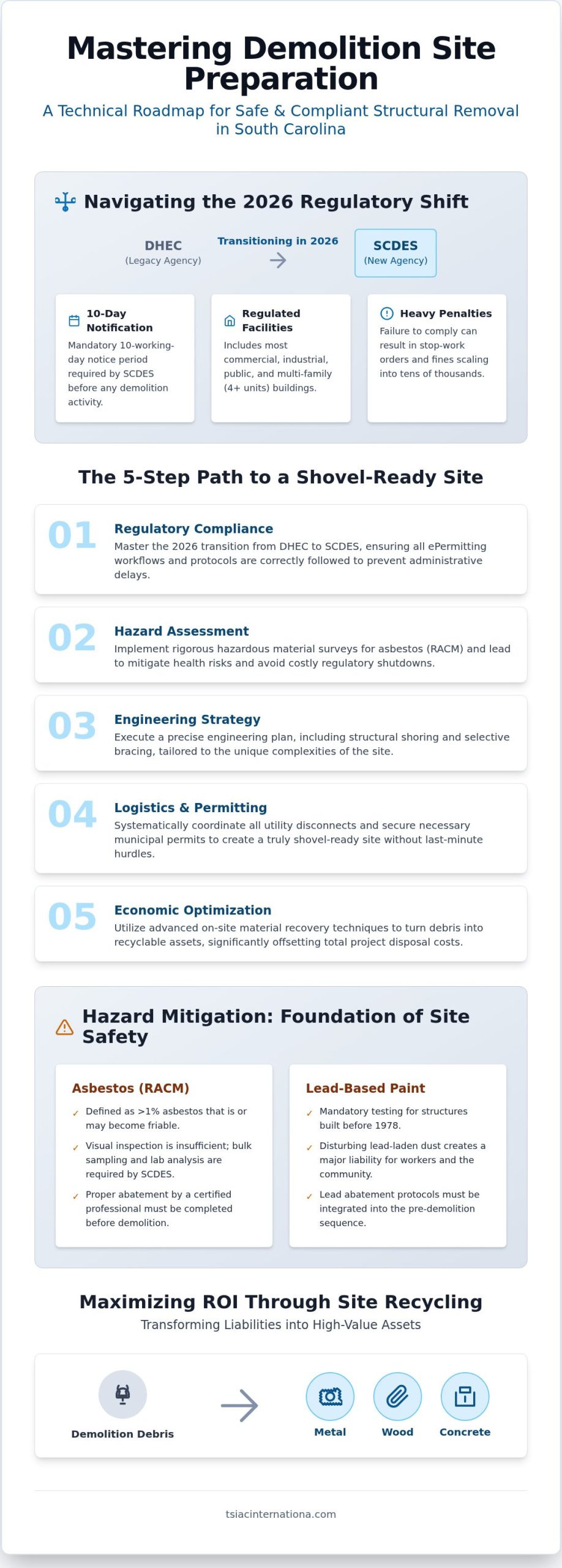
The Pre-Demolition Checklist: 5 Steps to a Shovel-Ready Site
Achieving a shovel-ready status requires a synchronized execution of administrative and physical tasks. For demolition site preparation south carolina, this checklist serves as the definitive protocol for property owners to avoid regulatory friction and onsite accidents. Skipping a single step in this sequence can lead to immediate work stoppages or environmental liabilities that jeopardize your project’s ROI.
- Step 1: Secure all SCDES and local municipal demolition permits. You must have approved permits from both state and local building departments before any mechanical disturbance occurs.
- Step 2: Execute a comprehensive hazardous material survey and abatement. As established in previous sections, this phase must be finalized and cleared by a third-party laboratory.
- Step 3: Coordinate utility disconnects. This includes water, gas, electric, and fiber optic lines, ensuring each service is terminated at the street or property line.
- Step 4: Establish a site safety plan and environmental controls. This involves setting up silt fences, storm drain protection, and designated PPE zones.
- Step 5: File the final 10-day notice with confirmed disposal routes. You must notify SCDES of the exact date work begins and where the debris will be hauled.
Utility Termination and Capping
Safe demolition site preparation south carolina depends on the absolute isolation of all energy sources. South Carolina law requires a ‘Call Before You Dig’ (811) request at least three full business days before any excavation or heavy equipment operation. We don’t just rely on utility company confirmations; our team verifies ‘air gaps’ in gas and electric lines to ensure no residual energy remains. Properly managing storm drainage is equally critical. We implement runoff controls to prevent sediment from entering the municipal system during the structural removal phase.
Site Security and Safety Controls
A secure perimeter is your first line of defense against unauthorized entry and liability. We establish OSHA-compliant PPE zones where hard hats, high-visibility vests, and respiratory protection are mandatory for all personnel. Fire prevention protocols are also strictly enforced, especially when using torches for metal cutting or during the removal of flammable building materials. We maintain clear, unobstructed access paths for emergency vehicles and state inspectors at all times. If you need a partner to manage this complex checklist, our team provides comprehensive structural demolition services that prioritize compliance and safety.
Material Recovery: Maximizing ROI Through Site Recycling
Recycling is often viewed as a secondary environmental goal, but in professional demolition site preparation south carolina, it’s a primary economic driver. By diverting materials from landfills, you significantly reduce tipping fees, which are among the largest variable costs in any structural removal project. We implement rigorous on-site sorting protocols to isolate high-value scrap metal, structural steel, and clean wood early in the process. Concrete removal provides another opportunity for cost recovery; we utilize on-site crushing to transform heavy debris into usable aggregate fill. This approach doesn’t just lower disposal expenses; it also satisfies the strict requirements for LEED certification and modern green building standards.
The logistics of material recovery require a disciplined staging area where debris is categorized as it’s removed. Metal components are processed for immediate transport to regional foundries, while masonry and concrete are stockpiled for mechanical crushing. This on-site processing eliminates the need for hundreds of heavy-truck trips, reducing both your carbon footprint and the wear on local infrastructure. When a project is managed with this level of technical oversight, the waste from the old building often becomes the foundation for the new one.
TSIAC’s Commitment to Environmental Stewardship
With over 15 years of industry experience, we’ve refined our recycling services to meet the specific needs of South Carolina’s commercial sector. We don’t just claim to recycle; we provide verified tracking and reporting of recycling percentages for every client. This transparency is essential for developers seeking tax credits or municipal incentives tied to sustainable construction practices. By partnering with local South Carolina recycling facilities for metal and plastic, we ensure that the maximum amount of material stays within the local circular economy, reinforcing our role as a responsible project partner.
Final Site Stabilization
The final phase of demolition site preparation south carolina is the transition from a debris-free zone to a buildable lot. Once the structural removal is complete, we focus on post-demolition grading and erosion control to stabilize the soil. This prevents runoff and ensures the site meets all local environmental codes before new construction begins. We handle the final closeout of all SCDES permits, providing you with a complete documentation package that includes disposal manifests and air clearance certificates. Our goal is to hand over a site that’s not just empty, but technically prepared for its next lifecycle phase.
Securing Your Project’s Future with Compliant Site Preparation
Transitioning a structure to a shovel-ready site is a technical evolution that requires precise coordination between regulatory bodies and physical execution. By prioritizing SCDES compliance and integrating hazardous material surveys into your engineering plan, you eliminate the liabilities that stall large-scale developments. Professional demolition site preparation south carolina isn’t just about clearing land; it’s about establishing a foundation of safety and fiscal responsibility through advanced material recovery and strategic utility management.
You shouldn’t navigate these 2026 regulatory shifts alone. With 15+ years of industry experience, TSIAC International acts as a specialized partner, managing the critical intersection of abatement and structural removal. We ensure your site meets every South Carolina standard while maximizing your ROI through comprehensive abatement and demolition integration. Get a Professional Site Preparation Quote from TSIAC International today to secure your project timeline with our SCDES regulatory compliance experts. Your next development deserves a clean start backed by methodical precision and a commitment to zero-incident performance.
Frequently Asked Questions
Do I need an asbestos survey if I am only doing a partial interior demolition?
Yes. Any renovation or demolition of a regulated facility in South Carolina requires a comprehensive asbestos survey regardless of the project’s physical scope. SCDES regulations mandate bulk sampling to identify any potential hazards before your team disturbs any surfaces. This technical requirement ensures that interior gutting doesn’t accidentally release microscopic fibers into occupied zones or the surrounding environment, protecting you from future litigation.
How much does demolition site preparation typically cost in South Carolina?
Costs vary significantly based on the structure’s square footage, the presence of hazardous materials, and the complexity of utility disconnects. Factors like SCDES permitting fees and the extent of required structural shoring also influence the total project investment. We don’t provide generic quotes; instead, we recommend a project-specific assessment to determine the precise engineering and environmental requirements for your site to ensure accurate budgeting.
What happens if I start demolition before the 10-day SCDES notice expires?
Starting work before the notification period ends isn’t just a risk; it’s a direct violation of state law that leads to immediate stop-work orders. SCDES inspectors use this 10-day window to review your hazardous material survey and may visit the site for a pre-demolition audit. Premature activity jeopardizes your permits and creates unnecessary legal liability for the property owner and the contractor involved.
Is a residential garage demolition subject to the same SCDES rules as a commercial building?
Typically, no. Single-family residential structures and their associated outbuildings, like detached garages, are often exempt from SCDES notification rules unless they’re part of a larger commercial development or public project. However, you must still follow local municipal building codes and safety standards for structural removal and debris disposal. We always suggest verifying the specific status of your structure with local building departments before beginning work.
Who is responsible for disconnecting the utilities before a demolition project begins?
The property owner is ultimately responsible for coordinating with utility providers to ensure water, gas, and electricity are terminated at the property line. During demolition site preparation south carolina, we don’t just take your word for it; our team verifies that these “air gaps” are physically established. This process prevents accidental strikes and ensures the safety of heavy machinery operators during the structural removal phase.
How does TSIAC handle hazardous material disposal for South Carolina projects?
We transport all hazardous waste to SCDES-approved disposal facilities using specialized containment and transportation protocols. Every load’s documented with a detailed waste shipment manifest, which provides a definitive legal paper trail for your compliance records. It’s this methodical approach to asbestos and lead abatement that ensures toxic materials are never mixed with standard construction debris or sent to unpermitted South Carolina landfills.
Can I recycle concrete from a demolition site to use as foundation for a new building?
Concrete can be crushed on-site and repurposed as high-quality aggregate fill for new foundations or road bases. This material recovery strategy is a core component of our demolition site preparation south carolina process. It doesn’t just reduce landfill tipping fees; it also supports LEED certification goals by keeping heavy masonry materials within the project’s circular economy, turning a waste product into a valuable asset.
What are the common signs that my site requires lead paint abatement?
Structures built before 1978 have a high probability of containing lead-based paint, which requires professional laboratory testing before any mechanical demolition. Peeling or “alligatoring” paint on older wood or metal surfaces are common signs, but visual checks aren’t enough. Since lead dust is a significant hazard during wrecking, we conduct XRF testing to identify these risks and implement containment protocols early in the phase.
