
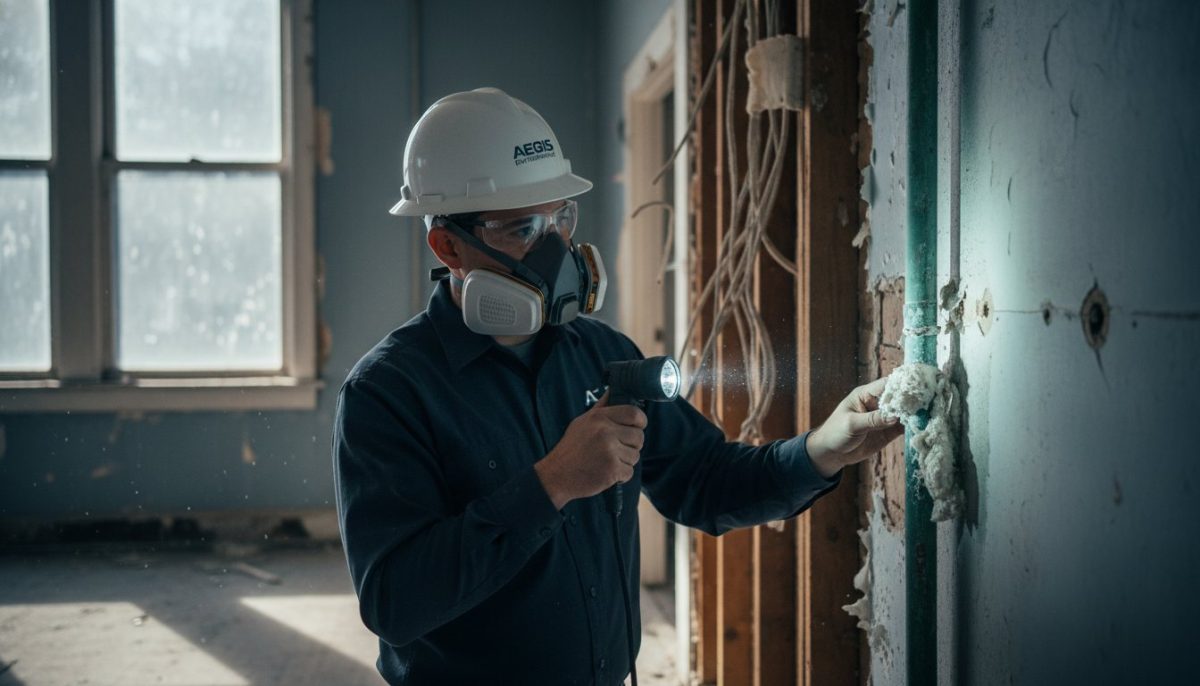
If you’re planning a renovation or structural update in 2026, could the very walls of your property be harboring a silent regulatory and health liability? Most property owners feel a justified sense of anxiety when facing potential hazardous materials, especially with the EPA’s 2024 ban on chrysotile asbestos and the high-stakes legal challenges currently moving through the courts. It’s difficult to keep track of shifting phase-out deadlines and even harder to know which legacy products actually pose a risk during an interior gutting or selective demolition project. You don’t have to guess when it comes to the safety of your occupants or the legal standing of your property.
We recognize that the fear of accidental exposure and the complexity of modern compliance can be a significant burden. This guide provides a definitive asbestos containing materials list to help you identify hazards with methodical precision. You’ll learn to distinguish between high-risk friable insulation and non-friable products while gaining a clear roadmap for professional management. By following these established technical protocols, you can transform uncertainty into a controlled, professional plan for safe material removal and site preparation.
Key Takeaways
- Understand the technical 1% threshold that defines Asbestos Containing Materials (ACM) and why historical building practices necessitate rigorous inspection.
- Utilize our comprehensive asbestos containing materials list to identify hidden hazards across residential and commercial structures before disturbing any surfaces.
- Learn to evaluate material risk by distinguishing between friable and non-friable states, which dictates the required containment and safety protocols.
- Establish clear “Stop Work” authority and discovery protocols to ensure immediate crew safety when suspicious materials are encountered during a project.
- See how professional abatement and selective demolition work together to maintain regulatory compliance while keeping your project timeline on track.
Defining Asbestos Containing Materials (ACM) in 2026
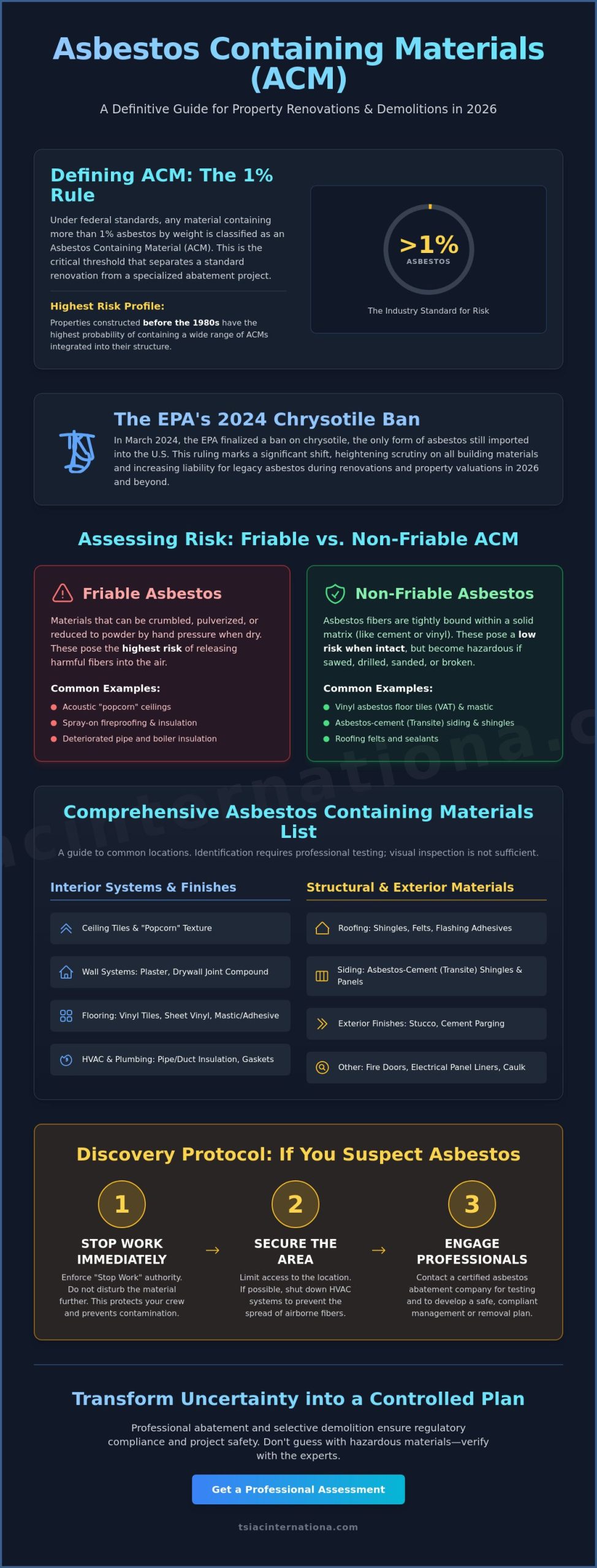
In the technical sector of hazardous material management, precision is the baseline for safety. Defining Asbestos Containing Materials (ACM) requires a strict adherence to regulatory thresholds. Under current federal standards, any material containing more than 1% asbestos by weight is classified as ACM. This mineral was once celebrated as a miracle component due to its exceptional tensile strength and resistance to heat and chemical erosion. It became a staple in fireproofing and thermal insulation until the health risks became undeniable. Even in 2026, property owners must contend with this legacy. Buildings constructed prior to the 1980s remain the highest priority for inspection because they often contain a complex asbestos containing materials list integrated into their structural fabric.
The 1% threshold is the industry standard for risk. It’s the line between a standard renovation and a specialized abatement project. Property owners in 2026 must understand that legacy asbestos is the primary driver of risk. The EPA’s recent actions have effectively closed the door on new chrysotile use, but the millions of tons already installed in our infrastructure don’t simply vanish. Every structural update requires a methodical assessment to ensure these fibers aren’t released into the environment.
The 2024 EPA Chrysotile Ban and Beyond
The EPA’s March 2024 ruling was a watershed moment for the industry. It finalized the ban on chrysotile asbestos, which was the only form still being imported into the United States. While this rule establishes phased deadlines, such as the five year phase out for asbestos diaphragms in the chlor-alkali industry, its effect on property management is immediate. In 2026, property valuations and renovation feasibility studies must account for these stricter standards. Modern imports are now under intense scrutiny to ensure they don’t contain even trace amounts that could trigger liability during future maintenance.
Why Identification is Mandatory for Demolition
Identification isn’t optional. It’s a legal prerequisite. Before any structural disturbance begins, OSHA and EPA regulations mandate a thorough asbestos survey. If you’re planning an interior gutting or selective demolition project, an unintentional disturbance of ACM can lead to catastrophic air quality issues and massive fines. Professional protocols require that we identify every item on the asbestos containing materials list before the first tool is used. This methodical approach protects both the site crew and the long term value of the asset. We don’t guess with hazardous materials; we verify through scientific testing and documented site history.
The Comprehensive Asbestos Containing Materials List
Identifying hazardous substances in a building is a technical exercise that goes far beyond visual observation. Many modern materials mimic the appearance of legacy products, making it impossible to declare a site “asbestos-free” without laboratory verification. To assist property owners in their risk assessment, we have organized The Comprehensive Asbestos Containing Materials List into functional categories based on their location within a structure. This systematic approach is essential during the pre-demolition phase to ensure no hidden fibers are disturbed. Relying on sight alone is a liability; many materials, such as certain types of plaster or insulation, look identical to safe alternatives but contain significant concentrations of chrysotile or amosite fibers.
Structural and Exterior Materials
Exterior surfaces often utilized asbestos for its weatherproofing capabilities and fire resistance. Asbestos-cement products, commonly known as Transite, were used for siding and roofing shingles because of their extreme durability. While these are non-friable when intact, they become dangerous if they’re broken, drilled, or weathered. Property owners should also inspect roofing felts, flashing adhesives, and older stucco applications. These materials often contain fibers to improve structural integrity against the elements, and their removal requires specific containment protocols to prevent environmental contamination.
Interior Finishes and Decorative Elements
The interior of a building holds the highest density of items on a typical asbestos containing materials list. Vinyl composition tile (VCT) is a frequent culprit, but the greater risk often lies in the “black mastic” adhesive used to secure it. Popcorn ceiling textures and acoustic tiles were industry standards for sound dampening and fireproofing through the late 20th century. Perhaps the most overlooked risk is drywall joint compound. In many older structures, the compound used to finish walls contains asbestos. This means a seemingly simple wall removal can lead to widespread fiber release if not handled by professionals.
Mechanical and Thermal Systems
Mechanical rooms are high-risk zones that require methodical inspection. Thermal system insulation (TSI) on boilers and pipe runs is often highly friable. HVAC systems may contain asbestos-lined duct wrap or furnace gaskets that can distribute fibers throughout the building if disturbed. Even electrical systems aren’t exempt. Panel partitions, cloth wire insulation, and arc chutes frequently appear on a professional asbestos containing materials list. Because these systems are often integrated into the building’s core, they require a strategic approach during selective demolition to maintain safety.
Misidentifying these materials can lead to project shutdowns and health liabilities. We recommend that property owners treat any suspicious material as hazardous until a certified lab confirms otherwise. Taking a disciplined approach to identification ensures that your project remains compliant with 2026 regulatory standards while protecting everyone on the job site.
Assessing Risk: Friable vs. Non-Friable Asbestos
Risk management in the hazardous materials sector begins with a technical assessment of friability. Friability serves as the primary metric for airborne fiber risk assessment because it quantifies the ease with which hazardous fibers can enter the breathing zone. By definition, a friable material is one that can be crumbled, pulverized, or reduced to powder by simple hand pressure when dry. This physical state dictates the “Hazard Class” of the material and determines the level of containment required by law. When reviewing an asbestos containing materials list, property owners must look beyond the presence of the mineral and evaluate the stability of the matrix holding the fibers.
Many owners fall into a “false sense of security” regarding non-friable materials like vinyl floor tiles or cement siding. While these products are relatively safe when left undisturbed, their physical state changes immediately upon mechanical impact. Grinding, sawing, or crushing during an interior gutting project can transform a stable Category I material into a friable hazard. This transition is why professional selective demolition protocols treat all suspect materials with extreme caution. Before proceeding with any work, establishing clear Discovery Protocols: What to Do is essential for protecting the health of the crew and future occupants.
Category I and II Non-Friable Materials
Regulatory bodies distinguish between two categories of non-friable ACM. Category I materials include packings, gaskets, resilient floor coverings, and asphalt roofing products. These are generally durable and don’t release fibers easily. Category II materials encompass everything else, such as asbestos-cement (Transite) products. While Category II materials are more rigid, they’re still susceptible to becoming airborne if they’re crushed or subjected to intense weathering. Deciding whether to leave these in place during maintenance depends on their condition; however, identifying items on the asbestos containing materials list as non-friable doesn’t exempt them from strict disposal regulations during a full structural demolition.
High-Risk Friable Materials
Friable materials represent the highest level of risk in commercial and industrial structures. Spray-applied fireproofing is perhaps the most dangerous form of ACM because it’s often loosely bonded and can be easily disturbed by air currents. Thermal system insulation (TSI) and pipe lagging are also high-priority hazards. These materials require Class I abatement protocols, which involve the use of negative air pressure, specialized HEPA filtration systems, and rigorous wet methods to ensure fibers don’t migrate. Because there’s no safe level of exposure, managing these materials requires a disciplined, technical approach that prioritizes total containment over convenience.
Discovery Protocols: What to Do When You Suspect Asbestos
If you uncover suspicious material during an interior gutting or concrete removal project, the first step is non-negotiable: stop all work immediately. This “Stop Work” authority is a critical safety protocol that prevents the further disturbance of fibers and protects both your crew and the building’s occupants. Suspicious materials should always be treated as hazardous until proven otherwise by a certified industrial hygienist (CIH) or a licensed asbestos inspector. We strongly discourage DIY sampling. Disturbing a material to take a sample without proper containment can release millions of microscopic fibers into the air. These fibers are often drawn into the HVAC system, causing cross-contamination throughout the entire facility and significantly increasing the scope of the eventual cleanup.
Professional discovery protocols ensure that the site remains stable while a technical assessment is performed. Once the area is secured, an inspector will conduct a thorough walkthrough to update your asbestos containing materials list. This process isn’t just about safety; it’s about maintaining the legal integrity of your project. In 2026, regulatory scrutiny is at an all-time high, and documented discovery protocols are your best defense against liability and project delays.
The Asbestos Survey and Testing Process
A professional survey involves methodical bulk sampling analyzed in a laboratory. Inspectors typically use Polarized Light Microscopy (PLM) for standard building materials. However, Transmission Electron Microscopy (TEM) is often required for more complex matrices, such as floor tiles or thin-film coatings, where fibers are too small for PLM to detect. The resulting survey report provides a quantified asbestos containing materials list that acts as the foundation for your project’s safety plan. This report is essential for building a compliant asbestos removal south carolina strategy that meets all current DHEC and EPA standards.
Developing an Abatement Strategy
Once the survey is complete, you must choose between abatement and encapsulation. While encapsulation may be a viable short-term fix for materials in good condition, full abatement is the only permanent solution for a total structural demolition. Budgeting for this phase must be integrated into the early planning stages of your project to avoid surprise costs. If your property was constructed before 1978, we also recommend integrating lead abatement into the workflow. Combining these services reduces mobilization costs and ensures a cleaner transition to the recycling and demolition phases.
If you’ve encountered suspicious materials on your job site, contact our expert team for a professional assessment and asbestos abatement services to keep your project moving forward safely.
Professional Abatement: Safely Managing Asbestos with TSIAC
Professional management of hazardous materials requires more than just equipment. It demands a deep, technical understanding of material science and regulatory shifts. With 15 years of experience in the field, we’ve developed a methodology that prioritizes site stability and environmental safety. When we approach a project, we don’t view abatement as an isolated task. Instead, we integrate it directly with our structural and selective demolition workflows. This unified approach ensures that every item on the asbestos containing materials list is neutralized before structural disturbances begin, reducing the risk of project delays and health liabilities.
Our commitment extends to environmental stewardship. Once the abatement phase is complete and the site is cleared, we prioritize recycling wood, metal, and plastic components. This reduces the burden on landfills and aligns with modern sustainability goals. We handle the entire compliance chain with methodical precision:
- Establishing airtight containment and negative pressure zones.
- Utilizing HEPA-filtered air scrubbing systems to capture microscopic fibers.
- Securing independent air clearance testing to verify site safety.
- Providing documented disposal manifests for all hazardous waste.
Neutralizing the asbestos containing materials list is the critical first step in a successful redevelopment project. You’ll receive a transparent record of every action taken on your property, ensuring that the legacy of hazardous materials doesn’t hinder your future plans.
Comprehensive Remediation Solutions
We specialize in commercial interior gutting where hazardous ACM must be removed before any architectural elements are stripped. In selective demolition projects, our teams employ specialized containment to isolate work zones, allowing other areas of the building to remain unaffected. We provide a single-source solution for hazardous material abatement, including lead and mold remediation. This eliminates the need for multiple contractors and streamlines the communication process for property owners.
Next Steps for Your Project
Moving from identification to action requires a clear, fixed-price contract. We provide detailed estimates for structural demolition and abatement so you can budget with confidence. To prepare for our site arrival, property owners should ensure all utilities are properly disconnected and site access is secured. Once the project concludes, we provide a final clean certificate and all necessary documentation for future development or occupancy. This paperwork serves as your guarantee that the property meets all safety standards.
Securing Your Property’s Future Through Methodical Abatement
Managing a 2026 construction project requires more than a simple walkthrough. You’ve seen that a definitive asbestos containing materials list is the foundation of a safe site, allowing you to distinguish between stable non-friable products and high-risk friable hazards. By following established discovery protocols and prioritizing laboratory verification over visual guesswork, you protect your investment and your people from regulatory and health liabilities.
TSIAC International brings over 15 years of industry experience to every project, integrating specialized abatement with comprehensive structural and selective demolition expertise. Our commitment to environmental responsibility means we don’t just remove hazards; we actively recycle wood, metal, and plastic on every site to minimize the impact on our landfills. Secure Your Site with TSIAC International’s Professional Abatement Services and move forward with the confidence that your project is built on a clean, compliant foundation.
Frequently Asked Questions
Is there a safe level of asbestos exposure for building occupants?
No safe level of asbestos exposure has been established by the scientific community. Even minimal inhalation of microscopic fibers can lead to severe respiratory diseases decades after the initial contact. This reality makes the systematic identification of every item on an asbestos containing materials list a critical safety requirement. Property owners must prioritize total containment and professional removal over attempting to manage exposure levels.
Can I identify asbestos just by looking at a material?
Visual identification is technically impossible for the vast majority of building products. While some specific materials like Transite piping are recognizable to experienced professionals, most hazardous fibers are microscopic and embedded within a stable matrix. You must rely on laboratory analysis, such as Polarized Light Microscopy, to confirm the mineral’s presence. It’s a dangerous liability to assume a material is safe simply because it looks like modern drywall or flooring.
What should I do if I accidentally disturbed asbestos-containing materials?
Stop all work immediately and evacuate the area to prevent further fiber release. You should shut down the HVAC system to ensure that airborne particles don’t migrate to other parts of the building. Seal the entry points to the affected room with plastic sheeting and contact a certified professional for air quality testing. Don’t attempt to clean the debris with a standard vacuum, as this will only distribute the fibers more widely.
Does the 2024 EPA ban mean all asbestos is now illegal to have in a building?
The 2024 EPA ban specifically targets the ongoing use and import of chrysotile asbestos; it doesn’t mandate the immediate removal of all legacy materials. Existing asbestos can legally remain in a structure as long as it’s in good condition and remains undisturbed. However, this ruling increases the regulatory pressure to identify and remove these materials during any planned structural updates or selective demolition projects to ensure long-term compliance.
How much does professional asbestos abatement typically cost?
Abatement costs are determined by technical factors such as the material’s friability, its location, and the total square footage requiring containment. Removing friable pipe insulation in a confined basement involves different specialized equipment than removing non-friable floor tiles in an open warehouse. Property owners should request a comprehensive site assessment to understand their specific budgetary requirements. Investing in professional abatement prevents the far greater costs associated with environmental fines and project shutdowns.
Is asbestos only found in old insulation and floor tiles?
Asbestos is present in thousands of products beyond the most commonly known insulation and tiles. It’s frequently found in drywall joint compounds, roofing adhesives, electrical panel partitions, and even window glazing. Our asbestos containing materials list highlights that these fibers were used in mechanical, structural, and decorative elements throughout the 20th century. Any property built before the late 1980s likely contains asbestos in multiple, often overlooked, applications.
Can I sell a property that contains asbestos-containing materials?
You can sell a property containing asbestos, but you’re generally required by law to disclose its presence to potential buyers. Failure to disclose known hazardous materials can lead to significant legal liabilities and post-sale litigation. Providing a professional asbestos survey report can build trust with buyers by demonstrating that the risks are fully identified and manageable. Many commercial buyers expect to find these materials and will factor the abatement into their renovation budgets.
What is the difference between an asbestos survey and an asbestos abatement plan?
An asbestos survey is a diagnostic document used to identify the location, type, and quantity of hazardous materials within a building. An abatement plan is a tactical roadmap that outlines the specific engineering controls, safety measures, and disposal protocols required for safe removal. The survey identifies the hazards, while the abatement plan explains how a professional crew will neutralize them. Both documents are essential for maintaining a compliant and safe job site.
