
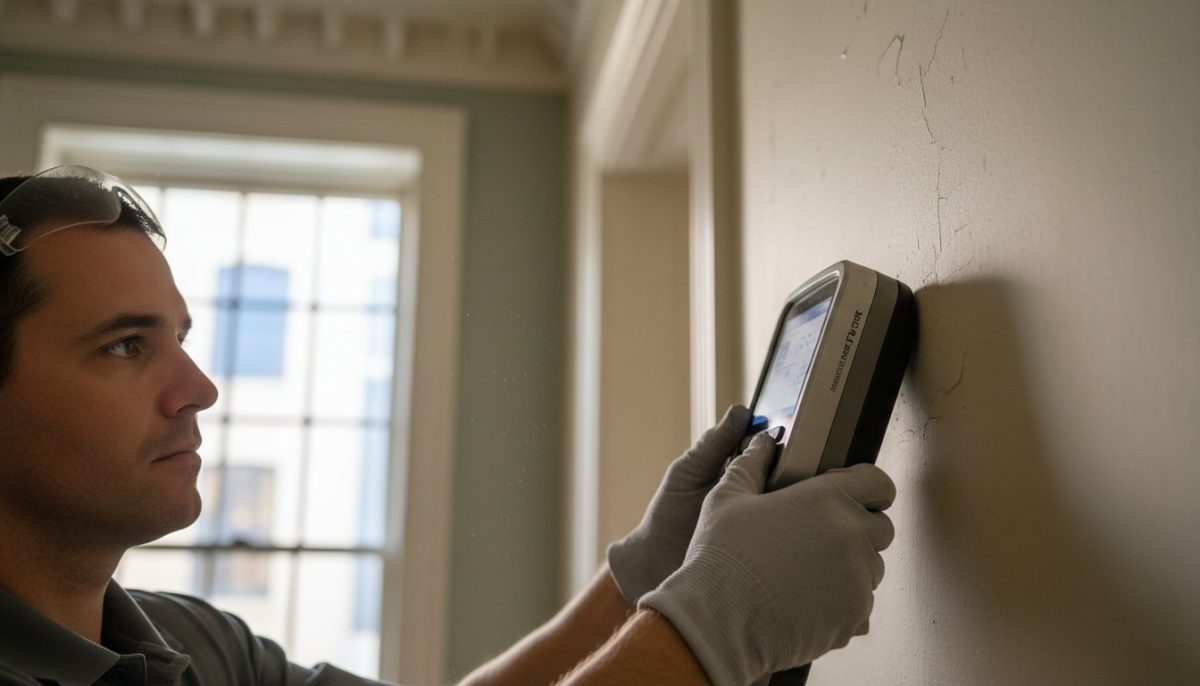
Did you know that an estimated 34% of South Carolina residential structures built before 1978 still contain lead-based hazards? You’re likely aware that managing an older property involves more than just aesthetic upkeep; it requires a rigorous commitment to structural safety and regulatory compliance. The risk of health liabilities or heavy fines from the South Carolina Department of Environmental Services (SC DES) is a legitimate concern for any disciplined property owner who values precision and safety. This guide provides a technical roadmap for lead paint testing south carolina to ensure your 2026 operations align with both EPA and state-specific mandates. You’ll gain the clarity needed to distinguish between cost-effective professional inspections and the inherent limitations of retail DIY kits. We’ll examine the specific protocols for 2026, including the shift from basic Renovation, Repair, and Painting (RRP) standards to advanced abatement strategies that protect your long-term assets. By following these engineering-grade standards, you can move from uncertainty to a state of total structural control and documented safety.
Key Takeaways
- Identify why pre-1978 properties in high-risk areas like Charleston and Myrtle Beach require specialized attention due to historic lead-based paint hazards.
- Compare the technical advantages of non-destructive XRF (X-Ray Fluorescence) scanning versus laboratory analysis for efficient and accurate on-site results.
- Navigate the complex regulatory landscape of lead paint testing south carolina by understanding the latest SC DES and EPA RRP Rule requirements.
- Discover the critical protocols for containment and the long-term safety benefits of choosing permanent abatement over temporary interim controls.
- Learn how 15+ years of engineering precision in the Lowcountry ensures that even the most challenging hazardous material removal projects are managed with total compliance.
Why Lead Paint Testing is Critical for South Carolina Properties
Structural integrity and safety in South Carolina’s historic real estate market rely on more than just aesthetic preservation. Properties built before the 1978 federal ban represent a massive portion of the state’s housing stock; specifically, 62% of residential units in older urban corridors. Lead paint testing south carolina protocols are the only way to verify if a structure meets modern safety standards. The history of Lead-based paint in the United States reveals that federal bans didn’t eliminate the material; they merely stopped new applications. For South Carolina owners, this means decades of accumulated paint layers often hide toxic concentrations of lead chromate or lead carbonate.
By 2026, insurance premiums for uncertified historic multi-family units in South Carolina are projected to rise by 18% as carriers tighten liability requirements. This financial pressure makes early detection a fiscal necessity. A property with documented lead hazards can see a 12% decrease in market value if the owner fails to provide a clear mitigation plan during the due diligence phase. Whether you’re managing a commercial renovation in Myrtle Beach or a residential restoration in Columbia, understanding the technical state of your substrates is the first step in risk management.
The Historic Charleston Factor
Charleston’s unique environmental conditions create a high-risk scenario for lead paint degradation. The city’s average humidity levels, which often exceed 70%, accelerate the breakdown of lead-based primers. This process, known as chalking, releases microscopic particles into the local soil and air. Owners of landmarks must also satisfy the Board of Architectural Review (BAR) requirements. These legal obligations mandate that any lead disturbance during exterior scraping or repainting follows strict containment procedures to prevent contaminating the dense Lowcountry urban environment.
Health Risks and Liability
Inhalation of lead dust remains the primary vector for toxicity during structural demolition or selective renovations. When contractors use high-heat guns or power sanders without HEPA filtration, they aerosolize lead particles that settle into HVAC systems. For commercial property managers and landlords, the legal stakes are high. South Carolina law, aligned with EPA’s RRP (Renovation, Repair, and Painting) Rule, imposes fines of up to $37,500 per day for violations that expose tenants to lead hazards.
Landlords often mistakenly believe that applying a fresh coat of latex paint solves the problem. This is rarely a long-term legal or safety solution; it’s merely a temporary mask. Friction surfaces like window sashes and door frames will inevitably grind through new layers, exposing the lead underneath. Professional lead paint testing south carolina identifies these high-friction areas before they become a liability. Relying on “encapsulation” without a certified inspection report leaves owners vulnerable to personal injury lawsuits and significant civil penalties.
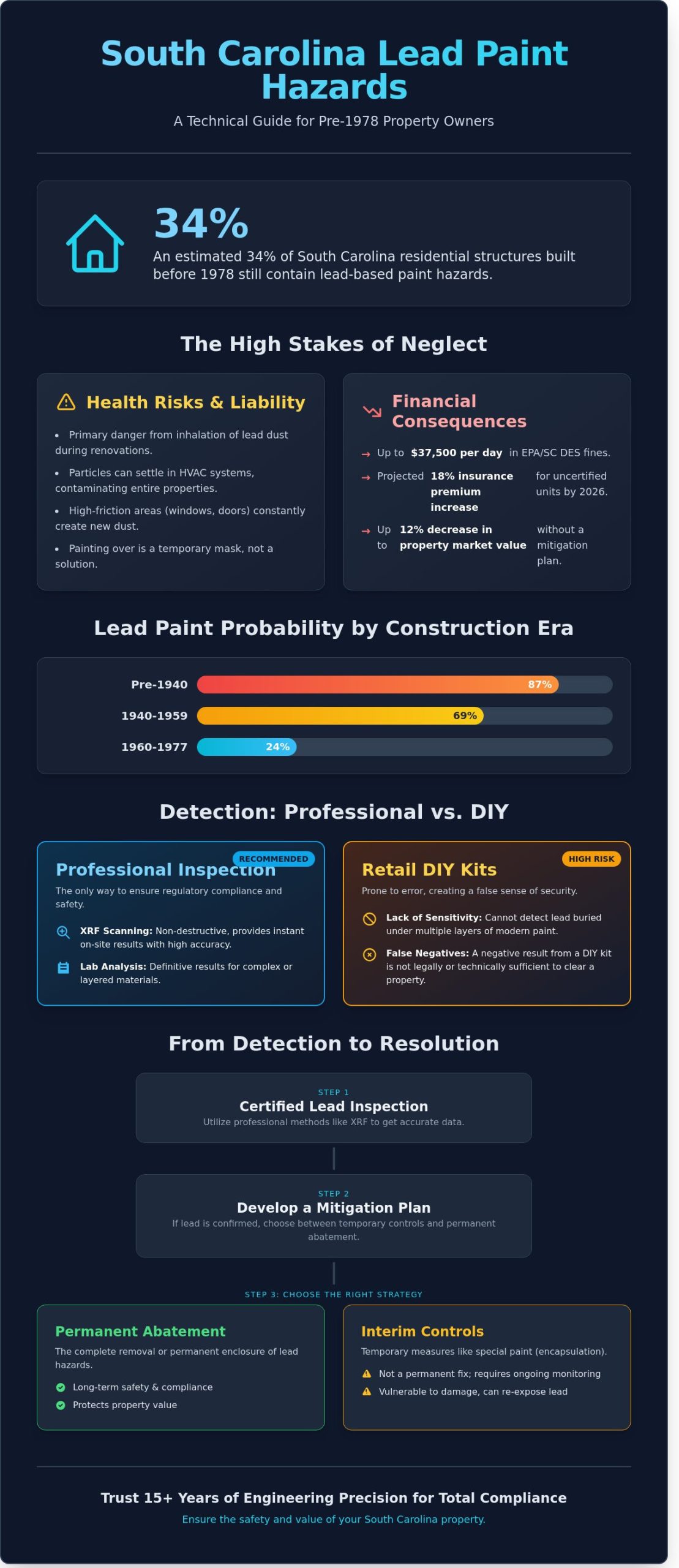
- Pre-1940 Homes: 87% chance of containing lead-based paint.
- 1940-1959 Homes: 69% chance of containing lead-based paint.
- 1960-1977 Homes: 24% chance of containing lead-based paint.
Precision in testing ensures that renovation budgets are allocated correctly. Instead of guessing which walls require abatement, technical data allows for targeted intervention. This engineering-led approach saves time and prevents the unnecessary removal of safe historic materials. It’s about maintaining the balance between preserving South Carolina’s architectural heritage and ensuring the biological safety of its inhabitants.
Professional Lead Testing Methods: XRF vs. Laboratory Analysis
Professional inspection of historic properties in cities like Charleston or Greenville requires a technical approach that balances accuracy with the preservation of architectural integrity. Property owners must choose between non-destructive surface analysis and invasive chemical sampling. Selecting the right protocol for lead paint testing south carolina requires a technical understanding of building substrates and historical coating layers. While DIY kits exist, they lack the sensitivity needed to detect lead buried under twenty layers of modern latex, often yielding false negatives that compromise occupant safety.
Technical assessments typically begin with a visual inspection to identify friction surfaces, such as window sashes and door frames, where lead dust is most likely to accumulate. A certified risk assessor then determines whether X-Ray Fluorescence or paint chip sampling is the most efficient path forward. This decision often hinges on the specific substrate; for instance, ornate plasterwork requires a different diagnostic tool than a standard exterior clapboard. Professional results provide the empirical data necessary for 100% compliance with EPA lead safety standards.
XRF Testing: The Industry Standard
X-Ray Fluorescence (XRF) technology serves as the primary diagnostic tool for rapid, non-destructive onsite analysis. The device emits a controlled beam of high-energy X-rays that displaces electrons in the lead atoms within the paint. As these atoms return to a stable state, they emit a secondary X-ray, or fluorescence, which the handheld analyzer measures with a 95% confidence interval. This method identifies lead concentration through multiple layers of paint without damaging the surface. It provides immediate results, allowing for real-time decision-making during a structural audit.
Only licensed professionals should operate XRF machinery because the equipment requires precise calibration and specialized training to interpret complex readings on metallic or curved substrates. While the initial cost of a professional XRF survey is higher than manual sampling, it eliminates the need for patching damaged walls and reduces laboratory turnaround times. It’s a vital component for any comprehensive lead paint testing south carolina strategy, especially when dealing with large-scale renovations where hundreds of surfaces require verification.
Laboratory Analysis and Dust Wipes
When XRF readings are inconclusive or when a precise chemical breakdown is required, risk assessors turn to laboratory analysis. This process involves collecting a physical paint chip, typically two square inches in size, and sending it to an EPA-recognized laboratory. Technicians use Atomic Absorption Spectroscopy (AAS) or Inductively Coupled Plasma (ICP) to measure lead content. Results are reported in parts per million (ppm) or percent by weight. Under federal law, paint is considered lead-based if it contains 5,000 ppm or 0.5% lead by weight. This method is the final word in legal and insurance disputes.
Testing must extend beyond the paint itself to account for environmental migration. Dust wipe sampling measures the actual risk of exposure in living spaces by collecting particles from floors and window sills. As of 2021, the EPA lowered the dust-lead hazard standards to 10 micrograms per square foot (µg/ft²) for floors. In South Carolina’s coastal regions, soil testing is equally critical, as exterior paint flaking over decades can contaminate the perimeter of a home. For complex projects involving structural modifications, consulting with a specialized structural partner ensures that these technical risks are managed alongside the physical construction process.
- Soil Sampling: Necessary for homes built before 1950 where exterior lead concentrations often exceed 1,200 ppm in play areas.
- Water Testing: Essential if the property contains lead service lines or interior brass fixtures manufactured before 2014.
- Clearance Testing: Performed after lead hazard reduction to ensure the environment is safe for re-occupancy.
Navigating South Carolina Lead Regulations (SC DES & EPA)
Effective June 1, 2024, the South Carolina Department of Environmental Services (SC DES) assumed the regulatory oversight previously managed by DHEC. This agency now handles the enforcement of lead-based paint protocols across the state alongside federal authorities. The cornerstone of these protections is the EPA Renovation, Repair, and Painting (RRP) Rule. It dictates that any firm disturbing more than six square feet of interior paint in a pre-1978 home must be lead-safe certified. Ignoring these mandates doesn’t just risk health; it invites heavy litigation and state-level enforcement actions that can stall a renovation indefinitely.
Property owners often struggle to choose the correct protocol when ordering lead paint testing south carolina services. A Lead Inspection is a surface-by-surface inventory. It uses X-Ray Fluorescence (XRF) analyzers to identify exactly where lead exists on walls, windows, or trim. Conversely, a Lead Risk Assessment is more diagnostic. It identifies active hazards like deteriorating paint, lead-contaminated dust, or soil issues. For historic preservation, a risk assessment is usually the superior choice because it provides a prioritized plan for hazard control rather than just a simple list of locations. It’s about finding the source of the danger, not just the presence of the material.
The regulatory landscape is tightening to protect vulnerable populations. In October 2024, the EPA finalized a rule that significantly lowers the thresholds for lead dust in residential settings. By 2026, the EPA lead hazard standards will transition to a “reportable level” standard. This means any amount of lead dust detected by a certified laboratory will be considered a hazard. These updates require contractors to adopt more rigorous HEPA-vacuuming and wet-cleaning cycles to pass final clearance testing. If your project concludes after these 2026 updates, the margin for error during the final cleaning phase will effectively be zero.
Residential vs. Commercial Compliance
Regulations classify structures built before 1978 as “Target Housing.” This includes most historic residences in Charleston. If a facility houses children under age six for six hours weekly, it’s a child-occupied facility. For commercial interior gutting, SC DES requires lead paint testing south carolina as a mandatory pre-demolition step. OSHA Standard 1926.62 also dictates worker safety if lead levels exceed 30 micrograms per cubic meter of air.
Certification Requirements for SC Contractors
Verify a firm’s status through the EPA’s Lead-Safe Certification search tool before any work begins. In South Carolina, SC DES can issue fines reaching $37,500 per day for non-compliant lead disturbance. Contractors must maintain a strict paper trail, including the “Renovate Right” receipt and dust-wipe clearance reports. These documents must be kept for a mandatory 3-year period to prove compliance during state audits.
From Testing to Abatement: What Happens if Lead is Found?
Confirming the presence of lead through professional lead paint testing south carolina requires an immediate, structured response. Once a laboratory report identifies lead concentrations exceeding 1.0 mg/cm² or 0.5% by weight, the property owner enters a regulatory framework designed to protect human health. The first 48 hours are critical. We prioritize site containment by isolating the affected areas with 6-mil polyethylene plastic sheeting and high-tack tape. Under South Carolina DHEC guidelines, occupants must receive written notification of the findings within 15 days. This transparency ensures that residents take necessary precautions while we determine the most effective path forward.
Property owners must choose between interim controls and permanent abatement. Interim controls, such as specialized HEPA vacuuming and dust-suppressant cleaning, offer a temporary reduction in risk. However, these methods require ongoing monitoring every 6 to 12 months. For historic structures in South Carolina, permanent abatement is the standard for long-term safety. This process involves a 20-year guarantee of lead-free surfaces. It requires a rigorous technical approach that treats the building as a complex industrial site rather than a simple renovation project.
Professional Abatement Strategies
Our team implements several specialized methods to ensure the total removal or stabilization of hazards. We select the strategy based on the architectural importance of the substrate and the severity of the lead concentration. Common professional methods include:
- Mechanical Removal: We utilize HEPA-shrouded power tools that connect directly to industrial vacuum systems. These systems capture 99.97% of airborne particulates at the source, preventing the spread of toxic dust.
- Encapsulation: When removal isn’t feasible due to structural integrity, we use encapsulation. This involves applying an ASTM E1795-certified liquid coating that creates a permanent, impact-resistant bond over the lead paint.
- Component Replacement: For 1920s-era sash windows or doors, component replacement is often the safest strategy. Removing the entire architectural element eliminates the friction points where lead dust is most likely to be generated during daily use.
Waste Management and Disposal
Handling lead-contaminated debris in South Carolina follows strict protocols under Regulation 61-107.19. We don’t simply haul waste to a standard landfill. Every pound of material is sorted and categorized to minimize environmental impact. TSIAC International employs a precise sorting method that separates recyclable metals from hazardous paint chips. In a typical 2,500-square-foot historic restoration, we often divert up to 30% of the total waste weight through careful material recovery. This disciplined approach reduces the volume of hazardous material entering South Carolina’s specialized disposal sites, ensuring 100% compliance with state transport manifests.
The process concludes with final clearance testing. A certified third-party inspector performs dust wipe sampling on floors, windowsills, and troughs. To pass, floor samples must show lead levels below 10 micrograms per square foot (µg/ft²). Only after these laboratory results confirm the site is decontaminated can the containment barriers be removed and the space declared safe for re-occupancy. If you’ve received positive results from lead paint testing south carolina, you need a partner who understands the engineering behind the safety.
Ensure your historic property meets the highest safety standards by consulting with our experts today. Contact TSIAC International for professional abatement solutions.
Why TSIAC International for Lead Abatement in the Lowcountry
TSIAC International has maintained a specialized presence in the Charleston hazardous material removal sector since 2008. Over these 15 years, we’ve refined a workflow that bridges the gap between technical demolition and environmental safety. Our team understands that historic homes in the Lowcountry require more than just brute force; they demand a surgical approach to lead paint removal. We offer integrated services that allow a project to move from selective demolition to lead abatement without the friction of hiring multiple subcontractors. This continuity reduces project timelines and ensures that safety standards remain consistent from the first swing of a hammer to the final clearance test.
Safety isn’t a suggestion at our job sites. We operate under strict adherence to SC DES (South Carolina Department of Environmental Services) and EPA protocols. This commitment ensures that every square inch of a property is handled with environmental responsibility. We utilize advanced HEPA filtration and negative air pressure systems to contain lead dust, which is particularly volatile in the humid South Carolina climate. Our site cleanliness standards exceed industry norms. We don’t just meet the minimum requirements; we aim for a pristine environment that protects both our specialized technicians and the families who will eventually occupy these historic spaces.
Our Professional Abatement Process
Our workflow begins the moment lead paint testing south carolina results are finalized. We collaborate with independent testing firms to translate their data into a precision abatement plan. This ensures we target only the necessary areas, saving time and structural material. Our experience includes over 250 historic renovations and large-scale commercial gut-outs where lead was a major factor. We provide every client with a fixed-price abatement contract. This transparency eliminates the unexpected costs often associated with environmental remediation in older structures. Our process includes:
- Detailed site containment using 6-mil polyethylene sheeting and reinforced entry points.
- Wet-scraping and HEPA-vacuuming techniques to minimize airborne particulates.
- Chemical stripping for intricate historic moldings where mechanical removal is impossible.
- Comprehensive waste management and disposal at certified hazardous waste facilities.
Serving Charleston and Beyond
From our central hub in North Charleston, we serve the entire Grand Strand and the broader Lowcountry region. Our reputation is built on successful outcomes in high-stakes environments. In 2022, we managed the lead removal for a 14,000-square-foot historic renovation where 85% of the original woodwork contained toxic levels of lead paint. We completed the project three days ahead of schedule with zero safety incidents and passed the final lead paint testing south carolina inspection on the first attempt. Our local knowledge of SC building codes and historic board requirements makes us a vital partner for any renovation project. We don’t just remove hazards; we prepare your property for its next century of life.
Ready to secure your property and ensure a lead-free environment? Request a Lead Abatement Quote from TSIAC International today to speak with a specialist about your specific project needs.
Securing Your Property Assets and Health for 2026
Compliance with South Carolina Department of Environmental Services (SC DES) and EPA standards isn’t just a legal hurdle; it’s a fundamental safety requirement for any property built before 1978. Accurate lead paint testing south carolina remains the first line of defense against hazardous exposure and long-term liability. Whether you utilize XRF technology for instant results or detailed laboratory analysis for verification, precise data ensures your remediation strategy is built on engineering facts rather than assumptions. For complex commercial projects that may involve multiple contaminants beyond lead paint, comprehensive hazardous material abatement South Carolina protocols ensure all environmental risks are properly identified and mitigated. TSIAC International brings over 15 years of specialized experience to the Charleston Lowcountry, operating as a strictly vetted EPA Certified Lead-Safe Contractor. Our team is fully licensed, bonded, and insured for hazardous materials, providing the technical precision required for even the most complex abatement projects. You don’t have to navigate these evolving 2026 regulations alone or risk the integrity of your structure with uncertified labor. Secure Your Property with Professional Lead Abatement Services and gain the peace of mind that comes from working with proven industry experts. Taking proactive steps today ensures a safer environment for your community and a more secure, compliant future for your real estate investment.
Frequently Asked Questions
Is lead paint testing mandatory before home renovations in South Carolina?
Lead paint testing south carolina is mandatory for all pre-1978 residences under the EPA Renovation, Repair, and Painting (RRP) Rule when a project disturbs more than 6 square feet of interior surface. Contractors must either assume lead is present or perform verified testing using EPA-recognized methods. Failure to comply with these federal regulations can result in civil penalties exceeding $37,500 per violation per day.
How much does a professional lead inspection cost in Charleston?
A professional lead inspection in Charleston typically costs between $300 and $600 for a standard 2,000-square-foot residential property. Larger historic estates in the Downtown District often require more extensive XRF scanning, which can push costs toward $850. These prices cover the certified inspector’s site visit, equipment usage, and the detailed technical report required for legal documentation.
Can I use a DIY lead test kit for legal compliance in SC?
DIY kits like the 3M LeadCheck are EPA-recognized for some residential applications, but they don’t meet the legal requirements for lead abatement projects or commercial compliance. Professional lead paint testing south carolina utilizes XRF analyzers that provide non-destructive, instant results with 95% accuracy. Relying on retail swabs often leads to false negatives on older, multi-layered historic surfaces where lead is buried under modern coatings.
What is the difference between lead abatement and lead-safe renovation?
Lead abatement is a specialized set of procedures designed to permanently eliminate lead-based paint hazards for at least 20 years. Lead-safe renovation involves interim controls and work practices that minimize dust during standard maintenance or remodeling. Abatement requires South Carolina DHEC-certified supervisors and specific containment protocols that go far beyond standard RRP guidelines to ensure total site safety.
How long does the lead paint removal process take for a commercial building?
Lead removal for a 10,000-square-foot commercial facility typically requires 7 to 14 business days depending on the substrate’s condition. This timeline includes site stabilization, specialized containment setup, and the final HEPA vacuuming process. Complex industrial sites involving abrasive blasting or chemical stripping may extend the schedule by an additional 5 days to ensure 100% compliance with safety standards.
What should I do if my child tests positive for lead in South Carolina?
You should immediately contact the South Carolina Department of Health and Environmental Control (DHEC) at 803-898-3432 if a child’s blood lead level exceeds 3.5 micrograms per deciliter. State law requires healthcare providers to report these results within 10 days of the test. You’ll need a certified environmental investigation of your home to identify and mitigate the specific source of exposure immediately.
Are there grants available for lead paint removal in SC historic homes?
The HUD Lead Hazard Control Grant Program provides funding for lead mitigation, often covering up to $10,000 per unit for qualifying low-income households. Additionally, the South Carolina State Historic Preservation Office offers a 25% state income tax credit for the rehabilitation of certified historic residential structures. These financial incentives help offset the technical costs of specialized abatement in 19th-century properties.
How does TSIAC International handle lead-contaminated debris?
TSIAC International manages lead-contaminated waste through rigorous adherence to the Resource Conservation and Recovery Act (RCRA) standards. We utilize 6-mil polyethylene bagging for all hazardous debris and ensure transport to Subtitle D landfills permitted for such materials. Every project includes a documented chain of custody and a final disposal certificate to guarantee your site remains 100% compliant with environmental regulations.
