

Most interior renovation budgets fail before the first sledgehammer swings because they treat demolition as a simple labor expense rather than a complex engineering phase. Calculating a realistic interior demolition cost per square foot requires looking past the surface to account for structural integrity and environmental liabilities. It’s a high-stakes calculation where missing a single detail, like the updated 2026 EPA lead dust clearance levels, can lead to cascading delays and unmanaged costs.
You’re likely here because you’ve received inconsistent quotes or you’re concerned about hidden hazardous materials like asbestos and lead. It’s frustrating when a project’s financial foundation feels like it’s built on guesswork. We’ll help you master these variables by providing a technical framework to evaluate professional bids and understand the true drivers of project expenses. This guide details the critical differences between selective and total demolition while highlighting the impact of modern safety regulations on your bottom line. By the end, you’ll have the professional insight necessary to establish a defensible budget that ensures your project remains controlled, compliant, and safe.
Key Takeaways
- Establish a realistic financial baseline by understanding the 2026 national average range for standard interior projects.
- Learn how building age and material complexity directly influence the interior demolition cost per square foot, moving beyond generic estimates to technical accuracy.
- Identify how to integrate asbestos and lead abatement into your planning to prevent mid-project budget collapses and ensure strict regulatory compliance.
- Distinguish between the surgical precision of selective demolition and the comprehensive scale of full interior gutting to align your investment with specific project outcomes.
- Evaluate how professional crews mitigate long-term liability and structural risk while significantly accelerating the project timeline through specialized equipment.
Understanding the Baseline: Interior Demolition Cost Per Square Foot in 2026
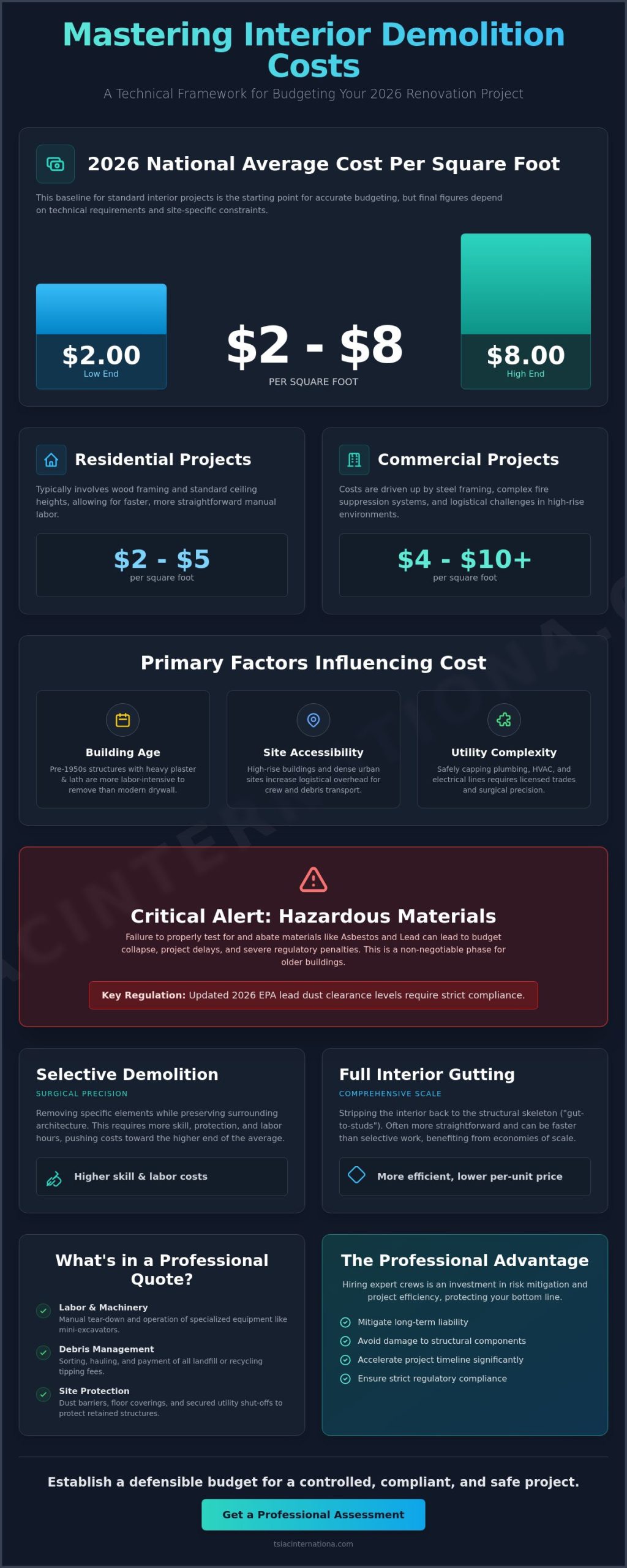
Interior demolition is the systematic removal of non-structural components within a building’s envelope. This process typically targets drywall, flooring, cabinetry, and drop ceilings without compromising the building’s skeletal integrity. For project managers and property owners, establishing an accurate interior demolition cost per square foot is the first step in ensuring financial feasibility. In 2026, the national average for standard projects ranges from $2.00 to $8.00 per square foot. This baseline serves as a starting point, but the final figure is dictated by the project’s technical requirements and logistical constraints.
While square foot pricing provides a reliable budgeting framework, professionals often adjust these rates based on material density and site accessibility. A “gut-to-studs” project involves stripping everything back to the structural skeleton, which is often more straightforward than selective demolition. The latter requires surgical precision to remove specific elements while preserving the surrounding architecture. This level of care increases labor hours and requires specialized protection measures, often pushing the cost toward the higher end of the national average.
Residential vs. Commercial Price Discrepancies
The environment where the work occurs significantly impacts the bottom line. Residential projects usually fall within the $2 to $5 per square foot range. These jobs typically involve wood framing and standard ceiling heights, which allow for faster manual labor. Commercial projects, however, often range from $4 to $10 or more per square foot. The presence of steel framing, complex fire suppression systems, and the logistics of working in high-rise environments drive these figures upward. It’s a standard industry observation that larger square footage projects often benefit from an economy of scale, where the mobilization of heavy equipment and specialized crews results in a lower per-unit price for the client.
What is Included in a Standard Demolition Quote?
When reviewing a professional bid, it’s vital to understand what the scope of work covers. A comprehensive quote ensures there are no hidden fees during the project’s execution. Standard inclusions generally consist of:
- Labor: This covers both manual tear-down and the operation of specialized machinery like mini-excavators or skid steers.
- Debris Management: This involves the sorting of materials for recycling, hauling waste from the site, and the payment of landfill tipping fees.
- Site Protection: Professionals install dust barriers, floor coverings, and ensure all utility shut-offs are secured to prevent damage to retained structures.
Primary Factors Influencing Your Interior Demolition Estimates
The national baseline for an Interior Gut Renovation is influenced by specific site conditions that generic calculators often overlook. Building age is a primary technical variable. Structures built before 1950 often utilize plaster and lath construction. This material is significantly heavier and more labor-intensive to remove than modern gypsum-based drywall. Removing plaster requires specialized handling and more man-hours, which naturally increases the interior demolition cost per square foot. Older buildings also demand a higher degree of caution to avoid disturbing structural components that may have settled over decades.
Site accessibility also dictates the operational tempo. Projects located in high-rise offices or dense urban footprints require meticulous mobilization planning. If crews must transport debris through service elevators or coordinate street closures for dumpsters, the logistical overhead climbs. Similarly, utility complexity requires surgical precision. Capping plumbing, HVAC, and electrical lines isn’t just about removal. It’s about safe termination. This requires coordination with licensed trades to ensure the building’s core systems remain operational while the interior is stripped. A failure to manage these technical interfaces can lead to expensive emergency repairs.
Labor and Mobilization: The “Quiet” Cost Drivers
Mobilization fees are a necessary line item in a professional bid. These fees cover the logistics of transporting specialized machinery, such as mini-excavators or robotic breakers, to the job site. For large-scale commercial contracts, prevailing wage requirements can further shift the pricing structure. Additionally, working in occupied buildings often necessitates night work or restricted hours. These shifts carry a labor premium due to the specialized scheduling and the need for increased site security during off-hours. Managing these labor variables is essential for maintaining a predictable budget.
Debris Disposal and Tipping Fees
Effective waste management is a cornerstone of a successful project. Debris disposal and landfill tipping fees typically account for 20% to 30% of the total project cost. The type of waste generated is a critical factor. Clean debris, such as unpainted wood or scrap metal, is cheaper to process than mixed construction waste. In many cases, recycling metal framing can provide a financial offset, reducing the total waste volume sent to landfills. This technical approach to waste management helps maintain a controlled interior demolition cost per square foot. If you are planning a complex project, it’s essential to partner with a team that understands these professional interior gutting requirements.
Hazardous Material Abatement: The Critical Impact of Asbestos and Lead
The discovery of hazardous materials mid-project is the primary reason interior renovation budgets collapse. Standard demolition protocols are designed for the physical removal of debris, not the containment of microscopic toxins. When asbestos or lead paint is identified, all mechanical and manual demolition must halt immediately. Federal law requires that these materials are professionally abated before any structural or cosmetic removal continues. This transition from standard demolition to environmental remediation can increase the interior demolition cost per square foot by an additional $5.00 to $15.00 for the affected areas. Failure to account for these variables during the pre-construction phase often leads to expensive emergency mobilizations and regulatory fines.
Compliance with EPA and OSHA standards is a legal necessity that protects both the workforce and the building’s future occupants. In 2026, regulatory oversight has intensified, particularly regarding dust control and waste manifests. Engaging a licensed contractor for hazardous material handling transfers the significant legal liability of toxic exposure from the property owner to the specialist. This professional oversight ensures that the project remains within the bounds of the law while maintaining the safety of the site’s environmental envelope.
Asbestos Abatement Service Fees
Asbestos is frequently found in high-traffic or high-heat areas of older buildings. Common locations include vinyl floor tiles, acoustic “popcorn” ceilings, pipe insulation, and certain textured paints. The cost of asbestos removal is driven by the rigorous containment process required to prevent fiber release. Technicians must establish negative air pressure zones and utilize HEPA filtration systems to scrub the air during the removal process. These technical safeguards, combined with specialized disposal requirements at certified landfills, account for the premium pricing associated with asbestos-impacted square footage.
Lead Paint and Mold Remediation
Lead-based paint is a critical concern for any structure built before 1978. Under the updated EPA lead dust action levels effective January 12, 2026, post-abatement clearance standards have become much stricter, with floor levels set at 5 µg/ft². Meeting these benchmarks requires a surgical removal approach. Similarly, mold remediation often becomes necessary when water damage is uncovered behind existing drywall. Unlike standard debris removal, mold requires antimicrobial treatment and careful isolation to prevent cross-contamination of the HVAC system. Both lead and mold remediation demand a level of precision that standard demolition crews aren’t equipped to provide, making professional environmental services essential for a successful project outcome.
Strategic Planning: Selective Demolition vs. Full Interior Gutting Costs
Choosing between selective removal and a total gut-out is a strategic decision that dictates the project’s logistical rhythm. Many property owners assume that removing fewer components naturally lowers the interior demolition cost per square foot. However, the opposite is often true in practice. Selective demolition requires surgical precision to isolate specific elements while protecting the building’s structural integrity and remaining finishes. This increased reliance on manual labor and sophisticated protection measures often results in a higher unit price compared to the high-volume efficiency of a total gutting project. The complexity of working around “keep” items necessitates a slower, more methodical pace that drives up labor hours.
When to Choose Selective Demolition
Selective demolition is the preferred method for historical preservation or projects in “live” environments where business operations must continue in adjacent rooms. This approach demands rigorous engineering controls and a highly disciplined crew. Key requirements for these projects include:
- Shoring: Temporary structural supports are often necessary to maintain stability when removing load-bearing partitions.
- Vibration Monitoring: Essential for protecting sensitive electronics or historical masonry in adjacent spaces.
- Site Protection: The installation of dust-tight partitions, HEPA air scrubbers, and reinforced floor coverings to protect finishes that must remain.
It’s a process where the primary goal is to leave the surrounding environment completely undisturbed, which requires a specialized skill set beyond standard demolition.
The Advantages of a Full Interior Gut-Out
A full interior gut-out involves stripping a structure down to its structural shell or “studs.” This method is highly efficient for large-scale redevelopments and commercial interior gutting services. By removing all internal obstructions, you provide a clean slate for the installation of modern MEP (Mechanical, Electrical, Plumbing) systems. This transparency also simplifies the building inspection process, as inspectors can easily verify the condition of the structural frame and utility connections without the need for invasive testing or opening walls multiple times.
While a total gutting project involves a higher volume of debris, the use of heavy machinery and streamlined workflows keeps the overall interior demolition cost per square foot more predictable. If your project requires a total reset of the building’s interior layout, a comprehensive gut-out is the most cost-effective path forward. To ensure your project begins with a technically sound foundation, you can learn more about our strategic approach to commercial interior gutting services to help define your project scope.
Maximizing ROI: Why Professional Abatement and Demolition Protect Your Bottom Line
Professional demolition is a strategic investment in risk management rather than a simple labor expense. While the initial interior demolition cost per square foot might appear higher than hiring general laborers, the technical efficiency of specialized machinery and skilled operators provides a faster path to the construction phase. Professional crews utilize robotic breakers and mini-excavators to complete in days what manual labor takes weeks to finish. This speed reduces financing costs and allows for faster tenant occupancy. Beyond speed, you’re transferring the massive liability of structural safety and hazardous waste management to a licensed partner. This transfer of risk is a critical safeguard against the unpredictable costs of workplace injuries or environmental accidents.
Avoiding the “change order” trap requires thorough pre-demolition inspections. A professional contractor identifies potential complications, such as hidden mechanical runs or secondary wall layers, before the contract is signed. This technical foresight ensures that your interior demolition cost per square foot remains stable throughout the project lifecycle. Fixed-price contracts based on these detailed assessments prevent the budget creep that often plagues less disciplined projects.
The Value of Integrated Abatement and Demolition
Hiring a single contractor for both abatement and demolition is a proven cost-saving strategy. It eliminates the “downtime” typically found between a remediation team finishing and a demolition crew starting. A unified team manages the entire environmental shell, ensuring that containment zones are handled with the structural removal in mind. This integration also streamlines the documentation process. Having a single, comprehensive manifest for hazardous material disposal is vital for maintaining the long-term resale value of the property. It provides future buyers with an indisputable record of environmental compliance and safety.
Environmental Responsibility as a Cost Saver
Modern demolition is as much about material science as it is about physical removal. Professional sorting of wood, metal, and plastic directly reduces the volume sent to landfills, which lowers the total impact of tipping fees. Recovering high-value materials like metal framing and copper piping can provide salvage credits that offset a portion of the project’s expenses. These “green” practices aren’t just about ethics. They provide a tangible ROI through LEED certification points and reduced waste management costs. By treating debris as a resource rather than waste, you protect your bottom line and the environment simultaneously.
Ready to secure your project’s financial foundation? Contact TSIAC International for a comprehensive interior demolition quote.
Securing Your Project’s Financial and Structural Foundation
Navigating the complexities of a renovation requires more than just a surface level understanding of baseline prices. A realistic interior demolition cost per square foot is built on technical data, from the density of the materials being removed to the stringent 2026 EPA lead dust standards. By distinguishing between the surgical precision of selective work and the high volume efficiency of a total gut-out, you can align your budget with your building’s specific requirements. Professional oversight doesn’t just speed up the timeline. It provides a defensible framework for safety and environmental compliance.
TSIAC International offers over 15 years of structural and selective demolition experience, providing the technical expertise required for high stakes environments. Our crews are certified asbestos and lead abatement specialists who prioritize comprehensive material recycling and strict environmental adherence. We don’t just clear a space; we manage your liability through every phase of the removal process. To ensure your next project starts with professional precision, Request a Professional Interior Demolition Quote from TSIAC International. Your project deserves a foundation built on expert control and unwavering reliability.
Frequently Asked Questions
How much does it cost to gut a 2,000 sq. ft. commercial space?
Commercial gutting costs are influenced by the density of steel framing and mechanical systems. For a 2,000 square foot space, the interior demolition cost per square foot typically falls between $4 and $10 for standard projects. This results in a project range of $8,000 to $20,000, though this excludes hazardous material abatement or specialized high-rise logistics that require after-hours labor.
Does the price per square foot include asbestos testing?
Standard demolition quotes usually exclude the cost of initial environmental testing. Federal regulations require a separate inspection and laboratory analysis before any demolition activities begin to identify potential hazards. If asbestos is identified, the abatement phase is quoted as a distinct service line to account for negative air pressure containment and certified disposal protocols.
Can I save money by removing the drywall myself?
DIY removal is often counterproductive for commercial or complex residential projects. While it may seem like a cost-saving measure, inexperienced removal can disturb hidden load-bearing elements or aerosolize hazardous particles like lead dust. Professional crews use specialized equipment to ensure structural safety and site cleanliness, which prevents expensive repairs and delays during the reconstruction phase.
What is the difference between selective and total interior demolition?
Selective demolition involves the surgical removal of specific components while preserving others, such as historical features or structural supports. Total demolition, often called a gut-out, strips the building entirely to its structural frame or studs. Selective work usually carries a higher hourly labor cost due to the precision and protection measures required to avoid collateral damage to the retained structure.
How do tipping fees affect my demolition budget?
Tipping fees are the charges paid at landfills to dispose of construction waste and can account for 30% to 50% of your total budget. These fees fluctuate based on material weight and local municipal regulations. Implementing a recycling program for metal framing and wood can significantly reduce the interior demolition cost per square foot by diverting heavy materials from the waste stream.
Is a permit required for interior demolition?
Most municipal governments require a demolition permit for any project that alters the interior footprint or utility connections. Permit fees range from $100 in small towns to over $1,000 in major metropolitan areas. Failing to secure the proper documentation before work begins can result in immediate work stoppages and significant legal penalties from local building departments.
How long does a typical 5,000 square foot interior gut-out take?
A standard 5,000 square foot gut-out typically requires five to ten business days for a professional crew. This timeline includes site protection, mechanical terminations, and systematic debris removal. Factors such as restricted site accessibility or the presence of heavy flooring materials like concrete can extend this duration to ensure methodical progress and safety.
What happens if lead paint is found during the demolition process?
If lead paint is discovered, all work must stop immediately to prevent the spread of toxic dust. Under the January 2026 EPA regulations, specialized abatement procedures must be implemented to meet new, stricter clearance levels. Professionals will use HEPA-filtered vacuums and wet-removal techniques to isolate the hazard and protect the building’s environmental integrity before standard demolition resumes.
