

If you’re searching for a reliable bonded demolition contractor, start by checking the bond for the specific project. A bond review can stall when the demolition scope or contract documents leave important details unclear. A general assurance that a contractor is bonded isn’t enough: the bond must match the project, contract, and parties involved.
The process can be confusing because bid, performance, and payment bonds serve different purposes, and requirements vary by contract and project owner. Incomplete plans, scope details, or contract information can also slow a surety’s review. Confirm project-specific requirements with the owner or a qualified surety professional before proceeding.
This guide from TSIAC International explains which bond types may apply, what project information to assemble for a surety or bond producer, and how to check that bond documents accurately identify the project, obligee, contractor, and contract terms. Use it to prepare a clearer submission and review the documentation before work moves forward.
Key Takeaways
- Bond requirements depend on the owner, contract, project type, and applicable rules. Confirm them before preparing a submission.
- Understand how bid, performance, and payment bonds differ, then identify which bond types the contract requires.
- Assemble a clear project package with the demolition scope, schedule, site conditions, and responsibility assignments to support surety review.
- Check that bond documents match the executed contract, including the principal, obligee, project description, required bond type, and stated amount.
- When evaluating a demolition contractor, assess scope clarity, relevant experience, safety planning, and responsiveness to documentation requests.
How demolition project bonding works and when it may be required
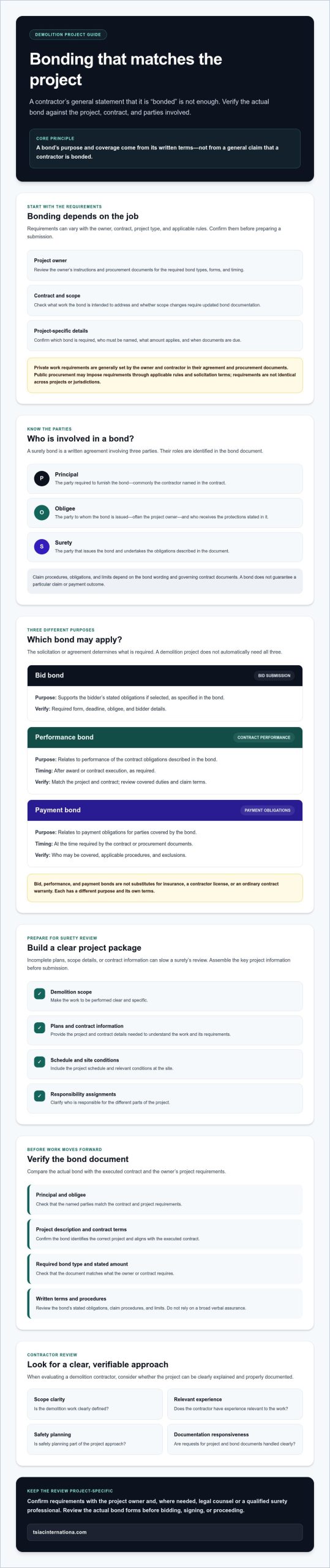
Bonding requirements depend on the project owner, contract, project type, and applicable rules. A surety bond is a written agreement involving three parties: the principal required to provide the bond, the obligee receiving its protection under the bond’s terms, and the surety that issues it. The exact obligations, claim procedures, and limits depend on the bond wording and governing contract documents.
A contractor’s broad statement that it is “bonded” doesn’t establish that a specific demolition project is covered. The statement could refer to another contract or a bond required for a different purpose. Ask for the actual bond document and compare it with the project requirements. A bond’s purpose and coverage come from its written terms, not from a general claim that a contractor is bonded.
When evaluating a demolition contractor, check whether the bond identifies the project and satisfies the owner’s requirements. Confirm which bond is required, who must be named, and what work it addresses. A performance bond is one type used in construction contracts, but its effect depends on its language and the associated agreement.
Who participates in a demolition project bond?
The principal is the party required to furnish the bond, commonly the contractor named in the contract. The obligee is the party to whom the bond is issued, often the project owner, and receives the protections stated in it. The surety issues the bond and undertakes the obligations described in the document. A bond doesn’t guarantee a particular claim or payment outcome. Any response depends on its terms and the circumstances.
Which projects may require bonding?
For private work, the owner and contractor generally set project requirements in their agreement and procurement documents. Public procurement may impose bonding requirements through applicable rules and solicitation terms, but requirements aren’t necessarily identical across projects or jurisdictions. In either case, review the instructions, contract, and bond forms before bidding or signing.
Confirm requirements directly with the project owner and, where needed, legal counsel or a qualified surety professional. Check whether bonding is required, which bond types and amounts apply, who must be listed as principal and obligee, and when the documents are due. If the demolition scope changes, ask whether the existing bond documentation must also be revised. Resolving these questions before submission helps prevent mismatches between the contract and bond.
Which demolition bonds may apply: bid, performance, or payment
Bid, performance, and payment bonds address different stages and risks in a contract. The project owner’s solicitation or agreement determines which are required; a demolition project doesn’t automatically need all three. The Surety & Fidelity Association of America offers background on surety bonds, but the controlling details for a particular job are in its procurement documents and executed bond forms.
A bid bond addresses the bidder’s obligations, a performance bond addresses contract performance, and a payment bond addresses specified payment obligations. These bonds aren’t substitutes for insurance, a contractor license, or an ordinary contract warranty. Insurance responds to covered risks under an insurance policy; a license reflects applicable authorization or qualifications; and a warranty sets out contractual commitments. Each has a different purpose and its own terms.
| Bond type | Purpose | Usual timing | Party protected | Key verification point |
|---|---|---|---|---|
| Bid | Supports the bidder’s stated obligations if selected, as specified in the bond | With the bid submission | Usually the obligee named in the solicitation | Confirm the required form, deadline, obligee, and bidder details |
| Performance | Relates to performance of the contract obligations described in the bond | After award or contract execution, as required | The obligee named in the bond | Match the project and contract; review covered duties and claim terms |
| Payment | Relates to payment obligations for parties covered by the bond | At the time required by the contract or procurement documents | Eligible parties identified under the bond’s terms | Check who may be covered, applicable procedures, and exclusions |
What does a bid bond address?
A bid bond accompanies a bid when the solicitation requires one. It can provide procurement assurance tied to the bidder’s stated commitments, but it doesn’t establish that every bid-related circumstance is covered. Review the solicitation for the prescribed bond form, submission deadline, obligee’s exact legal name, and consistency between the bidder named on the bond and the bid. A mismatch can prompt questions during review.
How do performance and payment bonds differ?
A performance bond may address whether the contractor performs the obligations identified in the contract. A payment bond may address payment obligations to covered subcontractors, suppliers, or other parties, depending on the wording. Coverage, claim procedures, deadlines, and exclusions depend on the executed documents. Read the bond alongside the contract rather than relying on a certificate or a general statement that a contractor is bonded.
If you’re searching for a bonded demolition contractor charleston sc, verify the bond for the specific job and confirm which types the owner requires. If you’re still defining the demolition work, you can discuss your demolition project scope with an experienced contractor. Confirm bond requirements and documentation separately with the owner and a qualified surety professional.
How to prepare a demolition project for surety review
A well-organized submission gives a surety or bond producer a clearer picture of the contract and the contractor’s capacity to perform it. It doesn’t guarantee approval or a particular underwriting decision. First confirm what the project owner requires, then assemble documents that describe the work and responsibilities consistently.
- Confirm the requirement. Ask the owner which bond type, form, amount, obligee name, and submission deadline apply. Check the solicitation and contract for project-specific instructions.
- Collect the governing documents. Gather the solicitation, draft or executed contract, scope of work, drawings, schedule, addenda, and required bond forms. Include revisions so the review reflects the current package.
- Define the demolition scope. Identify the structures or areas to be removed, demolition limits, retained structures and components, and excluded work. A clear scope helps avoid uncertainty about what the contractor has agreed to perform.
- Describe the schedule and site conditions. Include the proposed sequence and schedule, access constraints, site conditions, and known hazardous-material information. Identify restrictions that could affect work planning.
- Assign project responsibilities. State who is responsible for permits, utility coordination, waste handling, and site controls. Check that the contract documents and scope don’t assign a task inconsistently or leave a key responsibility unclear.
- Prepare contractor and capacity information. Ask what financial statements, work history, current project commitments, or other underwriting materials may be requested. Organize relevant information about personnel, equipment, subcontractors, and project-management responsibilities.
- Check the package before submission. Compare company and project names, scope, schedule, and contract details across the documents. Resolve discrepancies and ask a qualified surety professional what additional information applies to the submission.
Assemble clear contract and project documents
Demolition documents should show not only what will be removed, but also what must remain undisturbed. For example, drawings and scope notes can clarify the boundary between selective removal and retained building elements. Include available information about hazardous materials without implying that an unverified condition has been assessed. The aim is a package that lets reviewers understand the work, constraints, and assigned responsibilities.
Prepare contractor and capacity information
A surety or bond producer may request financial and project-capacity information to evaluate the proposed obligation. Provide requested materials in the specified format, and explain current commitments or resource assignments clearly. Don’t assume that one contractor’s prior submission defines what’s needed for another project. A contractor’s experience planning the scope can help make the bid package more precise, but bonding decisions remain with the surety.
When comparing a bonded demolition contractor charleston sc, assess whether the contractor can explain its scope and supply project documentation that aligns with the owner’s requirements. Confirm bond status and project-specific terms directly rather than relying on a general assurance.
How to review and verify demolition bond documents
Review the executed bond against the final contract, not just a proposal, certificate, or verbal assurance. A document can look complete yet refer to a different project, name the wrong obligee, or use a bond type that doesn’t match the procurement requirements. Check each item against the controlling contract documents before treating it as project coverage.
The bond form and the contract together determine the documented obligation. Neither a contractor’s general statement that it is bonded nor an unrelated bond establishes what work, parties, or period a particular bond covers.
What should the bond document match?
Use this checklist to compare the bond with the executed contract and procurement documents:
- Principal and obligee: Confirm the contractor’s and project owner’s legal names match the contract and required bond form.
- Project identification: Match the project name, location or identifier, and any contract reference. Make sure the description points to the correct demolition work.
- Bond type and amount: Verify that the document provides the bond type and stated amount required by the contract. Don’t assume a different bond satisfies the requirement.
- Scope and contract dates: Check that the scope reference and contract date correspond to the executed agreement and its applicable revisions.
- Execution details: Confirm required signatures are present, the effective date is clear, and any required surety authorization can be verified through appropriate channels.
- Form and timing: Compare the submitted document with the required form and submission deadline in the solicitation or contract.
A discrepancy doesn’t automatically establish whether a bond is valid or invalid. It does mean the project team should pause and seek clarification from the obligee and qualified legal or surety advisers before relying on the document. Keep written responses with the project records.
How can a project team avoid common verification errors?
Don’t rely solely on a certificate, an email, or a contractor’s broad claim of being bonded. Those statements may not show the bond’s full terms or whether it corresponds to this contract. Read the complete executed bond, including referenced forms or conditions. Don’t assume it covers work, parties, or time periods that aren’t included in its terms.
Keep the executed bond with the signed contract, required forms, and relevant revisions in the project file. If you’re evaluating a bonded demolition contractor charleston sc, verify project-specific bond documentation separately from the contractor’s demolition qualifications. For help defining the demolition work and boundaries in a clear project scope, discuss your demolition project scope with TSIAC International.
Choose a demolition contractor with a clear, verifiable project approach
A contractor’s proposal should make the work understandable before crews arrive on site. Compare bidders on how clearly they define the demolition scope, explain relevant experience, address site safety and material handling, and respond to document requests. If you’re searching for a bonded demolition contractor, treat bond documentation as a separate item to verify, not as a substitute for assessing the contractor’s plan and qualifications.
Questions to ask before awarding demolition work
Use the project documents to guide a focused conversation. Ask each contractor:
- Which structures, areas, or materials are included, and what is specifically excluded?
- How will the work be sequenced, and what depends on access, site conditions, or coordination with other trades?
- What relevant demolition experience can you describe, and how will the team address site safety and material-handling procedures?
- How will hazardous-material concerns be identified and coordinated with the demolition scope?
- Who is responsible for debris handling, project records, and communicating changes to scope or site conditions?
- Who prepares and responds to project documents, including revisions, and how will the team keep records aligned with the current contract?
Look for specific, consistent answers. For example, a proposal should distinguish removal from retained building elements and clarify who handles debris, rather than relying on broad language that leaves responsibilities open to interpretation. Compare the answers with the written scope before making an award.
If the contract requires a bond, request the project-specific executed documentation and verify it against the contract and owner’s requirements through appropriate channels. A general claim of being bonded doesn’t establish that the bond applies to the work under consideration.
Discuss your demolition scope with an experienced contractor
TSIAC International has over 15 years of industry experience in demolition and abatement. Its capabilities include structural and selective demolition, interior gutting, asbestos and lead abatement, and debris recycling. This experience can inform a discussion about defining project limits, coordinating related work, and assembling a clear scope. It doesn’t establish bond status, which should be confirmed separately with the project owner or a qualified surety professional.
To discuss the demolition work involved, contact TSIAC International about your project scope.
Move forward with a clear scope and verified documents
A sound bonding process starts with confirming what the contract requires, preparing a complete project package, and checking that the executed bond matches the project and parties. Bid, performance, and payment bonds serve different purposes, so don’t assume one bond or a general claim of being bonded satisfies every requirement. Confirm project-specific terms with the owner and a qualified surety professional.
If you’re evaluating a bonded demolition contractor charleston sc, consider both the contractor’s project approach and the documentation you can verify. TSIAC International brings over 15 years of demolition and abatement industry experience, with structural and selective demolition, interior gutting, and hazardous-material abatement capabilities. Its recycling practices include wood, metal, and plastic on every project site. These capabilities can inform project-scope discussions, but bond status and bond terms should always be verified separately.
A clearly defined scope is a practical place to begin. Discuss your demolition project with TSIAC International to explore the work involved and the information needed to describe it accurately.
Frequently Asked Questions
What does it mean for a demolition project to be bonded?
A bonded demolition project has a surety bond issued for a specific contractual obligation when the owner or contract requires one. The agreement generally involves a principal, such as the contractor; an obligee, often the project owner; and a surety. The bond’s written terms define its purpose, parties, coverage, limits, and claim procedures. A contractor’s general statement that it is bonded doesn’t establish that a particular project is covered.
Which bond is typically needed for a demolition project?
There isn’t one bond type that applies to every demolition project. A solicitation or contract may require a bid bond during bidding, a performance bond for specified contract obligations, a payment bond for covered payment obligations, or a combination. Private owners and public procurement processes may set different requirements. Check the project documents for the required bond type and form, and confirm unclear or jurisdiction-specific requirements with the owner or a qualified surety professional.
How do I get a demolition project bonded?
Start by asking the project owner which bonds, forms, and submission deadlines apply. Assemble the solicitation, contract, demolition scope, drawings, schedule, site-condition information, and assigned responsibilities, then contact a surety or bond producer about the submission process. They may request contractor financial and project-capacity information. Review the issued bond against the executed contract for matching parties, project description, type, amount, and dates. Approval and timing depend on the surety’s review.
Can a demolition contractor get bonded after winning a bid?
Possibly, but whether a contractor can obtain the required bond after award depends on the solicitation, contract terms, deadlines, and surety review. Some procurement documents require a bid bond with the bid and other bonds after award; don’t assume that sequence applies to your project. Confirm the required timing before submitting a bid. If a deadline has passed or the requirement is unclear, contact the owner and a qualified surety professional promptly.
What documents may a surety request for a demolition bond?
A surety or bond producer may request the solicitation, draft or executed contract, scope of work, drawings, schedule, required bond forms, and details about site conditions and responsibilities. Contractor information may also be requested, such as financial statements, relevant work history, current project commitments, and information about personnel, equipment, subcontractors, and project management. Requirements vary by submission. Ask the surety professional what applies, and provide consistent, current documents that describe the same project and scope.
How can I verify that a demolition contractor is bonded for my project?
Request the executed, project-specific bond and compare it with the contract and procurement documents. Check the principal and obligee’s legal names, project identifier and description, required bond type and amount, contract references, signatures, and effective date. Confirm required surety authorization through appropriate channels. A certificate, verbal assurance, or general statement that you’re hiring a bonded demolition contractor charleston sc doesn’t prove that the bond covers your project. Ask the owner or a qualified adviser to resolve discrepancies.
Are demolition bonds the same as contractor insurance?
No. A surety bond is a contractual agreement involving a principal, obligee, and surety, with obligations defined in the bond document. Insurance is a separate policy that addresses covered risks under its terms. Neither document replaces the other, and a bond doesn’t automatically provide insurance coverage. Review the contract’s bonding and insurance requirements separately, and verify each document with the appropriate issuer or qualified adviser instead of treating one as evidence that the other requirement is met.
Does TSIAC International provide surety bonds?
TSIAC International provides demolition and abatement services, including structural and selective demolition, interior gutting, and hazardous-material abatement. Contact the company directly to ask about its bond status if relevant to your project, and verify any required project-specific bond with the project owner or a qualified surety professional before relying on it.
