
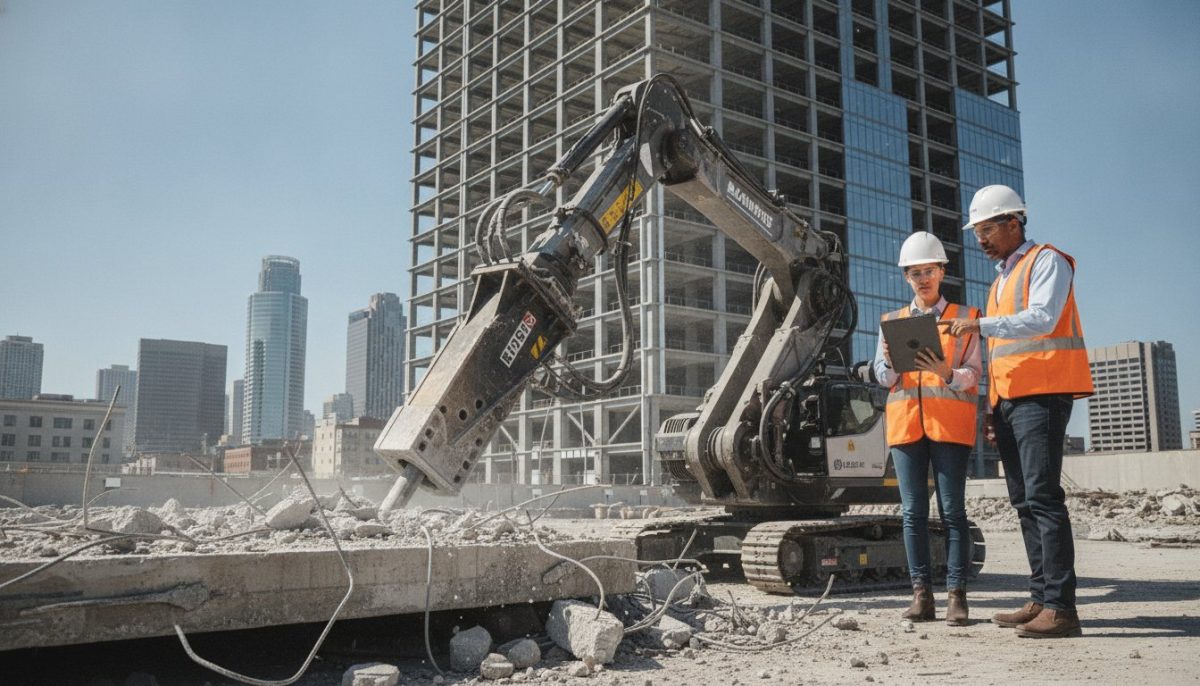
It’s easy to underestimate the sheer scale of managing debris, especially when the EPA reports that construction waste generates over 600 million tons of material annually. You likely recognize that hitting an unmarked utility line or discovering hazardous materials in a foundation can turn a routine job into a liability nightmare. This guide provides the technical roadmap you need to master large scale concrete removal with total confidence. We’ll compare the efficiency of mechanical and robotic breaking systems, outline a recycling focused debris management plan, and ensure your project remains fully compliant with the latest 2026 safety standards.
Key Takeaways
- Learn why transitioning from pneumatic hammering to hydraulic and robotic breakers is essential for maintaining technical precision and safety on modern commercial sites.
- Understand the legal necessity of pre-demolition environmental testing to identify asbestos and lead hazards hidden within legacy concrete foundations.
- Implement a ‘Zero Waste’ debris management plan that uses onsite sorting to separate concrete for recycling, significantly reducing your environmental footprint.
- Discover how partnering with experienced demolition contractors charleston sc can consolidate abatement and removal services to prevent costly timeline delays.
- Master vibration control techniques to ensure selective concrete demolition doesn’t compromise the structural integrity of shared-wall buildings.
The Engineering of Concrete Breaking and Removal
Concrete breaking is the science of controlled fracturing. It involves the intentional degradation of structural integrity in reinforced or unreinforced elements to facilitate safe removal. While a casual observer might see only destruction, professional demolition contractors charleston sc view a slab as a complex puzzle of compressive and tensile forces. Understanding the historical and technical evolution of The Engineering of Demolition helps clarify why modern methods prioritize precision over brute force. This discipline ensures that energy is directed only where it’s needed, preventing collateral damage to adjacent structures or underground utilities.
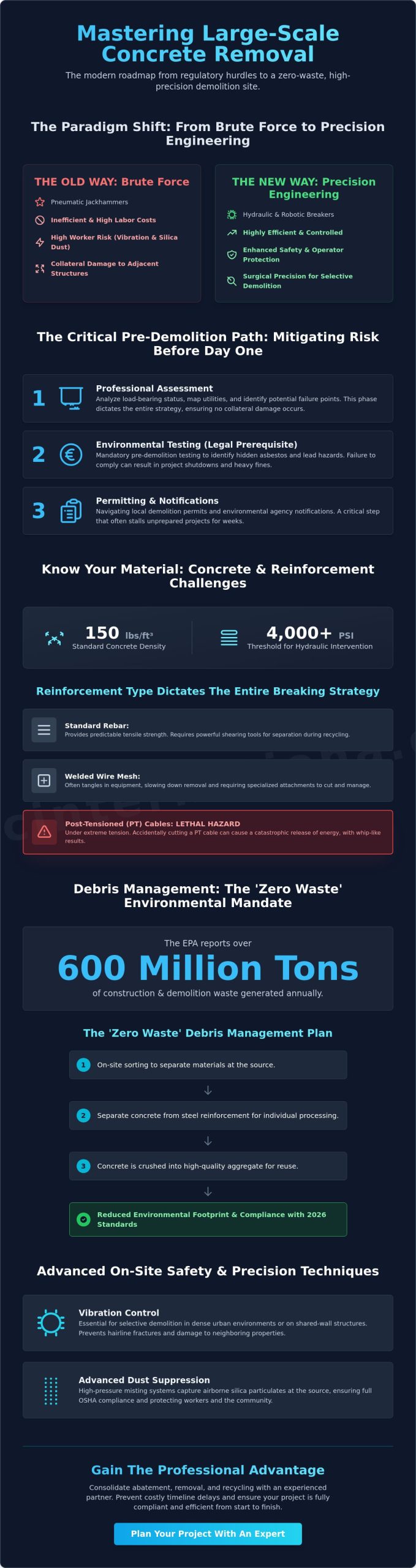
For commercial scale projects, manual removal via handheld jackhammers is a failed strategy. It’s inefficient, leads to high labor costs, and exposes workers to prolonged vibration and silica dust. Modern mechanical breaking uses hydraulic leverage to achieve in minutes what a crew would struggle to finish in days. Before any heavy machinery arrives on site, a professional assessment is mandatory. We analyze the load bearing status of the concrete and the proximity of sensitive infrastructure. This phase identifies potential failure points and dictates whether we’ll use traditional mechanical breakers or more advanced robotic systems.
Understanding Concrete Density and Weight
Standard cured concrete weighs approximately 150 lbs per cubic foot. This figure is the non-negotiable baseline for all hauling logistics and disposal calculations. Underestimating this density leads to overloaded trucks and compromised site safety. In many legacy structures across the Lowcountry, we encounter ‘over-pouring.’ This occurs when foundations were cast wider or deeper than original blueprints indicated to compensate for soft coastal soil. When concrete strength exceeds a threshold of 4,000 to 5,000 PSI, hydraulic intervention becomes a technical necessity rather than a choice. High PSI ratings in industrial floors require specialized attachments that can penetrate the dense crystalline matrix without overheating the equipment.
The Role of Reinforcement in Demolition
The presence of reinforcement completely changes the breaking strategy. Standard rebar provides predictable tensile strength, but post-tensioned (PT) cables require extreme caution. Cutting a tensioned cable during the breaking process can cause a lethal release of stored energy, as the cable snaps back through the slab like a whip. We also manage welded wire mesh, which often tangles in traditional buckets and requires specialized shearing tools. The type of reinforcement also dictates the end-of-life path for the material. Clean, unreinforced concrete is easily crushed into high quality aggregate. Conversely, concrete heavily integrated with steel requires additional processing stages to separate the metal, which is essential for meeting modern 2026 environmental recycling standards.
Modern Methods for Precision Concrete Demolition
The landscape of structural removal has evolved beyond the era of indiscriminate impact. Today, professional demolition contractors charleston sc utilize a spectrum of hydraulic and robotic systems that prioritize structural preservation and environmental safety. Brute force is a relic. Modern methodology focuses on energy efficiency and the mitigation of secondary risks, such as structural fatigue in adjacent buildings. Whether we’re performing bulk removal of a reinforced foundation or the surgical extraction of a mezzanine, the choice of equipment is dictated by the specific technical parameters of the site.
Vibration control is the primary concern when working on shared-wall structures or in dense urban environments. Excessive resonance can cause hairline fractures in neighboring masonry or disrupt sensitive equipment in nearby facilities. To counter this, we employ advanced dust suppression technologies that utilize high-pressure misting systems. These systems capture airborne particulates at the source, ensuring that on-site personnel and the surrounding community remain protected. Adhering to the strict safety protocols for Managing Hidden Hazards ensures that every project meets federal compliance standards before the first strike occurs.
Hydraulic Breaking vs. Diamond Sawing
The decision between hydraulic hammers and diamond-tipped saws involves a clear cost-benefit analysis of speed versus precision. Hydraulic hammers are the preferred choice for bulk removal due to their high production rates and ability to fracture dense materials quickly. However, they carry a higher risk of transmitting vibrations. Diamond sawing offers surgical precision, creating clean edges without the risk of micro-fractures in the remaining slab. We often utilize ‘soft-cut’ methods during the initial phases of a project to isolate the demolition zone, effectively disconnecting the target area from the rest of the structure. This technical separation is vital for maintaining the integrity of the building’s permanent footprint.
Selective Demolition and Robotic Breaking
Robotic breaking represents the pinnacle of modern demolition technology. These remote-controlled units allow operators to perform high-intensity breaking in confined or hazardous spaces where traditional machinery cannot fit. Because these robots are typically electric and zero-emission, they’re the standard for indoor concrete removal projects. This level of control is fundamental in selective demolition, where the goal is to preserve specific structural elements while removing others. By removing the operator from the immediate impact zone, we significantly reduce the risk of injury while maintaining the precision required for complex renovations. Choosing the right methodology requires a partner who understands these technical nuances; you can explore our professional concrete removal services to see how we apply these standards in the field.
Managing Hidden Hazards: Asbestos and Lead in Concrete
Concrete foundations and industrial slabs often mask hazardous legacy materials that are invisible to the untrained eye. Professional demolition contractors charleston sc understand that in structures built before 1980, environmental testing isn’t a suggestion; it’s a legal mandate. Breaking concrete without a verified hazardous material survey risks releasing friable asbestos fibers or lead-laden dust into the atmosphere. This technical reality necessitates a unified safety plan where abatement and structural removal operate as a single, synchronized workflow. Failure to identify these hazards early can lead to immediate site shutdowns and significant regulatory fines.
Mechanical grinding or heavy impact breaking can easily aerosolize contaminants trapped within the concrete matrix. When these particles become airborne, they pose a severe inhalation risk to workers and the surrounding community. To maintain high Environmental Recycling Standards, the concrete must be certified clean before it’s processed into recycled aggregate. Contaminated material requires specialized disposal in Class 3 regulated landfills, which fundamentally alters the logistics of debris management and project budgeting. We prioritize containment at the source to ensure that hazardous elements are never introduced into the waste stream.
Asbestos-Containing Materials (ACM) in Foundations
Asbestos was frequently utilized in moisture barriers, mastics, and expansion joint fillers to enhance the durability and chemical resistance of concrete structures. When these materials are embedded in or adhered to concrete, standard breaking methods are prohibited until the ACM is stabilized. The technical process for asbestos removal in these environments involves establishing negative pressure enclosures and utilizing HEPA-filtered ventilation systems. Regulatory requirements in South Carolina dictate continuous air monitoring during the demolition of suspect concrete to ensure fiber counts remain below the strict OSHA-mandated permissible exposure limits.
Lead Paint Remediation on Industrial Concrete
Industrial concrete floors, silos, and secondary containment basins often feature legacy lead-based coatings designed for extreme corrosion resistance. We evaluate these surfaces to determine if chemical stripping or full mechanical removal is the most efficient path for remediation. Chemical agents can effectively soften lead coatings for manual scraping to minimize dust, while mechanical removal requires specialized vacuum-shrouded equipment to capture particles at the point of impact. Under the EPA RRP Rule, firms performing renovations or demolition on pre-1978 structures must be lead-safe certified and follow specific work practices to prevent lead contamination throughout the job site. This disciplined approach ensures that the site is safe for follow-on trades and future occupants.
Debris Logistics and Environmental Recycling Standards
Sustainable demolition in 2026 is defined by the transition from disposal to recovery. Modern demolition contractors charleston sc no longer view concrete debris as waste, but as a valuable raw material for future infrastructure. Achieving ‘Zero Waste’ goals on a commercial site requires a disciplined logistical framework that begins before the first hydraulic breaker is deployed. Once concrete is certified clean of hazardous materials, the focus shifts to maximizing the recovery rate through methodical onsite processing. This approach reduces landfill fees and provides the local construction market with high quality recycled aggregate.
The technical process of material recovery relies on strict separation protocols. By isolating different waste streams at the point of generation, we prevent cross-contamination that would otherwise render materials unrecyclable. Clean concrete is a versatile resource. When crushed to specific gradations, it’s repurposed as structural fill or road base, meeting the criteria for inert waste streams allowed in South Carolina structural fills. This closed-loop system is essential for large scale projects where the volume of debris can otherwise overwhelm local disposal capacity.
The Onsite Material Sorting Process
Efficient sorting is both an economic and environmental necessity. We utilize magnetic separators to extract rebar and welded wire mesh during the breaking process, diverting these metals to local scrap processors. This not only generates a secondary revenue stream for the project but also ensures the remaining concrete is clean for crushing. Professional contractors implement dedicated staging areas for wood, plastic, and metal on every project site. This methodical organization allows for the high-volume throughput required to keep the demolition schedule on track while maintaining 100% debris accountability.
Logistics and Hauling Requirements
Calculating hauling logistics involves more than simple volume estimates. We must account for the ‘swell factor,’ a physical reality where broken concrete occupies significantly more space than its original solid state. Typically, fractured concrete expands by 30% to 50% in volume, meaning a 1,000 square foot slab requires far more roll-off containers than its initial dimensions suggest. Underestimating this expansion leads to site congestion and delayed timelines. Every load must also comply with national DOT regulations for overweight debris hauling. Since concrete weighs approximately 150 lbs per cubic foot, we calculate truck loads with precision to ensure all transit remains within legal weight limits for Charleston’s roads. For projects requiring a managed, compliant debris stream, you can request a professional recycling and logistics plan to ensure your site remains efficient and sustainable.
Hiring a Concrete Removal Contractor: The Professional Advantage
Selecting a partner for large-scale concrete removal requires a transition from technical theory to operational execution. While many demolition contractors charleston sc can operate heavy machinery, few possess the engineering depth to manage the intersection of structural instability and environmental risk. Vetting a contractor based on their ability to provide a fixed-price structural demolition contract offers the budget certainty essential for commercial stakeholders. This financial predictability is only possible when a contractor performs a rigorous pre-project analysis, utilizing a comprehensive demolition guide to account for every variable from permit timelines to debris swell factors.
The complexity of 2026 regulatory standards means that experience isn’t just a metric of time, but a measure of risk mitigation. A single-source contractor who manages both the structural breaking and the hazardous material abatement significantly reduces the friction that typically stalls multi-phase projects. When a single entity holds accountability for the entire scope, the owner benefits from streamlined communication and a unified safety culture. This integrated approach ensures that environmental compliance documentation is handled concurrently with the physical removal, preventing the administrative bottlenecks that often delay site handovers.
Evaluating Contractor Credentials and Safety
A contractor’s safety record is best reflected in their Experience Modification Rate (EMR). An EMR below 1.0 indicates a safety performance that is superior to the industry average, which is a critical benchmark for high-risk concrete breaking. You should demand a Site-Specific Safety Plan (SSSP) that details the exact measures for vibration monitoring, dust suppression, and utility protection. Contractors with 15+ years of experience in government and commercial agency standards understand that safety isn’t a checklist; it’s a methodology. This level of expertise translates to better risk management on active job sites, ensuring that unexpected foundation anomalies don’t escalate into safety incidents or costly liabilities.
The Benefits of Integrated Abatement and Demolition
Integrated services eliminate the scheduling conflicts that arise when separate abatement and demolition crews compete for site access. By consolidating these functions, demolition contractors charleston sc can maintain a continuous workflow, moving directly from material stabilization to structural removal without mobilization delays. This synergy is particularly valuable when managing the hazardous materials discussed in previous sections, as the same team that identifies the risk is responsible for its containment. This continuity reduces the owner’s exposure to regulatory scrutiny and ensures a cleaner transition to the construction phase. Contact TSIAC International for a professional consultation on your next concrete removal project to ensure your site meets the highest standards of technical precision and safety.
Mastering Your Next Concrete Removal Project
Executing a large-scale concrete removal project in 2026 requires a fusion of engineering precision and environmental responsibility. Success hinges on more than just mechanical force; it requires the early identification of sub-surface hazards like asbestos and the disciplined management of debris logistics. Partnering with elite demolition contractors charleston sc ensures that your site remains compliant with SC DHEC standards while maximizing material recovery through onsite recycling. By prioritizing technical assessment over brute force, you protect both your project timeline and the structural integrity of your permanent assets.
TSIAC International leverages over 15 years of industry experience to provide integrated asbestos and lead abatement expertise that simplifies complex project workflows. Our unwavering commitment to environmental recycling on every job site ensures that your concrete debris is repurposed as a sustainable resource rather than lost to a landfill. We provide the technical certainty and methodological accuracy required for high-stakes structural demolition. Request a Quote for Professional Concrete Removal today to secure a partner who values safety and efficiency as much as you do.
Frequently Asked Questions
How much does professional concrete breaking and removal cost per square foot?
Project costs are determined by slab thickness, reinforcement density, and site accessibility rather than a flat rate. While national averages for removal exist, leading demolition contractors charleston sc calculate estimates based on the specific PSI of the concrete and the logistical requirements of hauling heavy debris. Thick industrial slabs with post-tensioned cables require more specialized equipment and labor hours than a standard unreinforced four-inch slab.
Can concrete with lead paint or asbestos be recycled?
Concrete contaminated with lead-based coatings or asbestos fibers cannot enter the standard recycling stream. It must undergo professional abatement or be transported to a Class 3 regulated landfill for hazardous materials. Clean concrete is a valuable resource for recycled aggregate, but any presence of legacy hazardous materials requires specialized handling to prevent environmental contamination and ensure full regulatory compliance across the waste stream.
What is the difference between concrete breaking and concrete cutting?
Concrete breaking utilizes hydraulic impact to fracture the material into manageable pieces, whereas concrete cutting uses diamond-tipped saws for surgical precision. Breaking is the standard for bulk removal where speed and volume are the primary priorities. Cutting is essential for selective demolition where you must preserve the structural integrity of the remaining slab or prevent micro-fractures from traveling into adjacent foundations.
Do I need a permit for concrete removal on my commercial property?
Yes, commercial concrete removal in Charleston typically requires a demolition permit, which involves a review period of three to eight weeks. Property owners must also file a notification with SC DHEC at least 10 working days before breaking begins to confirm asbestos compliance. Professional demolition contractors charleston sc manage these administrative requirements to ensure the project remains compliant with all municipal and state building codes.
How do you protect underground utilities during heavy concrete breaking?
We utilize ground-penetrating radar (GPR) and private utility locating services to map all subsurface lines before the first strike. This technical assessment identifies the exact depth and location of electrical, water, and gas conduits. In high-risk areas, we employ soft-digging techniques or hand-breaking to isolate the utility lines, effectively preventing the catastrophic damage that occurs when heavy machinery strikes unmarked or shallow infrastructure.
What happens to the concrete debris after it is removed from the site?
Clean concrete debris is transported to a processing facility where it’s crushed into recycled aggregate for road base or structural fill. This process involves using magnetic separators to remove rebar and other metal reinforcements for scrap processing. By diverting clean concrete from landfills, we support local sustainable construction goals and provide a cost-effective, high-quality material for future infrastructure projects throughout the Lowcountry.
Is robotic demolition safer than traditional hydraulic breaking?
Robotic demolition is significantly safer because it allows the operator to control the equipment from a remote distance, entirely removed from the immediate hazard zone. These machines are typically electric and zero-emission, making them the preferred choice for indoor projects where air quality and noise are primary concerns. Their compact size allows for high-intensity breaking in confined spaces that traditional excavators simply cannot access safely.
How long does it take to remove a standard 5,000-square-foot concrete slab?
Removing a 5,000-square-foot slab typically requires three to five days of onsite activity once the equipment is fully mobilized. This timeline accounts for the initial breaking, onsite material sorting, and the complex logistics of hauling multiple truckloads of heavy debris. Factors like the “swell factor” of broken concrete and the complexity of steel reinforcement can influence this duration, requiring a methodical approach to maintain the schedule.
