
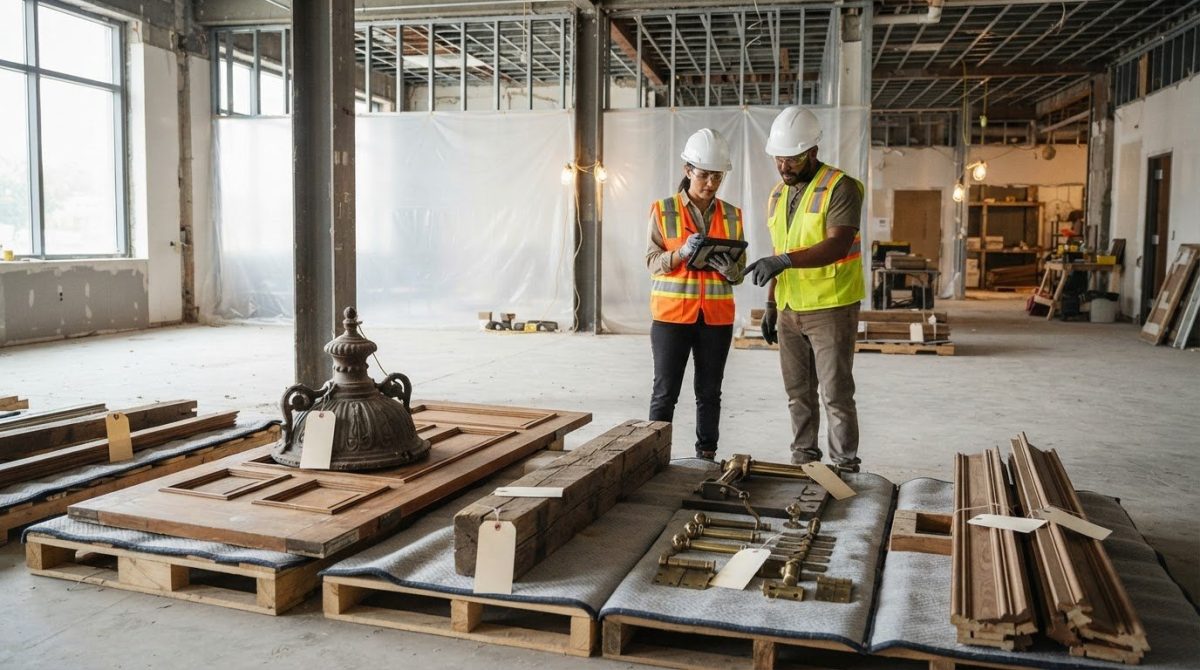
A reusable door, light fixture, or timber beam can become debris before anyone has time to assess it. Salvaging architectural elements before demolition works best when recovery is planned in advance, not improvised as materials are removed. Early planning matters when you’re deciding what’s worth saving, concerned demolition could damage it, or coordinating recovery with hazardous-material abatement.
Start by identifying potential salvage candidates and assessing their condition, removal requirements, and likely destination. Then plan for safe handling, temporary storage, and the sequence of selective demolition, abatement, and debris removal. This guide explains how to evaluate reuse options, decide when materials may be better suited to recycling, and coordinate the work before demolition begins. A demolition contractor experienced in selective demolition, abatement, and recycling can help align these activities. Confirm project-specific recovery capabilities before scheduling work.
Key Takeaways
- Build a candidate inventory that records each feature’s material, dimensions, condition, attachment method, and intended destination.
- Plan salvaging architectural elements before demolition as a defined work sequence, with priorities aligned to access, structural conditions, and project scope.
- Keep safety assessment and qualified review ahead of disturbing components that may contain hazardous materials.
- Choose an approach based on project needs, and evaluate experience with selective demolition, safety planning, documentation, and material handling.
- When direct reuse isn’t suitable, consider whether recovered materials can be directed to recycling instead.
Why Salvage Architectural Elements Before Demolition Starts?
Architectural salvage is the planned recovery of building features for reuse, resale, or preservation before demolition. It differs from ordinary debris removal, where materials are cleared as part of the demolition process, and from recycling, which processes materials for use as raw material rather than retaining an intact feature. The broader practice of Deconstruction describes taking a building apart to recover components rather than removing it only as debris.
Planning matters because features can be fragile, difficult to detach, or integrated with surrounding construction. Once demolition begins, routine removal can crack, bend, or break an item that might otherwise have been recovered intact. Identifying priorities early gives the project team time to plan the removal sequence, access, labor, and storage. Salvage still depends on each item’s condition and whether it can be accessed and removed safely within the project schedule.
Which architectural elements may be candidates for salvage?
Potential candidates include doors and hardware, millwork, decorative metalwork, lighting, stone, and specialty fixtures. Age or visual appeal alone doesn’t establish that an item is sound, safe to remove, or suitable for another use. Record each candidate with photographs, its location, approximate dimensions, and observed condition. Note visible damage and how it appears to be attached, but don’t disturb uncertain or potentially hazardous materials before appropriate assessment.
When does salvage make sense for a demolition project?
Compare the feature’s preservation value and likely reuse with the effort required to remove it, the time available, and the storage conditions needed after recovery. A sound door with accessible hardware may be a more practical candidate than brittle trim bonded to a wall or a large fixture with no confirmed destination. Built-in, damaged, contaminated, or difficult-to-access elements may not be suitable for salvage.
Make the decision item by item before finalizing demolition plans. Confirm who will remove each feature, how it will be handled, and where it will go. Without a safe removal plan and protected storage, an item can be damaged after recovery. Don’t assume salvage will produce a financial return or that every recovered component will be reusable. A project-specific assessment can help weigh preservation goals against labor, timing, access, and condition. If direct reuse isn’t appropriate, recycling may be more suitable than treating the material as ordinary debris.
How to Assess Salvage Value, Condition, and Reuse Potential
A candidate list is useful only if it supports a clear decision. Before finalizing demolition plans, assess each item’s condition, material, dimensions, attachment method, removal effort, and likely destination. A feature that appears valuable may be difficult to remove intact or have no confirmed recipient. This structured review makes salvaging architectural elements before demolition a project decision rather than an assumption.
What should a salvage inventory record?
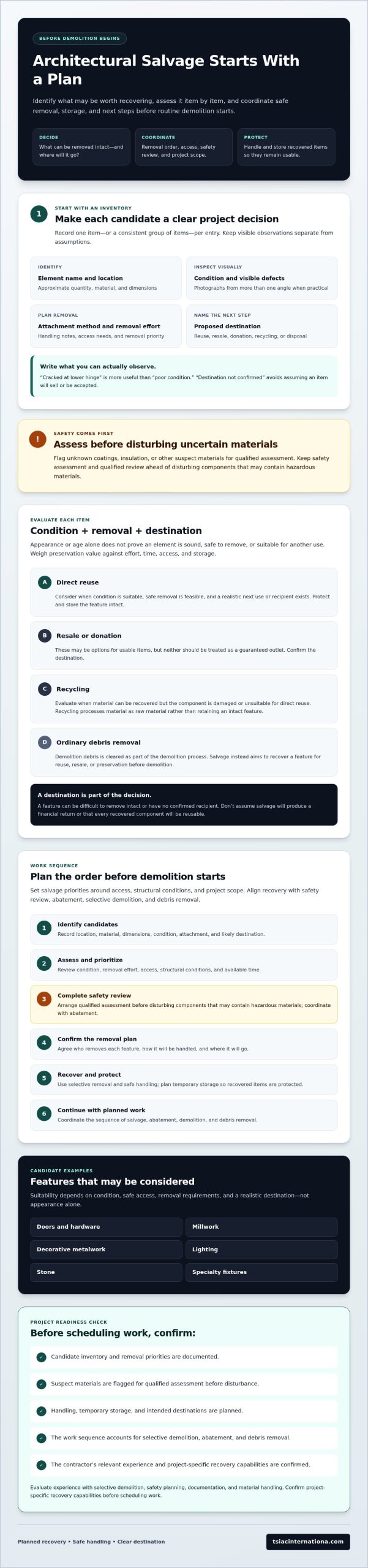
Use one inventory entry per item or consistent group of items. Record the element name, location, approximate quantity, dimensions, visible defects, and photographs from more than one angle when practical. Add a removal priority, handling notes, and proposed destination, such as reuse, resale, donation, recycling, or disposal. Flag unknown coatings, insulation, or other suspect materials for qualified assessment before anyone disturbs them.
Keep observations separate from assumptions. “Cracked at lower hinge” is more useful than “poor condition”; “destination not confirmed” is more accurate than assuming an item will sell or be accepted. This record gives the project team a shared basis for comparing options and planning removal.
How can teams decide between reuse and recycling?
Direct reuse is most practical when an element is in suitable condition, can be removed safely, and has a realistic next use or recipient. Resale or donation may be options, but neither should be treated as a guaranteed outlet. If a material can be recovered but the component is damaged or unsuitable for reuse, recycling may be worth evaluating. The U.S. EPA’s Sustainable Management of Construction and Demolition Materials provides broader guidance on material recovery and management.
Use this compact comparison to set the next step for each inventory entry:
- Direct reuse: Sound condition and a plausible use; removal effort is manageable; protect and store intact; confirm the recipient or project use.
- Resale or donation: Usable condition, but no owner reuse plan; assess removal and handling needs; verify interest and acceptance before scheduling recovery.
- Recycling: Recoverable material, but unsuitable as an intact feature; separate and handle by material type; confirm an appropriate recycling route.
- Disposal: Unsafe, contaminated, badly damaged, or without a suitable recovery path; follow project handling requirements and include it in debris planning.
Compare condition, demand, labor, timing, and storage together. If selective removal is part of the project, discuss the inventory and handling priorities with a demolition team before setting the sequence. For broader context on recycling demolition debris, see recycling demolition debris, and confirm which recovery capabilities apply to the specific project.
How to Salvage Architectural Elements Before Demolition: A Work Sequence
Recovery works best when it is built into the demolition plan, with clear boundaries and an agreed order of work. Salvaging architectural elements before demolition requires coordination between the owner, design team, and relevant contractors so removal priorities fit the project scope, site access, structural conditions, and schedule. The appropriate removal method depends on how each element is constructed and should be confirmed through qualified project assessment.
What happens during pre-demolition planning?
Walk the site with the owner, design team, and relevant contractors before scheduling removal. Mark which components will remain, which are designated for salvage, and which are slated for demolition. Agree on access, responsibilities, removal priorities, and temporary protection. Resources from Build Reuse can also help teams consider building-material recovery and reuse during project planning.
A practical work sequence can then move from survey to protected storage:
- 1. Confirm the scope: Review the candidate inventory and verify which items still have a proposed destination and a viable removal plan.
- 2. Assess the work area: Confirm access routes, nearby retained components, structural conditions, and any safety or abatement requirements before disturbance.
- 3. Set boundaries and priorities: Mark salvage areas clearly and identify the order of removal. Resolve conflicts with demolition activities before work begins.
- 4. Prepare protection: Establish how adjacent surfaces and retained elements will be protected, and confirm how recovered items will be moved out of the work area.
- 5. Remove selectively: Use a method suited to the element’s material, attachment, and condition. Careful separation can limit avoidable damage to both the item and components designated to remain.
- 6. Document and transfer: Update the inventory after removal, note any damage or change in condition, and record where each item is being transferred or stored.
How should recovered elements be handled and stored?
Keep each item connected to its inventory record. Label it with an identifier that matches the record, then use handling and packaging suited to its material, fragility, and exposure risks. A fragile fixture, for example, needs different protection from a substantial metal component. Assign a secure, suitable storage location before removal and confirm who accepts custody at each transfer. Without clear ownership and storage arrangements, recovered elements can be damaged, misplaced, or left exposed before they reach their intended destination.
How to Coordinate Salvage with Safety, Abatement, and Demolition
Salvage priorities must fit the project’s safety plan and demolition sequence. Before anyone disturbs a component, confirm what is known about its materials, condition, and surroundings. A reusable-looking feature isn’t a reason to bypass qualified assessment or applicable project requirements. If recovery conflicts with worker protection, containment, or safe access, pause salvage work until the responsible professionals resolve the issue.
What if a feature may contain hazardous materials?
Stop and seek qualified assessment if coatings, insulation, or the contents of a fixture or assembly are unknown and could present a hazard. Don’t take samples, scrape finishes, open enclosed components, or attempt removal without appropriate qualifications and direction. The assessment should inform whether the item can be recovered, whether abatement must occur first, and how the work area needs to be managed. Salvage goals remain secondary to protecting workers and meeting applicable project requirements. Consult the project team’s hazardous-material abatement guidance before setting a recovery date.
How do demolition teams protect retained building components?
Before demolition starts, mark retained and salvage-designated features on the work plan and establish clear physical separation from components scheduled for removal. Identify access routes and agree who is responsible for protection, removal, and moving each item. Coordinate the sequence so salvage does not conflict with containment needs or expose workers to active demolition areas.
Selective demolition can support careful removal when components must remain intact, but the appropriate method depends on the assembly, its connections, and structural conditions. Qualified project review should determine how the work proceeds. A method suitable for a detached fixture may not be appropriate for a feature integrated into a wall or structural system. Coordinate salvage, abatement, and demolition schedules before work begins, and communicate changes in condition or access to the responsible parties. For broader process and safety context, review the project’s demolition planning materials.
Clear coordination helps prevent salvage tasks from becoming unplanned work inside an active demolition zone. Information about selective demolition and abatement is available from TSIAC International.
How to Choose a Salvage Approach and Prepare for Demolition
The right coordination model depends on the building and recovery goals. A straightforward project with a few accessible items may suit owner-led coordination, provided someone has time and expertise to manage removal, storage, and transfer. Fragile, integrated, or technically complex features may call for specialist salvage involvement. Coordination with a demolition contractor can help align selective removal with demolition sequencing, site access, and abatement activities. No single approach fits every project, and none can guarantee that a component will be recovered intact or find a next use.
Which salvage coordination option fits the project?
Compare the project’s complexity, element fragility, schedule, and available expertise before assigning responsibilities. Clarify in writing who identifies candidates, approves removal, arranges labor and storage, coordinates transport, and accepts recovered materials. Ask about relevant experience with selective removal, safety planning, documentation, and material handling. For salvaging architectural elements before demolition, clear decision-making authority matters: the person approving recovery should understand both the preservation priority and the project constraints.
What should owners confirm before demolition begins?
Use a final readiness check to resolve gaps before scheduling demolition or abatement work:
- Inventory: Confirm each item’s location, condition notes, removal priority, and intended destination.
- Responsibilities: Name who approves removal, performs or coordinates the work, arranges storage and transport, and accepts custody.
- Access and protection: Confirm access routes, separation from demolition areas, and measures to protect retained components.
- Safety review: Resolve questions about suspect materials through qualified assessment before disturbance.
- Sequence: Check that salvage activities fit the demolition scope, abatement work, site access, and overall schedule.
- Disposition: Confirm whether each recovered item is intended for reuse, resale, donation, recycling, or another planned route. Don’t assume an outlet is secured until it has been confirmed.
TSIAC International provides selective demolition, hazardous-material abatement, and recycling services. These capabilities may be relevant to project planning, but confirm specific material recovery needs and responsibilities for each job. Recycling can be considered for materials that aren’t suitable for direct reuse.
Discuss your demolition requirements and project scope with TSIAC International to determine how selective demolition, abatement, and recycling may fit the work plan.
Plan Recovery Before the Demolition Work Begins
Successful salvaging architectural elements before demolition starts with clear decisions: identify candidates early, assess condition and safe removal requirements, and confirm where each item will go. A documented inventory and coordinated sequence help align salvage with abatement, selective demolition, access, and storage. Not every feature will be suitable for reuse, so evaluate each one on its merits and consider recycling when direct recovery isn’t appropriate.
TSIAC International has more than 15 years of industry experience and provides selective demolition, structural demolition, and hazardous-material abatement. Its project-site recycling practices include recovery of wood, metal, and plastic. Confirm the specific scope and material recovery capabilities relevant to your project before scheduling work.
Start with a clear project plan and assigned responsibilities. Discuss your demolition and selective-removal requirements with TSIAC International to review the scope and how the work may be coordinated. Careful preparation helps your team make informed decisions before demolition begins.
Frequently Asked Questions
What architectural elements can be salvaged before demolition?
Doors, hardware, millwork, decorative metalwork, lighting, stone, and specialty fixtures may be candidates for salvaging architectural elements before demolition. Suitability depends on more than age or appearance: assess visible damage, material, attachment, safe access, and whether there’s a realistic destination. Photograph each item, note its location and approximate dimensions, and record concerns. Don’t disturb components if their materials or coatings are uncertain until they’ve been assessed by qualified professionals.
When should architectural salvage be planned before demolition?
Plan salvage during early project development, before finalizing demolition and abatement schedules. This gives the owner and project team time to identify candidates, assess removal needs, confirm access, and arrange labor, handling, and storage. It also allows salvage priorities to be coordinated with components that must remain and areas scheduled for demolition. Waiting until debris removal is underway can reduce access and leave little time to recover fragile or integrated features carefully.
How do you decide whether an architectural element is worth salvaging?
Compare the item’s condition, material, dimensions, attachment method, preservation or reuse value, and removal effort. Then consider timing, safe access, storage requirements, and whether a recipient or future use is confirmed. A sound, accessible fixture with a clear destination may be a stronger candidate than brittle trim that is difficult to separate intact. If direct reuse isn’t practical, evaluate resale, donation, or recycling without assuming an outlet or financial return.
Can architectural elements be salvaged during demolition?
Yes, some elements can be recovered during a planned selective-demolition sequence, but salvage should be scheduled rather than improvised as general demolition proceeds. Identify items in advance, define which components must remain, and coordinate removal with access, structural conditions, and any abatement work. The appropriate method depends on how each feature is attached and constructed. If recovery could compromise safety or damage retained components, pause and seek qualified project review.
What should happen if salvaged materials may contain hazardous substances?
Stop work on the uncertain component and arrange qualified assessment before disturbing it. Don’t scrape coatings, open enclosed components, collect samples, or attempt removal without appropriate expertise and direction. The assessment should guide whether abatement or other controls are needed and whether recovery can proceed safely. Salvage goals never take priority over worker protection or applicable project requirements. Coordinate decisions with the responsible abatement and demolition professionals before setting a removal sequence.
How should salvaged architectural elements be stored?
Label each recovered item with an identifier that matches its inventory record, including its condition and intended destination. Choose packaging and handling suited to the material and fragility, and protect items from relevant exposure risks during transfer and storage. Confirm a secure, suitable storage location before removal, then identify who accepts custody and responsibility for the item. Without a planned destination and clear handoff, recovered features may be damaged, misplaced, or left exposed.
Who should coordinate architectural salvage before demolition?
The owner or project lead should ensure responsibilities are assigned among the design team, demolition contractor, abatement professionals, and any salvage specialist involved. The right arrangement depends on the building’s complexity, element fragility, schedule, and available expertise. Put in writing who identifies candidates, approves removal, coordinates labor, arranges storage and transport, and accepts recovered materials. A contractor experienced in selective demolition and hazardous-material abatement can help align salvage priorities with the broader work plan.
