
Commercial mold removal services shouldn’t be treated as a simple cleaning task; they’re a specialized structural abatement process that requires surgical precision and integrated hazardous material management. When mold infiltrates your facility, the visible growth is often just a symptom of deeper contamination hidden behind drywall or within HVAC systems. You likely understand the pressure of maintaining indoor air quality while fearing the liability and operational downtime that a major remediation project can trigger. It’s a complex balancing act, especially when you’re managing multi-service abatement involving both mold and asbestos.
This 2026 guide will help you discover the technical standards and structural strategies required to permanently eliminate mold from your commercial property. You’ll learn how to maintain full regulatory compliance and achieve a mold-free environment that passes rigorous third-party clearance. We’ll preview the latest ANSI/IICRC S520 standards and the 2026 National Defense Authorization Act mandates, providing you with a clear roadmap to secure your building’s health with minimal disruption to your daily operations. Our goal is to provide the full regulatory documentation you need for insurance and compliance through methodical, expert-led execution.
Key Takeaways
- Understand why commercial mold remediation is a specialized structural safety protocol rather than a standard maintenance task.
- Learn the technical limitations of biocides and why deep structural abatement is required for porous commercial materials.
- Discover how to implement the 2026 methodology for commercial mold removal services, including high-volume HEPA filtration and negative air pressure containment.
- Navigate the complexities of the ANSI/IICRC S520 standard and the critical role of Independent Environmental Professionals in ensuring liability protection.
- Identify the strategic advantages of partnering with heavy-duty abatement contractors who integrate demolition and remediation for permanent results.
Evaluating the Risks of Mold in Commercial Environments
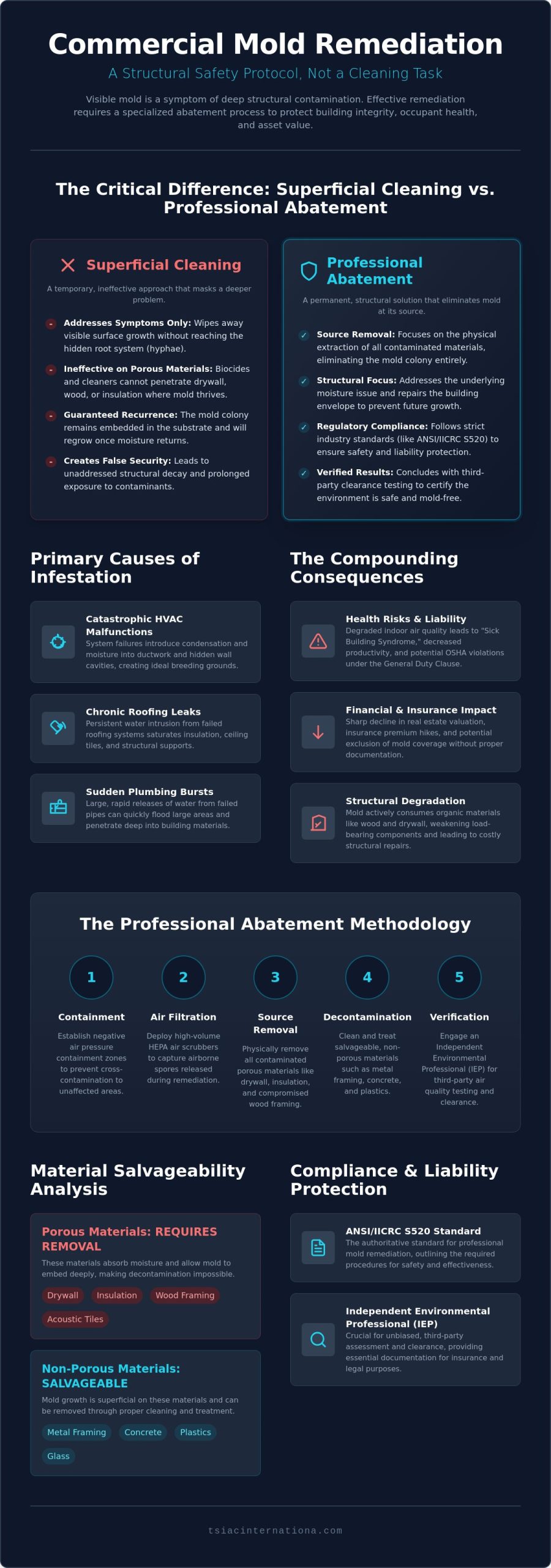
Professional commercial mold removal services represent a specialized structural safety protocol rather than a standard custodial task. In large-scale facilities, mold isn’t merely an aesthetic issue; it’s a biological contaminant that compromises the integrity of the building. Most commercial infestations stem from three primary mechanical failures: catastrophic HVAC malfunctions, chronic roofing leaks, or sudden plumbing bursts. These events introduce moisture into hidden cavities, creating an environment where spores thrive. Failure to address these triggers immediately can lead to a sharp decline in commercial real estate valuation. Appraisers and potential buyers increasingly view unmitigated mold as a significant liability, often requiring extensive price concessions or complete remediation before a transaction can proceed.
The legal implications of poor indoor air quality (IAQ) are substantial. Insurance providers are tightening their requirements, often excluding mold coverage unless specific preventative measures and professional abatement protocols are documented. For those seeking a comprehensive overview of mold and its environmental behavior, it becomes clear that moisture control is the only path to long-term structural viability. Unresolved moisture issues also trigger insurance premium hikes. Many carriers now require detailed remediation logs and third-party clearance certificates before renewing policies on older commercial assets.
Health Risks and Liability for Facility Managers
Property owners face significant liability when “Sick Building Syndrome” affects a workforce. Mold spores significantly degrade indoor air quality, which directly correlates with decreased employee productivity and increased sick leave. OSHA doesn’t have a specific permissible exposure limit for mold. However, they monitor workplace conditions under the General Duty Clause. This requires employers to provide a workplace free from recognized hazards. Facility managers must recognize that IAQ is a measurable metric of building health. It’s a core component of modern risk management that protects both the staff and the bottom line.
Even if your facility doesn’t require full-scale abatement, maintaining high hygiene standards is essential; for professional support in the South Vancouver Island area, you can check out Sani-Tech Victoria.
Structural Degradation of Building Materials
Mold is a decomposer that actively consumes organic substrates. Wood framing, drywall, and even certain acoustic ceiling tiles serve as food sources. If left untreated, this biological activity can eventually weaken load-bearing components. This leads to costly structural repairs. Engaging professional commercial mold removal services early prevents these structural failures from escalating into a total building loss. Determining which materials are salvageable is a technical decision. While non-porous surfaces like metal framing or concrete can often be decontaminated, porous materials like drywall or insulation usually require total removal. This ensures the mold won’t return and the structural integrity remains intact.
The Critical Difference Between Mold Cleaning and Professional Abatement
Many property managers mistake surface cleaning for a permanent solution. Wiping down visible growth or applying a store-bought biocide only addresses the symptoms of a much larger structural issue. Professional commercial mold removal services focus on abatement, which is the total physical extraction of the mold and its root system. In a commercial setting, biocides are often insufficient because they cannot penetrate deeply into porous materials like drywall, insulation, or wood framing. If the hyphae, or the roots of the mold, remain embedded in the substrate, the colony will inevitably return once moisture levels fluctuate. True remediation requires a methodical approach that prioritizes source removal over chemical masking.
The EPA’s guide to commercial mold remediation emphasizes that the only way to ensure a mold-free environment is to physically remove the contaminated materials. This process often involves complex logistics, especially when the mold is located within building envelopes or interstitial spaces. For stakeholders managing aging assets, understanding the broader requirements of hazardous material abatement south carolina is essential. It ensures that the remediation strategy accounts for all environmental toxins, not just biological ones, protecting both the building’s value and the occupants’ health. If your facility has a history of moisture intrusion, a professional assessment is the first step toward a permanent fix.
The Hazard Overlap: Mold, Asbestos, and Lead
Mold rarely exists in a vacuum. In older commercial structures, the moisture that fuels mold growth often degrades other hazardous materials. Spores frequently hide behind asbestos-containing pipe insulation or within wall cavities coated in lead-based paint. Disturbing these areas without a master abatement plan can release a cocktail of toxins into the air. This is why asbestos removal south carolina expertise is frequently required alongside commercial mold removal services. A unified approach prevents cross-contamination and ensures that one remediation effort doesn’t inadvertently trigger a separate environmental crisis.
Why Commercial Projects Require Selective Demolition
Selective demolition is the cornerstone of effective commercial remediation. Unlike residential “gut jobs,” this is a surgical process. Technicians remove only the compromised sections of the structure, such as specific drywall panels or flooring sections, while preserving the surrounding integrity. This precision is necessary because non-invasive methods cannot reach the moisture trapped deep within commercial wall assemblies. By utilizing selective demolition, we can extract the mold source directly. This minimizes the footprint of the project and allows for a faster return to normal operations, provided the work is performed under strict containment protocols.
The 2026 Standard for Commercial Mold Remediation: A Step-by-Step Methodology
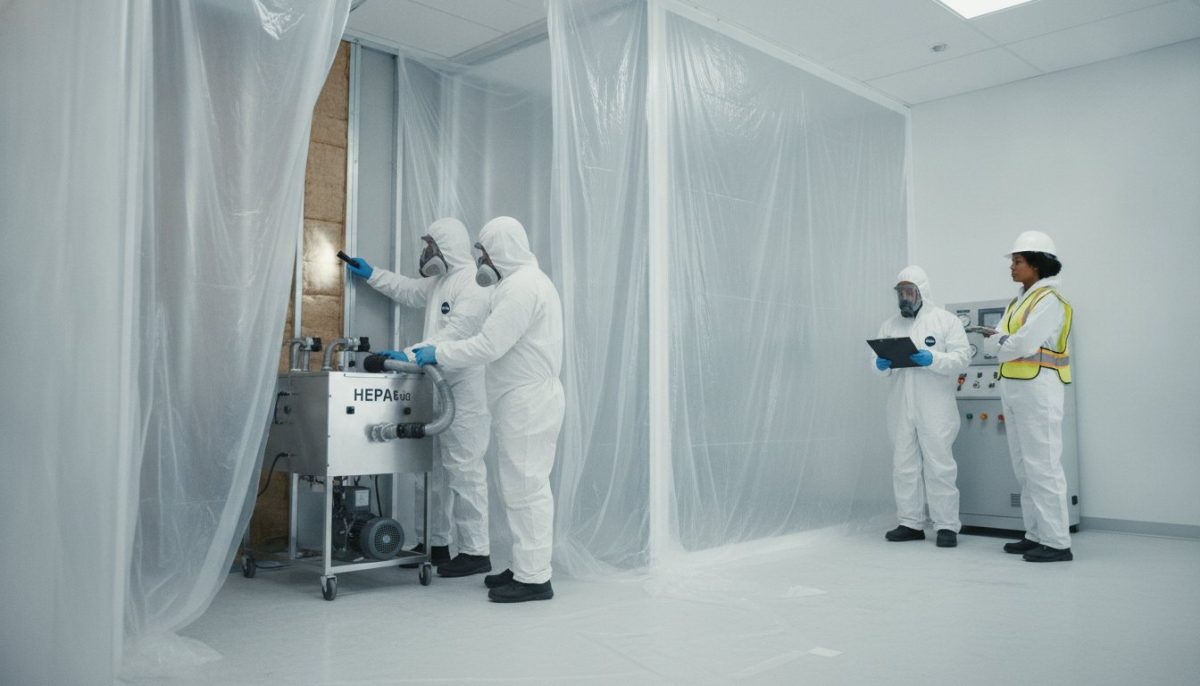
The 2026 industry standards for commercial mold removal services demand a level of technical precision that far exceeds traditional restoration methods. Large-scale projects now operate under the ANSI/IICRC S520-2025 standard, which mandates rigorous containment and air filtration protocols. We utilize high-volume HEPA air scrubbers capable of multiple air exchanges per hour to ensure that microscopic spores don’t migrate during the removal process. These machines work in tandem with industrial-grade negative air pressure units to create a controlled environment. Adhering to OSHA’s guide to mold in the workplace ensures that every technician and building occupant remains protected throughout the abatement cycle. This methodology isn’t just about removing visible growth; it’s about managing the entire atmospheric volume of the affected zone.
When moisture intrusion is systemic, the remediation process often requires stripping building interiors down to the structural studs. This level of intervention is necessary to identify hidden colonies that thrive behind insulation and within metal framing. We don’t guess where the mold stops. We use thermal imaging and moisture mapping to define the exact boundaries of the contamination. For property owners facing severe infestations, we often integrate commercial interior gutting services to facilitate a total reset of the indoor environment. This comprehensive approach guarantees that no residual spores remain to re-colonize the space once the build-back begins.
Phase 1: Advanced Containment and Negative Air
Engineering a containment zone starts with the application of 6-mil polyethylene sheeting to isolate the work area from the rest of the facility. We don’t simply tape up plastic; we create airtight seals at every junction, including HVAC vents and plumbing penetrations. Technicians monitor pressure differentials using digital manometers to verify that the containment remains intact. Negative air pressure serves as the fundamental mechanism of modern containment by ensuring air only flows into the work zone, never out. This prevents the cross-contamination of clean areas, allowing the rest of your business to remain operational while we work.
Phase 2: Surgical Removal and Debris Management
Once containment is verified, we begin the surgical removal of contaminated drywall, ceiling tiles, and fiberglass insulation. These materials are bagged and sealed within the containment zone to prevent spore release during transport. Concrete and masonry surfaces require a different approach; we use specialized abrasive tools and wire brushing followed by HEPA vacuuming to extract mold from the pores of the substrate. Managing acoustic ceiling systems is particularly critical, as these porous tiles often act as a secondary reservoir for spores. If a ceiling system is compromised, total removal is typically the only path to achieving a successful third-party clearance test.
Compliance, Liability, and Regulatory Standards in Mold Remediation
Compliance in the remediation sector isn’t optional; it’s the foundation of effective risk management. The ANSI/IICRC S520 Standard for Professional Mold Remediation serves as the procedural benchmark for all high-stakes projects. Adhering to these guidelines ensures that commercial mold removal services meet the necessary “standard of care” expected by courts and insurance carriers. A critical component of this process is the involvement of an Independent Environmental Professional (IEP). By hiring an IEP to perform initial assessments and develop the remediation protocol, property managers create a clear separation between the consulting and the physical abatement. This transparency is vital for validating that the project was executed without a conflict of interest and remains compliant with the 2026 National Defense Authorization Act mandates for facility safety.
Post-remediation verification (PRV) follows the physical removal of the contaminant. This involves rigorous clearance testing, including air and surface sampling, to confirm that the fungal ecology has returned to normal levels. Without a successful PRV report from a third-party lab, a project cannot be considered complete. We also maintain a strict chain-of-custody for all waste generated during the process. Documenting where every bag of contaminated debris is transported ensures compliance with local environmental regulations and prevents future liability regarding improper disposal. This methodical approach turns a potential disaster into a documented success story.
Documentation for Insurance and Legal Defense
Insurance adjusters require more than just a finished project; they need a comprehensive paper trail. We maintain daily logs that track humidity levels, temperature, and equipment performance. Photo documentation captures the state of the structure before, during, and after the abatement. Moisture mapping is particularly important here. It provides empirical proof that the underlying cause of the mold has been resolved. This level of detail protects property owners from future litigation by proving that the remediation was thorough and followed all legal mandates. Detailed reporting is your best defense against long-term liability claims.
Safe Disposal and Environmental Responsibility
Transporting mold-contaminated materials requires specific handling to prevent spore release during transit. While mold isn’t always classified as hazardous waste in the same way as asbestos, improper disposal in standard landfills can lead to environmental hazards. We follow the same rigorous standards outlined in our guide to the demolition process south carolina to manage debris. This includes double-bagging porous waste and ensuring that all materials are handled by licensed hauling professionals. Proper waste management is the final step in ensuring the safety of your property and the surrounding community.
If you’re managing a facility that requires a high-precision approach to safety and compliance, schedule a technical consultation with our abatement specialists today.
Advanced Structural Remediation: The TSIAC International Approach
TSIAC International operates as a heavy-duty abatement contractor, distinguishing our methodology from standard cleaning companies that lack industrial capacity. We bring 15+ years of experience in managing complex demolition and remediation projects across diverse commercial sectors. Our team understands that mold is often the result of deep-seated structural failures. Therefore, our commercial mold removal services don’t stop at the surface. We integrate structural and selective demolition to reach the source of the contamination, ensuring a permanent solution rather than a temporary fix. This surgical approach preserves the building’s essential components while removing every trace of organic decay.
Our commitment to job site safety is absolute. Every project is managed by experienced supervisors who prioritize containment integrity and worker protection. We don’t just follow the rules; we set the standard for technical precision in the field. By treating mold remediation as a structural abatement process, we provide property owners with the confidence that their assets are being handled by professionals who understand the physics of building science. We manage the entire lifecycle of the project, from initial containment to final structural clearance, ensuring that the facility is safe for re-occupancy.
Integrated Abatement and Demolition Services
Efficiency in large-scale remediation comes from consolidating hazardous material management. When a building requires a total renovation, TSIAC handles the “full gut” process, which includes the systematic removal of all non-structural components. Using a single contractor for mold, asbestos, and lead abatement eliminates the logistical friction of coordinating multiple specialized crews. This unified command structure is particularly effective for projects involving concrete removal in commercial foundations or sub-grade basements where moisture has compromised the substrate. We provide the heavy equipment and technical expertise needed to strip a facility down to its core while maintaining a sterile environment.
Environmental Recycling and Debris Sorting
Our debris management strategy focuses on sustainability and cost-efficiency. We don’t just dump waste into landfills; our teams perform on-site sorting to recover valuable materials like metal framing, wood, and industrial plastics. This recycling process reduces the overall volume of waste, which directly lowers project costs for our clients. We utilize heavy machinery and specialized sorting protocols to manage large-scale debris flows without slowing down the remediation timeline. It’s a disciplined approach that balances environmental responsibility with the practical needs of a commercial construction site. By recovering materials, we help clients meet their corporate sustainability goals while ensuring all hazardous components are disposed of according to strict regulatory mandates.
Securing the Structural Integrity of Your Facility
Commercial property management in 2026 demands a shift from reactive cleaning to proactive structural abatement. You’ve seen how hidden mold behind walls can compromise both health and building value. Permanent results depend on following the ANSI/IICRC S520 standards and utilizing surgical demolition to extract the root of the problem. Expert commercial mold removal services go beyond the surface. They ensure that your facility meets all legal and insurance requirements through rigorous documentation and third-party clearance testing.
TSIAC International brings over 15 years of industrial abatement experience to every project. Our certified hazardous material specialists manage the complex intersection of mold, asbestos, and lead with technical precision. By choosing a partner with a comprehensive environmental recycling program, you’re not just fixing a building; you’re investing in a sustainable, safe future for your occupants. Take the definitive step toward a mold-free environment. Request a Professional Abatement Quote from TSIAC International today and secure your property’s long-term health.
Frequently Asked Questions
What is the difference between mold removal and mold remediation?
Mold remediation is a comprehensive structural safety protocol that includes assessment, containment, root cause correction, and extraction. While “removal” refers only to the physical act of taking out contaminated materials, remediation ensures the environment is returned to a normal fungal ecology. This methodical approach is essential for commercial properties to ensure long term structural integrity and regulatory compliance.
How long does a commercial mold remediation project typically take?
The duration of a project depends on the scale of the contamination and the complexity of the building’s architecture. Small, isolated zones may be completed within 3 to 5 days. Larger facilities requiring commercial mold removal services and selective demolition often take several weeks to reach final third party clearance, especially if HVAC systems are involved.
Can my business remain open during the mold removal process?
Yes, businesses can often remain operational provided that strict containment protocols are maintained. We utilize 6-mil polyethylene barriers and industrial-grade negative air pressure machines to isolate the work zone. This engineering control prevents the migration of spores into occupied areas, ensuring that the rest of the facility remains safe for employees and clients.
Is a third-party air quality test required after remediation?
Professional standards dictate that an Independent Environmental Professional (IEP) should perform post remediation verification (PRV). This third party testing provides an objective, lab certified report confirming that the remediation was successful. It is a critical document for liability protection, insurance claims, and proving that the building is safe for re-occupancy.
Does insurance typically cover commercial mold removal services?
Insurance coverage generally depends on whether the mold resulted from a “covered peril,” such as a sudden plumbing burst or catastrophic roofing failure. Most policies exclude mold caused by chronic maintenance neglect or high humidity. Property managers should review their specific policy endorsements to understand their coverage limits for biological contaminants and structural abatement; to see how elite insurance professionals are trained to navigate these complex property and casualty risks, you can discover IICS.
How much does commercial mold remediation cost per square foot?
Project costs are determined by the accessibility of the mold, the type of substrates affected, and the volume of air filtration required. Factors such as the presence of asbestos or lead significantly impact the resource allocation and safety protocols needed. We provide detailed technical assessments to define the exact scope of work before any physical abatement begins.
What is the IICRC S520 standard and why does it matter?
The ANSI/IICRC S520 is the recognized industry standard of care for professional mold remediation. It outlines the mandatory procedures for containment, moisture control, and the physical removal of mold. Adhering to this standard ensures that commercial mold removal services are performed with technical precision, protecting the property owner from legal and health related liabilities.
Can mold return after a professional abatement project?
Mold cannot return if the underlying moisture source is permanently eliminated and the contaminated materials were surgically removed. Our process includes moisture mapping and structural drying to ensure the environment no longer supports fungal growth. As long as the building envelope remains secure and humidity levels stay controlled, the remediation results are permanent.
