
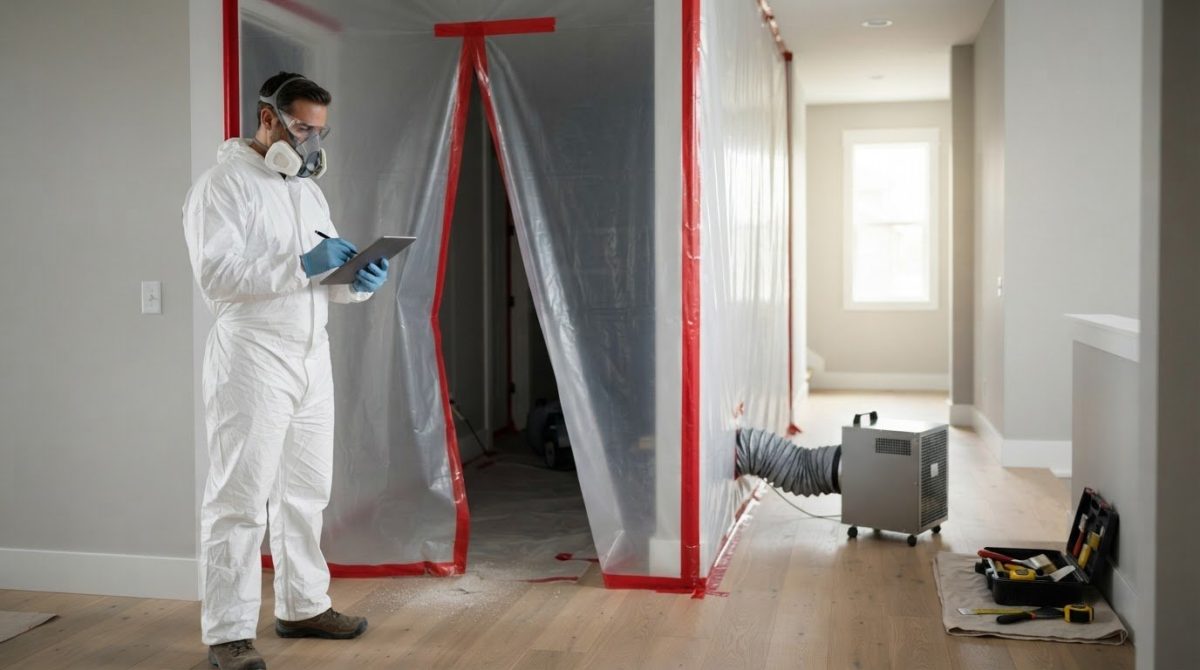
What if a containment barrier looks intact, but dust appears outside the work area? A mold remediation containment failure isn’t always obvious. Plastic sheeting alone can’t show whether barriers, airflow controls, and work practices are keeping the work zone contained. If you’re concerned that dust or particles may have reached occupied areas, document what you see and request an assessment rather than assuming the cleanup has failed or succeeded.
Visible debris beyond the containment boundary, damaged or open barriers, and unexpected airflow may warrant attention, but none proves that contamination has spread. Mold and moisture can also remain hidden after visible cleanup, so observations need to be considered in context. Don’t disturb the work area. Record the location and time, then promptly share your concern with the remediation team and ask for clear direction on whether work should continue.
This article explains common causes and warning signs of containment problems, how barriers, airflow, and work practices work together, and what a measured response can involve. TSIAC International provides mold remediation informed by more than 15 years of industry experience.
Key Takeaways
- A mold remediation containment failure means contaminants may have crossed the intended work-area boundary, but visible signs alone don’t confirm what happened.
- Barriers, airflow controls, filtration, and work practices work together. Negative pressure is a control approach, not a guarantee that particles cannot escape.
- Damaged barriers, uncontrolled openings, or dust beyond the work zone are observations to document and assess, not proof that mold has spread.
- If you suspect a breach, avoid disturbing materials, record what you observe, and raise the concern through the project communication channel.
- A controlled response connects assessment, containment planning, remediation, and appropriate verification to the building conditions and project scope.
What Mold Remediation Containment Failure Means, and Why It Matters
Containment failure occurs when controls do not keep work-area contaminants within the intended boundary. In mold remediation, that boundary is designed to limit the movement of particles and contaminated dust from the active work zone into surrounding spaces. A suspected breach is a reason to document and assess conditions, not proof that contaminants spread, that anyone was exposed, or that every nearby area is affected. The term describes a loss of control, not a confirmed health outcome.
The distinction matters because a containment problem can affect work beyond the original area. Airborne particles may move with airflow, while dust or debris can be carried on tools, materials, or footwear if work practices do not control movement. If materials may have reached adjacent rooms, the assessment and cleanup scope may need review. That possibility should be investigated, not assumed from a single observation.
What containment is designed to control
A work-area boundary combines physical barriers and airflow controls with work practices that limit movement between the contained zone and the rest of the building. Its purpose is to reduce migration during removal and cleanup. It does not certify that surrounding rooms are contamination-free or guarantee that no particle can escape. The appropriate setup depends on building conditions, affected materials, and the project scope.
Containment can’t be judged by looking at plastic sheeting alone. A barrier may be in place, but an opening, damaged section, or uncontrolled movement of people and materials can undermine the boundary. Airflow also matters because its direction and control can affect whether particles remain in the work zone. These elements need to be considered together.
Containment failure versus other remediation problems
A barrier or airflow problem is different from mold returning because moisture remained or removal was incomplete. An unresolved leak or inadequate drying can support continued or renewed growth without proving that containment failed during the original work. Conversely, a possible breach does not establish that the underlying moisture source was left unresolved.
Visible mold outside the work boundary warrants assessment, but appearance alone can’t establish where it came from, whether it is related to the remediation, or what species it is. A stain or patch may have another explanation, and visual inspection cannot confirm airborne contamination. Separate the observation from the conclusion: record where and when it appeared, then evaluate it in relation to the work area and moisture history.
This distinction keeps concerns focused. The phrase mold remediation containment failure refers to controls that did not maintain the intended work-area boundary, not every instance of mold discovered after cleanup. General background on mold and health is available in Mold health issues, but it can’t determine whether a particular room or project experienced a breach. Site-specific conditions require a project-level assessment.
How Mold Remediation Containment Works: Barriers, Airflow, and Work Practices
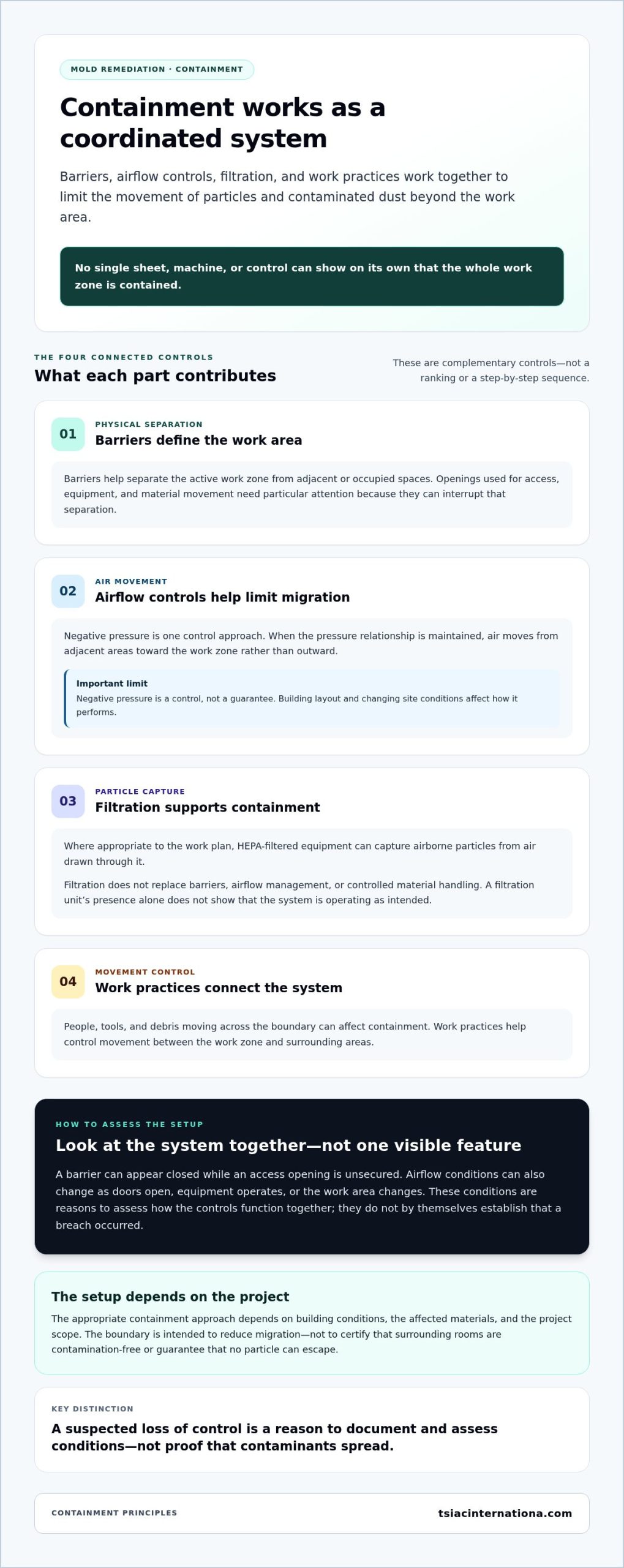
Containment is a coordinated system, not a single sheet of plastic or machine. Physical barriers separate the active work area from adjacent spaces. Airflow controls help direct air toward or through the work zone, and appropriately selected filtration captures airborne particles passing through equipment. Together, these measures reduce the chance that contaminated dust and particles migrate beyond the work boundary. They do not make escape impossible. The setup needs to suit the building, the materials being handled, and the project scope.
How barriers and pressure relationships help limit migration
Barriers define the work area and help separate it from occupied or unaffected spaces. Openings for access, equipment, and material movement need particular attention because each can interrupt that separation. Negative pressure is one airflow-control approach. When the pressure relationship is maintained, air moves from adjacent areas toward the work zone rather than outward. It is a control, not a guarantee, and building layout and changing site conditions affect how it performs.
For example, a barrier may appear closed while an access opening is left unsecured during a transfer. Pressure conditions can also change as doors open, equipment operates, or the work area changes. These examples do not establish that a breach occurred. They show why containment needs to be assessed as a functioning system, not judged by one visible feature. The EPA Mold Remediation Guide discusses containment as part of remediation planning and describes approaches suited to different work conditions.
Why filtration and work practices matter
Where appropriate to the work plan, HEPA-filtered equipment can capture airborne particles from air drawn through it. Filtration supports containment, but it doesn’t replace barriers, airflow management, or controlled material handling. The presence of a filtration unit alone does not show that the system is operating as intended or that particles aren’t moving by another route.
Work practices connect these controls to what happens on site. People moving between the work zone and surrounding areas, tools crossing the boundary, and debris being carried out can all affect containment. A controlled process accounts for how people, equipment, and removed materials enter and leave, reducing unnecessary transfer of dust to adjacent spaces. Procedures depend on the work and the building; no single checklist fits every project.
That’s why seeing plastic sheeting or a running filtration unit does not establish whether the full setup is effective. The controls need to be considered together and in relation to current site conditions. TSIAC International provides mold remediation services for projects that require coordinated work.
Signs of a Possible Containment Breach, and What They Do Not Prove
A damaged barrier, an unsecured opening, or dust outside a designated work zone can raise a reasonable concern during remediation. Each is an observation to report, not a complete diagnosis. A warning sign merits assessment but does not independently confirm a breach. The question is whether work-area controls maintained their intended boundary, which requires evaluating site conditions rather than relying on one clue.
A possible sign of mold remediation containment failure doesn’t establish that mold spread, identify the source of material, or show how far it may have traveled. Keep what you directly observed separate from what you suspect.
Observable conditions that warrant prompt attention
Look only from a safe, accessible location. Don’t touch, move, or test suspect materials or equipment. Record the time and location, describe what you can see, and share it through the project’s communication channel. If airflow equipment or barriers appear changed, report the visible condition without entering the work zone to investigate.
| Visible condition | What it may warrant assessing | What it does not prove alone |
|---|---|---|
| A barrier appears torn, displaced, or detached | Whether the boundary remained intact and when the damage occurred | That contaminants crossed the barrier |
| An access point appears open or unsecured | How the opening was used and whether controls were maintained | That material escaped through it |
| Dust or debris is visible beyond the work boundary | Its origin and whether it is associated with the remediation | That it contains mold or came from the work area |
| An airflow-control device appears off or altered | Whether airflow conditions changed during work | That negative pressure was lost or a breach occurred |
Why symptoms, odors, and stains are not definitive tests
A musty odor may prompt investigation, but odor alone can’t establish its source, the presence of active mold, or a containment breach. Health symptoms also have multiple possible causes. They can’t identify mold exposure or link a condition to a particular remediation project without qualified evaluation. OSHA’s Mold Remediation Guidelines provide general information relevant to worker protection and mold remediation, but they don’t determine what occurred at an individual site.
Discoloration may reflect past moisture or another condition. Appearance alone cannot confirm active growth, identify a mold species, or establish the extent of affected materials. A stain outside the work area deserves attention in context, including the building’s moisture history and the project scope. It is not, by itself, proof that containment failed.
For a useful record, note the exact location, time, and visible condition. Take a photograph from a safe position if permitted by project rules, and report whether the condition changed. Don’t sweep or clean dust, open barriers, or handle materials to “check” them. These actions can disturb evidence and make the situation harder to assess. A factual report helps the remediation team evaluate the concern and determine next steps.
What to Do if Mold Remediation Containment Fails
If you suspect a containment problem, focus first on preventing further disturbance and communicating what you observed. A damaged barrier or dust beyond the work zone may need prompt assessment, but neither establishes on its own that contamination spread. Don’t enter the contained area or try to repair the setup yourself. A calm, specific report gives the remediation team a basis to assess conditions and decide whether work controls or project scope need adjustment.
Document concerns without disturbing the work area
Make a brief written record while details are fresh. Note the date and time, exact location, what appeared different, and whether the condition changed. If project rules allow, take photographs from a safe position without crossing barriers, touching materials, or entering the work zone. Don’t clean visible dust, move debris, open barriers, or dismantle containment. Those actions may disturb materials and complicate assessment.
Use this checklist to keep your report factual and useful:
- Location: Identify the room or area and where the condition is in relation to the work boundary.
- Timing: Record when you noticed it and, if known, when it first appeared.
- Barrier condition: Describe visible damage, displacement, or an open access point without handling it.
- Visible changes: Note dust, debris, or other changes outside the work zone, distinguishing what you saw from what you suspect.
- Documentation: List any photographs taken from a safe position and share them through the project communication channel.
How assessment and corrective planning should proceed
Raise the concern through the established project communication channel and share your observations without presenting them as a confirmed diagnosis. Keep people away from visibly affected work zones where practical, and don’t cross barriers to investigate. If someone has health concerns, they should seek guidance from an appropriate healthcare professional. A site observation cannot establish the cause of symptoms.
A project assessment should consider the affected area, the condition of the boundary and airflow controls, and plausible routes by which dust or debris could have moved. The review should also distinguish a possible containment issue from other conditions, such as unresolved moisture or incomplete removal. Conclusions and next steps depend on site-specific findings.
Corrective planning may involve reviewing the work area, controls, handling practices, or defined scope, then determining how work should proceed. The response should fit the building conditions and affected materials rather than rely on assumptions from a single photograph or odor. If a concern remains unresolved, request clear communication about what was assessed and what the plan addresses before treating the issue as settled. This measured approach keeps the response focused when a possible mold remediation containment failure is reported.
TSIAC International provides mold remediation backed by more than 15 years of industry experience. Discuss your mold remediation project with the team.
How Professional Mold Remediation Addresses Containment Concerns
A professional response treats containment concerns as a project-control issue that needs assessment, not an assumption based on one visible sign. The team reviews the reported condition in context, considers the work area and affected materials, and determines whether the existing plan still fits the site. If conditions have changed, the work plan may need to address revised controls, scope, or sequencing before work proceeds.
That sequence connects four parts of the job: assessment, containment planning, controlled remediation, and verification appropriate to the project. Each step informs the next. For example, visible debris near an access point may prompt a review of how materials move through the area, while a moisture concern may require attention to the source as well as the affected materials. Neither observation alone determines the full scope.
What a controlled remediation response should clarify
Clear project communication helps owners and other stakeholders understand what is being addressed and why. The work plan should identify the defined scope, affected areas, general sequence of work, and how a reported containment concern will be evaluated. Documenting observations, assessment findings, and plan changes creates a shared record and reduces the risk that an unresolved question is mistaken for a completed task.
Verification should be appropriate to the project and interpreted within its limits. It helps assess specified conditions; it should not be presented as a promise of a particular test result, completion date, or health outcome. A careful closeout explains what was reviewed and what remains outside the defined scope.
When to bring in an experienced remediation contractor
Complex or extensive work, remediation in an occupied building, or a concern affecting areas beyond the original work zone may require coordinated professional management. Building layout, affected materials, moisture conditions, and the relationship between remediation and other work can all influence project planning. A qualified contractor can assess these conditions and align the work plan with the project’s needs.
TSIAC International provides mold remediation alongside demolition and hazardous-material abatement services, bringing more than 15 years of industry experience to projects that require careful coordination. That broader experience is relevant when remediation intersects with material removal or other work, while the appropriate scope depends on the specific building and conditions.
If you’re dealing with a possible mold remediation containment failure or planning work that needs a coordinated response, discuss the project with TSIAC International. A clear conversation about observed conditions and project scope is a practical next step toward deciding how the work should be assessed and managed.
Move Forward With a Clear Project Decision
After a concern is raised, the next useful step is to turn uncertainty into a documented project decision. Keep the question specific: what condition was reviewed, which part of the work plan it affects, and what remains unresolved? This helps ensure a possible mold remediation containment failure is neither treated as confirmed spread nor dismissed without review.
As the project moves forward, clear handoffs matter. Make sure the relevant people understand the assessment and how its findings affect the next decision. If the concern remains unresolved, keep it visible in project communications rather than relying on assumptions or informal updates. The goal is not to demand certainty from one observation, but to make decisions with a clear record of what was considered.
To discuss a remediation concern and possible next steps, talk through your mold remediation project with TSIAC International. Share the conditions you observed and the project scope so the team can discuss a practical path forward.
Frequently Asked Questions
What is mold remediation containment failure?
Mold remediation containment failure is a loss of effective control over the work-area boundary, allowing contaminants to potentially move beyond the area designated for remediation. It describes a problem with containment, not every issue discovered after cleanup. Mold returning can instead relate to unresolved moisture, while mold that remains may reflect incomplete removal. Those conditions require separate assessment, since recurrence alone doesn’t establish that containment failed during the work.
Can mold spores spread if remediation containment is damaged?
Yes, particles may migrate if a damaged barrier or opening disrupts work-area controls, particularly during active removal or debris handling. But damage alone doesn’t show that spores escaped, that anyone was exposed, or how far material may have traveled. A tear noticed after work, for example, doesn’t reveal when it occurred. The condition and nearby areas need to be considered alongside the project timeline and work practices.
How can you tell if mold remediation containment has failed?
You can note warning signs, but you can’t confirm failure from appearance alone. Possible concerns include a displaced barrier, an unsecured access point, or dust visible beyond the work boundary. Record the location and time, and photograph the condition only from a safe position. Don’t touch suspect materials or enter the work area to investigate. A project-specific professional assessment may be needed to determine whether controls were compromised.
What should I do if I see mold remediation barriers come down?
Stay outside the work area and don’t try to put the barriers back, clean debris, or move materials. Note when and where you saw the barrier down, what was visible nearby, and whether work was underway, then raise the concern promptly through the project communication channel. If permitted, take a photo from a safe position. Keep others away from the visibly affected zone where practical while awaiting project guidance.
Does a moldy smell prove that containment failed?
No. A moldy or musty smell isn’t a definitive test for a containment breach, active mold, or the location of a source. Odors may have multiple explanations, including moisture-related conditions elsewhere in a building. Note where and when the smell occurs and whether it changes, then report it as an observation. An assessment can consider the building and remediation context; smell alone can’t establish the cause or extent of contamination.
Can remediation continue after a suspected containment breach?
Possibly, but the decision should follow a project-specific assessment rather than an assumption that work is safe to continue or must stop. The remediation team may need to review the reported condition, the work area, and whether current controls remain suitable. Depending on findings, the plan or sequence may need adjustment. If you notice a concern, report it promptly and request clear direction through the project communication channel before approaching the affected area.
How is a mold containment breach assessed?
Assessment considers the reported observation alongside the work area, timing, affected materials, and plausible routes of movement through the building. For instance, a nearby doorway or shared passage may be relevant to review, but its presence doesn’t prove particles traveled through it. The assessor can compare site conditions with the project scope and work record. No single sign, odor, or stain independently establishes whether a breach occurred or its extent.
