
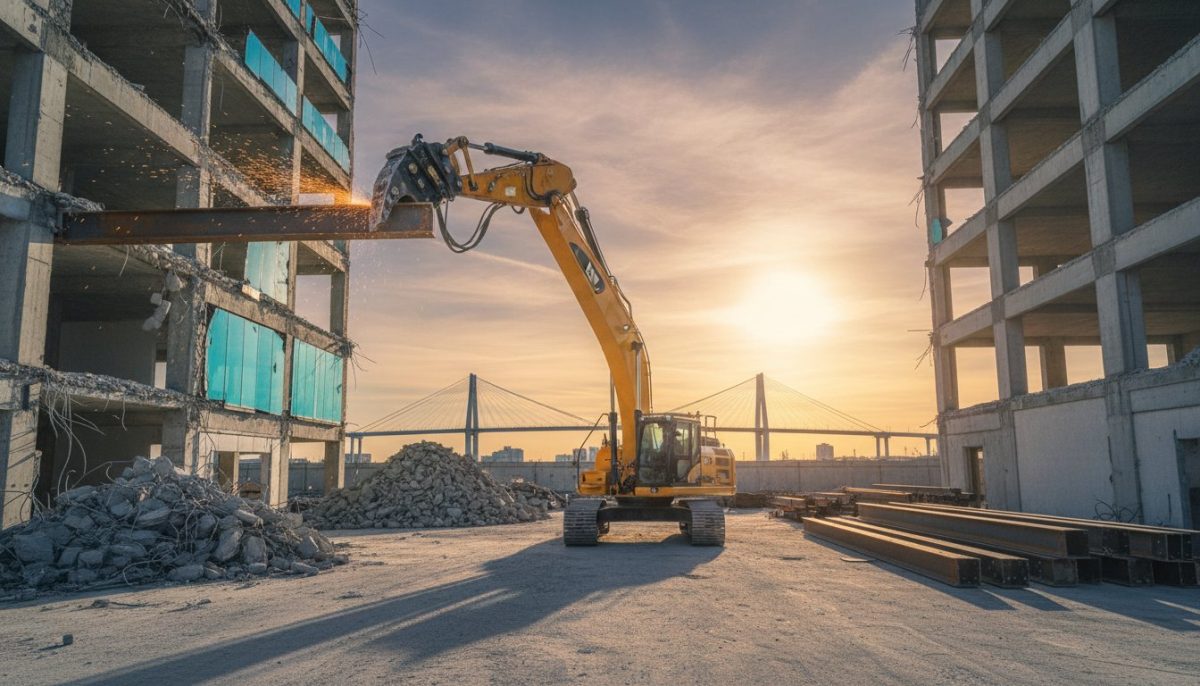
Did you know that a significant percentage of commercial buildings constructed before 1978 across the nation contain hazardous materials like asbestos or lead paint? For developers and facility managers, these hidden liabilities often transform a straightforward project into a regulatory nightmare. You likely understand that a successful demolition isn’t defined by the force of the impact, but by the surgical precision of the preparation. This asbestos abatement case study examines how a high-stakes structural removal was executed without the typical delays or safety liabilities that plague less managed sites.
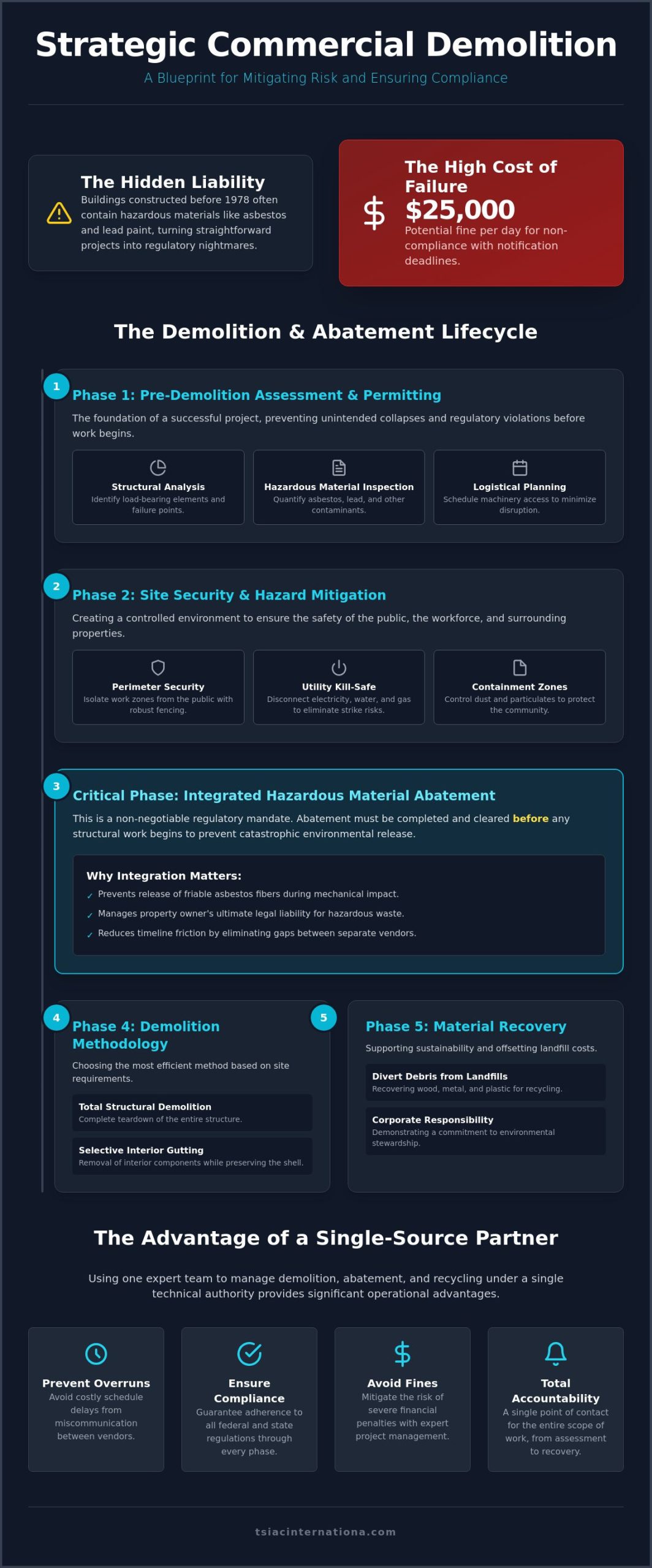
It’s natural to feel concerned about the shifting requirements of federal and state environmental agencies, especially when failure to meet notification deadlines can result in fines of $25,000 per day. At TSIAC International, we understand these challenges. We’ll examine the technical execution, safety protocols, and environmental strategies used to manage a complex commercial demolition project. You’ll gain a clear roadmap for integrating lead and asbestos abatement into your workflow. This includes a breakdown of site management techniques and evidence of how responsible material recovery can offset rising landfill tipping fees while ensuring total compliance through every phase of the project.
Key Takeaways
- Understand why commercial demolition is a complex engineering lifecycle that requires rigorous pre-demolition surveys to ensure structural and site stability.
- Discover through this asbestos abatement case study south carolina how integrating hazardous material remediation into the initial project phases prevents regulatory fines and schedule overruns.
- Learn the technical distinctions between total structural demolition and selective interior gutting to determine the most efficient method for your specific site requirements.
- Explore how modern material recovery protocols for wood, metal, and plastic can divert significant debris from landfills while supporting corporate environmental responsibility.
- Identify the operational advantages of using a single-source partner to manage the entire scope of demolition, abatement, and recycling under one technical authority.
The Lifecycle of a Strategic Commercial Demolition Project
Commercial demolition is far more than the simple act of tearing down a structure. It represents a sophisticated engineering and environmental lifecycle that requires meticulous planning and disciplined execution. At its core, this process is a multi-phase operation where structural stability and environmental safety are prioritized over raw force. This asbestos abatement case study south carolina demonstrates how a methodical approach prevents the common pitfalls of budget overruns and safety violations that often derail less organized projects. Effective project management serves as the central nervous system of the contract, coordinating seamlessly between general contractors, engineers, and municipal authorities to ensure every regulatory benchmark is met before the first machine arrives on site.
Phase 1: Pre-Demolition Assessment and Permitting
The foundation of a successful project lies in a comprehensive structural analysis. We examine load-bearing elements and potential points of failure to prevent unintended collapses that could endanger adjacent properties or personnel. Regulatory requirements in South Carolina mandate exhaustive inspections for hazardous materials before any physical work begins. Asbestos, lead paint, and other legacy contaminants must be identified and quantified by certified inspectors. In high-density urban environments, logistical planning for heavy machinery access is a primary concern. We develop precise arrival and staging schedules to minimize traffic disruption and maintain site efficiency, ensuring that the project remains on track from day one.
Phase 2: Site Security and Hazard Mitigation
Once the assessment is complete, we transition to physical site preparation. This phase dictates the safety and speed of the entire contract. We install robust perimeter fencing and pedestrian protection measures to completely isolate the work zone from the public. A critical step in our safety protocol is the kill-safe verification process. During this stage, all utilities, including electricity, water, and gas, are disconnected and confirmed dead by certified technicians to eliminate the risk of accidental strikes. Following this, we establish environmental containment zones based on the protocols outlined in the demolition process in South Carolina. These zones ensure that any disturbed particulates remain within a controlled environment, protecting both the workforce and the surrounding community. By treating site preparation as a technical discipline rather than a formality, we create a controlled environment where the actual demolition can proceed with maximum precision.
Integrated Hazardous Material Abatement: Asbestos and Lead Management
In the context of this asbestos abatement case study south carolina, the sequence of operations is as critical as the physical execution. Comprehensive asbestos removal must be completed and cleared before any structural demolition begins. This is a regulatory mandate designed to prevent the release of friable fibers into the atmosphere during mechanical impact. When a building is demolished with hazardous materials still present, the resulting dust creates an environmental crisis that is exponentially more expensive to remediate than a proactive removal. For historic commercial shells in Charleston, lead paint remediation requires equally stringent containment protocols to manage heavy metal dust during the selective strip-out phase.
Property owners carry the ultimate legal liability for the entire lifecycle of hazardous waste generated on their sites. Relying on a single-source contractor who manages both abatement and demolition reduces timeline friction and eliminates the common communication gaps between separate vendors. This integration ensures that the transition from hazardous material remediation to structural removal is seamless, documented, and safe. Technical expertise in managing these overlapping phases is what separates a successful project from one plagued by stop-work orders.
Containment and Negative Pressure Systems
Technical precision during removal involves establishing a negative pressure environment. We use high-efficiency particulate air (HEPA) filtration systems that cycle the air within the containment zone, ensuring no contaminated air escapes. Continuous air monitoring provides real-time data to verify that fiber counts remain within safe limits. To further mitigate risk, we employ the wet method of removal. By saturating the material with amended water, we prevent toxic fiber aerosolization. Site personnel must adhere to rigorous decontamination shower protocols, passing through a multi-stage unit to ensure that no particulates leave the work zone on clothing or equipment.
Safe Disposal and Regulatory Compliance
Compliance with EPA asbestos regulations requires a transparent chain-of-custody for all hazardous waste. Every load of regulated material is tracked from the site to a Class 3 landfill permitted by the SCDES. This documentation is vital. It protects the client from future environmental litigation by providing a verifiable record of legal disposal. Following the standards found in this hazardous material abatement guide ensures that every OSHA and EPA requirement is satisfied. If you’re planning a project involving aging infrastructure, partnering with an integrated specialist can safeguard your investment and your reputation.
Comparing Structural and Selective Demolition Methodologies
Choosing between total structural removal and selective deconstruction depends entirely on the future utility of the site and the presence of hazardous materials identified during initial surveys. Structural demolition involves the complete removal of a building footprint and its foundation, effectively clearing the lot for new construction. In contrast, commercial interior gutting services represent a form of surgical selective demolition where the exterior shell is preserved while the interior core is modernized. This asbestos abatement case study south carolina highlights how the methodology choice is often dictated by environmental findings. If a historic facade contains significant lead paint or asbestos, the cost-benefit analysis might shift from preservation toward total removal to ensure long-term liability protection and site safety.
The machinery requirements vary significantly between these two paths. Total removal relies on heavy-duty excavators equipped with hydraulic shears or grapples, while selective work often requires hand-held robotic breakers that navigate tight interior corridors without compromising load-bearing capacity. Regardless of the method, adherence to the OSHA Asbestos Standard for Construction is non-negotiable to protect workers during the disturbance of any structural elements. Our technical teams evaluate the structural drawings to determine which equipment will provide the most efficient result without endangering the stability of the remaining assets.
Total Structural Removal: Speed and Efficiency
When speed is the primary driver, we execute a top-down demolition sequence. High-reach excavators systematically dismantle the structure from the upper floors down, preventing uncontrolled collapses. Managing large-scale debris piles is a logistics-heavy task. We use on-site concrete pulverization to reduce bulk and prepare materials for recycling. During this high-impact phase, we continuously monitor the stabilization of adjacent buildings. This ensures that no seismic or structural damage occurs to neighboring properties in high-density Charleston corridors.
Selective Demolition: Precision and Preservation
Selective demolition is the preferred choice for adaptive reuse and tenant improvement projects. Our teams strip interiors down to the structural studs, removing non-essential walls, MEP systems, and finishes. The challenge here is maintaining structural integrity while removing specific wings or floors. We use shoring and temporary bracing to support the shell, allowing the historic character of a building to remain intact while creating a blank canvas for modern redevelopment. This precision ensures that the most valuable parts of a property are saved, reducing waste and preserving the architectural heritage of the site.
Sustainability in Demolition: The Material Recovery Process
Modern demolition is a material recovery operation, not a waste-generation event. The industry has moved beyond the outdated “smash and haul” mentality, shifting instead toward surgical deconstruction. This asbestos abatement case study south carolina underscores that once hazardous contaminants are cleared, the remaining structure becomes a valuable inventory of resources. We view every building as a source of wood, metal, and concrete that can be diverted from landfills and reintroduced into the supply chain. This approach is essential in a market where landfill tipping fees continue to rise and environmental regulations become more stringent.
Concrete removal provides a specific economic and environmental advantage through on-site crushing. By pulverizing structural concrete, we create high-quality recycled aggregate that can be reused immediately for sub-base preparation or site stabilization. This eliminates the massive costs associated with hauling debris away and purchasing new gravel. For developers, these practices are a primary driver for securing LEED certification points. High-percentage debris recycling significantly lowers the carbon footprint of the project, turning a demolition site into a model of corporate social responsibility.
The On-Site Sorting Methodology
Site efficiency depends on a disciplined sorting methodology. We separate ferrous metals, such as structural steel beams, from non-ferrous materials like copper piping and aluminum siding to maximize recovery value. Segregating clean wood from treated lumber is equally vital. Only untreated timber can be effectively mulched or recycled, while treated wood requires specialized handling. Managing these workflows on cramped commercial sites requires precise container placement and a constant rotation of bins. We use a multi-container strategy to ensure that cross-contamination is avoided, which preserves the marketability of all recovered materials.
Landfill Diversion Goals and Reporting
Environmental compliance reports require detailed calculations of diversion rates. We track the weight of every material stream leaving the site to provide developers with accurate data for their sustainability audits. Our partnerships with specialized recycling facilities ensure that even difficult materials like plastics and certain drywall types are handled responsibly. A zero-waste mindset doesn’t just protect the environment; it enhances the project’s bottom line. If you’re looking to maximize the recovery value of your property, contact our technical team to discuss your recycling goals and project requirements.
Why TSIAC International is the Preferred National Partner for Complex Demolition
The Advantage of Integrated Abatement and Demolition
Vertical integration is the primary differentiator that sets us apart from standard contractors. Most developers experience significant friction when coordinating between separate abatement and demolition vendors. Communication gaps between these entities often lead to stop-work orders or scheduling delays that inflate budgets. By acting as a single-source provider, we eliminate these inefficiencies. Unified project management allows us to synchronize the abatement of hazardous materials with the structural removal phase. This seamless transition provides substantial cost savings and ensures that the asbestos abatement case study south carolina outcomes, safety, compliance, and speed, are replicated on every site. Our 15-year clean regulatory record is a testament to our ability to navigate the most complex municipal requirements without error.
Commitment to National Safety and Environmental Standards
Safety is the non-negotiable foundation of every project timeline we develop. We maintain rigorous internal safety training programs and PPE requirements that often exceed federal mandates. To minimize human risk in hazardous environments, we utilize advanced machinery and robotic technology for high-risk tasks. This investment in technology ensures that our teams can maintain high productivity levels while working in unstable or contaminated structures. Our national reach allows us to bring this level of technical expertise to any market, ensuring that every project meets the highest environmental and safety benchmarks. Contact TSIAC International today for a comprehensive commercial demolition consultation to see how our integrated approach can streamline your next project.
Mastering the Complexity of Modern Commercial Demolition
Successful redevelopment begins with the precise dismantling of the past. As demonstrated in this asbestos abatement case study south carolina, the difference between a project’s success and a regulatory failure lies in the integration of engineering expertise with environmental responsibility. By treating demolition as a material recovery operation rather than a waste-generation event, developers can mitigate liability while achieving significant sustainability benchmarks.
Frequently Asked Questions
What is the difference between selective and structural demolition?
Structural demolition involves the complete removal of a building footprint and its foundation to clear a lot for new construction. Selective demolition is a surgical process where specific wings or interior elements are removed while maintaining the integrity of the remaining structure. This approach is common in adaptive reuse projects where a historic facade or core must be preserved for future redevelopment.
How long does the commercial demolition permitting process usually take?
Most commercial projects require at least 10 working days for the South Carolina Department of Environmental Services (SCDES) notification period before work can begin. The broader municipal permitting process typically spans two to four weeks depending on the complexity of the site and the density of the surrounding urban environment. Technical reviews of structural and environmental plans must be completed before any machines are mobilized.
Why is an asbestos survey required before a commercial building can be demolished?
Federal and state regulations mandate a comprehensive asbestos inspection to prevent the accidental release of friable fibers during mechanical demolition. Identifying hazardous materials during the pre-planning phase allows for a controlled removal within this asbestos abatement case study south carolina framework. Without a certified survey, a project faces immediate stop-work orders and significant fines from the SCDES and EPA.
Can concrete and metal from a demolition site be recycled?
Concrete and metal represent the most recyclable materials on a modern demolition site. Ferrous and non-ferrous metals are sorted and sent to recovery facilities; meanwhile, structural concrete is often crushed on-site for use as recycled aggregate. These practices can divert over 85% of total debris from landfills, significantly lowering the carbon footprint of the project and helping developers achieve LEED certification points.
What are the common safety hazards on a commercial demolition site?
Primary hazards include unintended structural collapses, exposure to toxic dust like silica or asbestos, and the risk of striking live utilities. To mitigate these risks, we employ rigorous kill-safe verification protocols for electricity and water. Advanced machinery and robotic breakers are also used in unstable zones to minimize human exposure to physical and environmental dangers on the job site.
How does hazardous material abatement impact the overall project timeline?
Hazardous material abatement typically adds two to four weeks to the front end of a project because it must be completed before structural demolition begins. However, integrating these services under a single-source provider prevents the timeline friction associated with separate vendors. This asbestos abatement case study south carolina proves that proper preparation ensures the mechanical removal phase can proceed without interruptions or environmental liabilities.
What is a gut-out service and when is it necessary?
A gut-out service involves stripping a building down to its structural studs and load-bearing elements. This process is necessary for tenant improvement projects where the existing MEP systems and interior finishes must be modernized. It allows for a complete redesign of the interior space while preserving the structural shell and architectural character of a commercial property.
Does TSIAC International provide documentation for environmental compliance?
TSIAC International provides a complete documentation package, including waste shipment records and air monitoring reports, to ensure total environmental compliance. We maintain a transparent chain of custody for all hazardous materials, tracking them from the site to a permitted Class 3 landfill. This rigorous record-keeping protects property owners from future litigation by providing verifiable proof of legal and safe disposal.
