

A routine ceiling repair can become an asbestos-control issue before anyone realizes what lies above the tile. An asbestos operations and maintenance plan helps building owners manage identified asbestos-containing materials in place. It sets out how to monitor their condition and control everyday work to avoid disturbance.
It’s reasonable to be concerned that maintenance, repairs, or contractor access could damage material that appears stable. A practical plan replaces guesswork with clear responsibilities, work practices, communication, and records. It also defines when work must stop and the condition needs professional assessment.
This guide explains the core elements an O&M plan should cover, who should carry out each responsibility, and how training and documentation support safe in-place management. It also outlines how to respond when material is damaged or renovation is planned, including when ongoing management is no longer sufficient and professional repair or asbestos abatement should be considered. An O&M plan controls routine risks, but it doesn’t make every future task safe to proceed.
Key Takeaways
- An asbestos operations and maintenance plan connects inspection findings to a current ACM inventory and clear management procedures.
- Assign a program manager, define staff responsibilities, and establish who to notify when conditions change.
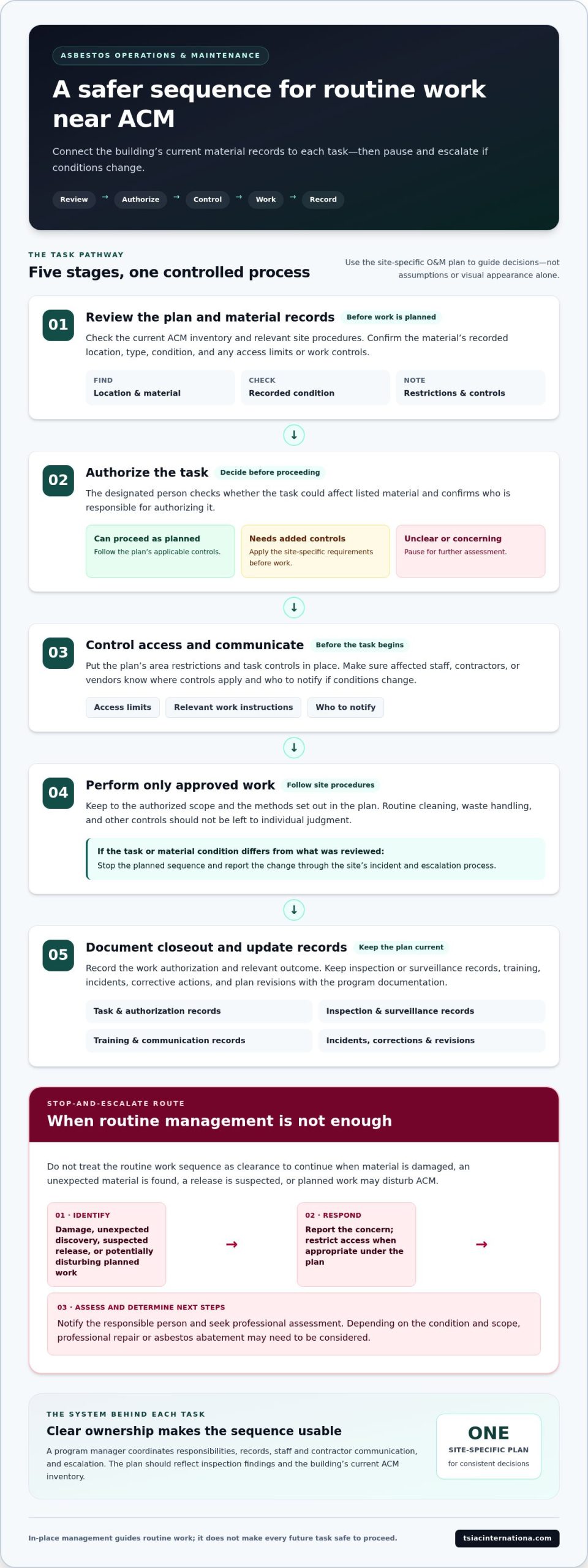
- Use a consistent work sequence: review the plan, authorize the task, control access, perform approved work, and document closeout.
- Build implementation around reliable inspection records, mapped materials, staff training, and scheduled reviews aligned with applicable requirements.
- Recognize when damage, a suspected release, or planned work calls for professional assessment and potentially repair or abatement.
What Is an Asbestos Operations and Maintenance Plan, and What Does It Do?
An asbestos operations and maintenance plan is a documented program for managing identified asbestos-containing materials (ACM) while a building is occupied and maintained. It connects inspection findings to practical controls: where materials are located, what condition they’re in, who is responsible for them, and how work should be planned to limit disturbance. It also explains how materials are monitored and how changes in condition are reported.
The purpose is not simply to record that asbestos is present. A usable plan guides day-to-day decisions, such as whether a maintenance task can proceed as planned, needs added controls, or should pause for further assessment. It supports in-place management when suitable, but it doesn’t establish that every ACM is safe to leave undisturbed or make work on damaged or potentially disturbed material appropriate without further action.
An O&M program is different from a one-time inspection or a project-specific repair or abatement. An inspection provides information about materials at a particular time. Repair or abatement addresses a defined condition or scope of work. The ongoing plan uses inspection and project records to guide building operations over time. For schools, the Asbestos Hazard Emergency Response Act (AHERA) is a relevant example of a framework addressing asbestos management and O&M in school buildings. Requirements for other properties depend on the applicable rules.
Which buildings and people may need an O&M plan?
Owners and managers of workplaces, apartment buildings, hospitals, and other properties may need a plan when ACM is present or suspected. That doesn’t mean every building automatically has the same requirement. Applicability depends on factors such as building use, known materials, planned activities, and governing federal, state, or local requirements.
The plan should account for anyone whose work or access could intersect with listed materials. Employees, occupants, maintenance personnel, contractors, and vendors may all need relevant instructions, though their roles differ. Maintenance staff, for example, may need to check material records before a repair. Contractors need to know where controls apply before work begins. Clear communication helps prevent tasks from proceeding on assumptions.
What materials and conditions should the plan address?
ACM is material containing asbestos; under the applicable definition, it generally contains more than 1% asbestos. Presumed asbestos-containing material (PACM) is material treated as asbestos-containing under certain regulatory contexts unless appropriate evidence establishes otherwise. The precise meaning and use of these terms can vary by rule, so an inventory should identify how each material was classified and what assessment supports that determination.
Visual appearance alone can’t confirm whether a material contains asbestos. The inventory and condition record should be based on appropriate inspection and assessment, noting location, material type, and observed condition. It should also indicate whether ordinary access or planned work could disturb the material. Stable material in a low-traffic area presents a different management question from damaged material near repeated maintenance activity. These details help determine whether continued in-place management is suitable or the condition needs professional evaluation.
What Should an Asbestos O&M Plan Include?
A usable asbestos operations and maintenance plan is a controlled document, not a generic checklist. It should reflect the building’s inspection findings and current ACM inventory, so staff can connect each listed material to its location, condition, access limits, and required work controls. Include a written policy that states the program’s purpose, scope, and process for escalating concerns.
The EPA Guidance on Asbestos O&M Programs describes core setup steps such as appointing a program manager, inspecting the building, and developing the plan. The document also needs to work for the people who use and maintain the property. Site-specific procedures should address access, maintenance, cleaning, waste handling, incident response, communication, training, and recordkeeping.
- Access and work controls: Explain how staff check material records before work, who authorizes tasks that could affect listed materials, and what restrictions apply to specific areas.
- Cleaning and waste: State which methods are permitted for routine cleaning near ACM and how waste from approved work is handled under applicable requirements. Don’t leave these decisions to individual judgment.
- Incident response: Set out how to report damaged material, an unexpected discovery, or a suspected release, including who can restrict access and who must be notified.
- Training and communication: Specify which groups need plan information, what instruction suits their roles, and how updates reach affected staff and contractors.
- Monitoring and records: Document inspections or surveillance, work authorizations, training, incidents, corrective actions, and plan revisions.
Assign ownership and document the building’s ACM information
Name a program manager and define their authority to coordinate building staff, contractors, vendors, and asbestos professionals. The manager should maintain a record for each identified material, including its location, type when established, observed condition, assessment details, and any access restrictions. Keep inspection reports, the current plan, training records, work authorizations, and updates together in a controlled, retrievable location. Make clear which version is current.
Set out procedures, training, and emergency communication
Before work begins, identify who must receive relevant plan information, especially when a task could affect listed material. Training should match each person’s role: awareness helps people recognize and report concerns, while performing asbestos-related work requires separate authorization and appropriate qualifications under applicable rules. Give staff a clear route to stop and report work if they find damaged material or suspect a release.
Make responsibilities specific. For example, a maintenance worker reports newly exposed material to the designated manager. The manager restricts access as appropriate and escalates the issue for assessment instead of allowing unplanned disturbance. Record the report, decisions, and follow-up so the inventory and procedures stay aligned with actual building conditions. When assessment identifies a need for project-based repair or removal, asbestos abatement and compliance documentation can form part of a controlled, documented response.
How Do Daily Work Practices Keep Asbestos Management Under Control?
A written plan supports building operations only when staff and contractors use it before work begins and record what happens afterward. Make the sequence repeatable, so a routine repair doesn’t rely on memory, assumptions, or a worker’s visual judgment. Each step in an asbestos operations and maintenance plan should connect the task to current material information and clearly assigned responsibility.
- Check the plan. Compare the task location and scope with the ACM inventory and any access restrictions. If the work area or material status isn’t clear, pause and seek guidance from the designated program contact.
- Authorize the work. Confirm who reviewed the task, what controls apply, and whether assigned workers are trained and authorized for their duties. Staff must not disturb listed or suspect material outside their training and authorization.
- Control access. Tell affected occupants and workers about the work area and any restrictions. Coordinate schedules and access with maintenance crews, contractors, and vendors so other activity doesn’t interfere with controls.
- Perform only approved tasks. Follow the work instructions and applicable controls. Stop if material differs from the records, suspect material appears unexpectedly, or conditions change in a way the plan doesn’t address.
- Document closeout. Record what work took place, who performed or approved it, observations, and any corrective actions. Send relevant updates to the person responsible for maintaining the plan.
What should happen before maintenance or contractor work begins?
Review the precise work scope against the inventory before authorizing the job. For example, a request to access a ceiling should identify whether the ceiling or concealed spaces are listed, what restrictions apply, who oversees the task, and what information must reach occupants or other crews. Applicable worker-protection requirements, including those in the OSHA Asbestos Standard 1910.1001, depend on the work and setting. If records don’t match site conditions, stop the affected task and escalate for assessment instead of proceeding on an assumption.
How should teams document work and monitor material condition?
For each relevant job, capture the date, location, scope, personnel, approval, observations, and corrective actions. Record material damage, unexpected discoveries, or changes in building use that could affect future work planning. Keep entries with the current inventory and make them accessible to authorized staff and contractors who need them to plan assigned tasks. Follow the plan’s surveillance schedule and document findings consistently, so changes can be compared over time.
Routine surveillance and prompt reporting give building managers information to support informed asbestos-management decisions. Records of completed work and observed changes help the next person understand what has been checked, what remains restricted, and when the plan needs review.
How Do You Implement, Review, and Update an Asbestos O&M Plan?
Implementation turns the written plan into a working system for everyday building decisions. Start with reliable inspection information, assign ownership, make material locations and procedures easy to find, and ensure affected people understand their responsibilities. An asbestos operations and maintenance plan should change when the information or conditions it relies on change, rather than remain static in a file after the building has moved on.
- Appoint an accountable owner. Assign a manager to coordinate plan access, staff communication, review actions, and updates.
- Gather current records. Assemble available inspection reports, material assessments, previous work records, and relevant building information. Identify gaps that may affect planned work.
- Map identified ACM. Link each material’s recorded location and condition to building plans or another clear location system, and note applicable access restrictions.
- Set out procedures and train affected staff. Explain how staff check material information, coordinate work, report concerns, and follow assigned controls. Brief contractors and vendors on relevant restrictions before they work in affected areas.
- Retain records and track open actions. Use a consistent system for training records, acknowledgements, work controls, decisions, unresolved issues, and plan revisions.
Make the current plan and inventory accessible to the people who need them, while keeping document control clear enough to prevent outdated copies from guiding work. A short orientation should explain where records are maintained, who handles questions, and what to do if site conditions don’t match the documentation. Record who received the briefing and any follow-up still required.
How can a building team roll out the plan?
Introduce the procedures to affected employees and maintenance teams before relying on them for work planning. For outside contractors and vendors, share relevant location information and restrictions before work begins, then document that communication alongside the work authorization. Keep unresolved actions visible and assign someone to follow up, so gaps don’t quietly become assumptions during later maintenance.
What changes should trigger a plan review?
Set review timing according to applicable requirements and the building’s management procedures; there’s no single interval appropriate to every property. Review affected sections when new survey findings arrive, material condition changes, occupancy or building use shifts, or renovation, demolition, or maintenance could disturb listed materials. The asbestos removal guide offers broader context on asbestos management and removal.
For each revision, record what changed, the revision date, who reviewed it, and how updated information was communicated to staff and relevant contractors. If assessment identifies a need for project-based repair or abatement, plan and document that response separately from routine in-place management. Learn about asbestos abatement services when a building assessment indicates abatement is needed.
When is an O&M Plan Not Enough? Abatement Needs
An O&M plan is for managing asbestos-containing material in place when its condition and the building’s activities make that approach suitable. It doesn’t repair damaged material or authorize work that could disturb it. If the material’s condition, location, or planned work can’t be managed under the existing procedures, pause the affected activity and arrange professional assessment.
Escalation may be needed when:
- Listed material is damaged, deteriorating, or otherwise appears changed from its recorded condition.
- Material is unexpectedly disturbed, or a release of fibers is suspected.
- Renovation, demolition, or maintenance could affect ACM, including material concealed from view or outside the planned work area.
These signs don’t, by themselves, determine the final corrective action. They do mean the existing plan and available information may no longer be enough to guide the work safely. Don’t rely on appearance alone to identify material or decide that work can proceed.
What conditions call for reassessment rather than routine O&M?
For visible damage or deterioration, follow the site’s incident procedures, keep people away from the affected area as appropriate, and notify the designated manager. If unexpected disturbance or a suspected release occurs, stop work in the affected area, prevent further access where appropriate, and seek professional assessment. Avoid handling or cleaning the material unless directed under an appropriate response procedure.
Planned work can also change the decision. Material that could remain managed during ordinary building use may require a different response if renovation or demolition will contact, enclose, or remove it. Review the work scope and assessment before activities begin. The question is not simply whether ACM is present, but whether the proposed work can proceed under existing controls or requires a separate corrective project.
How does professional abatement fit into the management process?
Abatement is a project-based response to a defined need, distinct from routine operations and maintenance. When assessment indicates repair or removal is appropriate, plan the scope and controls for that work, and address applicable documentation and safe disposal as part of project execution. After the project, relevant records and material information can inform future building decisions. The hazardous material abatement guide provides related context on planning this type of project.
TSIAC provides asbestos abatement and related regulatory compliance documentation. This project work can address conditions that routine in-place management cannot, without replacing the building’s ongoing O&M procedures. Learn about TSIAC’s asbestos abatement services.
Put Your Next Asbestos Decision on a Controlled Path
The value of an asbestos operations and maintenance plan depends on how well it keeps pace with the building. Treat each change in condition, use, or planned project as a reason to confirm that the next decision is based on current information, not assumptions. That discipline helps building owners move from routine management to project-based corrective work when circumstances call for it.
When assessment indicates that repair or removal is appropriate, the next step is a defined project scope and documented execution. TSIAC International brings more than 15 years of industry experience to demolition and hazardous-material projects, with asbestos abatement supported by regulatory compliance documentation. This work is distinct from administering an O&M program, but it can provide a controlled response when in-place management is no longer suitable.
Discuss asbestos abatement with TSIAC as you plan the next step for your building. With the right information and project response, you can move forward with greater clarity and control.
Frequently Asked Questions
What is an asbestos operations and maintenance plan?
An asbestos operations and maintenance plan is a building-specific written program for managing identified asbestos-containing material (ACM) during normal use and maintenance. It sets out work practices, role-appropriate training, and monitoring procedures to help prevent unintended disturbance. The plan doesn’t remove asbestos or prove that every material can remain in place. Its instructions should be grounded in inspection and assessment information for the property, rather than assumptions based on building age or appearance.
Does every building with asbestos need an O&M plan?
No single answer applies to every property. Whether a plan is needed depends on the building, identified or suspected materials, activities that could disturb them, and applicable requirements. EPA describes O&M programs as useful for owners and managers of buildings where ACM may be present, but its guidance isn’t itself a regulation. For a specific determination, review relevant federal, state, and local requirements and seek advice from a qualified asbestos professional.
Who should be responsible for an asbestos O&M plan?
The building owner or organization should assign a knowledgeable person with enough authority to coordinate asbestos-related activities. Depending on the organization, this role might belong to a facilities manager, building engineer, superintendent, safety director, or owner. The responsible person needs a clear way to coordinate with maintenance staff, contractors, and asbestos professionals, and to bring unresolved concerns to the appropriate decision-maker. Written role assignments help prevent assumptions about who approves or communicates work controls.
How often should an asbestos O&M plan be reviewed?
There’s no universal review interval that applies to every building. Follow applicable requirements and the organization’s management procedures, and review the plan when inspection information, material condition, building use, or planned work changes. For example, a new survey finding may affect access instructions or contractor briefings even if other procedures remain current. Keep a record of review dates, revisions, the person responsible, and how updated controls reach affected personnel.
Can building maintenance continue when asbestos-containing material is present?
Sometimes, but the presence of ACM alone doesn’t determine whether a particular task can proceed. Before work, compare its location and scope with the material inventory, condition information, and applicable controls. A task near a listed material may require restrictions or a different work plan. Staff shouldn’t disturb listed or suspect material outside their training and authorization. If site conditions differ from the records, stop the affected activity and escalate before continuing.
What should you do if asbestos-containing material is damaged?
Follow the building’s incident procedures and prevent access to the affected area as appropriate. Don’t disturb the material or attempt to clean suspect debris. Report the damage promptly to the designated building contact so the condition can be assessed by qualified asbestos professionals. The appropriate response depends on what was affected, the circumstances, and the site’s procedures. Avoid improvising cleanup or re-entry instructions before the situation has been evaluated.
Does an asbestos O&M plan replace asbestos abatement?
No. An O&M plan supports ongoing management of ACM that is suitable to remain in place; it doesn’t replace corrective project work when repair or abatement is needed. EPA and FWS guidance recognize that some conditions call for more than routine management. Damage, suspected disturbance, or planned work may warrant escalation, but these indicators don’t determine the remedy by themselves. Professional assessment helps establish the appropriate response and project scope.
