
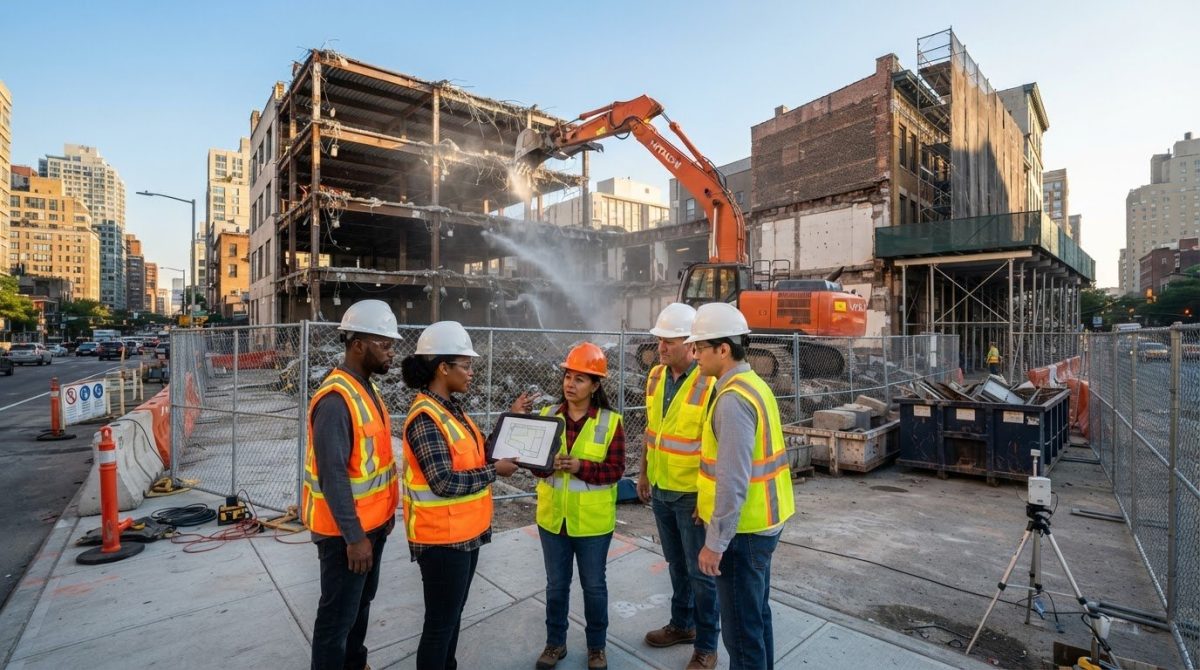
What if the most serious demolition risk is the condition no one identified before work began? Hidden hazardous materials, uncertain structural stability, and exposure to adjacent properties can turn an orderly plan into an urgent field decision. Effective demolition project risk mitigation strategies connect early investigation with clear controls and ongoing verification.
It’s reasonable to worry that an incident, scope change, or coordination failure could disrupt the schedule and put people or property at risk. A risk register alone won’t prevent that. Each significant hazard needs a practical control, an accountable owner, and a response plan for when site conditions differ from expectations.
This guide explains how to identify and prioritize demolition risks, assign responsibilities, and monitor controls from preconstruction through closeout. You’ll see how structural assessments, hazardous-material planning, work sequencing, site protection, and debris management fit together, plus practical criteria for evaluating a demolition contractor’s planning. TSIAC International provides structural and selective demolition, interior gutting, asbestos and lead abatement, and recycling, scopes that can be coordinated as parts of one project plan.
Key Takeaways
- Define the demolition scope and separate documented conditions from assumptions that need investigation.
- Coordinate structural, hazardous-material, and site-interface controls so sequencing, access, and exclusion zones work together.
- Compare elimination, engineering, administrative, and PPE controls, favoring protections that rely less on individual behavior.
- Turn demolition project risk mitigation strategies into daily field actions with assigned owners, inspections, and clear change escalation.
- Assess a demolition partner’s planning through scope clarity, hazard coordination, sequencing, responsibilities, and documentation.
Demolition Project Risk Mitigation Strategies Start with Early Assessment
Reliable demolition project risk mitigation strategies begin before equipment reaches the site. Early assessment connects each hazard to a control, a responsible owner, and a review point. It also defines the work: demolition scope and method, occupied areas, neighboring assets, access routes, utilities, and operating constraints. An overview of Demolition can help clarify how methods differ, but the project plan must reflect the specific structure and site.
Separate verified conditions from assumptions. Available plans, prior-use records, structural information, and hazardous-material reports offer a starting point, not proof that every condition is known. Record information gaps and assign surveys, records reviews, or site investigations to resolve them before the affected work begins. This keeps an unverified assumption from quietly becoming a field instruction.
What should a demolition risk assessment cover?
Build a site picture that includes the structure, people, utilities, adjacent properties, access and egress routes, and areas that must remain operational. Review the planned method against structural information and known asbestos or lead reports. For each unknown, document what needs investigation, who owns the follow-up, and which work must wait for the finding. The assessment should remain a working document, not just a preconstruction file.
How do teams prioritize demolition project risks?
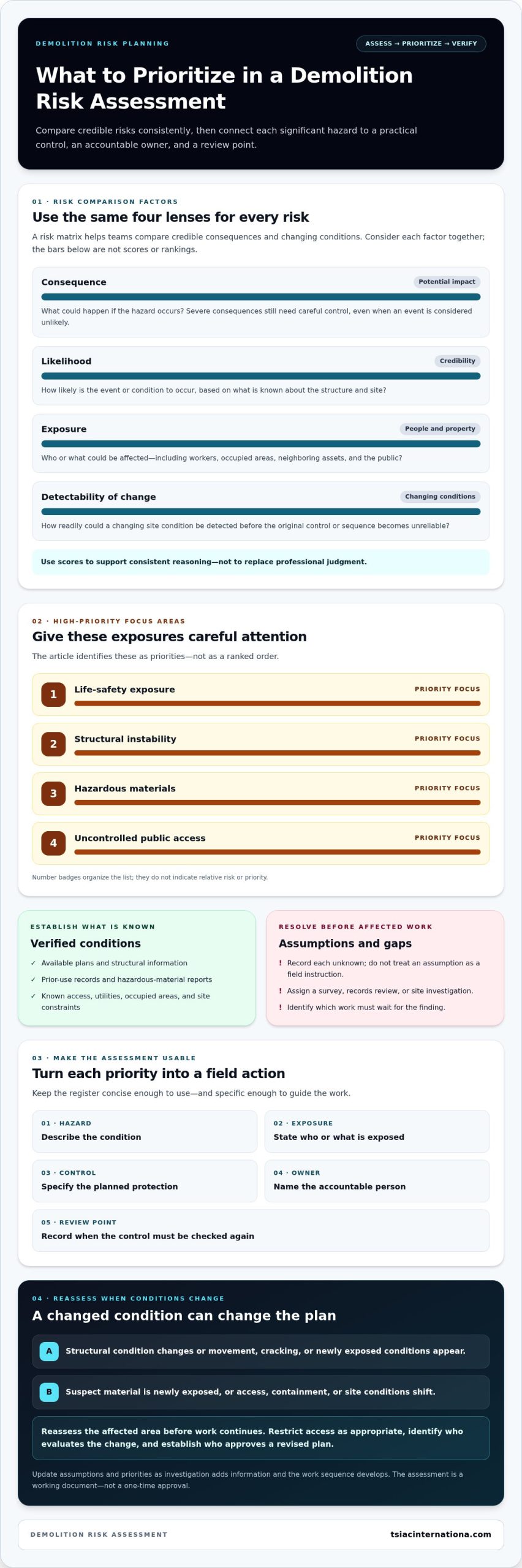
Use a consistent risk matrix to compare credible consequences, likelihood, exposure, and how readily changing conditions can be detected. Scores help teams apply the same reasoning, but they don’t replace professional judgment: an event with severe consequences still needs careful control, even if it is considered unlikely. Prioritize life-safety exposure, structural instability, hazardous materials, and uncontrolled public access. For every high-priority item, record the planned control, accountable owner, and review trigger.
For example, a change in structural condition, newly exposed material, or a shift in site access may trigger reassessment before work continues in the affected area. Keep the register concise enough to use: describe the hazard, who or what is exposed, the control, the accountable person, and when the control must be checked again. That creates a direct link between assessment and field action.
Early assessment is not a one-time approval. As investigation adds information and the work sequence develops, update assumptions and priorities so controls remain aligned with actual site conditions.
Control Structural, Hazardous-Material, and Site-Interface Risks Together
Demolition hazards interact. A change in structural stability can alter the safe work sequence, shift an exclusion zone, and affect access to an occupied area. If suspect material is present, the sequence must also account for assessment, containment, removal, and waste handling before that material is disturbed. Treating these as separate work packages can leave gaps at the handoffs. Strong demolition project risk mitigation strategies connect the physical work, hazard controls, and site interfaces in one coordinated plan.
How do structural conditions affect demolition controls?
Structural condition, construction type, and the selected demolition method inform the order of work and the controls needed at each stage. A survey and planned sequence help determine where exclusion zones belong, which access routes remain available, and whether temporary support is needed. Make these controls specific to the structure and review them as work progresses. OSHA’s demolition safety standards provide a reference for demolition planning and workplace hazards.
Unexpected movement, cracking, or newly exposed structural conditions can make the original sequence unreliable. Pause work in the affected area, restrict access as appropriate, and reassess the condition and controls before proceeding. The response should identify who evaluates the change and who approves the revised plan, rather than leaving the decision to informal judgment in the field.
How should hazardous materials and site interfaces be managed?
Plan hazardous-material assessment and abatement before demolition reaches suspect materials. Coordinate containment boundaries, authorized access, communication between crews, and material handling and removal. At interfaces, a demolition crew’s route, equipment staging, or debris movement must not conflict with active containment or expose adjacent work areas.
Map other site-specific interfaces alongside the work sequence: utility locations and isolation points, neighboring property, dust and noise pathways, vibration-sensitive areas, and routes used by workers or the public. For example, if a debris path crosses an occupied access route, define how the route will be separated and how affected people will be informed. Changes in access, containment, or site conditions should trigger a review of the affected controls.
Abatement planning should account for how assessment, containment, removal, and debris handling connect to the demolition sequence. TSIAC International provides structural and selective demolition, interior gutting, asbestos and lead abatement, and debris recycling, allowing related scopes to be coordinated in project planning.
Compare Demolition Risk Controls by How They Prevent Exposure
Choose controls based on the assessed hazard and site conditions, not a standard checklist alone. Compare how directly each measure prevents exposure, who must implement it, how it will be inspected, and what risk remains. The common demolition hazards outlined by the Canadian Centre for Occupational Health and Safety include structural collapse, hazardous materials, and falls. The relevant controls still need to be selected for the specific project and applicable requirements.
Which control types belong in a demolition risk plan?
Use the hierarchy of controls to compare options. Higher-level controls generally rely less on individual behavior, while procedures and PPE remain important supporting measures. The examples below are planning prompts, not universal prescriptions.
| Control type | How it can apply | What to verify |
|---|---|---|
| Elimination | Change the scope or sequence, where feasible, to avoid a crew’s exposure to a specific hazard. | Confirm the revised method removes the exposure rather than shifting it to another task or area. |
| Engineering | Use assessed physical separation, containment, or equipment safeguards to isolate people from a hazard. | Assign installation and inspection; document limits such as access points or conditions that could compromise the control. |
| Administrative | Set work procedures, access restrictions, sequencing instructions, and task-specific training. | Identify who communicates and checks the procedure, and when it needs review. |
| Personal protective equipment | Provide PPE selected for the identified exposure as a final protective layer. | Define required use, fit, condition, and replacement or inspection responsibilities. |
A procedure or PPE requirement shouldn’t substitute for a feasible measure that removes or physically controls the exposure. Layer controls when the assessment shows residual risk remains.
How can teams compare control options objectively?
For each proposed measure, record its expected effect on exposure, implementation owner, inspection method, assumptions, limitations, and residual risk. For instance, a barrier may separate people from a work zone, but the plan still needs to address openings, changing access routes, and who checks the separation. These details make demolition project risk mitigation strategies verifiable in the field.
Monitoring can reveal changed conditions, but it doesn’t remove the hazard. Pair inspections or monitoring with a defined response: who evaluates the finding, what work pauses, and how controls are restored or revised. Contingency measures manage exceptions; they don’t replace preventive controls. Review the demolition sequence alongside the controls so each measure is in place before the task that depends on it begins.
Put Demolition Risk Mitigation Strategies into Daily Field Practice
A risk control only works if the crew can apply it under actual site conditions. Make demolition project risk mitigation strategies part of the daily work cycle, with clear authority to pause affected tasks when conditions no longer match the plan.
What belongs in a daily demolition safety briefing?
Keep the briefing specific to the day’s work area and sequence. Cover hazards, exclusion zones, access routes, interfaces with other operations, and controls that need checking. Confirm who is responsible for each action, how crews will communicate, and which emergency arrangements apply. Ask workers to report anything that differs from the plan before proceeding.
A practical field routine is:
- Brief the crew: Review the task, sequence, hazards, boundaries, and responsibilities.
- Verify conditions: Check that the work area and access match the plan before the task starts.
- Inspect controls: Confirm barriers, containment, equipment safeguards, and other planned measures are in place and usable.
- Record changes: Log observations, control checks, and decisions, using photographs where they clarify a condition or handoff.
- Escalate exceptions: Notify the designated supervisor and pause affected work when a trigger is met.
How should teams handle changes and unexpected conditions?
Define stop-work and escalation triggers before work begins. Triggers may include unexpected material, structural movement, failed or displaced controls, or a changed site condition that affects safe access or the planned sequence. The person who observes the change should report it promptly; the designated supervisor should secure the affected area and route the issue for assessment.
Assign roles in the project plan: for example, a project manager coordinates decisions and communication, a site supervisor implements and checks field controls, and a designated reviewer evaluates proposed changes and approves revisions. Role titles can vary, but ownership must be clear. Work resumes only after the hazard has been reassessed, the method or controls revised as needed, and the approved change communicated to affected crews.
For selective interior work, this change-control discipline helps crews distinguish planned removals from elements that must remain. The commercial interior gutting guide offers related context on planning interior demolition scopes.
Keep daily records concise and retrievable. A dated issue log should capture what changed, where it occurred, who assessed it, what decision was made, and who was informed. Photographs can document site conditions or control placement, while brief handoff notes help the next shift understand open items without relying on memory. TSIAC International coordinates demolition work with abatement and interior gutting as related project scopes. For more on evaluating a project’s scope and planning needs, see TSIAC International’s demolition project planning.
Choose a Demolition Partner That Makes Risk Controls Visible
A sound proposal should show how risk planning will work on the project, not rely on broad assurances about safety or experience. Use a consistent framework to assess whether the scope, hazards, responsibilities, work sequence, and project records connect clearly. These details make demolition project risk mitigation strategies easier to evaluate before field activities begin and easier to track as conditions change.
What project documents make risk planning easier to evaluate?
Look for project-specific planning documents that explain what work is included, what hazards have been identified, how activities will be sequenced, and how site controls and communication will be managed. Responsibilities should make clear who implements controls, who inspects them, and who reviews proposed changes.
- Scope and sequence: Work boundaries, demolition method, interfaces with abatement or other activities, and the planned order of work.
- Hazard and control information: Known conditions, unresolved questions, planned controls, and the person accountable for each action.
- Field and closeout records: Inspection logs, change decisions, issue tracking, and records of completed closeout actions.
Documentation should reflect observed site conditions and be revised when new information affects the plan. It should also account for requirements applicable to the specific project, rather than treating a generic template as a substitute for project review.
How does coordinated demolition and abatement support project planning?
Structural work, hazardous-material abatement, interior gutting, and debris handling can affect one another’s access, sequencing, containment, and handoffs. Planning those interfaces together clarifies when one activity must be completed before another can proceed, how material moves through the site, and who communicates changes between work groups. For example, planned debris routes should align with active containment boundaries and the established work sequence.
TSIAC International brings over 15 years of demolition and abatement industry experience to structural and selective demolition, asbestos and lead abatement, interior gutting, and debris recycling. Recycling practices for wood, metal, and plastic are implemented on every project site. These coordinated capabilities support alignment of related scopes and responsibilities, while allowing the controls and sequence to reflect the actual site.
Review the planning approach, records, and responsibilities against the project requirements, then discuss the scope and site conditions with TSIAC International. Discuss your demolition project with TSIAC International.
Carry a Clear Risk Plan from Assessment to Closeout
Demolition project risk mitigation strategies work best as a connected process: identify uncertain conditions early, coordinate structural and hazardous-material controls with site interfaces, and verify controls as work progresses. Clear responsibilities and records help teams respond when field conditions differ from the plan.
A demolition partner should make its scope, sequencing, controls, and documentation understandable and specific to the project. TSIAC International brings over 15 years of demolition and abatement industry experience, with services including structural and selective demolition, asbestos and lead abatement, and interior gutting. Recycling practices for wood, metal, and plastic are implemented on every project site.
Discuss your project requirements and planning needs with TSIAC International’s demolition team. A clear conversation is a practical first step toward a well-coordinated project plan.
Frequently Asked Questions
What are the biggest risks in a demolition project?
The most serious demolition risks include structural instability, falling materials, hazardous substances, utility strikes, and exposure of workers or the public to active work areas. Dust, vibration, and noise can also affect neighboring properties or occupied parts of a site. The actual risk profile depends on the structure, demolition method, materials, and site conditions. Assess how hazards interact, since a change in sequence or access can affect several controls at once.
How do you create a demolition risk assessment?
Start by defining the scope, method, sequence, occupied areas, utilities, access routes, and nearby assets. Review available building and structural records, prior-use information, and hazardous-material reports, then identify assumptions that need investigation. Rank hazards using consistent factors such as credible consequence, likelihood, exposure, and how readily changing conditions can be detected. Effective demolition project risk mitigation strategies connect each priority risk to a control, a responsible owner, and a review trigger.
How can hazardous materials be managed during demolition?
Identify and assess suspect materials before demolition disturbs them, using relevant records and appropriate site investigation. Plan any required abatement in coordination with the demolition sequence, including containment boundaries, crew access, communication, material handling, and disposal. Keep work areas and responsibilities clear at the handoff between abatement and demolition activities. Document findings and changes, and follow requirements applicable to the project and jurisdiction. If unexpected suspect material is exposed, pause affected work and reassess before proceeding.
What is the hierarchy of controls in demolition?
The hierarchy of controls orders risk controls from measures that address a hazard at its source to those that rely more on individual action: elimination, engineering controls, administrative controls, and personal protective equipment. For example, a scope change may avoid an exposure, while physical separation may isolate workers from a hazard. Procedures and PPE remain important, but should not replace stronger feasible controls. Select and layer measures according to assessed site conditions and applicable requirements.
When should demolition work stop because of an unexpected condition?
Pause the affected work when conditions materially differ from the plan, such as unexpected suspect material, structural movement, a failed barrier, or an unanticipated utility or access issue. Secure the area as appropriate and notify the designated supervisor. The team should reassess the hazard, determine whether the method or controls need revision, and communicate approved changes to affected workers. Resume only when the changed condition has been addressed and the relevant controls are in place.
How often should a demolition risk assessment be reviewed?
Review the assessment before work starts and whenever new information or a site change could affect the hazards or controls. Triggers include a revised demolition sequence, newly exposed materials, changed access, control failure, or observed structural movement. Daily briefings and field inspections help identify changes, while phase transitions provide useful planned review points. There’s no single review interval suitable for every project, so set review triggers and responsible owners in the project plan.
How can demolition teams reduce risks to neighboring property?
Map adjacent structures and property, access routes, and occupied areas during planning, then assess how the demolition method and sequence could affect them. Select project-specific controls for separation, dust, noise, vibration, and public access, and assign responsibility for checking those measures. Maintain clear communication about relevant work interfaces and reassess if site conditions or the sequence changes. Monitoring can help reveal changing conditions, but teams still need preventive controls and a defined response to findings.
