
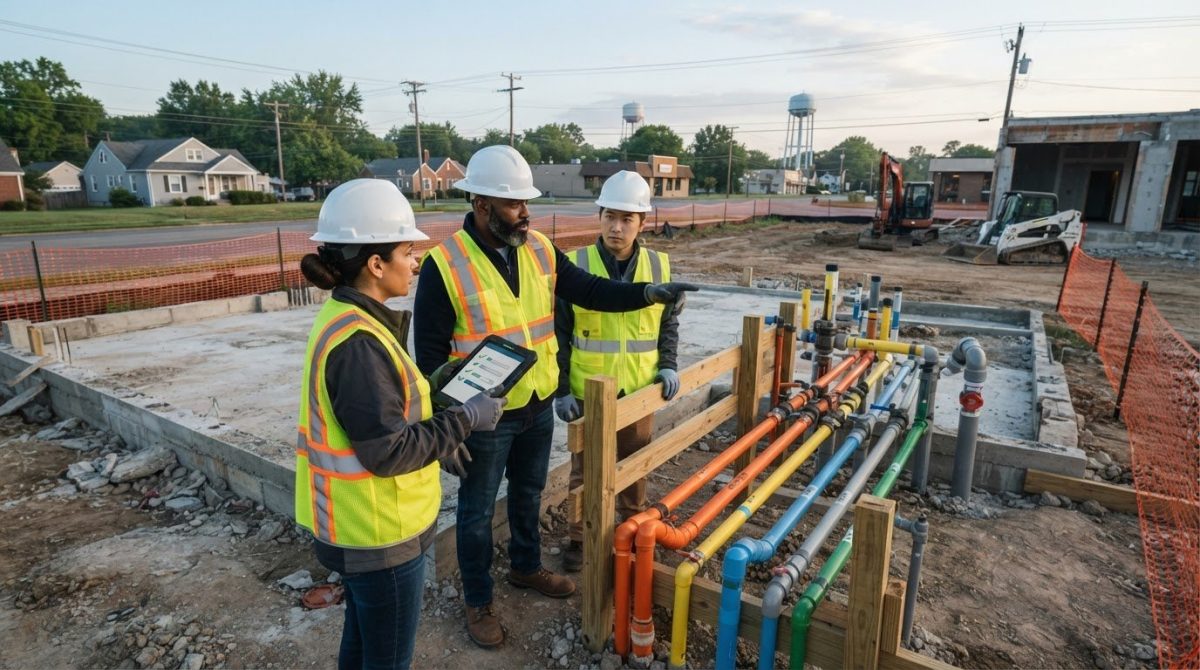
A submitted utility-disconnection request doesn’t make a site demolition-ready. Planning utilities disconnection for demolition means identifying every service, coordinating the required work, and verifying its status before the handoff. An overlooked connection or unclear responsibility can create safety concerns and disrupt the project schedule.
The owner, utility providers, and demolition team each have a role, so assign responsibilities early. Requests and approvals may take time, and a service that’s switched off may not have been physically disconnected or otherwise made safe for demolition. Document and communicate each service’s status rather than assuming it is ready.
This checklist walks through a practical sequence: inventory services at the property, assign coordination responsibilities, allow time for provider processes, and collect written confirmation before demolition begins. It also explains how to hand off utility records and account for utility status alongside demolition and abatement planning. TSIAC International brings more than 15 years of demolition and abatement experience to project planning and handoffs.
Key Takeaways
- Build a complete inventory of electric, gas, water, sewer, telecommunications, and other connected services before setting the demolition sequence.
- For planning utilities disconnection for demolition, assign coordination responsibilities and obtain provider-specific timing and written status records.
- Track each service separately, including whether it has been disconnected, isolated, or remains unresolved.
- Use a documented checklist to flag conflicting information and communicate verified utility status before the demolition handoff.
- Coordinate utility readiness with demolition and abatement planning, while keeping provider-performed service work distinct from site preparation.
Planning Utilities Disconnection for Demolition: What Must Be Identified First?
Before demolition planning can proceed reliably, the project team needs a clear picture of every service connected to the property. Utility disconnection is the coordinated termination or isolation of those services before demolition activities begin. The inventory should cover electricity, natural gas, water, sewer, telecommunications, and any other connections serving the building or site.
A disconnection request is a record of work requested, not proof that the service has been disconnected. Until the provider’s work and status are confirmed and documented, treat the service as unresolved. This distinction matters because planning must account for both the broader Demolition process and the conditions at the specific site.
Which utility services should the demolition team inventory?
Start with visible service entrances, meters, electrical panels, utility cabinets, and known connections to the site. Compare these observations with available property, maintenance, and utility records. Record a service that appears inactive, or a line that isn’t shown in current records, for follow-up instead of assuming it is disconnected.
For each service, document its type, provider, account reference, current status, and responsible contact. Note where it enters or serves the property when that information is available. This creates a working inventory that the owner and project team can update as provider requests progress.
Who is responsible for each disconnection step?
Responsibility is shared, but the tasks are distinct. Utility providers control work on their service-side infrastructure and issue confirmations about the status of their services. The owner or authorized representative typically initiates requests and supplies the information needed to coordinate them. The demolition contractor uses the documented status to plan work, communicate site conditions, and prepare a clear handoff.
Assign a named contact for each service and record who will submit the request, track provider communication, and share confirmation with the team. If records conflict with site observations, flag the discrepancy for resolution before treating the status as settled.
For planning utilities disconnection for demolition, the inventory is a control document, not just an administrative list. It shows what is known, what remains open, and which confirmations must inform work planning. Provider procedures and terminology can differ, so record the stated status accurately instead of assuming what “off” or “disconnected” means.
How to Coordinate Utility Disconnections Before Demolition
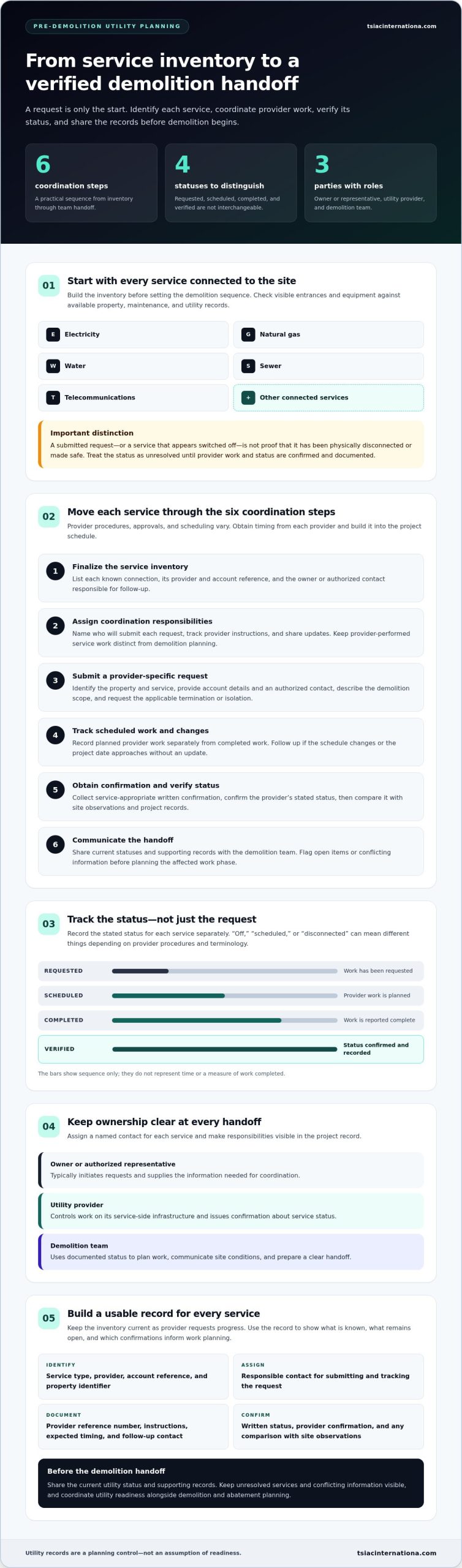
Use a consistent sequence to move each service from identification to documented status. Begin coordination early because provider procedures, approvals, and scheduling vary. Obtain timing from each provider and build it into the project schedule. A submitted request is only the first step. Requested, scheduled, completed, and verified are separate statuses, and project records should show which one applies to each service.
- 1. Finalize the service inventory. List every known utility connection, its provider and account reference, and the owner or authorized contact responsible for follow-up.
- 2. Assign coordination responsibilities. Identify who will submit each request, track provider instructions, and share updates with the project team. Keep provider-performed service work separate from demolition planning.
- 3. Submit provider-specific requests. Provide the property identifier, service type, account details, and authorized contact information. Describe the planned demolition scope and request the applicable termination or isolation. Record any provider reference number, instructions, expected timing, and follow-up contact.
- 4. Track scheduled work and changes. Record planned provider work separately from completed work. Follow up if the schedule changes or the project date approaches without an update.
- 5. Obtain confirmation and verify status. Collect written confirmation or other provider documentation appropriate to the service. Confirm completion with the provider, then compare the documented status with site observations and project records.
- 6. Communicate the handoff. Share the current status and supporting records with the demolition team. Flag open items or conflicting information before planning the affected work phase.
What information should a disconnection request include?
Make each request specific enough for the provider to identify the property and service. Include the service address or other property identifier, service and account details, the authorized representative’s contact information, and the planned demolition scope. State the requested service termination or isolation. Then add the provider’s response, reference number, instructions, expected timing, and follow-up contact to the project record.
How should project teams verify provider work is complete?
Use service-specific documentation rather than treating a scheduled appointment or closed request as proof of completion. Obtain the provider’s confirmation, verify its stated status with the provider, and compare it with site conditions and project documentation. If records disagree or site observations raise a question, pause the status handoff and resolve the discrepancy with the responsible contact.
Check and document each service separately. One completed request or general site note cannot establish the status of every connection. This supports safer sequencing and a clear handoff. As demolition and abatement planning develops, TSIAC International’s demolition services can be part of the project’s broader work planning.
Utility Disconnection for Demolition: Compare Services and Coordination Needs
Each service has its own provider, equipment, work process, and evidence of completion. Use the comparison below to identify coordination needs, then record the provider’s exact status and any open questions. Terminology and procedures vary by provider and jurisdiction, so don’t treat a label such as “off” or “released” as proof of a specific condition without clarification.
| Service | Likely provider | Planning question | Status record to retain |
|---|---|---|---|
| Electricity | Electric utility or service provider | Which service or equipment serves the demolition area, and what work remains provider-controlled? | Provider confirmation, work reference, and stated service status |
| Natural gas | Gas utility or service provider | Does the service serve only this property, or does it connect to a shared or adjoining area? | Provider confirmation and record of the service status or completed work |
| Water | Water utility or service provider | Where is the service boundary, and does the connection serve other buildings or users? | Provider communication identifying the service and its current status |
| Sewer | Sewer utility or local service authority | Which connection serves the property, and are any branches shared? | Written status confirmation or other provider documentation |
| Telephone, internet, and cable | Telecommunications or communications provider | Are any lines shared, active, or needed for an adjoining property or site system? | Provider reference and confirmation of the applicable service status |
| Other or buried services | Relevant utility or service provider | Are there site connections or underground facilities that could affect work limits? | Locate request records, provider responses, and unresolved-item notes |
How do electrical, gas, and water disconnections differ?
Electrical and gas services can present serious hazards if their status is unclear, so provider confirmations must be explicit and available to the team before demolition planning relies on them. Water and sewer coordination requires attention to connection boundaries, especially if a line, branch, or facility serves more than one property. The table identifies questions to resolve, not technical instructions. Qualified personnel and providers determine service work and any isolation method.
What about telecommunications and shared or buried utilities?
Include telephone, internet, cable, and other communications connections, even if they seem secondary to building operations. An active or shared feed may support neighboring or occupied areas and affect demolition limits or sequencing. For underground utilities, 811 is a starting point for locating procedures. Requirements and coverage vary, so document the applicable process and any remaining uncertainty.
During planning utilities disconnection for demolition, mark occupied areas, shared feeds, adjoining properties, and services that must remain operational. Don’t let a general site-wide status obscure a connection that crosses the work boundary. Carry those distinctions into the handoff so demolition sequencing reflects verified service records and clearly flagged exceptions.
Pre-Demolition Utility Disconnection Checklist for a Safer Site Handoff
A reliable handoff depends on records the project team can review, not assumptions based on a meter, panel, or visible line. Use this checklist as a working file, update it when provider information changes, and flag unresolved services or conflicting records before planning the affected work phase. Site observations help identify questions, but they don’t replace provider confirmation or a qualified safety assessment.
Which documents belong in the project utility file?
Organize the file so the team can trace each service from initial inventory to current status. Include:
- Service records: the utility inventory, provider and account references, request submissions, correspondence, and provider reference numbers.
- Status evidence: completion confirmations or other provider documentation, with the date received and the service it covers.
- Site information: utility plans and location records, clearly marked with their revision dates. Note where site observations differ from the documents.
- Open items: unresolved questions, the person assigned to follow up, the next action, and any provider response or expected update.
Retain older records when they explain a change in service status. Make the current version easy to identify as the working reference, and distinguish superseded information so it isn’t mistaken for the latest status.
What should the demolition handoff communicate?
Give the demolition team a concise, current summary for every service. State what the provider has documented, identify services that remain active or unresolved, and mark relevant boundaries, access restrictions, and connections that must stay available. If site conditions conflict with provider records, call out the discrepancy rather than presenting the file as settled.
- Records reviewed: identify the current utility inventory and supporting confirmations.
- Work boundaries: show affected areas and connections, including shared or adjoining services.
- Exceptions: list open items, responsible contacts, and follow-up needed before the planned work phase.
- Team communication: distribute the summary to relevant project participants and record when it was updated.
Coordinate utility readiness with hazardous-material planning. Abatement and demolition sequencing should reflect documented site conditions, while recognizing that utility records don’t replace separate material assessments. The handoff should show known conditions, outstanding questions, and the records supporting each status.
Use this documented handoff to keep open issues visible as planning utilities disconnection for demolition moves into site preparation. For demolition planning support, explore TSIAC International’s demolition services.
From Utility Readiness to Demolition: Making the Project Handoff Clear
Verified utility status gives the demolition team information it can use to plan sequence, access, and site preparation. A project may include selective demolition in one area while adjacent spaces remain occupied, or interior gutting planned around services that must stay available. Structural demolition has different work limits, but it still depends on clear records showing which services are confirmed, which remain active, and where restrictions apply.
Utility providers perform their own service work and provide the applicable status information. The demolition team uses that documentation to plan its work. Visual observations or a contractor’s schedule don’t replace provider confirmation. Keeping these responsibilities distinct helps the project team make informed decisions about scope and sequence.
How does utility readiness affect the demolition schedule?
Provider appointments and confirmations are project dependencies, not assumptions. Track them alongside milestones such as access preparation and planned demolition phases, without relying on a universal lead time. If an appointment shifts or confirmation is delayed, update the schedule, notify affected project participants, and reassess work that depends on the service’s documented status. Record the change and next follow-up action so the team is working from the same information.
During planning utilities disconnection for demolition, distinguish a schedule update from a verified change in site status. A revised appointment date doesn’t confirm that work is complete. The handoff should reflect the latest provider documentation and clearly flag any open dependency.
What information should the demolition contractor receive?
Provide the contractor with the defined work scope, current site plans, utility inventory, provider confirmations, and a concise list of limitations or unresolved items. Mark occupied or adjacent areas, access restrictions, shared connections, and services that must remain operational. These details help the team align its methods and work boundaries with actual site conditions instead of incomplete assumptions.
For projects involving interior demolition, the commercial interior gutting guide offers related scope context. Consider utility readiness alongside abatement planning when hazardous materials are part of the project, since each phase has distinct planning and documentation needs.
A clear handoff turns utility records into usable project controls. TSIAC International brings more than 15 years of demolition and abatement experience to structural and selective demolition, interior gutting, and related project scopes. Discuss your demolition or abatement scope with the TSIAC team as planning moves toward execution.
Carry Verified Utility Status Into Your Demolition Plan
A demolition-ready handoff depends on a complete service inventory, provider-specific documentation, and clear communication about what is confirmed, active, or unresolved. Requests, scheduled work, and completed disconnections are different milestones. Keep each service’s status distinct and make open issues visible before the relevant work phase.
Effective planning utilities disconnection for demolition also means using verified information to guide work sequencing, access, and site preparation. Utility providers perform their service-side work; the demolition team plans around documented status and the project’s defined scope. Coordinating these steps with abatement planning helps the project team prepare with greater clarity.
TSIAC International brings more than 15 years of demolition and abatement experience, including structural and selective demolition, interior gutting, and hazardous-material abatement. Discuss your demolition or abatement project with TSIAC International to plan a well-organized handoff. Clear records and careful coordination provide a sound basis for the work ahead.
Frequently Asked Questions
How far in advance should utilities be disconnected before demolition?
Start coordinating as soon as the demolition scope and target schedule take shape. There’s no single lead time that applies to every service because provider processes, scheduling, and local requirements can differ. Get current steps and expected timing from each provider, then track appointments and confirmations against project milestones. Leave room for follow-up if a date changes, and don’t treat a scheduled visit as proof that service work is complete.
Can demolition begin after a utility disconnection request is submitted?
No. A submitted request only shows that work was requested; it doesn’t establish that the service has been disconnected or otherwise addressed. Before the relevant demolition work proceeds, obtain provider documentation of completed work and communicate the service status to the project team. If documentation conflicts with site observations or leaves the status unclear, flag the issue for resolution rather than assuming the connection is safe to disturb.
Who is responsible for disconnecting utilities before demolition?
Responsibility is coordinated among the property owner or authorized representative, utility providers, and the demolition team. The owner or representative generally initiates service requests and tracks provider communication. Providers control work on their service-side infrastructure and supply status information. The demolition contractor uses that documentation to plan work and prepare the handoff, but doesn’t perform the provider’s disconnection work. Assign a contact for each service so requests, updates, and records don’t fall between project roles.
Which utilities need to be disconnected before demolition?
Inventory every service connected to or crossing the site, including electricity, natural gas, water, sewer, telephone, internet, cable, and other communications or site services. Shared connections, adjoining properties, and occupied areas may affect what must remain operational and how work is sequenced. The required status and process depend on the service and project conditions. Record each connection separately and confirm its status with the responsible provider rather than relying only on visible equipment or old plans.
Is calling 811 enough to identify all utilities before demolition?
No. Contacting 811 can be a starting point for underground utility locating, but it doesn’t by itself verify that building services have been disconnected or identify every site connection. Coverage and procedures vary, and site records or observations may point to additional services that need follow-up. Include aboveground services, shared feeds, and known private or site-specific connections in the inventory, then document locate information and unresolved questions for the project team.
What proof should I keep after utilities are disconnected?
Keep provider confirmations or other service-specific documentation showing work status, along with request records, reference numbers, correspondence, and relevant instructions. File each record against the service it covers, and note when it was received and who verified it. Keep current site plans and utility-location information with revision dates, too. If a service remains active or its status is uncertain, record that limitation and the responsible contact instead of marking it complete.
Can utilities be disconnected while the building is still occupied?
Possibly, but only with careful coordination around occupants, building operations, and services that must remain available. A disconnection can affect shared systems or adjoining spaces, so identify who and what depends on each connection before scheduling provider work. Coordinate proposed timing and impacts with the owner, occupants, and project team, and document which services are changing status. Don’t assume an occupied building can safely lose a service without a project-specific plan.
