
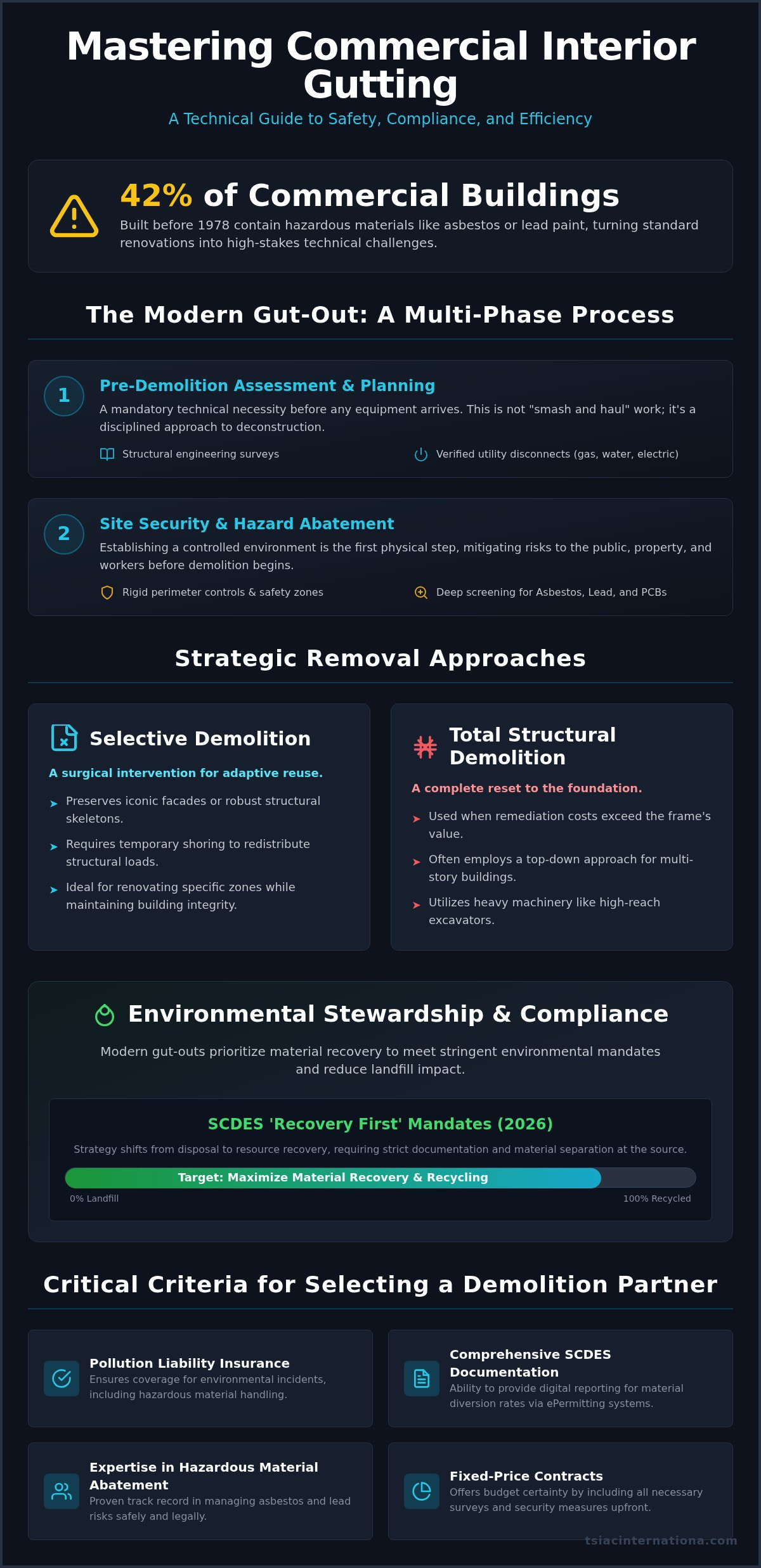
Did you know that approximately 42% of commercial structures built before 1978 contain hazardous materials like asbestos or lead paint? For property owners and developers, these hidden liabilities transform a standard renovation into a high-stakes technical challenge. You’re likely aware that a project’s success hinges on the quality of the initial strip-out, yet the mounting pressure of stringent environmental regulations and rising landfill tipping fees can make the process feel overwhelming. Managing a commercial interior gutting project requires more than just brute force; it demands a surgical approach to structural stripping that prioritizes safety and environmental stewardship.
This guide will help you master the complexities of interior demolition by providing an authoritative look at industry-standard safety, compliance, and efficiency protocols. You’ll learn how to secure a clean, build-ready structural shell while navigating the latest federal and state environmental agency mandates. We’ll preview the essential documentation needed for hazardous material removal and explain how a “Recovery First” strategy for debris can significantly reduce your project’s environmental footprint. By the end of this article, you’ll have the technical framework necessary to turn a high-liability site into a controlled, professional workspace.
Key Takeaways
- Differentiate between standard demolition and the multi-phase engineering required for large-scale commercial gut-outs to ensure project precision.
- Identify whether your renovation requires surgical selective demolition for specific zones or a total structural reset to the building’s foundation.
- Mitigate legal and safety risks by integrating professional asbestos and lead abatement into the early stages of the construction timeline.
- Master the technical process of commercial interior gutting myrtle beach to achieve a clean, build-ready shell while maximizing material recovery and recycling.
- Evaluate potential demolition partners based on specialized pollution liability insurance and their ability to provide comprehensive SCDES regulatory documentation.
Understanding the Scope of Modern Commercial Interior Gutting
Professional commercial interior gutting myrtle beach isn’t merely about stripping walls; it’s a multi-phase engineering and environmental process. Unlike residential projects where a small crew might handle debris, commercial gut-outs involve massive scales and complex structural dependencies. You’re dealing with high-capacity HVAC systems, specialized fire suppression networks, and structural load-bearing elements that require precise calculations before a single stud is removed. The liability involved in these environments is significantly higher due to the presence of regulated hazardous materials and the potential for structural failure if the removal isn’t sequenced correctly.
Modern structural removal utilizes heavy machinery like skid steers and robotic demolition units to maintain tight schedules, but their deployment requires meticulous site preparation. This isn’t just “smash and haul” work. It’s a disciplined approach to Deconstruction and environmental stewardship, where materials are separated at the source to meet the 2026 SCDES ‘Recovery First’ mandates. The regulatory landscape in 2026 has shifted significantly, now requiring digital reporting of material diversion rates and stricter adherence to state-level environmental protocols through the South Carolina Department of Environmental Services ePermitting system.
Phase 1: Pre-Demolition Assessment and Planning
Before any heavy equipment arrives on-site, a comprehensive assessment is a technical necessity. This involves structural engineering surveys to identify load-bearing walls and floor load limits to prevent accidental collapses during the removal of heavy interior components. You must also coordinate utility disconnects with municipal providers to ensure gas, water, and electrical lines are safely capped and verified. The pre-demolition survey is a mandatory safety protocol designed to identify structural vulnerabilities and hazardous material locations before any mechanical intervention occurs.
Phase 2: Site Security and Hazard Identification
Structural vs. Selective Demolition: Strategic Removal Approaches
Choosing between total and selective demolition isn’t just a matter of preference; it’s a strategic decision based on the building’s future utility and structural viability. Total structural demolition represents a complete reset to the foundation. This is typically reserved for structures where the cost of remediation exceeds the value of the existing frame. In contrast, selective demolition acts as a surgical intervention. This approach is vital for adaptive reuse projects in Myrtle Beach, where preserving an iconic facade or a robust structural skeleton is more efficient than starting from scratch.
Maintaining structural integrity during partial removals is the primary technical challenge. When we execute commercial interior gutting services, we must account for the redistribution of loads. Removing a mezzanine or a heavy concrete floor slab requires temporary shoring to prevent the remaining structure from shifting or failing. This level of precision ensures that the building remains safe for subsequent trades to begin their work immediately. It’s a disciplined methodology that separates professional engineers from standard cleanup crews.
The Mechanics of Total Structural Removal
Total removal relies on a calculated sequence of operations. For multi-story commercial buildings, a top-down approach is standard to maintain control over the structure’s center of gravity. We utilize high-reach excavators equipped with hydraulic shears and processors to systematically dismantle the building. Managing the debris flow is critical; if the site becomes congested with mixed waste, safety margins drop and efficiency stalls. We prioritize source separation to ensure metal and concrete are processed for recycling, keeping the site organized and compliant.
Selective Demolition for Commercial Renovations
Selective demolition for commercial interior gutting myrtle beach requires a specialized toolkit. We often deploy robotic breakers and precision saw cutting in confined spaces where heavy machinery cannot safely operate. These tools allow us to strip interiors to the structural shell without vibrating adjacent walls or damaging shared utility systems. It’s essential to remember that even during minor removals, compliance with federal asbestos regulations is mandatory if the work disturbs regulated materials. If you’re preparing for a complex tenant improvement, it’s wise to consult with a structural specialist to verify your removal plan before work begins.
Hazardous Material Abatement: Managing Asbestos and Lead Risks
Abatement is the non-negotiable first phase of any responsible commercial interior gutting myrtle beach project. You can’t safely dismantle a structure until you’ve neutralized the environmental threats embedded within its walls. In coastal South Carolina, approximately 42% of commercial buildings constructed before 1978 contain hazardous materials like asbestos or lead based paint. Attempting to strip these interiors without professional containment doesn’t just risk public health; it invites catastrophic legal liability. Professional hazardous material abatement in South Carolina ensures that these toxins are identified and removed before mechanical demolition begins, preventing the release of microscopic fibers or dust into the surrounding environment.
The stakes of hazardous material management are exceptionally high. As of 2026, OSHA penalties for serious safety violations can reach $16,550 per item, making strict adherence to OSHA demolition safety guidelines a financial necessity. Class I and Class II abatement projects require specialized equipment, including high capacity HEPA air scrubbers and industrial grade decontamination units. We treat every site with methodological precision, ensuring that workers are protected and that the property owner receives full regulatory documentation to prove the site is clean. This documentation is vital for securing subsequent building permits and maintaining the property’s long term value.
Asbestos Abatement Protocols
Asbestos containment requires a rigorous multi-barrier approach. We establish negative air pressure zones to ensure that no air escapes the work area without passing through HEPA filtration systems. Our teams utilize wet-method removal techniques, which involve saturating materials with amended water to prevent fiber aerosolization during the stripping process. Every pound of asbestos waste is tracked through a strict chain of custody, from the moment it’s sealed in regulated bags to its final arrival at a certified SCDES disposal facility. This level of transparency is essential for modern compliance.
Lead-Based Paint Removal and Containment
Lead hazards are frequently found in industrial frameworks and older commercial structures throughout the Myrtle Beach area. To mitigate these risks, we utilize specialized vacuum-shrouded tools that capture dust at the point of generation, alongside advanced chemical stripping agents that dissolve paint without creating airborne particles. The EPA Renovation, Repair, and Painting (RRP) rule mandates that firms performing renovations that disturb lead-based paint in pre-1978 commercial facilities follow specific work practices to prevent lead contamination, a requirement that remains strictly enforced through SCDES inspections in 2026. By following these protocols, we ensure the structural shell is entirely safe for the next phase of construction.
Interior Gutting and Environmental Stewardship
Stripping a building to its structural shell represents the final transformation in the demolition sequence. Once all hazardous materials have been neutralized through professional commercial interior gutting myrtle beach, the focus shifts to the systematic removal of non-structural components. This process isn’t just about clearing space; it’s a disciplined exercise in resource recovery. By isolating specific material streams, we prepare the “white box” environment that commercial tenants require for new improvements while ensuring that the building’s structural integrity remains undisturbed. This phase bridges the gap between a contaminated past and a build-ready future.
Adhering to the South Carolina Department of Environmental Services (SCDES) “Recovery First” mandate is a logistical priority. Every project must balance the speed of removal with the precision of material separation. This is particularly critical when dealing with structures that previously required asbestos removal in South Carolina, as the remaining clean materials must be kept free of cross-contamination to maintain their recycling value. Effective stewardship during a gut-out ensures that the vast majority of interior debris never reaches a landfill, aligning project goals with modern environmental standards.
Interior Component Removal: Metal Framing and Drywall
The systematic removal of non-load-bearing partitions requires a clear understanding of the building’s MEP (Mechanical, Electrical, and Plumbing) systems. We begin by stripping away finishes to expose the metal framing, allowing for the organized disconnection of electrical runs and plumbing lines. Managing acoustic ceiling removal is a specific technical challenge; these components must be dismantled carefully to prevent dust accumulation on the floor space, which can complicate the cleaning of the concrete slab. This methodical approach ensures that the resulting shell is free of debris and ready for the immediate installation of new tenant infrastructure.
Material Recycling: Wood, Metal, and Plastic
Diverting construction and demolition (C&D) debris from local landfills is both an environmental and a financial imperative. In Horry County, landfill tipping fees have reached $46 per ton as of 2026, making “smash and haul” methods financially unsustainable for large-scale commercial projects. We implement source separation on every site, isolating wood, metal, and plastic to maximize recovery rates. Scrap metal recovery, in particular, provides a significant opportunity to offset project costs through high-volume recycling. By prioritizing these recovery streams, we help manage the 600 million tons of C&D debris generated annually in the United States while delivering a more cost-effective solution for property owners.
If you’re ready to transition your property into a clean, build-ready state, you can request a fixed-price recycling and demolition plan to secure your project’s budget and timeline.
Selecting a Professional Demolition Partner: Critical Criteria
Selecting a contractor for commercial interior gutting myrtle beach is the final and most critical safeguard for your project’s liability. While a “lowest bid” approach is tempting during the procurement phase, it often masks significant deficiencies in insurance coverage or regulatory compliance. In a sector where a single oversight in hazardous material containment can lead to five-figure OSHA penalties, the cheapest option frequently becomes the most expensive. Professional contractors prioritize risk mitigation by maintaining specialized pollution liability and professional indemnity insurance. These policies are essential; they protect the property owner from claims related to environmental contamination or structural errors that standard general liability policies often exclude.
Experience in complex structural projects is another non-negotiable factor. With 15+ years of industry experience, a professional team has likely encountered the unique technical challenges of coastal South Carolina’s building stock. This depth of knowledge allows for a disciplined approach to demolition, serving everyone from individual homeowners to large-scale general contractors and government agencies on a national level. Whether the project involves a high-security government facility or a sensitive tenant improvement in a crowded commercial corridor, the methodology remains grounded in technical precision and unwavering reliability.
Certifications and Compliance Documentation
Verify that your partner holds all state-specific abatement licenses required by the SCDES and maintains a clean OSHA safety record. Large-scale commercial contracts also demand significant bonding capacity, which serves as a financial guarantee of the contractor’s ability to complete the work as specified. Before any equipment is mobilized, you should request a detailed Method Statement. This document outlines the exact sequence of operations, safety protocols, and material recovery plans, ensuring that every stakeholder understands the technical roadmap to a build-ready site.
The TSIAC International Advantage
TSIAC International represents the safe choice for high-liability projects by combining expertise in structural removal with specialized hazardous material remediation. We don’t just clear space; we manage the entire environmental and engineering lifecycle of the gut-out process. Our commitment to environmentally responsible project completion means that material recycling isn’t an afterthought but a core operational standard. Most importantly, we utilize a fixed-price contract model. This serves as the gold standard for budget certainty, protecting project managers from the “change order” culture that often plagues the demolition industry. By choosing a partner that values methodological accuracy over shortcuts, you ensure your project stays on schedule and fully compliant.
Securing Your Project’s Foundation for Future Development
Transitioning a commercial space from a dated, potentially hazardous environment into a clean, build-ready shell requires more than just manual labor. It’s an engineering discipline that balances technical precision with rigorous regulatory compliance. You’ve seen how professional commercial interior gutting myrtle beach integrates hazardous material containment with systematic structural stripping. By prioritizing source separation and adhering to the 2026 environmental standards, you don’t just reduce your project’s footprint; you protect your long term investment from significant legal and financial liability.
While protecting your physical assets is a priority, ensuring your leadership is equipped for the organizational shifts that accompany major developments is equally vital; learn more about Intact Academy to explore their specialized training in executive coaching and change management.
Success in high-stakes demolition depends on the caliber of your partnership. With 15+ years of industry experience and a specialized asbestos and lead abatement team, we provide the methodological accuracy required for complex structural projects. Our fixed-price contract model eliminates budget uncertainty, allowing you to move forward with confidence. If you’re ready to clear the way for your next tenant improvement or adaptive reuse project, Request a Fixed-Price Quote for Your Commercial Project today. Your property’s transformation starts with a controlled, professional reset.
Frequently Asked Questions
What is the average timeline for a commercial interior gutting project?
A standard commercial interior gutting myrtle beach project typically spans between two and six weeks depending on the total square footage and the presence of hazardous materials. Smaller retail spaces may be cleared in ten working days, while multi-floor office complexes require a longer, phased approach. We establish a precise project schedule during the initial assessment to ensure that subsequent construction trades can begin their work without delay.
Is an asbestos survey required before every commercial demolition?
Yes, a comprehensive asbestos inspection by a state-certified inspector is mandatory for nearly all commercial facilities in South Carolina before any renovation begins. This requirement, governed by SCDES Regulation 61-86.1, applies regardless of the building’s construction date. Failing to secure this survey before starting work can result in significant financial penalties and project shutdowns by state regulators who oversee commercial interior gutting myrtle beach activities.
What is the difference between selective and total structural demolition?
Total structural demolition involves the complete removal of a building down to its foundation, whereas selective demolition is a surgical process targeting specific interior elements. Selective demolition is the preferred choice for tenant improvements and historic preservation projects. It allows us to strip the interior to the structural shell while maintaining the integrity of the building’s exterior and load-bearing systems without requiring a total rebuild.
How do you manage dust and noise during a commercial gut-out?
We manage environmental impacts using industrial-grade HEPA air scrubbers and negative air pressure machines to contain airborne particulates within the work zone. Physical barriers and temporary sound-dampening partitions are installed to isolate the demolition area from adjacent spaces. For projects involving hazardous materials, we utilize wet-method removal techniques to prevent dust from becoming aerosolized, ensuring the safety of both workers and the public throughout the process.
Can you perform interior gutting while other parts of the building are occupied?
Yes, interior gutting can be performed in occupied buildings through meticulous logistical planning and off-hours scheduling. We utilize sealed containment zones and dedicated debris paths to prevent cross-contamination and minimize disruption to other tenants. High-impact noise activities, such as concrete breaking or structural cutting, are typically scheduled during evening or weekend shifts to maintain a productive and safe environment for the building’s remaining occupants.
What happens to the materials removed from the demolition site?
Removed materials are processed according to the SCDES “Recovery First” mandate, which prioritizes recycling and material recovery over landfill disposal. Metals, wood, and concrete are separated at the source to maximize their secondary value. This disciplined approach to waste management helps divert a significant portion of the 600 million tons of debris generated annually in the United States while reducing project tipping fees for the property owner.
Are permits included in your commercial demolition service fees?
While specific service inclusions vary by contract, professional demolition partners typically coordinate the mandatory $150 City of Myrtle Beach demolition permit and required SCDES notifications. A formal notification must be submitted through the ePermitting system at least ten working days before activity begins. We ensure all regulatory documentation and municipal bonds are in place to prevent legal delays during the structural stripping and interior removal phase.
How do you handle lead-based paint in older commercial buildings?
Lead-based paint is managed through specialized containment and removal protocols that comply with the EPA Renovation, Repair, and Painting (RRP) rule. We utilize vacuum-shrouded tools and HEPA-filtered extraction systems to capture lead dust at the source during mechanical removal. All lead-contaminated waste is sealed in regulated containers and transported to certified disposal facilities, providing the property owner with full documentation of safe removal and compliance.
