

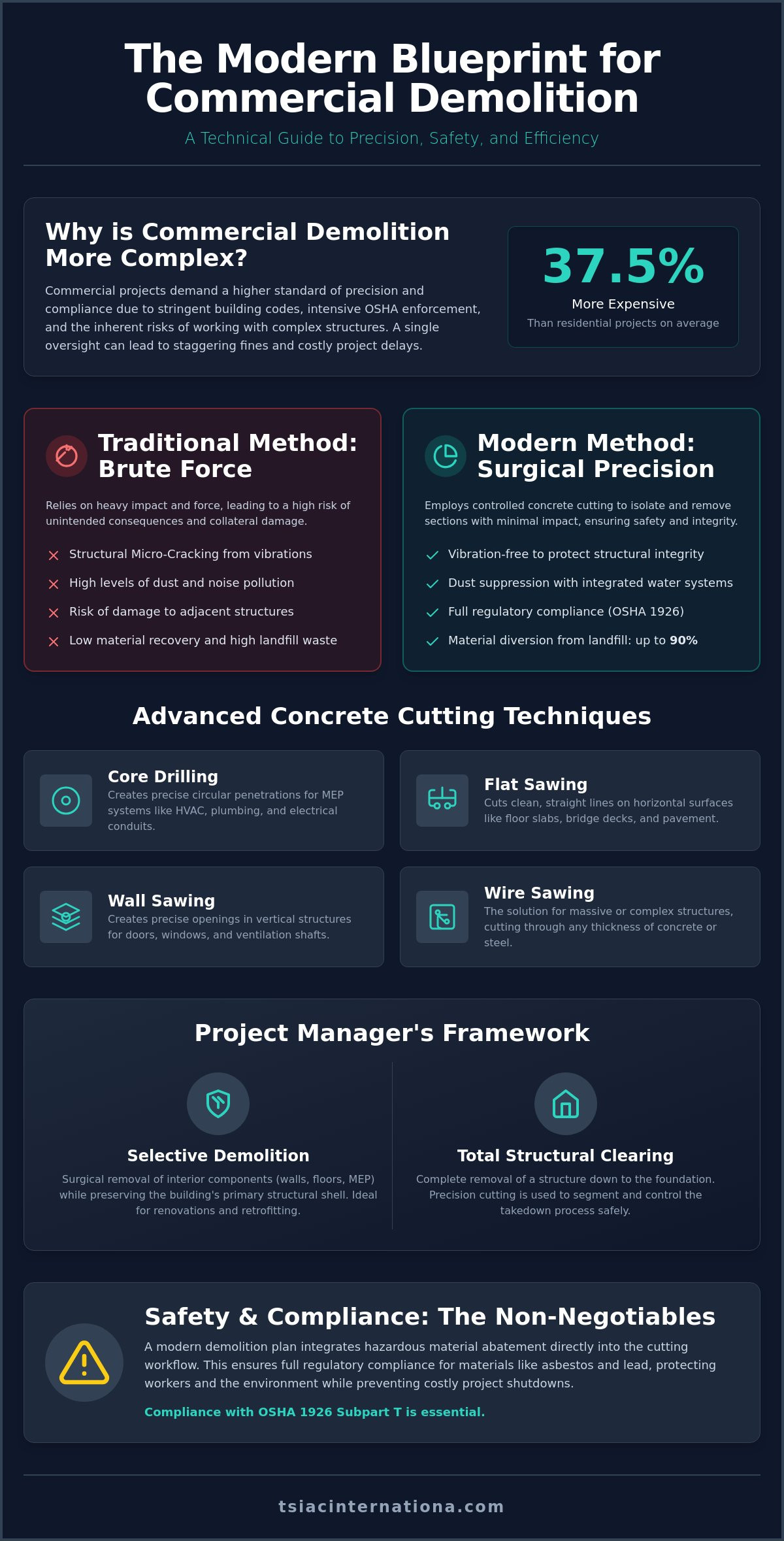
Commercial demolition in 2026 is, on average, 37.5% more expensive than residential projects because of the stringent building codes and intensive OSHA enforcement required today. For project managers, executing the commercial building demolition process means balancing aggressive timelines with the risk of unforeseen structural damage or environmental violations. You’ve likely seen how a single oversight in asbestos handling or an accidental cut into a load-bearing member can trigger staggering regulatory fines and months of costly delays.
This guide provides the technical roadmap you need to master complex structural removal through advanced diamond cutting methods and integrated hazardous material abatement. We’ll examine the methodology required to maintain structural integrity under current OSHA 1926 Subpart T standards while maximizing material recovery. You’ll learn how to transition from traditional wrecking to a surgical approach that ensures full regulatory compliance and targets up to 90% material diversion from landfills. By the end, you’ll have a disciplined framework for managing the most demanding technical challenges in modern demolition with absolute control and precision.
Key Takeaways
- Understand how precision concrete cutting serves as the technical foundation for maintaining the structural integrity of adjacent sections during complex removals.
- Gain insight into specialized diamond cutting methods, including core drilling for MEP systems and flat sawing for trenching or bridge decks.
- Learn to evaluate the commercial building demolition process using a project manager’s framework that distinguishes between selective interior gutting and total structural clearing.
- Identify the critical intersection between hazardous material abatement and structural demolition to ensure full regulatory compliance for asbestos and lead.
- Discover how an integrated demolition and recycling methodology combined with a fixed-price contract model can mitigate project delays and financial risks.
The Essential Role of Concrete Cutting in Modern Structural Demolition
Concrete cutting is defined as the controlled removal or modification of concrete structures through the use of specialized, diamond-tipped tools and high-precision machinery. In the context of a modern building demolition process, this practice serves as the surgical foundation for any project requiring more than just total site clearance. While traditional demolition relies on brute force to bring structures down, concrete cutting provides a methodology for isolating specific components without jeopardizing the stability of the remaining edifice. This technical precision is non-negotiable when dealing with complex commercial buildings where structural integrity must be maintained in adjacent sections or neighboring properties.
As we move through 2026, the industry has seen a definitive transition toward vibration-free removal techniques. This shift is driven by the need to protect sensitive urban infrastructure and minimize the environmental footprint of heavy construction. Traditional impact methods often send shockwaves through a building’s frame, which can lead to unintended consequences in aging existing structures. By utilizing advanced sawing and drilling, contractors can execute the commercial building demolition process with a level of control that was previously unattainable, ensuring that every cut is deliberate and every structural boundary is respected.
Why Precision Matters for Selective Demolition
Selective demolition demands a high degree of accuracy to protect critical load-bearing elements during complex renovations. When a project involves stripping a facility to its studs or modifying its floor plan, surgical concrete cutting ensures that the structural shell remains uncompromised. This approach significantly reduces noise and dust pollution, making it possible to work in occupied environments or sensitive zones like hospitals and data centers. Clean, straight edges produced by diamond sawing also allow for the seamless integration of new construction elements, reducing the need for extensive patchwork or structural reinforcement later in the project timeline.
Impact vs. Non-Impact Demolition Methods
The choice between impact and non-impact methods often determines the long-term health of a retained structure. Percussive tools, such as heavy jackhammers, carry the hidden risk of causing structural micro-cracking. These tiny fractures can propagate over time, leading to moisture ingress and the eventual degradation of the concrete’s load-bearing capacity. Non-impact methods, specifically diamond-tipped sawing, eliminate these vibrations entirely. This is particularly beneficial for vibration-sensitive project sites where delicate machinery or historical facades are present. By choosing non-impact techniques and referring to specialists like Airlift Concrete Experts to identify and address existing foundation issues, project managers effectively reduce long-term maintenance costs and ensure the stability of the remaining structural assets for decades to come.
- Vibration Control: Prevents micro-cracks in the remaining slab or foundation.
- Dust Suppression: Integrated water systems in modern saws capture silica dust at the source.
- Structural Isolation: Creates a physical break between the section being removed and the section being saved.
Advanced Techniques: From Core Drilling to Diamond Wire Sawing
Wire sawing represents the pinnacle of this technological spectrum. It’s the only viable solution for massive or uniquely shaped structures where traditional circular saws simply cannot reach. By looping a diamond-impregnated wire around a structure and utilizing a pulley system, we can cut through bridge piers or industrial machinery foundations of virtually any thickness. If you’re managing a site with complex geometry, consulting with experts in structural demolition ensures these advanced methods are integrated into your timeline correctly.
The Science of Diamond Tooling in 2026
The efficacy of modern cutting tools is rooted in material science. Synthetic diamond grit is now engineered to shear through heavy-gauge rebar and high-PSI concrete with minimal resistance. This process relies heavily on integrated water-cooling systems, which serve the dual purpose of protecting the blade’s structural integrity and suppressing hazardous silica dust. Diamond wire sawing is the premier method for removing large-scale reinforced foundations. Adhering to these technical protocols is a fundamental requirement for maintaining Safety and Compliance on high-stakes commercial sites.
Specialized Sawing for Heavy Infrastructure
Heavy industrial environments often demand deep-cut flat sawing for foundations that exceed standard depths. Project managers must evaluate the energy source carefully; hydraulic systems offer the torque needed for outdoor infrastructure, while electric saws are mandatory for indoor sites to prevent carbon monoxide buildup. The evolution of the commercial building demolition process has also introduced robotic cutting arms. These units are deployed in high-risk or inaccessible zones, allowing operators to maintain a safe distance while the machine performs high-precision cuts in unstable environments. This level of technical discipline prevents the structural micro-cracking common with older, percussive demolition methods.
Selective vs. Total Structural Demolition: A Project Manager’s Framework
Determining whether a project requires a surgical strike or a complete overhaul is the first critical decision in the commercial building demolition process. Project managers must evaluate the primary objective: are you stripping the interior to the studs for a tenant upfit, or are you clearing the entire lot for a new development? This decision hinges on a rigorous assessment of the existing structural shell and foundation. If the foundation is compromised or the building’s layout no longer serves modern industrial requirements, a total teardown often proves more cost-effective than attempting to retrofit an obsolete frame. Additionally, the impact on neighboring properties and shared utilities in dense South Carolina urban centers dictates the level of precision required to avoid collateral damage or utility service interruptions.
A thorough cost-benefit analysis should account for the potential for material recovery. Total demolition allows for high-volume recycling of structural steel and concrete, whereas selective projects focus on preserving the value of the remaining assets. Choosing the wrong framework early on can lead to catastrophic budget overruns or structural failures that jeopardize the entire site’s safety.
Selective Demolition: The ‘Surgical’ Approach
In scenarios involving historical preservation, tenant improvements, or wing removals, selective demolition is the preferred methodology. This approach allows for the removal of specific structural or non-structural components while maintaining the building’s overall stability. It’s almost always preceded by comprehensive interior gutting to remove finishes, MEP systems, and non-load-bearing partitions. Managing logistics becomes significantly more complex when a portion of the building remains operational. We must implement strict vibration monitoring and dust containment protocols to ensure that ongoing business activities or sensitive equipment in adjacent wings are not disturbed.
Total Structural Demolition: Complete Site Clearing
Total structural removal is reserved for high-rise buildings, derelict industrial plants, and full-scale site redevelopments. The demolition process for these projects begins with rigorous site preparation, including utility capping and hazardous material surveys. Once the site is secured, heavy machinery like high-reach excavators equipped with hydraulic shears and breakers takes the lead. This phase is about controlled momentum. Teams coordinate the systematic collapse of the structure to ensure debris falls within the established footprint, facilitating efficient hauling and maximum material recovery. In South Carolina, where commercial demolition is often significantly more complex than residential work, choosing the right framework is essential for maintaining the project’s financial health.
- Site Assessment: Verify soil stability and foundation integrity before choosing a method.
- Operational Constraints: Determine if noise or vibration limits require specialized cutting tools.
- Waste Management: Plan for the separation of recyclable metals and concrete at the source.
Safety and Compliance: Integrating Abatement into the Cutting Workflow
The commercial building demolition process is not merely a mechanical exercise; it is a highly regulated environmental operation. Before a single diamond blade touches a concrete slab, a comprehensive hazardous material survey is mandatory. Aging commercial facilities in South Carolina often contain legacy contaminants like asbestos in floor mastics or lead-based pigments in industrial coatings. Cutting into these materials without prior mitigation releases microscopic toxins into the air, creating immediate health risks and exposing project owners to severe regulatory penalties. We don’t view abatement as a separate hurdle but as the first technical step in a safe structural separation.
The intersection of asbestos removal and structural demolition requires a phased workflow. Abatement teams must clear the work zone before cutting crews arrive to ensure that structural modifications don’t disturb friable materials. Similarly, managing lead-based paint during sawing operations requires rigorous dust suppression. We use HEPA-filtered vacuums and specialized wet-cutting techniques to capture lead-contaminated slurry at the source, preventing site-wide contamination. This methodology protects both the environment and the workers on the ground.
Beyond environmental toxins, physical safety depends on what’s hidden inside the concrete itself. We utilize Ground Penetrating Radar (GPR) to map the internal landscape of a structure before any penetration occurs. This technology allows us to locate embedded utilities, conduits, and high-tension post-tension cables. Severing a post-tension cable can cause a catastrophic structural failure or a fatal incident, making GPR an essential tool for risk mitigation in modern demolition.
Asbestos and Lead Abatement Protocols
Interior gut-outs in older facilities demand strict containment strategies. We establish negative-pressure zones and decontamination chambers to prevent the migration of toxic fibers into non-work areas. Proper regulatory documentation is essential, as every ounce of hazardous waste must be tracked from the point of origin to a licensed disposal facility. It’s a fundamental requirement that hazardous material abatement must be performed by certified professionals to maintain project legality and safety.
Site Safety and Risk Mitigation
Protecting the workforce from silica dust is a core component of OSHA compliance. Whether we’re performing dry cutting with integrated extraction or wet sawing, we monitor air quality to ensure exposure remains below the Permissible Exposure Limit. Before any major structural section is removed, we implement structural shoring to distribute loads and prevent localized collapses. Successfully managing the commercial building demolition process means identifying these risks before they become incidents. If your next project requires this level of technical oversight, contact us for professional asbestos abatement and demolition services.
The TSIAC Methodology: Efficiency, Recycling, and Precision
TSIAC International operates at the intersection of technical precision and environmental stewardship. With over 15 years of field experience in South Carolina, our teams have refined a commercial building demolition process that prioritizes risk mitigation and structural control above all else. This extensive tenure allows us to anticipate site-specific challenges, such as hidden structural reinforcements or complex utility networks, before they impact the critical path. By identifying these variables early, we effectively reduce project timelines and lower the overall risk profile for the property owner. Unlike providers who offer variable estimates that fluctuate as complications arise, we utilize a Fixed-Price contract model for structural demolition projects. This approach provides stakeholders with absolute financial certainty and ensures that every technical requirement, from GPR scanning to shoring, is fully accounted for from day one.
Environmental Responsibility in Demolition
Sustainability in 2026 is no longer an optional add-on; it’s a core metric of project success. Our methodology incorporates rigorous on-site sorting techniques to ensure maximum material recovery of wood, metal, and concrete. By separating these materials at the source, we facilitate their re-entry into the circular construction economy and minimize landfill impact. This process isn’t just about waste management; it’s about reducing the total carbon footprint of the commercial building demolition process. Specialized hauling and logistics management ensure that debris is moved efficiently, preventing site congestion and maintaining a clean, safe working environment. This commitment to the environment reflects our role as a responsible partner in the South Carolina construction landscape.
Partnering with TSIAC International
Our expertise spans the full spectrum of the industry, from surgical residential interior gutting to massive commercial structural removals and industrial decommissioning. We approach every structural and selective demolition project with the same methodological rigor, ensuring that safety protocols and technical precision are never compromised. This disciplined character is what transforms a high-risk demolition liability into a controlled, predictable phase of your construction timeline. We don’t promise the impossible, but we do deliver what we undertake with absolute accuracy. We invite project managers and property owners to request a comprehensive project evaluation and a professional bid that reflects the true scope of your structural requirements.
- Fixed-Price Model: Eliminates budget creep through comprehensive upfront site assessment.
- 15+ Years Experience: Proven track record in South Carolina’s most challenging industrial environments.
- Integrated Abatement: Seamlessly combining hazardous material removal with structural demolition.
- Sustainability Focus: Targeting high diversion rates for wood, metal, and concrete recycling.
Advancing Structural Precision and Environmental Compliance
The evolution of the commercial building demolition process in 2026 demands a shift from blunt force to surgical precision. Mastering advanced diamond cutting techniques like wire sawing and core drilling ensures that structural modifications don’t compromise the stability of adjacent sections or existing foundations. By integrating hazardous material abatement directly into the cutting workflow, you mitigate the environmental risks associated with asbestos and lead while maintaining strict OSHA compliance. This integrated approach isn’t just about efficiency; it’s about protecting your long-term investment and the safety of the surrounding urban infrastructure.
TSIAC International brings over 15 years of specialized industry experience to every project site. Our team holds comprehensive asbestos and lead abatement certifications, ensuring your project meets 100% of regulatory requirements without the risk of unforeseen fines. We remain committed to maximizing the circular economy through rigorous material recycling, aiming for maximum recovery of wood, metal, and concrete. This disciplined methodology transforms complex technical challenges into predictable, well-managed outcomes.
Partner with TSIAC International for your next structural project. We look forward to helping you execute your next demolition phase with absolute reliability and professional discipline.
Frequently Asked Questions
What is the difference between concrete cutting and concrete demolition?
Concrete cutting involves the surgical modification or removal of specific sections using diamond-tipped blades, whereas concrete demolition refers to the total destruction or removal of a structure. Cutting is a precision-based method that preserves the integrity of surrounding structural members. Demolition typically utilizes heavier equipment, such as hydraulic breakers and shears, for complete site clearing and volume removal.
Do I need an asbestos survey before starting a concrete cutting project?
Yes, a thorough inspection for asbestos-containing materials is mandatory before any commercial building demolition process begins. South Carolina DHEC and EPA NESHAP regulations require a survey by a certified professional to identify friable materials in floor mastics, insulation, or coatings. This step prevents the accidental release of toxic fibers during cutting or sawing operations and ensures full legal compliance.
How deep can modern concrete saws cut?
Modern cutting equipment offers varying depths depending on the specific tool and application. Hand-held saws generally reach depths of 6 inches, while specialized wall saws can cut up to 30 inches deep from a single side. For massive industrial foundations or bridge piers that exceed these standard limits, diamond wire sawing provides a virtually unlimited depth capacity by looping the wire around the entire structure.
What is GPR and why is it used in concrete cutting?
GPR stands for Ground Penetrating Radar, a non-destructive testing method used to visualize the interior of a concrete slab. It’s essential for locating post-tension cables, rebar, and live electrical conduits before any penetration occurs. Using GPR prevents catastrophic structural failures and protects the workforce from high-voltage incidents by mapping the “hidden” hazards within the reinforced concrete.
Can concrete be recycled after it has been demolished?
Yes, concrete is one of the most recycled materials in the demolition industry, with some projects achieving diversion rates of 80-90% from landfills. Once structural removal is complete, concrete blocks are crushed into various grades of aggregate. This recycled material is frequently repurposed as a stable base for new roadways or as structural backfill for future construction sites.
How do you control dust during interior concrete cutting?
Dust control is achieved through two primary methods: integrated wet cutting and HEPA-filtered vacuum extraction. Wet cutting uses a continuous water flow to capture silica dust in a slurry, which is then vacuumed for proper disposal. For dry interior environments, we utilize high-efficiency vacuums connected directly to the cutting tools to maintain air quality and satisfy OSHA silica dust standards.
What are the common costs associated with structural demolition?
Structural demolition costs are influenced by the structure’s height, the presence of hazardous materials, and the complexity of the building’s frame. Factors like the proximity of neighboring properties and the need for specialized shoring also impact the total budget. Every project requires a detailed engineering survey to determine the specific technical requirements and logistical constraints before a bid is finalized.
Is selective demolition more expensive than total demolition?
Selective demolition often carries a higher cost per square foot than total demolition because of the intensive manual labor and precision required. Protecting operational wings and maintaining structural stability for retained sections necessitates specialized equipment and slower production rates. The commercial building demolition process for selective projects focuses on asset preservation and surgical removal rather than rapid site clearing.
