
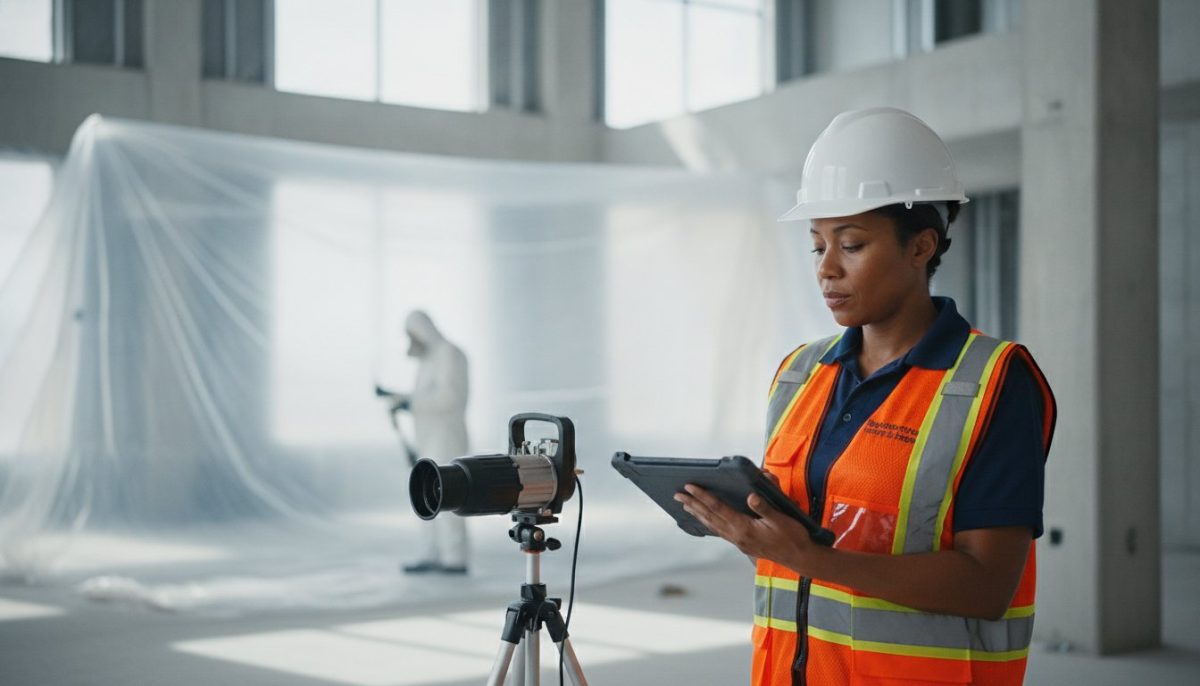
If a contractor is permitted to certify the quality of their own hazardous material removal, the objectivity of your safety data is compromised. Relying on the same entity for both execution and validation creates a conflict of interest that your legal and physical safety cannot afford. Prioritizing asbestos abatement third party air monitoring is the only way to ensure that the work meets rigorous safety standards without bias. This process serves as a necessary barrier against the risks associated with the 40,000 annual asbestos-related deaths in the U.S., providing an evidence-based “clean bill of health” for your property.
It’s natural to feel overwhelmed by complex OSHA requirements or the fear of future exposure lawsuits. You deserve the peace of mind that comes from knowing the air is safe to breathe. This article will teach you why independent oversight is the most reliable insurance policy for any abatement project. We’ll detail how third-party experts document compliance with the 0.01 f/cc clearance standard, protecting your liability and ensuring every technical parameter is met with disciplined precision.
Key Takeaways
- Understand the critical distinction between the removal contractor and the independent environmental professional who provides objective, unbiased oversight.
- Learn the technical differences between PCM and TEM sampling methods and why accredited laboratory analysis is non-negotiable for valid results.
- Discover why asbestos abatement third party air monitoring must be a continuous, multi-phase process to ensure safety from project start to final clearance.
- Identify the specific OSHA and EPA documentation requirements that transform air monitoring data into a robust legal shield against future liability.
- Gain insights into how professional abatement teams coordinate with independent monitors to maintain project timelines without compromising safety protocols.
What is Third Party Air Monitoring in Asbestos Abatement?
Third-party air monitoring is the systematic oversight of a remediation site by an Independent Environmental Professional (IEP). This individual functions as a neutral observer, ensuring that the physical asbestos abatement process remains within strict safety parameters. There’s a fundamental difference between the abatement team, who performs the labor, and the monitor, who conducts the scientific testing. One handles the hazard; the other validates the environment. This separation of duties is the cornerstone of modern industrial hygiene.
When a removal contractor is permitted to monitor their own air, it’s essentially “grading their own homework.” This practice creates a dangerous lack of accountability. If a containment barrier fails or microscopic fibers escape, a contractor focused on project completion might overlook the breach to avoid delays. An independent monitor has no such incentive. Their primary responsibility is to protect the building occupants and provide an unbiased record of the air quality. By employing an industrial hygienist, property owners ensure that the data driving safety decisions is accurate and untainted by commercial pressure.
The Legal and Ethical Necessity of Independence
The conflict of interest inherent in self-monitoring is why many jurisdictions and insurance providers now mandate separation between the removal and testing entities. For example, in New York, it’s a legal requirement that the abatement contractor and the air monitoring company remain separate business entities. From a liability standpoint, having a third-party record is vital. If a property owner faces a future lawsuit regarding exposure, these independent records serve as an objective legal shield. It proves that the asbestos removal south carolina or elsewhere followed every established protocol. Many insurance policies will not cover a claim unless asbestos abatement third party air monitoring was utilized to verify the final clearance.
Core Responsibilities of the Air Monitor
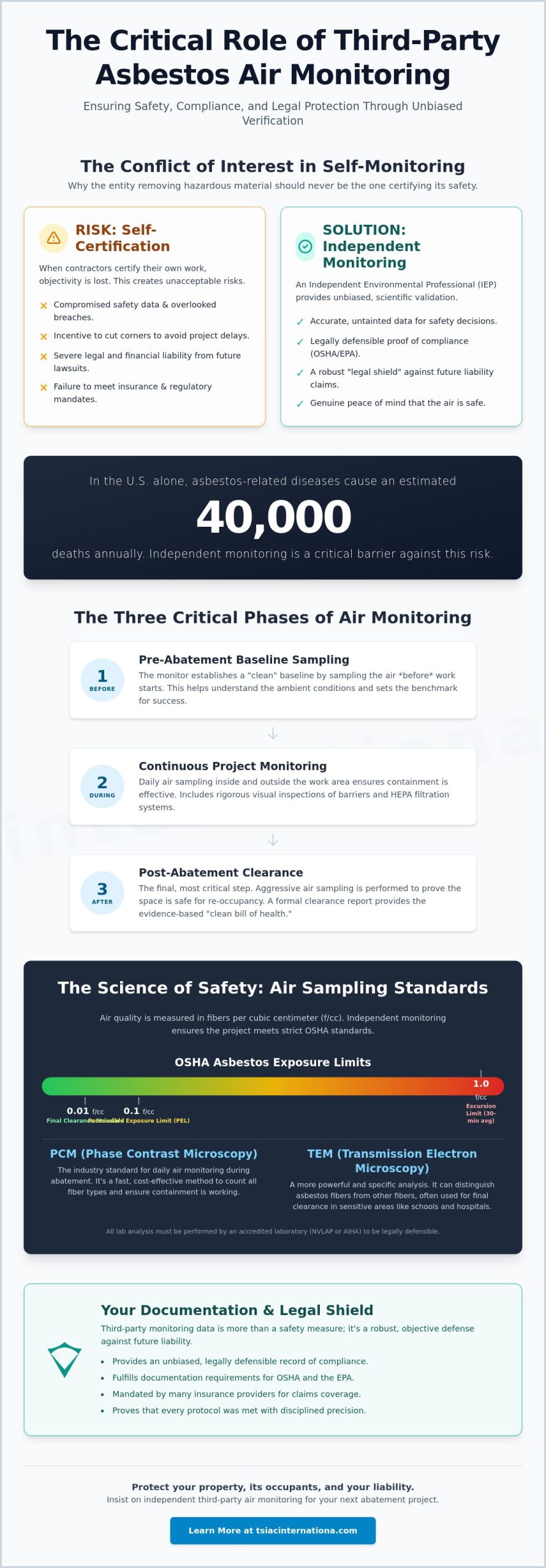
A professional monitor’s work begins long before the first material is disturbed. They establish a “clean” baseline by sampling the air before work starts to understand the ambient conditions. During the project, they perform daily sampling inside and outside the work area to ensure the containment remains effective. Their role also includes rigorous visual inspections of critical barriers and HEPA filtration systems. They look for physical defects, such as tape failures or punctures in the poly sheeting, before they lead to air contamination. Finally, the monitor issues the formal clearance report. This document contains the laboratory results required to prove the space is safe for re-entry. Without asbestos abatement third party air monitoring, this final “clean bill of health” lacks the necessary credibility for full regulatory compliance.
The Science of Air Sampling: PCM vs. TEM Methods
The technical execution of asbestos abatement third party air monitoring relies on high-volume air pumps and specialized filter cassettes. These pumps draw a measured volume of air through a filter, capturing microscopic particulates for analysis. The resulting data is expressed in fibers per cubic centimeter (f/cc), which is the standard metric used to determine if a space meets safety requirements. It’s vital that the laboratory performing the analysis holds accreditation through the National Voluntary Laboratory Accreditation Program (NVLAP) or the American Industrial Hygiene Association (AIHA). This ensures the results are legally defensible and scientifically accurate.
Accuracy in these measurements is the only way to verify that a site remains below the 0.1 f/cc Permissible Exposure Limit (PEL) established by OSHA’s asbestos standard. During active removal, the monitor must also account for the excursion limit, which is 1.0 f/cc averaged over a 30-minute sampling period. If you’re managing a complex project, reviewing a guide on asbestos removal south carolina can help you understand how these technical parameters fit into a broader regulatory strategy.
PCM (Phase Contrast Microscopy): The Industry Standard
Phase Contrast Microscopy (PCM) is the most common tool for daily monitoring. It uses a standard light microscope to count fibers that meet specific dimensional criteria, usually those longer than five microns with a 3:1 length-to-width ratio. Its primary advantage is speed. A monitor can often provide results on-site or within a few hours, allowing work to continue without interruption. However, PCM has a significant limitation: it cannot distinguish between asbestos and other fibers like fiberglass, gypsum, or organic dust. It simply counts everything that meets the size criteria. Despite this, PCM remains the standard for demonstrating daily compliance during active removal phases.
TEM (Transmission Electron Microscopy): The Gold Standard
Transmission Electron Microscopy (TEM) represents the gold standard of environmental testing. TEM uses an electron beam to view fibers at magnifications exceeding 20,000 times, allowing for the identification of individual asbestos fibrils. Unlike PCM, TEM can identify the specific mineral signature of asbestos, distinguishing it from harmless materials. It also detects much smaller fibers that are invisible under a light microscope. Under the Asbestos Hazard Emergency Response Act (AHERA), TEM is often mandatory for final clearance in school buildings and high-occupancy commercial spaces. While the cost is higher and the turnaround time is longer due to the need for a specialized laboratory, the level of certainty it provides is absolute.
The Three Critical Phases of Asbestos Air Monitoring
Effective asbestos abatement third party air monitoring isn’t a single event; it’s a continuous lifecycle that spans the entire duration of a project. The monitor works in tandem with the asbestos removal south carolina team to ensure that engineering controls remain intact. This collaboration provides the real-time data necessary to prevent fiber release episodes that could jeopardize the health of occupants in adjacent areas. Meticulous documentation at every stage is required to demonstrate full compliance with EPA asbestos regulations and protect the property owner from future liability.
Phase 1: Background and Pre-Abatement Sampling
Before any hazardous material is disturbed, the monitor must establish a baseline of the existing air quality. This involves placing sampling pumps in and around the proposed work area to determine the ambient fiber count. During this phase, the industrial hygienist also verifies that the containment area is properly sealed and that the negative pressure machines are functioning at the required flow rates. Background sampling serves as the definitive benchmark against which all subsequent air quality tests are measured.
Phase 2: Daily Area and Perimeter Monitoring
Once the removal begins, the focus shifts to containment integrity. The monitor places pumps at the perimeter of the work zone and near the decontamination unit to ensure zero leakage into “clean” areas of the building. This daily asbestos abatement third party air monitoring protects both the workers inside the enclosure and any occupants remaining in the building. If a “spike” in fiber counts is detected, the monitor has the authority to trigger immediate work stoppage protocols. The removal team must then identify the source of the leak and re-seal the containment before activities can resume.
Phase 3: Final Clearance Testing
The final phase is the most rigorous and determines when a space can be safely re-occupied. After the abatement team completes their final cleaning, the monitor performs “aggressive” air sampling. This technique involves using leaf blowers or fans to stir up any settled dust, ensuring that no microscopic fibers remain on surfaces. To pass, the air must test at or below the clearance standard of 0.01 f/cc. You cannot dismantle the containment barriers or turn off the negative air machines until the formal clearance report is received and signed by the independent professional. This document is your proof that the environment is restored to a safe, breathable condition.
Regulatory Compliance and Protecting Against Liability
Adhering to federal and state mandates is a complex undertaking that requires a dual focus on worker safety and environmental protection. OSHA standards primarily govern the health of the technicians performing the work, while EPA regulations focus on the impact the project has on the surrounding environment and public. Utilizing asbestos abatement third party air monitoring serves as the vital link between these two regulatory bodies. It provides an objective data set that proves your project remained within the legal limits of both agencies, effectively creating a “legal shield” against future litigation. Without this independent verification, a property owner is left vulnerable to claims of negligence that can arise decades after the work is finished.
The integrity of this legal shield depends entirely on a flawless “Chain of Custody.” This technical protocol tracks every air sample from the moment the filter is placed in the pump until the final analysis is recorded at the laboratory. If this chain is broken or poorly documented, the results may be ruled inadmissible in court. Professional monitors ensure that every sample is sealed, signed, and logged with precision. This level of detail is necessary because state-specific requirements often exceed federal standards. For instance, certain municipalities require more frequent sampling or lower clearance thresholds than the national baseline, making a local expert’s oversight indispensable.
The Role of AHERA and NESHAP Regulations
Federal laws like the Asbestos Hazard Emergency Response Act (AHERA) and the National Emission Standards for Hazardous Air Pollutants (NESHAP) dictate strict protocols for schools and commercial renovations. These regulations mandate the use of “Accredited Inspectors” and “Project Monitors” for specific types of work. Regulators often audit hazardous material abatement south carolina projects to ensure these protocols are followed. Failure to produce third-party monitoring logs during an unannounced inspection can lead to immediate work stoppages and significant financial penalties.
Close-out Documentation: The Project Record
The conclusion of a project should result in a comprehensive “Abatement Close-out Binder.” This document is the ultimate proof of a successful project. It should contain all laboratory results, the monitor’s daily logs, visual inspection certifications, and the final clearance report. It’s a best practice for property owners to keep these records for at least 30 years. This duration aligns with OSHA’s long-term record-keeping requirements for exposure data. Before hiring, you should always verify that your monitor holds current certifications and that their laboratory is NVLAP accredited to ensure the data is beyond reproach.
If you’re planning a renovation that involves hazardous materials, don’t leave your compliance to chance. Contact the experts at TSIAC International to discuss how our hazardous material abatement south carolina services can integrate with independent monitoring to protect your property and your future.
Coordinating with Your Abatement Contractor
Successful remediation requires disciplined coordination between the abatement team and the independent monitor. While their roles are distinct, their schedules must be perfectly aligned to maintain project momentum. Utilizing asbestos abatement third party air monitoring ensures that every phase of the project is validated by an objective expert. This partnership doesn’t just satisfy regulatory requirements; it creates a culture of accountability where safety is the primary metric of success. When these teams communicate effectively, the property owner benefits from a streamlined process that avoids costly delays.
To maintain the ethical independence discussed earlier, the property owner, architect, or General Contractor should contract the monitor directly. This ensures the monitoring firm’s loyalty remains with the client rather than the abatement contractor. Contractual separation is a fundamental safeguard against biased results. It’s a standard industry practice that protects the integrity of the final clearance report. When the monitoring team is independent, their data stands as an unassailable record of environmental safety.
Ensuring a Seamless Workflow
A professional team like TSIAC International understands that the monitor must be present during critical containment builds. This prevents bottlenecks during the demolition process south carolina, where abatement phases often dictate the overall timeline. Clear communication channels allow for rapid responses if a sampling pump malfunctions or if a containment barrier needs immediate repair. If a discrepancy arises between the removal team’s observations and the monitor’s data, a methodological approach is required. The teams must pause, investigate the technical cause, and implement a solution based on the monitor’s findings. This firmed-up hierarchy is what keeps a site safe and compliant.
Choosing the Right Partner for Your Project
When selecting a contractor, ask about their experience working with independent environmental professionals. A reputable firm like tsiac international charleston welcomes asbestos abatement third party air monitoring because it validates their high standards of workmanship. Before the project begins, use this final checklist to ensure a successful, compliant removal:
- Verify the monitor’s current state licensing and NVLAP laboratory accreditation.
- Confirm the abatement contractor has a designated liaison for the monitoring team.
- Ensure the project schedule accounts for the time needed for lab analysis and final clearance.
- Review the communication plan for “spike” detections or emergency work stoppages.
By following these steps, you ensure that your project meets every safety benchmark. The result is a clean bill of health for your building and the peace of mind that comes from knowing the air is safe to breathe. Professional oversight isn’t a project hurdle; it’s the only objective insurance policy that proves the work was done correctly.
Ensuring Long-Term Safety Through Independent Verification
Implementing asbestos abatement third party air monitoring is more than a regulatory box to check; it’s the foundation of a safe, habitable environment. By maintaining a strict separation between the removal team and the testing professional, you ensure that the data remains objective and beyond reproach. This disciplined approach protects your health and provides the legal documentation necessary to shield property owners from future liability. As we’ve detailed, the combination of technical precision in the lab and rigorous oversight on-site is what creates a truly secure project environment.
When you partner with a firm that respects this separation of duties, you gain the benefit of 15+ years of hazardous material experience. Our team at TSIAC International prioritizes expert coordination with independent environmental professionals to keep your project on schedule while adhering to the highest safety benchmarks. We provide comprehensive close-out documentation for every project, ensuring you have a permanent record of compliance and successful remediation. We don’t just clear the air; we provide the evidence that it’s safe.
Don’t leave your environmental safety to chance or unverified claims. Contact TSIAC International for a Professional Abatement Quote and take the first step toward a secure, asbestos-free property. We’re ready to help you navigate these technical challenges with precision and reliability.
Frequently Asked Questions
Is third-party air monitoring required by law for all asbestos removal?
Legal requirements for independent oversight vary by jurisdiction and the specific nature of the project. While federal OSHA standards mandate monitoring for worker safety, the Asbestos Hazard Emergency Response Act (AHERA) specifically requires it for school buildings. In some regions, such as New York State, it’s a legal mandate that the abatement contractor and the monitoring firm remain separate entities. Regardless of local laws, asbestos abatement third party air monitoring is considered an industry best practice for any commercial or high-risk residential project.
How much does asbestos air monitoring typically cost?
Industry rates for daily air monitoring services generally range from $600 to $1,200 per day for standard projects. For large-scale industrial sites or complex commercial buildings, these costs can increase to between $1,000 and $5,000 depending on the number of samples required. These fees are paid directly to the independent environmental professional to maintain their objectivity. This investment serves as a critical insurance policy against future legal claims and ensures the environment is truly safe for re-entry.
Can my asbestos removal contractor also perform the air testing?
While some jurisdictions may technically allow a contractor to perform their own testing, this practice creates a significant conflict of interest. Relying on a removal team to validate their own work compromises the integrity of the safety data. Professional standards dictate that asbestos abatement third party air monitoring should be conducted by a firm with no financial ties to the abatement company. This ensures that the results are unbiased, scientifically accurate, and legally defensible in the event of a future audit or lawsuit.
What is the difference between PCM and TEM air sampling?
The primary difference lies in the level of detail and the technology used for analysis. Phase Contrast Microscopy (PCM) is a fast, cost-effective method that counts all fibers meeting specific size criteria but cannot distinguish asbestos from other materials. Transmission Electron Microscopy (TEM) is the gold standard, using electron beams to identify the specific mineral signature of asbestos. TEM is often required for final clearances in schools and high-occupancy buildings where absolute scientific certainty is a priority.
How long does it take to get asbestos air test results back?
Turnaround times are largely determined by the analysis method chosen for the project. PCM results can often be provided on-site or within a few hours, allowing the project to proceed without significant downtime. TEM analysis requires a specialized laboratory environment, which typically results in a 24 to 48-hour waiting period. It’s essential to factor these timelines into your project schedule to ensure the containment remains intact until the final clearance report confirms the area is safe.
What happens if the final air clearance test fails?
A failed clearance test indicates that the fiber count remains above the 0.01 f/cc threshold, requiring an immediate response. The abatement contractor must perform a secondary “wet cleaning” and HEPA vacuuming of the entire containment area to remove any residual microscopic fibers. The independent monitor will then conduct another visual inspection and a new round of aggressive air sampling. The containment barriers must remain in place and the negative air machines must continue running until a passing result is achieved.
Do I need to leave the building during asbestos air monitoring?
Occupancy requirements depend on the project’s scope and the location of the work zone. While occupants don’t always need to vacate the entire building, they must remain completely clear of the containment area and its immediate perimeter. For projects involving the HVAC system or large-scale structural demolition, it’s often safer and more efficient to vacate the affected floors. Your project monitor will establish clear “exclusion zones” to ensure that no unauthorized individuals are exposed to potential fiber release episodes.
How do I find a qualified third-party air monitoring company?
You should prioritize firms that employ certified industrial hygienists and utilize laboratories with NVLAP or AIHA accreditation. These credentials ensure that the technicians follow standardized protocols and that the laboratory results are accurate. Your abatement contractor can often provide a list of independent environmental professionals they’ve worked with successfully in the past. Always verify that the monitoring firm carries its own professional liability insurance and holds all necessary state licenses for environmental testing.
