

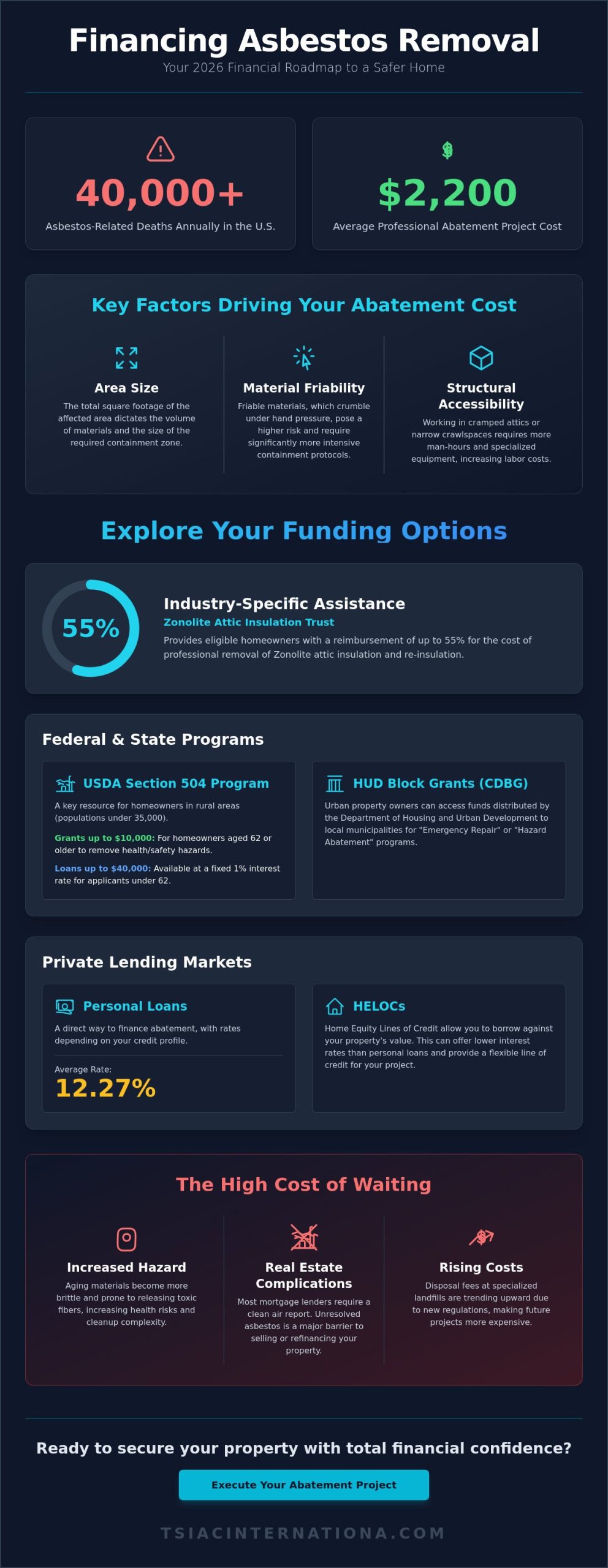
With more than 40,000 asbestos-related deaths occurring in the United States every year, delaying the containment of hazardous materials in your residence is a risk that carries a heavy price. For owners of properties built before 1980, the discovery of legacy toxins in insulation or piping often leads to immediate anxiety regarding the financing options for asbestos removal in homes. You likely recognize that professional abatement is non-negotiable for your family’s safety, yet the average $2,200 project cost can feel like a significant barrier when faced with complex application processes and strict regulatory requirements.
This 2026 guide provides the technical and financial roadmap you need to secure your property and protect your equity without depleting your liquid assets today. We’ll show you how to access the Zonolite Attic Insulation Trust, which currently offers a 55% reimbursement for qualified projects, and analyze private lending markets where average personal loan rates sit at 12.27%. You’ll gain a clear understanding of state-level grants and home equity lines of credit, allowing you to start the abatement process with disciplined precision and total financial confidence.
Key Takeaways
- Analyze how material friability and structural accessibility serve as the primary drivers for your total abatement investment.
- Identify eligibility for federal and state-level assistance, including specific programs for rural property owners and urban remediation projects.
- Compare the most effective financing options for asbestos removal in homes, weighing the benefits of HELOCs against specialized energy-efficiency loans.
- Protect your financial interests by navigating industry-specific trusts and identifying the limitations of standard “Pollution Exclusion” insurance clauses.
- Learn how to execute a safe, compliant removal by integrating professional abatement with full-scale demolition services for maximum efficiency.
Understanding the Financial Scope of Residential Asbestos Abatement
Asbestos abatement is a specialized engineering discipline focused on the total containment and secure extraction of hazardous fibers. It’s far more complex than standard demolition or general construction. Professionals must follow rigorous asbestos abatement procedures to prevent microscopic fibers from contaminating the entire structure’s HVAC system and living spaces. When property owners evaluate financing options for asbestos removal in homes, they must look beyond the simple labor cost. A total project budget includes initial diagnostic testing, the specialized labor for containment, and the logistical costs of certified hazardous waste disposal.
Three primary factors drive the final price of a project. First, the square footage of the affected area dictates the volume of materials and the size of the containment zone. Second, the material type is critical. Friable materials, which crumble under hand pressure, require significantly more intensive containment than non-friable items like vinyl floor tiles. Finally, accessibility plays a major role. Removing insulation from a cramped attic or piping from a narrow crawlspace requires more man-hours and specialized safety equipment. Attempting a DIY approach to save money often leads to cross-contamination, which can easily quadruple the eventual cost of professional remediation.
The Cost of Delay: Why Immediate Removal Saves Money
Delaying remediation is a financial risk that compounds over time. As asbestos-containing materials (ACM) age, they become more brittle and prone to releasing fibers, which increases the complexity of the eventual cleanup. In the 2026 real estate market, unresolved environmental hazards are a major deal-breaker. Most mortgage lenders require a clean air clearance report before approving a loan for a buyer. Disposal fees at specialized landfills are also trending upward following the 2024 EPA regulations, meaning a project that averages $2,200 today could be more expensive by next year.
Breakdown of Professional Service Fees
Professional fees cover the high-tech infrastructure required for safe removal. This includes the setup of negative air pressure systems and HEPA filtration units that ensure no fibers escape the work zone. You aren’t just paying for labor; you’re paying for the specialized transport and tipping fees at hazardous waste sites. Every project concludes with mandatory post-remediation air clearance testing. This final step provides the legal and medical documentation necessary to prove your home is safe, which is essential when exploring financing options for asbestos removal in homes.
Federal and State-Level Grants for Hazardous Material Removal
Government entities acknowledge that legacy asbestos in residential structures is a public health priority rather than a simple maintenance issue. While the EPA doesn’t provide direct cash payments to homeowners, several federal agencies offer targeted financing options for asbestos removal in homes through specialized grant and loan frameworks. These programs are designed to assist vulnerable populations, including seniors and low-income families, in eliminating environmental hazards that compromise structural safety and air quality.
The USDA Section 504 Home Repair Program
The USDA Section 504 Home Repair program is a primary resource for residents in rural areas, defined as locations with populations under 35,000. For homeowners aged 62 or older, the program provides a lifetime grant of up to $10,000 specifically for the removal of health and safety hazards. If the applicant is under 62 or requires more extensive remediation, the USDA offers loans up to $40,000 with a fixed 1% interest rate. Eligibility depends on the household income falling below 50% of the area median income. These funds are often the most cost-effective way to manage a project when local financing options for asbestos removal in homes are limited.
HUD and Local Government Assistance
Urban property owners should look toward the Department of Housing and Urban Development (HUD). HUD distributes Community Development Block Grants (CDBG) to local municipalities, which then create their own “Emergency Repair” or “Hazard Abatement” programs. Many cities in 2026 use these funds to cover the high costs of friable asbestos containment. The application process typically goes through your local housing authority or city planning office. You’ll need to provide specific documentation, including:
- Proof of property ownership and primary residency.
- Tax returns or pay stubs for all household members to verify income level.
- A certified asbestos inspection report identifying the specific hazard.
- A detailed quote from a licensed abatement contractor.
State-level initiatives offer additional layers of support. For example, Colorado maintains a pilot grant program for rural areas, and California provides cleanup assistance through the Equitable Community Revitalization Grant. These programs often prioritize properties where the presence of asbestos prevents other essential upgrades, such as weatherization or HVAC replacement. Before committing to a private loan, it’s prudent to review the regulatory requirements for your region to ensure your project qualifies for these public funds. This disciplined approach ensures that you utilize every available dollar of public assistance before tapping into personal home equity.
Private Financing Strategies: HELOCs vs. Personal Loans
Most homeowners find that government grants involve lengthy waiting periods that don’t always align with the urgency of a hazardous material discovery. Private financing options for asbestos removal in homes bridge this gap by providing immediate capital through established banking channels. Selecting the right instrument requires a calculated look at your property’s current equity and your specific timeline for remediation. Whether you prioritize the lowest possible interest rate or the fastest funding speed, the 2026 lending market offers several distinct pathways to secure your residence.
Leveraging Home Equity for Health Safety
Home Equity Lines of Credit (HELOC) and home equity loans remain the most cost-effective methods for funding significant abatement projects. As of late April 2026, the national average HELOC interest rate sits at 7.10%, while standard home equity loans average 7.91%. Because these products are secured by your property, they offer lower rates than unsecured debt. The approval process generally takes 2 to 4 weeks, making them ideal for planned renovations rather than emergency containment. It’s also worth consulting a tax professional; interest on these loans may be deductible if the abatement is part of a capital improvement that increases the home’s value or extends its functional life.
Unsecured Personal Loans for Immediate Action
When an inspection reveals friable asbestos that requires immediate intervention, speed becomes the primary metric. Personal loans are unsecured and can often be funded within 24 to 48 hours of application. As of April 29, 2026, the average personal loan interest rate is 12.27%, though borrowers with excellent credit scores of 750 or higher may see rates as low as 5.99%. These loans provide fixed monthly payments and don’t require using your home as collateral, which simplifies the risk profile for many families.
Beyond traditional bank loans, specialized “Green” or “Energy Efficiency” loans are increasingly relevant. These programs often apply when removing old asbestos insulation to make way for modern, high-R-value materials. Some contractors also offer in-house financing plans. You must scrutinize these carefully; many utilize “deferred interest” structures that can retroactively apply high APRs if the balance isn’t cleared within a specific promotional window. For massive projects involving structural demolition and abatement, a cash-out refinance allows you to consolidate the remediation costs into your primary mortgage, often securing the lowest long-term rate available in the market.
Industry-Specific Assistance: Trusts and Insurance Coverage
Beyond traditional loans and government grants, specialized industry trusts and insurance nuances represent critical financing options for asbestos removal in homes. These resources are often product-specific or dependent on the precise cause of material disturbance. Understanding the technical requirements for these funds is essential for homeowners who wish to offset the high upfront costs of hazardous material containment. While these sources require more rigorous documentation than a personal loan, they provide a non-recourse method of funding that does not add to your debt-to-income ratio.
The Zonolite Attorney Trust (ZAI Trust)
The ZAI Trust is a primary financial resource for property owners dealing with vermiculite attic insulation. Because much of the vermiculite sold under the Zonolite brand contained asbestos fibers, this trust was established to reimburse homeowners for removal and re-insulation costs. As of April 2026, the trust provides reimbursement for 55% of the total project cost, with a maximum payout capped at $4,330.42. To qualify, you must provide a laboratory report confirming the presence of Zonolite brand material or specific evidence of its installation. This trust is expected to operate for a minimum of 20 years, making it a stable pillar for long-term remediation planning.
Navigating Homeowners Insurance Claims
Standard homeowners insurance policies are notoriously difficult to tap for environmental remediation due to the “Pollution Exclusion” clause. This clause generally classifies asbestos as a pollutant, meaning that its mere presence or gradual deterioration is not a covered event. However, coverage may be triggered if the asbestos is disturbed by a “covered peril.” For example, if an accidental pipe burst ruins a ceiling containing asbestos, the cost of hazardous material abatement might be included in the water damage claim. In these instances, the insurance company isn’t paying for the asbestos itself, but for the necessary containment required to repair the primary damage.
Analyzing policy language requires a disciplined approach. We recommend working with a public adjuster who can identify specific endorsements that might override standard exclusions. Even if you expect a denial, filing a formal claim is a vital step in the documentation process. A formal letter of denial from your insurer is often a prerequisite for certain government grants or tax credits. When exploring financing options for asbestos removal in homes, having a complete paper trail of your insurance interactions strengthens your position with other lenders and trust funds. If you need a certified assessment to support your claim, you can request a professional site evaluation from our technical team to ensure your documentation meets the highest industry standards.
Executing Your Abatement Project with TSIAC International
TSIAC International brings over 15 years of specialized experience to the most challenging residential and industrial environments. We approach every project with engineering precision, recognizing that hazardous material containment is a critical phase of property management. Our asbestos removal services are designed to integrate seamlessly with broader structural goals. Whether you are performing a targeted remediation or preparing for a full-scale demolition, our team ensures that legacy toxins are eliminated before any structural changes occur. We maintain a steadfast commitment to environmental responsibility, utilizing advanced filtration technologies and ensuring all waste reaches certified disposal sites that follow 2026 sustainability protocols.
Why Professional Certification Matters for Financing
Lenders and grant administrators maintain strict requirements regarding who performs hazardous work. When you apply for financing options for asbestos removal in homes, the institution will often mandate that the funds be disbursed only to licensed, insured, and certified contractors. TSIAC International provides the comprehensive compliance documentation and air clearance reports necessary to satisfy these financial and regulatory audits. By following safe demolition processes, we do more than just clear the air; we protect your property’s long-term equity. This professional paper trail is indispensable for future resale, as it provides definitive proof to buyers and their mortgage companies that the home meets modern safety standards.
Getting Started: Your Professional Abatement Quote
Securing financing options for asbestos removal in homes requires a transparent and fixed-price quote that lenders can trust. Our site assessment process is disciplined and thorough. We evaluate the friability of the materials, the complexity of the containment zone, and the logistical requirements for secure disposal. This detailed scoping allows us to provide a technical roadmap that supports your grant or loan application with factual data rather than vague estimates. We understand that your budget and your family’s health are at stake, so we provide a clear path from the initial diagnostic to the final air clearance certificate.
A safe home is the foundation of a sound investment. By choosing a partner with the technical expertise to handle “impossible” locations and complex remediation needs, you ensure that your project is completed with mérnöki pontosság (engineering precision). We invite you to reach out for a professional site evaluation. Our team will provide the documentation and the specialized labor required to make your home safe, compliant, and ready for the future.
Securing Your Home’s Environmental Integrity
Navigating the various financing options for asbestos removal in homes requires a disciplined approach to both safety and fiscal responsibility. You now have a clear roadmap that includes the ZAI Trust’s 55% reimbursement potential and the immediate liquidity offered by the private lending market. These tools ensure that legacy toxins don’t have to remain a permanent risk to your family or your property’s equity. Professional abatement isn’t just a simple repair; it’s a strategic investment in a structure that meets the rigorous safety and air quality standards of 2026.
Success in remediation depends on the technical accuracy of your contractor. TSIAC International brings 15+ years of hazardous material expertise to every site, providing the licensed, regulation-compliant service that lenders and grant administrators demand. We eliminate the guesswork with fixed-price contracts for residential projects, ensuring your remediation stays on schedule and within your financial plan. Don’t let health risks linger due to budget complexity. Request a Professional Abatement Quote from TSIAC International today to start your project with engineering precision. You’ve the resources and the expert partner needed to make your home safe and compliant for the long term.
Frequently Asked Questions
Does homeowners insurance cover asbestos removal?
Homeowners insurance typically excludes asbestos removal under standard pollution exclusion clauses. Coverage only applies if the asbestos is disturbed by a sudden, accidental covered peril, such as a localized fire or a burst pipe. In those specific technical scenarios, the insurer covers the abatement as part of the primary damage repair process. You shouldn’t expect coverage for the gradual deterioration or simple presence of hazardous materials.
How do I qualify for the USDA Section 504 Home Repair grant?
To qualify for the USDA Section 504 Home Repair program, you must reside in a rural area with a population under 35,000 and have a household income below 50% of the area median. Homeowners aged 62 or older are eligible for lifetime grants up to $10,000. Other qualified applicants can access 1% fixed-rate loans for up to $40,000 to eliminate health hazards that compromise structural safety.
What is the Zonolite Trust and how much does it pay?
The Zonolite Attic Insulation (ZAI) Trust reimburses homeowners for 55% of the costs associated with removing Zonolite brand vermiculite insulation. As of April 2026, the maximum reimbursement is capped at $4,330.42. You must provide a laboratory analysis or specific photographic evidence confirming the brand’s presence to secure these funds, which also cover a portion of the re-insulation costs.
Can I include asbestos removal in a home renovation loan?
You can include abatement costs in specialized renovation loans like the FHA 203(k) or Fannie Mae HomeStyle mortgage. These instruments are excellent financing options for asbestos removal in homes because they allow you to bundle remediation and remodeling into a single monthly payment. This approach often secures a lower interest rate than unsecured personal loans or credit cards.
Are there tax credits available for removing asbestos from my home?
Federal tax credits for residential asbestos removal are not currently available; however, certain states offer localized incentives. For example, states like New York and Massachusetts have historically implemented tax credits for lead and asbestos abatement. Homeowners should consult a tax professional to see if current 2026 state-level environmental health funds or weatherization credits apply to their specific zip code.
What happens if I start a renovation and find asbestos unexpectedly?
If you discover suspicious material during a renovation, you must stop all work immediately and seal the area to prevent fiber release. Do not attempt to clean the debris with a standard vacuum or sweep the dust. You should contact a certified professional to conduct an inspection and air quality test before proceeding with any further structural disturbance or debris removal.
How long does the financing approval process usually take for abatement?
The timeline for approval depends entirely on the financial instrument you select. Personal loans often provide fund disbursement within 24 to 48 hours of application. In contrast, HELOCs typically require 2 to 4 weeks for appraisal and processing; while government grants like the USDA Section 504 program can take between 30 and 90 days to finalize.
Is asbestos removal considered a tax-deductible medical expense?
Asbestos removal is considered a tax-deductible medical expense if a physician recommends the remediation to alleviate a specific health condition, such as chronic respiratory issues. Under IRS Publication 502, these costs are deductible to the extent they exceed 7.5% of your adjusted gross income. This is one of the more technical financing options for asbestos removal in homes that requires detailed medical and contractor documentation.
