
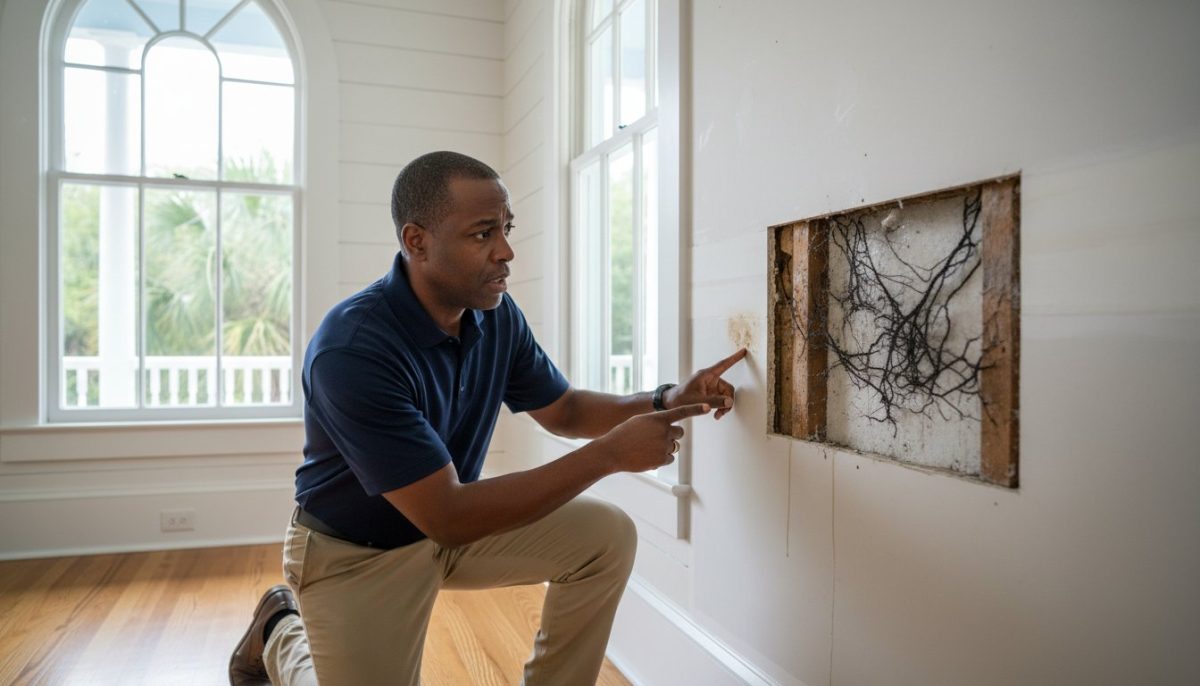
A single undetected leak can degrade the structural load-bearing capacity of timber framing by nearly 25 percent within just 14 days of moisture exposure according to 2024 building safety reports. You’ve worked hard to secure your property, and it’s natural to feel anxious when you suspect a hidden threat is silently undermining your investment or your family’s well-being. This 2026 Property Owner’s Detection Guide empowers you with the technical knowledge to identify the specific signs of mold in house environments before they necessitate a total structural overhaul.
We understand that uncertainty regarding remediation costs often leads to delayed action, but precision in early detection is your most effective cost-saving tool. This article breaks down the subtle biological indicators and moisture mapping techniques used by industry professionals. We’ll show you how to distinguish between common surface mildew and the deep-seated fungal growth that targets your building’s core. You’ll gain a clear, engineering-based perspective on moisture indicators and a definitive plan for securing a professional assessment to restore your home’s safety and structural integrity.
Key Takeaways
- Distinguish between harmless surface mildew and destructive fungal colonies that digest organic building materials and compromise structural integrity.
- Master the 12 visual and olfactory indicators to accurately identify the signs of mold in house before they escalate into costly property damage.
- Explore the “Iceberg Effect” to detect hidden mold hazards lurking within wall cavities, crawl spaces, and attics that standard inspections often miss.
- Learn why disturbing mold in older properties requires a specialized approach to avoid the simultaneous release of hazardous lead or asbestos fibers.
- Understand the engineering-led “Source Control” philosophy and when selective demolition is the only viable path to permanent structural restoration.
What is Mold and Why is it a Structural Hazard?
Mold is a biological organism belonging to the fungi kingdom that serves a specific ecological purpose: the decomposition of organic matter. In a residential setting, this process targets building materials rich in cellulose, such as timber framing, drywall paper, and insulation backing. Identifying the early signs of mold in house structures is critical because these organisms don’t just sit on the surface. They actively digest the substrate they inhabit. This biological breakdown transforms rigid building components into soft, decaying matter, directly threatening the safety of the occupants.
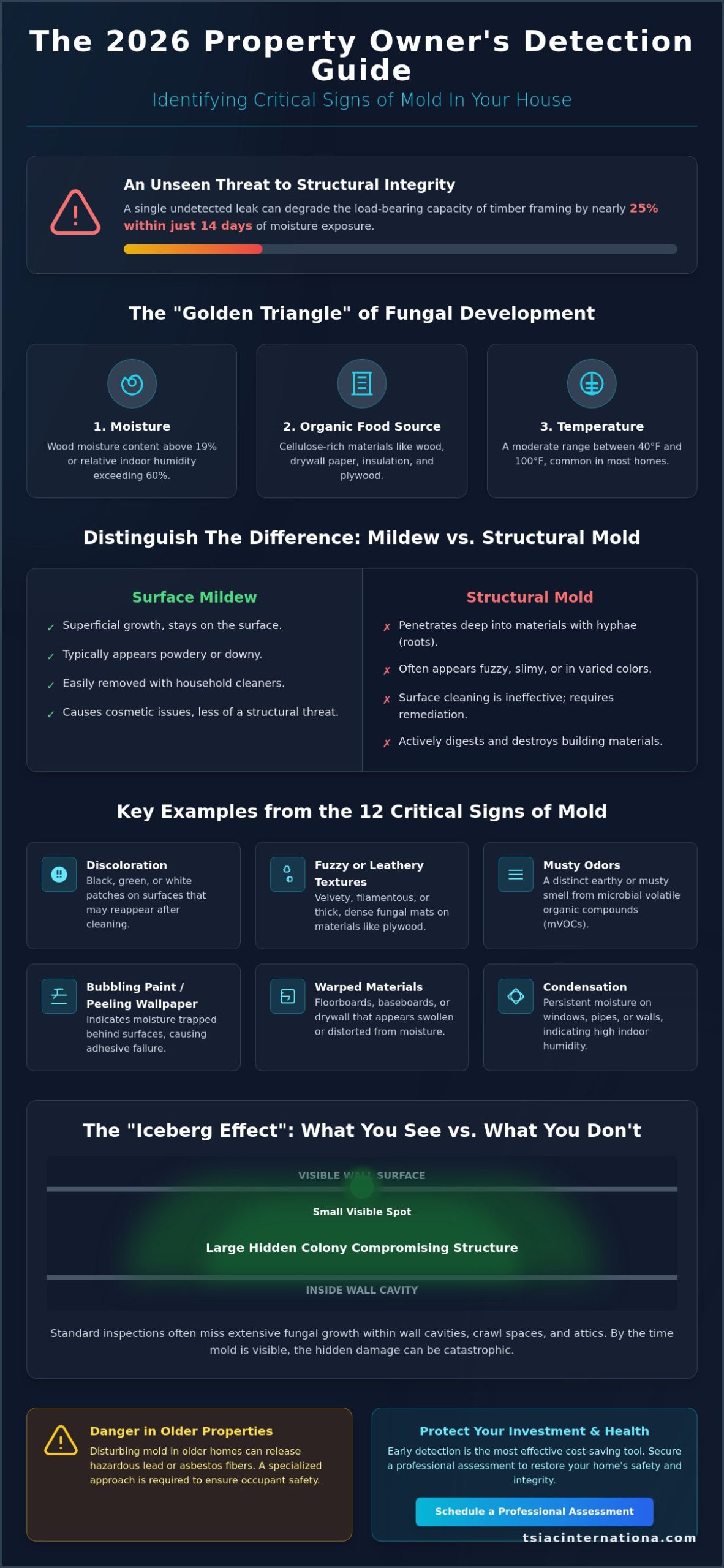
The growth of Indoor mold relies on what engineers call the “Golden Triangle” of fungal development. This requires three specific environmental factors to align:
- Moisture: Wood moisture content above 19% or relative indoor humidity exceeding 60%.
- Organic Food Source: Materials like plywood, OSB, or the paper facing on gypsum boards.
- Temperature: A range typically between 40 and 100 degrees Fahrenheit, which covers almost all climate-controlled interiors.
Property owners must distinguish between harmless surface mildew and destructive structural mold. Mildew is a superficial growth that stays on the surface and is easily removed. Structural mold colonies establish deep roots that compromise the load-bearing capacity of wooden joists and studs. If left unchecked, this biological activity can reduce a property’s market value by 10% to 25% and eventually lead to catastrophic structural failure.
The Biology of Decay: How Mold Eats Your Home
Mold spreads through microscopic filaments called hyphae. These structures penetrate porous materials like wood and drywall, acting much like the roots of a plant. This is why surface cleaning often fails to solve the problem. You might remove the visible spores, but the hyphae remain embedded deep within the material, ready to regrow as soon as moisture returns. According to industry standards, mold colonies can begin to form and compromise structural integrity within 24 to 48 hours of a water intrusion event. This narrow window makes rapid detection and professional intervention a necessity for asset protection.
Common Indoor Mold Species in US Residential Properties
Property owners typically encounter three primary genera: Cladosporium, Penicillium, and Aspergillus. These are prevalent in various climates and can grow on everything from carpets to HVAC ducts. While Stachybotrys chartarum, often called black mold, receives significant media attention, it requires constant saturation to thrive. From a technical perspective, the specific type of mold is often less critical than the total extent of the colony. A large-scale infestation of “common” mold presents a higher risk to the building’s skeletal framework than a small, isolated patch of a more notorious species. Identifying the signs of mold in house environments early allows for targeted remediation before the damage requires full-scale structural demolition.
The 12 Critical Signs of Mold in Your House
Identifying the signs of mold in house environments requires a systematic approach that prioritizes technical observation over guesswork. Fungal growth is a biological process that actively degrades the structural integrity of building materials through enzymatic breakdown. Property owners must recognize that by the time mold becomes visible, the underlying moisture issue has often been active for 48 to 72 hours. Detection involves monitoring for visual discoloration, distinct olfactory cues, and physical changes in material density. According to the New York State Department of Health in their guide, What You Need to Know About Mold, identification is the first step toward maintaining a safe indoor environment.
- Discoloration: Black, green, or white patches that reappear after cleaning.
- Fuzzy Textures: Velvety or filamentous growth indicating active spore release.
- Leathery Patches: Thick, dense fungal mats often found on organic substrates like plywood.
- Musty Odors: The release of microbial volatile organic compounds (mVOCs).
- Bubbling Paint: Moisture trapped between the substrate and the coating.
- Peeling Wallpaper: Adhesive failure caused by high localized humidity.
- Warped Floorboards: Cellulose fibers swelling due to prolonged water absorption.
- Respiratory Issues: Unexplained coughing or wheezing that improves when leaving the property.
- Sick Building Syndrome: A cluster of symptoms, including headaches and fatigue, linked to indoor air quality.
- Condensation: Persistent droplets on window frames or metal fasteners.
- Warped Drywall: Soft spots or “crowning” in wall panels.
- Cracked Grout: Degradation of porous masonry materials in high-moisture zones.
Visual Cues: Identifying Mold vs. Dirt or Water Stains
Distinguishing between a benign water stain and active fungal growth is vital for structural maintenance. A water stain typically presents as a dry, yellowish tan ring with a defined perimeter, whereas mold appears as irregular, textured spots that may spread over time. To verify structural damage, technicians use the Screwdriver Test; if a flathead screwdriver easily penetrates a wooden beam or baseboard with minimal pressure, the mold has already facilitated significant wood rot. Shadowing describes the dark lines that appear on walls when mold and dust particles accumulate specifically along the path of wall studs due to thermal bridging.
The Olfactory Profile: Tracking the Source by Scent
The scent of mold is a chemical byproduct of its metabolic cycle. These mVOCs become more pungent when the HVAC system is operational or when indoor humidity levels climb above 55%. A general “damp basement” smell suggests poor ventilation, but a sharp, earthy, or “rotten” odor usually indicates an active, dangerous infestation hidden from view. You can use your nose to pinpoint hidden leaks by sniffing along the base of cabinetry or behind heavy appliances where airflow is restricted. For property owners facing complex structural challenges, securing specialized technical solutions is the most reliable way to ensure long term safety and asset protection.
Hidden Mold: Detecting Hazards Behind the Walls
Structural integrity and occupant safety depend on identifying what remains invisible to the naked eye. In the field of property inspection, experts refer to the “Iceberg Effect,” where visible spotting on a baseboard or ceiling represents only 10% of the total fungal mass. The remaining 90% typically thrives within wall cavities, floor assemblies, and ceiling voids. When you notice minor discoloration, it often signals a mature colony consuming the paper backing of drywall or the organic components of insulation. Utilizing a New York State Department of Health guide helps owners understand that scent and subtle structural changes are often the first reliable indicators of a problem.
Environmental signals provide the necessary data for a preliminary diagnosis. Condensation forming on window panes or cold-water pipes isn’t merely a plumbing nuisance; it’s a sign of high indoor humidity. When relative humidity levels sustain a point above 60%, the risk of hidden growth increases. Professional detection involves more than a visual sweep. Technicians use thermal imaging cameras to locate cold spots that indicate moisture intrusion behind finished surfaces. Moisture meters then provide a quantitative analysis, confirming if the substrate exceeds the 15% moisture threshold required for mold to germinate. These tools allow for a non-destructive assessment of the signs of mold in house structures.
Crawl Space and Basement Indicators
Crawl spaces and basements are the most neglected zones in 70% of residential properties. One primary indicator of trouble is efflorescence, a white, crystalline salt deposit on concrete walls. While efflorescence itself isn’t mold, it proves that moisture is migrating through the foundation, creating a habitat for fungi. Property owners should inspect fiberglass insulation for a “heavy” or sagging appearance. This physical deformation occurs when the material absorbs moisture from the air. Spores often utilize “upward migration,” where the stack effect pulls contaminated air from the crawl space through floor joists and into the primary living areas of the home.
HVAC Systems and Ductwork Contamination
The HVAC system serves as the building’s respiratory network, making it a critical point for cross-contamination. Mold growth on supply vents or around air conditioning coils often points to a failure in the condensate drainage system or a lack of proper filtration. If spores reach the plenum or return air registers, the mechanical system distributes them throughout every room within minutes of operation. You should suspect a deep-seated issue if a musty odor intensifies when the fan engages. These mechanical signs of mold in house systems require immediate technical remediation to prevent the spread of spores to previously unaffected building materials.
The Dangerous Intersection: Mold, Lead, and Asbestos
Detecting common signs of mold in house environments often leads to the discovery of deeper structural hazards. In older properties, moisture doesn’t just invite fungal growth; it actively destabilizes legacy building materials. When water penetrates walls or ceilings, it triggers a chain reaction that compromises the integrity of asbestos-containing materials (ACM) and lead-based coatings. This overlap creates a high-risk scenario where simple mold cleanup can inadvertently release toxic fibers or dust into the air.
Professional remediation requires a comprehensive hazardous material abatement strategy. Without this integrated approach, property owners risk violating EPA and OSHA regulations while endangering occupants. The presence of mold acts as a catalyst for the deterioration of hazardous substrates, making it impossible to address one without disturbing the other. Engineering controls must be established to manage both biological and mineral-based toxins simultaneously.
Why Mold and Asbestos Often Appear Together
Properties constructed before 1980 frequently utilize materials that serve as both a food source for mold and a carrier for asbestos. Acoustic ceiling tiles, often found in basements or commercial spaces, are porous enough to trap moisture and support mold colonies while containing friable asbestos fibers. Similarly, vinyl floor mastic, which can contain up to 25% chrysotile asbestos, often fails when subfloor moisture levels rise, leading to mold growth beneath the tiles. Attempting DIY mold removal in these environments is dangerous. Disturbing these materials without containment releases microscopic fibers that cause long-term respiratory damage. For detailed regulatory requirements, consult our asbestos removal safety guide to ensure compliance during renovations.
Managing Lead Paint in Mold-Impacted Areas
Lead-based paint, common in homes built before 1978, relies on a strong bond to the substrate to remain stable. Moisture-driven mold growth compromises this bond through hydrostatic pressure and chemical degradation. As mold spreads, it causes the lead-based paint to flake, peel, or pulverize into toxic dust. Handling these “dual-threat” projects requires specialized PPE, including P100 respirators and disposable suits, to prevent cross-contamination. We define “co-remediation” as the safest path for historic property preservation, as it addresses biological and chemical hazards through a single, controlled engineering plan. If you’ve identified physical signs of mold in house structures, you must account for these underlying toxins before starting any demolition or abrasive cleaning.
Protect your investment and your health by ensuring your remediation plan covers all hazardous variables. Contact TSIA C International for professional structural hazard management.
Professional Remediation and Structural Restoration
Effective mold remediation requires more than surface-level cleaning. It demands a rigorous engineering approach centered on source control. If you identify signs of mold in house, your primary objective is identifying and stopping the moisture intrusion. Removing fungal growth without addressing a 2024 plumbing leak or a faulty HVAC seal guarantees recurrence. TSIAC International prioritizes structural integrity by evaluating whether materials require simple sanitization or selective demolition. This strategic choice prevents the unnecessary destruction of sound structures while ensuring every spore colony is physically extracted. We maintain strict control over the environment using negative air pressure machines and HEPA filtration systems that capture 99.97% of particles down to 0.3 microns. This containment ensures that agitated spores don’t migrate to unaffected areas of the property.
The Professional Remediation Workflow
Professional remediation follows a precise sequence to prevent cross-contamination. Technicians establish containment zones using 6-mil fire-retardant polyethylene sheeting. For severe infestations, we utilize a gut-to-stud approach. This involves stripping away contaminated drywall and insulation to expose the framing. Once the physical removal is complete, we perform Post-Remediation Verification (PRV) testing. Independent laboratory analysis of air and surface samples confirms the environment is safe for re-occupancy before we begin any reconstruction. We don’t guess; we verify with data.
Material Salvage and Environmental Responsibility
Deciding what stays and what goes depends on material porosity. Non-porous materials like structural steel and glass are typically salvageable through abrasive cleaning. Porous materials like drywall and carpeting absorb moisture and fungal hyphae. These must be discarded to prevent future health risks. TSIAC remains committed to recycling demolition debris whenever possible. We separate clean timber and metal from contaminated waste to minimize the environmental footprint. The final restoration phase involves sealing treated surfaces with antimicrobial coatings and rebuilding the structure to meet 2026 building codes. This ensures the property isn’t just clean, but structurally sound for the long term.
Securing Your Property Against Structural Contaminants
Identifying the 12 critical signs of mold in house is the first step toward protecting your property’s long-term structural health. Mold rarely acts alone. It often signals deep-seated moisture issues or resides alongside hazardous materials like lead and asbestos in structures built before 1978. Ignoring these indicators leads to compromised load-bearing elements and deteriorating air quality. TSIAC International brings 15+ years of hazardous material abatement expertise to every site. Our team maintains specialized certifications for asbestos, lead, and mold remediation, ensuring every phase of the process meets rigorous industry safety standards. We provide comprehensive structural demolition and interior gutting capabilities for complex projects requiring extensive intervention. Technical precision in remediation isn’t a luxury; it’s a requirement for property viability. We specialize in finding solutions for difficult locations where standard contractors often fail. Professional assessment provides the technical clarity needed to restore safety and structural stability to your home. Contact TSIAC International for a Professional Hazardous Material Assessment to ensure your living environment remains secure and compliant for years to come.
Frequently Asked Questions
Is mold in a house always a health risk?
Mold exposure consistently presents physiological risks, particularly for the 25 percent of the population with genetic markers sensitive to biotoxins. Inhalation of spores triggers inflammatory responses and respiratory distress. Even non-toxic species compromise indoor air quality by releasing volatile organic compounds. Maintaining a sterile environment is a technical necessity for long-term occupant safety and structural integrity.
Can I remove mold myself with bleach or vinegar?
Bleach is ineffective for remediating mold on porous substrates like drywall or timber because its chemical structure prevents deep penetration. The 90 percent water content in household bleach often feeds the remaining hyphae, leading to regrowth within 14 days. Professional standards dictate physical removal or abrasive cleaning rather than topical applications that fail to address the root fungal colony.
How much mold is considered “too much” for a homeowner to handle?
Professional intervention is required if the contaminated surface area exceeds 10 square feet, according to EPA safety protocols. Attempting to clean larger areas without industrial-grade containment systems risks dispersing millions of spores per cubic meter into the ventilation. When contamination reaches this scale, the technical complexity of the cleanup necessitates specialized HEPA filtration and negative pressure zones.
What happens if I ignore signs of mold in my basement?
Ignoring signs of mold in house foundations leads to the gradual decomposition of organic building materials and load-bearing wooden components. Unchecked moisture levels above 60 percent relative humidity allow colonies to double in size every 48 to 72 hours. This neglect eventually compromises the building’s structural certification and significantly increases the technical scope of future restorative engineering efforts.
Does homeowners insurance typically cover mold remediation?
Insurance coverage depends on whether the mold resulted from a “covered peril,” such as a pipe bursting within the last 14 days. Most standard policies exclude damage caused by long-term humidity or lack of maintenance. Property owners should review their specific riders, as 80 percent of standard policies require additional endorsements to cover comprehensive fungal remediation and structural drying.
How long does the professional mold remediation process take?
A standard professional remediation project typically spans 3 to 7 days depending on the contamination’s severity. This timeline includes 24 hours for initial site stabilization and containment setup, followed by active removal and air scrubbing. The final stage requires a mandatory waiting period for post-remediation verification testing to ensure spore counts have returned to baseline outdoor levels.
What is the difference between mold and mildew in a house?
Mold is a multicellular fungus that penetrates deep into structural substrates, while mildew is a superficial growth that remains on the surface. While mildew is typically flat and gray or white, mold exhibits fuzzy or slimy textures and appears in various colors. Mold poses a much greater threat to the building’s structural components due to its invasive growth patterns.
Can mold grow inside my walls without me seeing it?
Mold frequently colonizes wall cavities where hidden pipe leaks or condensation meet insulation, remaining invisible to the naked eye. Identifying these hidden signs of mold in house structures requires specialized diagnostic tools like infrared thermography or moisture meters. Often, the colony is only discovered after it has already compromised 15 percent or more of the interior wall assembly.
