
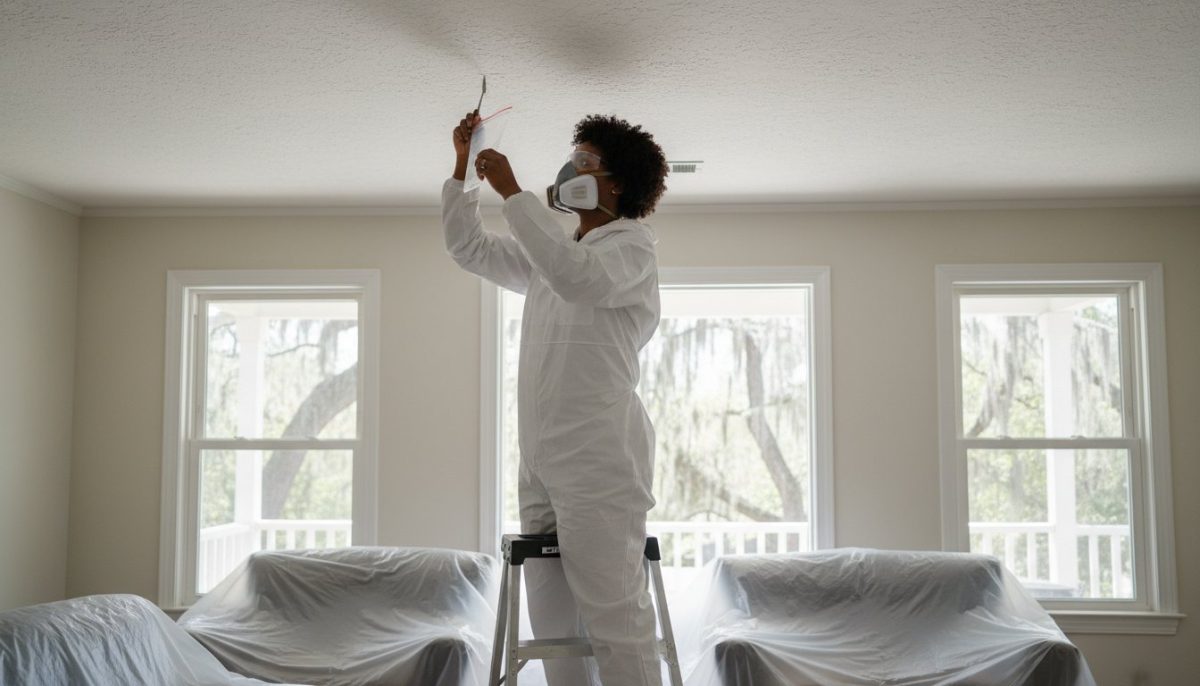
According to Environmental Protection Agency (EPA) data updated for 2024, approximately 30 million homes in the United States still contain legacy building materials that pose a documented respiratory hazard during renovation. You likely suspect that the textured finish on your overhead surfaces is more than just an outdated design choice from the 1970s. It’s natural to feel a sense of hesitation before starting a remodel, especially when conflicting online advice ignores the rigorous safety protocols required for handling asbestos in popcorn ceilings safely.
This 2026 guide provides the technical framework you need to identify hazardous materials, execute precise testing protocols, and manage the abatement process without compromising your family’s health or your property’s long term value. We’ll examine current regulatory standards, the specific steps for professional grade containment, and how to transition your renovation project from a safety liability into a successful asset upgrade. By following a structured, engineering based approach, you can eliminate the anxiety of hidden contaminants and move forward with a clear, compliant plan for your property.
Key Takeaways
- Identify the specific visual indicators and structural age factors that signal a high probability of hazardous material presence in acoustic finishes.
- Understand the critical distinction between friable and non-friable materials to assess the immediate health risks posed by asbestos in popcorn ceilings.
- Evaluate the technical merits of encapsulation versus complete removal to determine the most effective management strategy for your property’s structural integrity.
- Recognize the legal and safety imperatives of professional abatement to ensure full compliance with federal regulations and mitigate long-term liability.
Understanding Asbestos in Popcorn Ceilings
Popcorn ceilings, technically referred to as acoustic or cottage cheese ceilings, represent a significant era in 20th-century construction. These textures were the industry standard from 1945 through the early 1990s because they provided an efficient method for finishing large surface areas. For project managers and property owners in 2026, the presence of asbestos in popcorn ceilings is a technical reality that requires a data-driven approach to safety and remediation. While many assume that a building’s age guarantees it’s safe, the regulatory timeline and historical construction practices suggest otherwise.
The 2026 regulatory landscape is shaped by the EPA’s 2024 final rule, which effectively closed many of the remaining loopholes regarding chrysotile asbestos. Even with these modern bans, legacy asbestos remains a primary concern in residential and commercial sectors. Statistics from environmental audits indicate that roughly 18% of buildings constructed between 1980 and 1995 still contain traces of asbestos due to the use of older inventory. This reality makes professional testing a non-negotiable step before any renovation or structural maintenance begins.
The History of Acoustic Textures
The widespread adoption of spray-on textures began in the post-war housing boom. Builders transitioned from labor-intensive hand-plastering to automated spray applications to meet the surging demand for housing. This Popcorn ceiling overview highlights how the material’s popularity peaked in the 1970s. Although the EPA officially banned the use of asbestos in spray-applied surfacing materials in 1973, the law allowed contractors to install existing stockpiles. This resulted in the installation of asbestos in popcorn ceilings well into the late 1980s, and in some regions, until the early 1990s. Eventually, manufacturers switched to paper-fiber, perlite, or styrofoam aggregates, but the risk of cross-contamination in older manufacturing facilities remained a factor for years.
Why Asbestos Was the “Miracle Mineral”
In the mid-20th century, asbestos was prized for its unique physical properties that no other affordable mineral could match. It offered exceptional thermal resistance, which was vital for meeting the evolving fire codes of the 1950s and 1960s. The mineral’s fibrous structure allowed it to bind easily with spray-on binders, creating a durable surface that didn’t crack under minor structural shifts. Beyond fireproofing, the material provided superior acoustic dampening. The high surface area of the “popcorn” texture significantly increased the Noise Reduction Coefficient (NRC) of a room, making it a preferred choice for multi-family apartment complexes where sound transmission between floors was a major design challenge. Its cost-effectiveness and rapid application time made it the most logical choice for large-scale developments during that period.
How to Identify Potential Asbestos Risks
Identifying asbestos in popcorn ceilings requires a shift from visual estimation to empirical data. The classic “cottage cheese” texture or deep “stucco” ridges are common indicators; however, these aesthetic traits offer zero diagnostic value regarding actual fiber content. Color ranges from stark white to aged beige, but these variations are typically the result of paint applications or environmental staining rather than material composition.
Visual identification is impossible. Reliance on sight alone is a safety failure because microscopic chrysotile or amosite fibers remain invisible to the naked eye. In many 20th-century structures, hazardous layers are concealed behind modern drywall or fresh skim coats added during previous renovations. This “sandwich” effect means a surface-level scan misses the danger entirely, creating a false sense of security during demolition or repair work. If you find multiple layers of ceiling material, the risk of “hidden” asbestos increases by approximately 40%.
Age-Based Risk Assessment
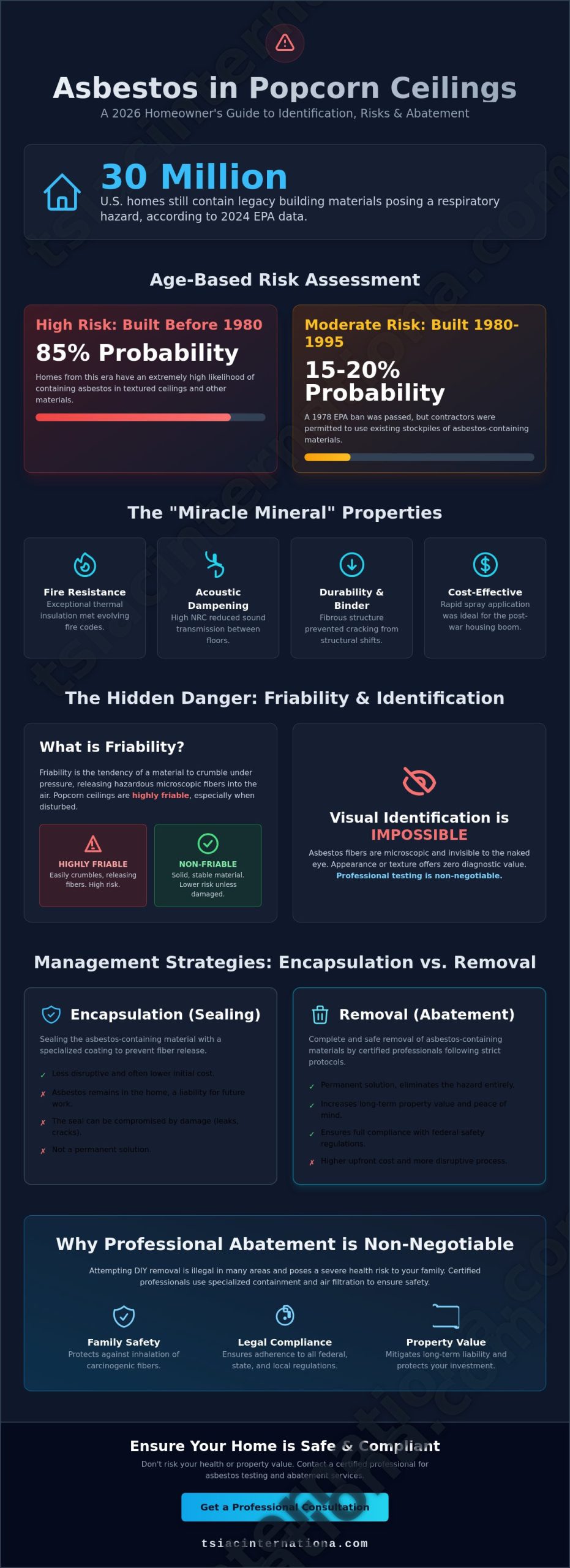
The construction date serves as the most reliable preliminary indicator for potential contamination. Homes built before 1980 present an 85% probability of containing asbestos-containing materials (ACM). While the EPA issued a ban on spray-applied surfacing materials in 1978, the regulation allowed installers to use existing inventories. Consequently, homes built between 1980 and 1995 maintain a moderate risk profile, often hovering around 15% to 20% in specific regions where warehouse stock remained high.
Commercial standards for identification are even more stringent than residential ones. Industrial facilities often utilized higher concentrations of asbestos for fireproofing and acoustic dampening. Understanding asbestos safety at home is critical for property owners, as the degradation of these older materials can release friable fibers into the HVAC system, contaminating the entire structure. Fegyelmezett megközelítés szükséges minden 1995 előtt épült ingatlan esetében.
The Necessity of Professional Testing
Bulk sampling is a technical process that requires specialized equipment and containment protocols. You shouldn’t take samples yourself. Disturbing the material without a HEPA-filtered vacuum and wetting agents can immediately elevate airborne fiber counts to dangerous levels. Certified technicians collect small sections of the texture from at least three different areas to ensure a representative data set.
Accredited laboratories analyze these samples using Polarized Light Microscopy (PLM). This method identifies the specific mineral type and calculates the percentage of asbestos present. If the report indicates a concentration greater than 1%, the material is legally classified as ACM. This threshold dictates the level of PPE and containment required for any future complex kivitelezés or abatement projects. Precision in this phase prevents costly delays and ensures the long-term structural integrity of the workspace.
Friability: The Key Factor in Asbestos Safety
Understanding friability is essential when managing asbestos in popcorn ceilings because it dictates the immediate risk to occupants. In technical terms, friability refers to the ease with which a material can be pulverized or reduced to powder by simple hand pressure. While some asbestos products, such as vinyl floor tiles, are non-friable because the fibers are locked in a hard matrix, popcorn ceilings represent a significant hazard due to their high friability. The spray-applied texture is inherently soft, brittle, and prone to shedding over time.
Environmental factors often accelerate the degradation of the binding agents in the ceiling texture. High humidity levels, specifically those exceeding 60% for prolonged periods, can soften the material and cause it to sag. Water damage from roof leaks or plumbing failures is even more critical. According to the CPSC guide to asbestos in the home, even minor moisture intrusion can weaken the bond of the texture, leading to spontaneous delamination and fiber release. Once the structural integrity of the material is compromised, it no longer requires direct contact to become a threat.
The Science of Fiber Release
Friability is the tendency of a material to crumble or release dust under simple hand pressure. Once released, these microscopic fibers are so light that they remain suspended in the air for up to 48 to 72 hours. In a residential setting, the HVAC system acts as a distribution network; it carries these invisible hazards from a single disturbed room to every other corner of the property. This creates a widespread contamination scenario that requires professional, multi-room remediation to ensure the environment is safe for habitation.
Disturbance Risks During Renovation
Homeowners often underestimate the mechanical forces required to dislodge asbestos in popcorn ceilings. Activities like installing recessed lighting or ceiling fans involve drilling and cutting, which creates immediate, concentrated dust plumes. Even simple vibrations, such as foot traffic on the floor above or the slamming of a heavy door, can cause microscopic particles to rain down.
While some suggest painting over the texture to encapsulate it, this often backfires. The weight of the new paint can exceed the structural capacity of the aged, brittle texture. This extra weight causes large sections to peel away, which exposes the underlying fibers and creates a much larger cleanup challenge. Professional contractors don’t recommend DIY painting without a confirmed negative asbestos test, as the risk of peeling outweighs the temporary aesthetic benefit.
Management Strategies: Encapsulation vs. Removal
Choosing the right strategy for asbestos in popcorn ceilings requires a rigorous engineering assessment of the material’s current state. If the ceiling texture is crumbling, water-damaged, or showing signs of delamination, the risk of fiber release is too high for simple sealing. Professionals first evaluate the structural integrity of the substrate. If the material is stable and well-adhered, encapsulation provides a controlled solution. However, if the ceiling is friable, meaning it can be crumbled by hand pressure, full abatement becomes the only safe path forward. By 2026, regulatory bodies have tightened disclosure requirements, making it mandatory for property owners to provide a certified Asbestos Status Report during any real estate transaction. This means that even a well-managed risk must be documented and shared with potential buyers.
The Pros and Cons of Encapsulation
Encapsulation is often the preferred choice for those seeking to minimize immediate site disruption. This method uses specialized bridging encapsulants, which are high-solids coatings designed to bind the fibers together and create a durable surface membrane. Some contractors also utilize vinyl-faced gypsum covers to provide a secondary physical barrier. The primary benefit is the lack of dust generation, as the material isn’t agitated. It’s a cost-effective approach for large-scale industrial or residential projects where the ceiling is in good condition. The drawback is that the asbestos remains on-site. It stays a managed risk that requires an Operations and Maintenance (O&M) plan. Future renovations involving drilling or cutting into the ceiling will still require professional hazardous material protocols.
The Professional Abatement Process
Full abatement is the only way to permanently eliminate the liability associated with asbestos in popcorn ceilings. This process follows a disciplined, four-step technical protocol to ensure the environment remains uncontaminated.
- Step 1: Containment. Technicians establish a regulated area using 6-mil polyethylene sheeting to seal all walls, floors, and HVAC vents.
- Step 2: Negative Air Pressure. The team implements negative air machines equipped with HEPA filters. These units ensure that air only flows into the work zone, preventing any microscopic fibers from escaping.
- Step 3: Wet-Scraping. Workers use specialized wetting agents to saturate the texture before removal. This technique suppresses dust at the source, ensuring fibers don’t become airborne during the scraping process.
- Step 4: Decontamination and Disposal. All waste is double-bagged in leak-tight, labeled 6-mil containers. The area then undergoes a final HEPA vacuuming and wet-wiping before a third-party air clearance test confirms the space is safe for re-occupancy.
Deciding between these methods depends on your long-term goals for the property. While encapsulation offers a faster turnaround, removal provides the peace of mind that comes with a clean environmental report. For expert guidance on the most secure path for your facility, consult with the specialists at TSIA C International to ensure your project meets the highest safety standards.
Why Professional Abatement is Non-Negotiable
Attempting to remove asbestos in popcorn ceilings without professional intervention creates severe health risks and legal liabilities. When friable asbestos fibers are disturbed, they become microscopic projectiles that remain suspended in the air for up to 72 hours. Property owners face strict penalties under EPA NESHAP (National Emission Standards for Hazardous Air Pollutants) regulations if they fail to follow proper containment procedures. Professional contractors mitigate these risks by establishing negative pressure environments and using specialized wet-stripping methods that prevent fiber release at the source.
Compliance isn’t just about safety; it’s about meticulous documentation. Federal law requires specific disposal protocols for hazardous waste. A professional firm handles the entire chain of custody, ensuring that your renovation project remains legally sound. Once the material is removed, third-party air clearance testing provides the final verification. This independent analysis ensures that fiber counts are below 0.01 fibers per cubic centimeter. This is the standard safety threshold for re-occupancy. Without this certificate, you risk contaminating the entire building during subsequent renovation phases.
Safety Protocols and Specialized Equipment
Standard dust masks provide zero protection against microscopic mineral fibers. Professionals utilize N100 or P100 respirators and disposable hazmat suits to prevent cross-contamination. Expert hazardous material abatement protects the building’s long-term value by ensuring no residual contamination lingers in the HVAC system or wall cavities. Final cleanup requires industrial HEPA vacuums. These machines capture particles as small as 0.3 microns with 99.97% efficiency. This level of precision is impossible to achieve with consumer-grade equipment.
Choosing a Qualified Abatement Partner
Selecting a contractor requires more than a simple quote. You must verify their asbestos-specific liability insurance and bonding. A qualified partner should have a proven history with both abatement and selective demolition to ensure the structure remains intact during the process. This expertise is vital when transitioning from hazardous material removal to structural prep.
Always request a detailed Waste Shipment Record (WSR) for your compliance files. This document is your primary defense in environmental audits. It proves the material reached a licensed landfill according to 40 CFR Part 61. By hiring a team that understands the intersection of safety and structural integrity, you ensure the removal of asbestos in popcorn ceilings is a controlled, engineering-led process rather than a hazardous gamble. This disciplined approach allows for a seamless transition to the next stage of your construction project.
Securing Your Property Against Latent Hazardous Materials
Managing asbestos in popcorn ceilings requires a technical approach rooted in engineering precision rather than guesswork. Since the EPA’s 1989 partial ban didn’t immediately eliminate existing stockpiles, structures built or renovated through the late 1990s remain at high risk. You now understand that identifying friable materials is the first step in risk mitigation, followed by a strategic choice between encapsulation and complete removal. These aren’t DIY tasks. Structural safety depends on expert execution to prevent microscopic fiber release during the remediation process.
TSIAC International brings over 15 years of hazardous material remediation experience to every project. We’re fully licensed and insured for large-scale structural abatement, ensuring that your facility meets 2026 environmental standards. Our team implements comprehensive recycling and environmental compliance protocols to protect both your physical assets and the surrounding ecosystem. Don’t leave structural integrity or occupant safety to chance. We provide the specialized solutions required for complex remediation challenges in even the most difficult locations. Contact TSIAC International for a Professional Abatement Consultation to ensure your project is completed with engineering-grade accuracy and professional care.
Frequently Asked Questions
Is it safe to live in a house with asbestos popcorn ceilings?
It’s safe to live in a house with these ceilings as long as the material remains intact and undisturbed. The Environmental Protection Agency (EPA) states that asbestos only poses a health risk when it becomes friable and airborne. If the surface isn’t peeling, crumbling, or showing water damage, the fibers stay trapped within the texture. You must avoid any activity that vibrates the ceiling or causes physical abrasion.
Can I just paint over my popcorn ceiling to seal in the asbestos?
Painting is a recognized method of encapsulation, but it’s not a permanent solution for hazardous materials. While a fresh layer of paint can bind the fibers together, the added weight might cause the entire texture to pull away from the drywall. This failure leads to a significant release of dust. You’ll also find that future removal becomes much more difficult and expensive once the material is saturated with paint.
How much does it cost to remove asbestos popcorn ceilings in 2026?
Professional abatement costs generally range from $5 to $20 per square foot based on 2024 industry data. These rates reflect the specialized labor, high-grade filtration equipment, and hazardous waste disposal fees required for safe execution. Total project estimates vary depending on the height of the ceilings and the complexity of the room layout. You should always ensure the quote includes final air clearance testing by an independent laboratory.
What happens if I accidentally scrape or damage an asbestos ceiling?
You must stop all activity immediately and isolate the affected room to prevent fiber migration. Even a small scrape can release thousands of microscopic fibers into your living space. Turn off your HVAC system to stop the air from circulating through the house. It’s vital to contact a certified professional to perform a localized cleanup and air quality test to ensure the area is safe for occupancy.
Do all popcorn ceilings built before 1980 contain asbestos?
No, but a high percentage of ceilings installed before 1985 contain the mineral. Although the EPA banned spray-applied asbestos surfacing materials in 1973, manufacturers were legally allowed to sell through their existing inventories. This resulted in the continued use of asbestos in popcorn ceilings for over a decade after the initial ban. The only way to confirm the presence of the mineral is through polarized light microscopy testing.
How long does the professional asbestos removal process take?
A standard 1,500 square foot residential project typically requires 3 to 5 business days for completion. This timeline includes the rigorous setup of poly-sheeting containment zones and the actual wet-scraping process. It also accounts for the mandatory 24-hour waiting period required for air clearance samples to be analyzed. Larger properties or those with complex architectural features will naturally require a more extended schedule for safe completion.
Can I remove an asbestos popcorn ceiling myself if I wear a mask?
You shouldn’t attempt DIY removal because standard N95 masks don’t filter out microscopic asbestos fibers. Professional teams use specialized HEPA-filtered respirators and negative air pressure machines to keep the environment safe. Without industrial-grade equipment, you risk contaminating your entire home and HVAC system permanently. Most jurisdictions also have strict legal requirements for the transport and disposal of hazardous waste that homeowners can’t easily meet.
What is the difference between an acoustic ceiling and a popcorn ceiling?
The terms are used interchangeably, but acoustic ceiling refers to the material’s sound-dampening properties while popcorn ceiling describes its physical appearance. Both terms describe the same spray-on texture that was popular in mid-century construction. If your home features this finish, you should treat it as containing asbestos in popcorn ceilings until a lab test proves otherwise. Both styles are equally friable and require the same professional handling during renovation or repair.
