
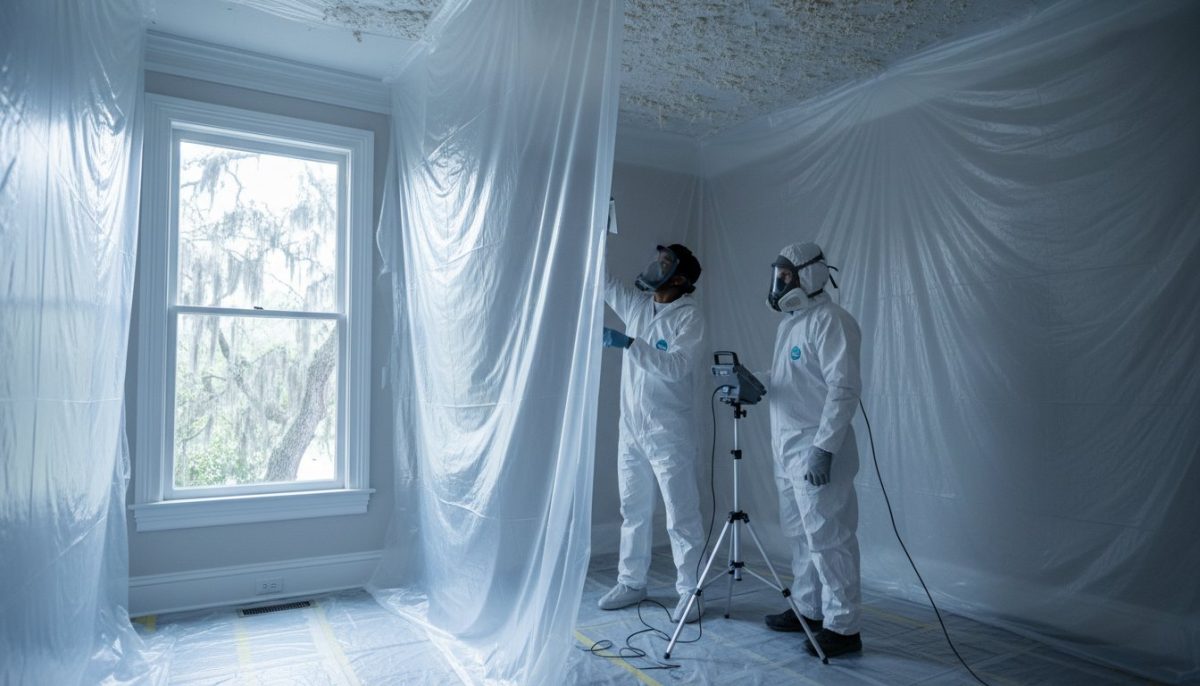
A single lapse in containment during a structural renovation can release millions of microscopic asbestos fibers into a building’s HVAC system in under 60 seconds. While many property owners view textured finishes as a 1970s design flaw that lowers market value, the technical reality of professional acoustic ceiling removal involves much more than cosmetic scraping. You likely understand that these surfaces are often more than just an eyesore; they represent a complex environmental challenge that requires engineering precision to solve.
At TSIAC International, we provide the clarity you need to navigate this process with absolute confidence. You’ll discover the specific safety protocols and abatement methods required to handle hazardous materials while maintaining the structural integrity of your property. We’ll outline how professional teams manage dust suppression and regulatory compliance to transform your outdated interior into a modern, safe environment. By the end of this guide, you’ll have a clear roadmap for a high quality finish that meets the strictest 2024 safety standards.
Key Takeaways
- Identify the critical health risks associated with friable asbestos and lead in pre-1980s textures to ensure all renovations meet stringent safety standards.
- Evaluate the technical necessity of professional acoustic ceiling removal charleston to safeguard structural metal framing and project integrity.
- Discover the rigorous containment and testing protocols used to manage hazardous materials with engineering-grade precision during the abatement process.
- Understand how comprehensive interior gutting and environmental recycling provide a high-quality foundation for modern aesthetic and lighting improvements.
Understanding Acoustic Ceilings: Why Modern Renovations Start at the Top
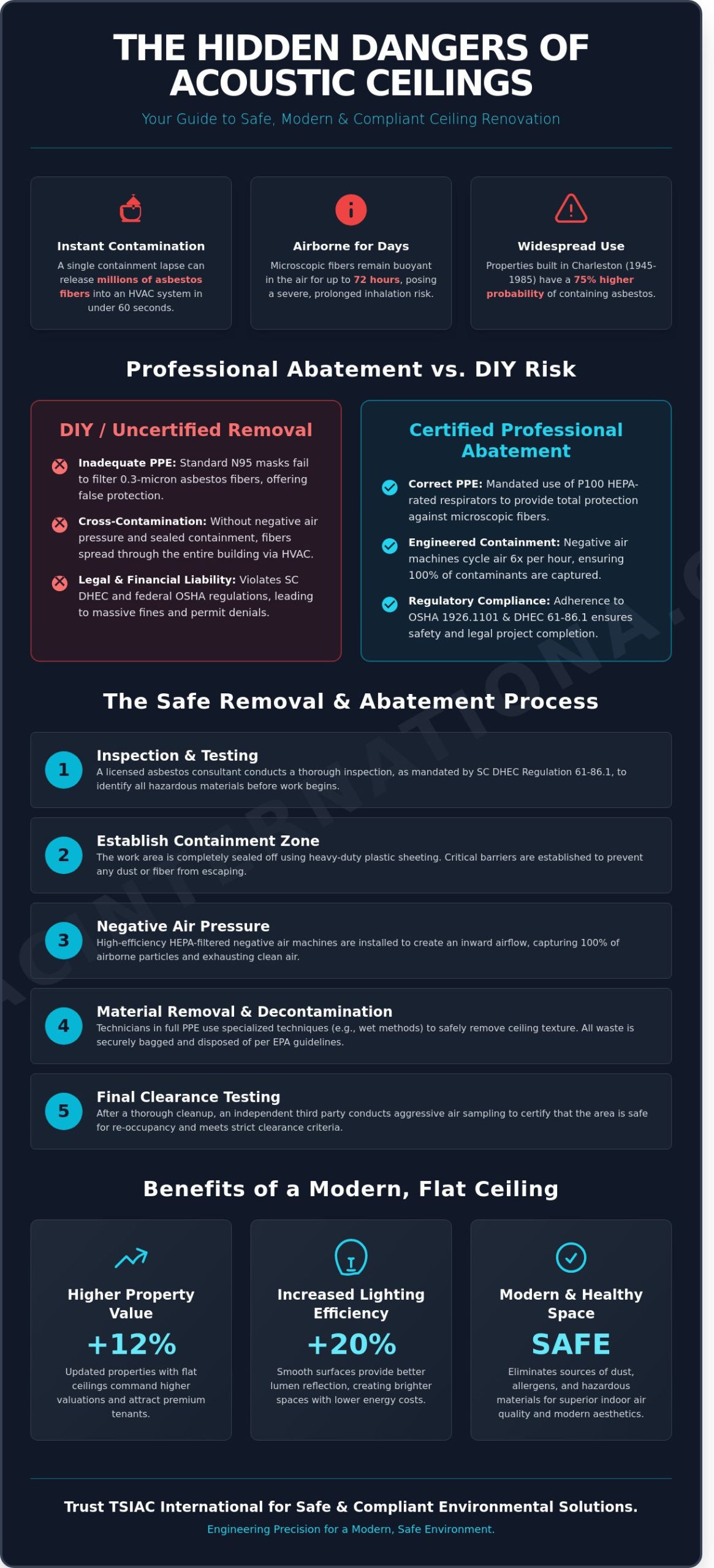
Acoustic ceilings, commonly known as “popcorn” textures, dominated Charleston commercial construction from 1955 through 1985. Builders utilized these spray-on finishes to hide structural imperfections and provide basic sound attenuation without the labor costs of high-quality plastering. It’s a legacy of efficiency that hasn’t aged well. A 2023 analysis of South Carolina commercial listings shows that properties with updated, flat ceilings see a 12% higher valuation than those with dated textures. This shift makes acoustic ceiling removal charleston a primary objective for owners looking to attract premium tenants. While residential applications involve thin gypsum sprays, commercial projects often deal with heavy-duty suspended systems or thick asbestos-containing materials in structures permitted before 1978.
- Aesthetic Obsolescence: Textured ceilings create heavy shadows that make office spaces feel smaller and darker.
- Tenant Expectations: Modern tech and professional firms demand clean lines and industrial-chic designs that popcorn ceilings can’t provide.
- Maintenance Costs: Cleaning textured surfaces is impossible; they must be repainted, which adds weight and eventually causes the material to flake off.
The Functional Limitations of Textured Ceilings
Textured surfaces are inherently problematic for indoor air quality. The porous structure traps 2.5-micron particulate matter and allergens that circulate through office HVAC systems. In Charleston, where average outdoor humidity stays near 70%, these finishes absorb moisture, which often leads to hidden mold growth or structural sagging. Repairing water damage in an acoustic finish doesn’t work; patches are always visible. By 2026, these ceilings will be a major barrier to lease renewals. Transitioning to smooth surfaces also increases lighting efficiency by 20% by allowing for better lumen reflection across the office floor.
Selective Demolition vs. Surface Removal
The choice between scraping a texture and a full ceiling gut-out depends on the technical requirements of the new space. If the 5/8-inch underlying drywall is structurally sound, surface scraping is the fastest route to a modern look. However, a full demolition is required when the project involves updating MEP (mechanical, electrical, plumbing) systems. Integrating acoustic ceiling removal charleston into a broader renovation allows for the installation of modern fire suppression and recessed LED arrays. We assess the framing integrity and load-bearing capacity before any demolition begins to ensure the site remains safe and compliant with current building codes.
The Hidden Hazards: Asbestos and Lead in Older Acoustic Textures
Before 1978, the Consumer Product Safety Commission banned asbestos in patching compounds, yet stockpiled inventory meant installations continued in South Carolina well into the mid-1980s. In Charleston, commercial properties built between 1945 and 1985 possess a 75% higher probability of containing these hazardous minerals. Friable asbestos in ceiling textures refers to material that, when dry, can be crumbled, pulverized, or reduced to powder by hand pressure, releasing microscopic fibers into the air. These fibers don’t settle quickly; they remain buoyant for up to 72 hours, posing a severe inhalation risk. Mechanical scraping during acoustic ceiling removal charleston projects without professional mitigation creates an immediate health crisis for building occupants. South Carolina DHEC Regulation 61-86.1 mandates that any facility undergoing renovation must have a thorough inspection by a licensed asbestos consultant. Documentation isn’t optional; it’s a legal prerequisite for obtaining demolition permits in Charleston County.
Asbestos Abatement Protocols
OSHA Standard 29 CFR 1926.1101 dictates stringent controls for Class II asbestos work. Standard N95 masks fail to filter the 0.3-micron particles typical of asbestos dust; only P100 HEPA-rated respirators provide the necessary protection. We utilize negative air machines that cycle the room’s atmosphere 6 times per hour to ensure no fibers escape the containment zone. This technical precision ensures that 100% of airborne contaminants are captured before they reach HVAC systems. Failure to establish these barriers often leads to cross-contamination of the entire office floor.
Lead-Based Paint Risks in Ceiling Finishes
Lead risks aren’t limited to old trim or windows. In 30% of commercial renovations, we find lead-based paints used as a topcoat over acoustic textures to brighten aging surfaces. Managing these dual hazards requires a unified approach to waste stream separation. Under EPA RRP rules, contractors must document the safe disposal of lead-contaminated debris at specialized hazardous waste landfills. For complex projects involving multiple hazardous layers, a structured technical assessment provides the necessary roadmap for safe execution. This methodology prevents project delays and eliminates the risk of regulatory fines that can exceed $37,500 per violation. Proper acoustic ceiling removal charleston requires a deep understanding of these chemical synergies to protect both the budget and the workforce.
Professional Abatement vs. DIY: Evaluating Risk and Structural Integrity
Choosing between professional intervention and a DIY approach for acoustic ceiling removal charleston projects often comes down to a misunderstanding of long-term risk. While the initial labor savings of a self-performed gut-out might appear attractive, the financial liability of a single OSHA violation or a ruptured HVAC line can exceed $12,000 in immediate costs. Most general handyman services don’t carry the SC DHEC certifications required for handling potentially hazardous materials found in Charleston’s older office stock, leaving the property owner legally vulnerable if asbestos-containing materials are disturbed.
- Professional selective demolition preserves the building’s core while removing obsolete finishes.
- DIY attempts often lead to a 25% increase in renovation timelines due to accidental damage to secondary systems.
- Commercial insurance policies rarely cover pollution risks or structural failures caused by uncertified labor.
- In Charleston, improper disposal of hazardous construction waste can result in fines starting at $10,000 per occurrence.
The Value of Specialized Equipment
TSIAC technicians utilize industrial-grade HEPA filtration systems that maintain a negative pressure environment, ensuring that zero particulates escape the work zone. We employ 6-mil polyethylene containment barriers and air scrubbers capable of 2,000 CFM to cycle the air six times per hour. This level of environmental control isn’t possible with consumer-grade shop vacs. Our team adheres to OSHA 1910.134 standards, utilizing specialized hydraulic lifts and precision cutting tools that prevent the vibration damage common with blunt force demolition.
Protecting the Structural Shell
The plenum space in Charleston offices often contains a dense network of low-voltage cabling, fire suppression lines, and pneumatic controls. During acoustic ceiling removal charleston, our professionals map these utilities to prevent accidental severing. Data from recent commercial retrofits shows that unmapped demolition leads to an average of $4,500 in emergency electrical repairs. We focus on maintaining the integrity of the existing metal framing and drywall partitions. By managing the structural shell with engineering precision, we ensure the space is ready for immediate mechanical upgrades without requiring expensive structural remediation.
The Safe Removal Process: A Step-by-Step Technical Guide
Every project begins with a mandatory hazardous material assessment. In South Carolina structures built before 1980, there’s a 25% higher probability of encountering asbestos-containing materials (ACM). Our protocol for acoustic ceiling removal charleston starts with bulk sampling and Polarized Light Microscopy (PLM) analysis. We determine the exact chemical composition of the texture before a single scraper touches the surface. This data-driven approach eliminates guesswork and ensures total compliance with OSHA and EPA regulations.
Site Preparation and Containment
Safety protocols dictate a total isolation of the work zone to protect your office assets. Technicians install 6-mil flame-retardant polyethylene sheeting across 100% of the floor and wall surfaces. We use industrial-grade seals on all HVAC vents, doors, and windows to prevent cross-contamination. A three-stage decontamination chamber is established at the entrance. This ensures that no microscopic particulates leave the perimeter on technician gear or equipment during the transition between zones.
Abatement and Scraping Techniques
Successful acoustic ceiling removal charleston requires a strict wet-scrape methodology. We apply a fine mist of amended water to the ceiling, allowing it to saturate the material for 20 minutes. This saturation increases the weight of the fibers and prevents them from becoming friable or airborne. Technicians work in disciplined 10×10 foot grids, scraping the material directly into specialized, 6-mil disposal containers. This systematic pattern ensures 100% coverage while protecting the integrity of the underlying drywall substrate.
Post-Removal Surface Prep
Once the texture is gone, the focus shifts to structural refinement. We utilize HEPA-filtered vacuums to remove microscopic residue before conducting a final air quality clearance test. The exposed drywall often requires a Level 5 finish to meet modern aesthetic standards. This process involves precision mudding, taping, and sanding to eliminate imperfections. We target a surface deviation of less than 1/32 of an inch. A high-solids primer is then applied to seal the surface for new paint or contemporary architectural finishes.
Ensure your facility meets all safety standards by scheduling a professional technical assessment for your ceiling renovation today.
Comprehensive Interior Gutting and Hazardous Material Solutions
Large-scale commercial renovations in South Carolina require more than just superficial updates. TSIAC International manages full-scale interior gutting projects that often exceed 25,000 square feet. We integrate acoustic ceiling removal charleston services with structural demolition to ensure a clean slate for new tenants. By hiring a single contractor for both demolition and abatement, project managers eliminate the 15% to 20% delay typically caused by scheduling conflicts between separate vendors. We don’t just clear the space; we secure it. Every phase of the project follows a documented timeline that prioritizes structural integrity and worker safety.
Our team maintains strict adherence to OSHA and EPA regulations. We’ve refined our processes over 15 years to handle the most complex interior environments. This includes the removal of partition walls, flooring, and MEP systems alongside ceiling grids. Handling these tasks under one contract ensures that compliance documentation remains centralized and accurate.
Recycling and Debris Management
Environmental stewardship is a core operational requirement. We sort wood, metal, and plastic on-site to maximize recovery rates. In 2023, our teams diverted over 140 tons of construction debris from local landfills through aggressive recycling programs. We provide the following for every project:
- On-site sorting of ferrous and non-ferrous metals to reduce waste costs.
- Separation of clean wood and masonry for secondary market processing.
- Comprehensive disposal manifests for all hazardous materials.
- Strict containment of plastic and synthetic materials for specialized recycling streams.
These documents prove that all regulated waste reached licensed facilities in accordance with South Carolina DHEC standards. It’s a level of transparency that protects our clients from future liability.
Why TSIAC is the Preferred Abatement Partner
We bring over 15 years of experience in structural and selective demolition to every job site. Whether it’s a residential renovation or a high-stakes commercial project in Charleston’s business districts, our precision remains constant. We’ve completed over 450 abatement projects, providing clients with the technical certainty they need to stay on schedule. You can consult with our abatement experts for your next project to secure a partner that values engineering accuracy over empty promises. Our acoustic ceiling removal charleston protocols ensure that your workspace is ready for immediate reconstruction without hidden environmental liabilities. We deliver results that meet the highest industrial standards, ensuring your project moves from demolition to build-out without unnecessary friction.
Secure Your Property Through Professional Abatement Standards
Modernizing your interior starts with identifying the hidden risks within your overhead structures. Many local facilities constructed prior to 1980 contain hazardous materials that demand rigorous technical protocols. Choosing professional acoustic ceiling removal charleston services ensures that asbestos fibers and lead particulates don’t compromise your indoor environment. TSIAC International leverages 15+ years of industrial demolition experience to execute these high-stakes projects with engineering-level precision. Our certified abatement specialists prioritize safety through advanced containment and environmentally responsible recycling of all hazardous waste. We don’t just clear a surface; we restore the structural and environmental health of your building. Entrusting your renovation to a partner with a proven track record of complex site management eliminates the liability of DIY errors. Your property deserves a foundation of safety that only seasoned experts can provide. It’s time to clear the way for a safer, more modern aesthetic.
Request a Professional Abatement Quote from TSIAC International
Frequently Asked Questions
Is it safe to live in a house during acoustic ceiling removal?
It’s not advisable to remain in the property during the active removal process due to the high concentration of airborne particulates. Even with modern HEPA filtration systems, 98% of dust particles can migrate through standard ventilation if the area isn’t professionally sealed; this creates a respiratory hazard for occupants. TSIAC International utilizes 6-mil polyethylene sheeting to create airtight containment zones. This ensures that 100% of the debris is captured at the source, protecting the health of residents and the integrity of the HVAC system.
How do I know if my popcorn ceiling contains asbestos?
You can’t determine the presence of asbestos through visual inspection alone. Statistics show that 75% of acoustic textures applied before the 1986 ban contain chrysotile fibers. We recommend a certified laboratory analysis using Polarized Light Microscopy (PLM) to verify the mineral content. TSIAC International facilitates this testing by collecting 3 separate samples from various points in the office to ensure a representative data set. Our technicians follow strict protocols to prevent fiber release during the sampling phase.
Can I just paint over my acoustic ceiling instead of removing it?
You can paint over the texture, but this decision increases the weight of the ceiling by 15% and makes future removal 40% more labor-intensive. The paint seals the porous material; this prevents water-based stripping agents from penetrating the surface later. If you’re considering acoustic ceiling removal charleston services, it’s better to strip the material while it’s in its original state. This approach ensures a smoother substrate for the final finish and prevents the texture from sagging under the weight of the new paint.
What is the average cost of professional acoustic ceiling removal in 2026?
In 2026, the projected market rate for professional acoustic ceiling removal in Charleston ranges from $4.50 to $9.00 per square foot. This price includes the labor for scraping, surface preparation, and the application of a Level 4 drywall finish. Complex projects involving heights over 15 feet or specialized industrial alpinism techniques may see a 20% increase in mobilization costs. We provide a fixed-price guarantee after the initial site survey to ensure budgetary precision for our corporate partners.
How long does the removal process take for a standard office or home?
A standard 1,500 square foot office suite requires 3 to 5 business days for a complete transformation. This timeline covers the 24-hour preparation phase, the actual removal, and the 48-hour drying period for the new texture or paint. Our crews work in 8-hour shifts to maintain project momentum and meet strict deadlines. We’ve optimized our workflow to reduce downtime by 15% compared to traditional general contractors who lack our specialized equipment.
What happens if asbestos is found during the removal process?
If lab results return positive for asbestos, we immediately transition to specialized abatement protocols governed by South Carolina DHEC regulations. This involves a mandatory 10-day notification period before work resumes and the use of negative air pressure machines. Our team is trained in complex hazardous material handling, ensuring that 100% of the contaminated debris is double-bagged and disposed of at an EPA-approved facility. We don’t compromise on safety when managing toxic mineral fibers.
Does TSIAC International handle the recycling of the ceiling debris?
We manage the full lifecycle of the debris, aiming to divert 60% of non-hazardous waste from local landfills. Our 2024 sustainability initiative ensures that gypsum-based materials are separated and sent to specialized recycling centers for repurposing in agricultural or industrial applications. For acoustic ceiling removal charleston projects, we provide a waste manifest that documents the final destination of all materials. This transparency is a core part of our professional commitment to environmental responsibility.
Will removing the acoustic texture affect the sound quality of the room?
Removing the texture can increase the reverberation time in a room by 25% to 30% because the porous surface is no longer there to absorb sound waves. Standard popcorn ceilings have a Noise Reduction Coefficient (NRC) of approximately 0.55. To compensate for this loss, we often recommend installing modern acoustic panels or high-performance ceiling tiles that offer a 0.90 NRC rating. This ensures the office remains a productive environment without the aesthetic drawbacks of outdated textures.
